

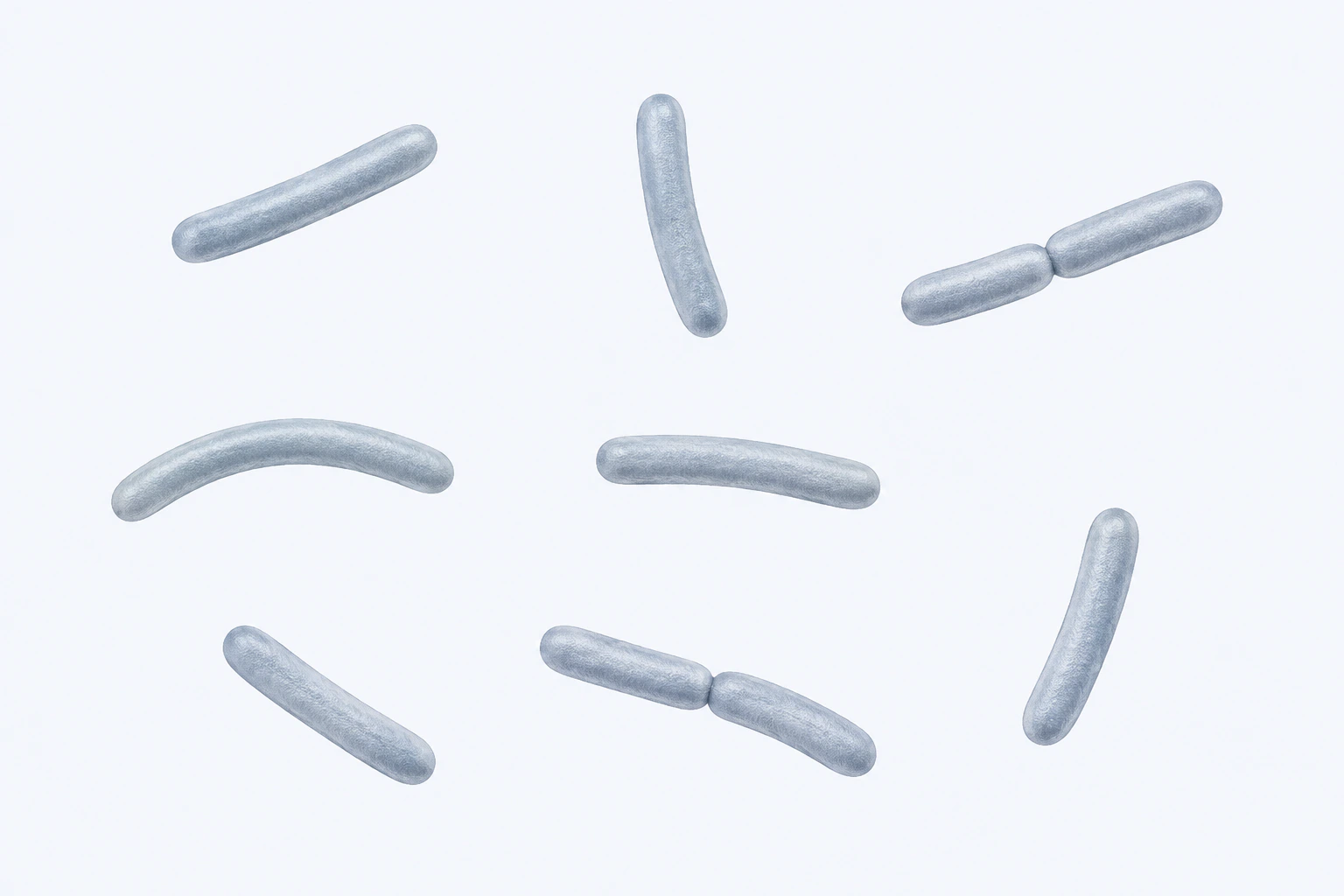
Type-species-anchored Oscillibacter elongated straight-to-gently-curved rods, shown as ten bodies in six single and two paired groupings. This genus-level scientific reconstruction is representative, non-universal, non-diagnostic, and not a micrograph.
Scientific media record1 verified identifier
- Subject
- Oscillibactertaxon · genus
- Identifiers
- NCBITaxon:459786
- Review
- Editorial review completeIdentifiers authority-verified · Accessibility validated · · oscillibacter|oscillibacter-morphology-v1.webp
- Digital source
- Trained-algorithmic mediaCreated with a trained generative algorithm and reviewed by WikiBiome for subject identity, scientific framing, identifiers, provenance, and accessibility.
- Scientific basis
- Oscillibacter — NCBI TaxonomyOscillibacter — LPSNOscillibacter valericigenes gen. nov., sp. nov.Oscillibacter valericigenes primary descriptionOscillibacter valericigenes genome
- License
- CC BY-SA 4.0Created
Oscillibacter is a genus of Gram-negative, strictly anaerobic, motile bacteria within the family Oscillospiraceae (phylum Firmicutes).
The type species, Oscillibacter valericigenes, was first isolated from the alimentary canal of a Japanese corbicula clam and named for its characteristic oscillating motility and its production of valerate (pentanoic acid), a five-carbon short-chain fatty acid that distinguishes it from the more commonly discussed Butyrate and propionate producers (,[1]Iino et al. 2007 — Oscillibacter valericigenes gen. nov., sp. nov.Takao Iino, Koji Mori, Kenji Tanaka et al. · 2007Open reference 1 ↓ taxonomic-description).
Oscillibacter is ecologically important as a sentinel of heavy metal exposure. Its depletion under cadmium and lead stress has been documented in multiple animal models, positioning it alongside Lachnospiraceae (Family) and Roseburia as an early casualty of metal-driven Dysbiosis.
Evidence map12 cited passagesInspect provenance +
Oscillibacter is a genus of Gram-negative, strictly anaerobic, motile bacteria within the family Oscillospiraceae (phylum Firmicutes). The type species, Oscillibacter valericigenes, was first isolated from the alimentary canal of a Japanese corbicula clam and named for its characteristic oscillating motility and its production of valerate (pentanoic acid), a
This iron dependency makes Oscillibacter vulnerable to toxic metal displacement. Lead exposure (100-500 ppm, 8 weeks) in Balb/C mice significantly decreased Oscillibacter alongside Lachnospiraceae and Ruminococcaceae, with concurrent increases in oxidative stress defense pathways (, animal-model).
Cadmium exposure in wild long-tailed dwarf hamsters significantly decreased Oscillibacter, identifying it as one of 14 potential pathogens/commensals affected by Cd perturbation (, animal-model).
Diet-responsive: On a low-carbohydrate, high-fat (non-ketogenic) diet, Oscillibacter was enriched alongside Escherichia/Shigella, and this LCD-associated community worsened colitis outcomes in mice—contrasting with the ketogenic diet, which enriched beneficial Akkermansia and Roseburia instead (, animal-model).
Metformin response: Oscillibacter increased in both healthy and T2D subjects after metformin treatment (, prospective-cohort).
Cancer ecology: In CRC tumor tissue, Oscillibacter abundance correlated with steroid biosynthesis and terpenoid pathways (, cross-sectional). After FMT in CRC mice, Oscillibacter was negatively correlated with anti-cancer cytokines, suggesting its reduction may be beneficial in the tumor microenvironment (, animal-model).
Cadmium exposure: Significantly decreased in wild hamsters exposed to CdCl2, identified among the most affected commensals (, animal-model).
Lead exposure: Decreased alongside Lachnospiraceae and Ruminococcaceae in lead-exposed mice (, animal-model).
Low-carb diet (non-ketogenic): Enriched on LCD but associated with worse colitis outcomes (, animal-model).
Metformin treatment: Increased in both healthy and T2D subjects after metformin (, prospective-cohort).
Colorectal cancer: Tumor tissue associations with steroid/terpenoid metabolism; negatively correlated with anti-cancer cytokines after FMT (, cross-sectional;, animal-model).
| Study | Finding | Evidence Level | |-------|---------|---------------| | | Described the type species from the alimentary canal of a Japanese corbicula clam | Taxonomic description | | | Significantly depleted by cadmium in wild hamsters | Animal model | | | Depleted by lead alongside Lachnospiraceae | Animal model | | | Negatively correlated with anti-can
Contents
1. Metal Dependencies2. Key Enzymes and Virulence Factors3. Ecological Role4. Conditions Associated5. Key Studies6. Cross-ReferencesMetal Dependencies#
Oscillibacter depends on iron for its anaerobic metabolism. Iron-sulfur cluster proteins are essential for its electron transport chain and fermentation pathways.
This iron dependency makes Oscillibacter vulnerable to toxic metal displacement. Lead exposure (100-500 ppm, 8 weeks) in Balb/C mice significantly decreased Oscillibacter alongside Lachnospiraceae and Ruminococcaceae, with concurrent increases in Oxidative Stress defense pathways (,[2]Gut dysbiosis in animals due to environmental chemical exposuresRosenfeld CS · 2017Open reference 2 ↓ animal-model).
Cadmium exposure in wild long-tailed dwarf hamsters significantly decreased Oscillibacter, identifying it as one of 14 potential pathogens/commensals affected by cadmium (Cd) perturbation (,[3]Cadmium Exposure Induces Changes in Gut Microbial Composition and Metabolic Function in Long-Tailed Dwarf Hamsters, Cricetulus longicaudatusMengfan Tao, Kanglin Cao, Xinsheng Pu et al. · 2024Open reference 3 ↓ animal-model).
Key Enzymes and Virulence Factors#
Oscillibacter is not pathogenic. Its key metabolic enzymes reflect a saccharolytic fermentation strategy. Valerate synthesis enzymes: The genus's defining metabolic feature is production of valerate from carbohydrate fermentation.
Valerate has immunomodulatory properties and may influence epithelial differentiation, though it is less studied than butyrate.
Butyrate production: Some Oscillibacter species also produce butyrate, contributing to the overall SCFA pool. Bile acid metabolism: Oscillibacter has been implicated in secondary bile acid transformation, linking it to lipid metabolism and cholesterol homeostasis.
Ecological Role#
In the healthy gut, Oscillibacter is a moderately abundant member of the Firmicutes community that contributes to the SCFA pool and bile acid metabolism. Its ecological significance becomes apparent under stress.
Metal exposure indicator: The reproducible depletion of Oscillibacter under both cadmium and lead exposure makes it a candidate biomarker for environmental metal stress on the Gut Microbiome.
Diet-responsive: On a low-carbohydrate, high-fat (non-ketogenic) diet, Oscillibacter was enriched alongside Escherichia/Shigella, and this LCD-associated community worsened colitis outcomes in mice—contrasting with the ketogenic diet, which enriched beneficial Akkermansia and Roseburia instead (,[4]Ketogenic Diet Alleviates Colitis by Reduction of Colonic Group 3 Innate Lymphoid Cells Through Altering Gut MicrobiomeKong C, Yan X, Liu Y et al. · 2021Open reference 4 ↓ animal-model).
Metformin response: Oscillibacter increased in both healthy and T2D subjects after metformin treatment (,[5]Elbere 2020 — Baseline Gut Microbiome Composition Predicts Metformin Therapy Short-Term Efficacy in Newly Diagnosed Type 2 Diabetes PatientsIlze Elbere, Ivars Silamikelis, Ilze Izabella Dindune et al. · 2020Open reference 5 ↓ prospective-cohort).
Cancer ecology: In CRC tumor tissue, Oscillibacter abundance correlated with steroid biosynthesis and terpenoid pathways (,[6]Metabolomics and 16S rRNA Sequencing of Human Colorectal Cancers and Adjacent MucosaLoke MF, Chua EG, Gan HM et al. · 2018Open reference 6 ↓ cross-sectional).
After FMT in CRC mice, Oscillibacter was negatively correlated with anti-cancer cytokines, suggesting its reduction may be beneficial in the tumor microenvironment (,[7]Fecal Microbiota Transplantation Inhibits Colorectal Cancer Progression: Reversing Intestinal Microbial Dysbiosis to Enhance Anti-Cancer Immune ResponsesHao Yu, Xing-Xiu Li, Xing Han et al. · 2023Open reference 7 ↓ animal-model).
Conditions Associated#
Depleted in:#
Cadmium exposure: Significantly decreased in wild hamsters exposed to CdCl2, identified among the most affected commensals (,[3]Cadmium Exposure Induces Changes in Gut Microbial Composition and Metabolic Function in Long-Tailed Dwarf Hamsters, Cricetulus longicaudatusMengfan Tao, Kanglin Cao, Xinsheng Pu et al. · 2024Open reference 3 ↓ animal-model).
Lead exposure: Decreased alongside Lachnospiraceae and Ruminococcaceae in lead-exposed mice (,[2]Gut dysbiosis in animals due to environmental chemical exposuresRosenfeld CS · 2017Open reference 2 ↓ animal-model).
Enriched in:#
Low-carb diet (non-ketogenic): Enriched on LCD but associated with worse colitis outcomes (,[4]Ketogenic Diet Alleviates Colitis by Reduction of Colonic Group 3 Innate Lymphoid Cells Through Altering Gut MicrobiomeKong C, Yan X, Liu Y et al. · 2021Open reference 4 ↓ animal-model). Metformin treatment: Increased in both healthy and T2D subjects after metformin (,[5]Elbere 2020 — Baseline Gut Microbiome Composition Predicts Metformin Therapy Short-Term Efficacy in Newly Diagnosed Type 2 Diabetes PatientsIlze Elbere, Ivars Silamikelis, Ilze Izabella Dindune et al. · 2020Open reference 5 ↓ prospective-cohort).
Complex associations:#
- Colorectal cancer: Tumor tissue associations with steroid/terpenoid metabolism; negatively correlated with anti-cancer cytokines after FMT (,[6]Metabolomics and 16S rRNA Sequencing of Human Colorectal Cancers and Adjacent MucosaLoke MF, Chua EG, Gan HM et al. · 2018Open reference 6 ↓ cross-sectional;,[7]Fecal Microbiota Transplantation Inhibits Colorectal Cancer Progression: Reversing Intestinal Microbial Dysbiosis to Enhance Anti-Cancer Immune ResponsesHao Yu, Xing-Xiu Li, Xing Han et al. · 2023Open reference 7 ↓ animal-model).
Key Studies#
| Study | Finding | Evidence Level |
|---|---|---|
| [1]Iino et al. 2007 — Oscillibacter valericigenes gen. nov., sp. nov.Takao Iino, Koji Mori, Kenji Tanaka et al. · 2007Open reference 1 ↓ | Described the type species from the alimentary canal of a Japanese corbicula clam | Taxonomic description |
| [3]Cadmium Exposure Induces Changes in Gut Microbial Composition and Metabolic Function in Long-Tailed Dwarf Hamsters, Cricetulus longicaudatusMengfan Tao, Kanglin Cao, Xinsheng Pu et al. · 2024Open reference 3 ↓ | Significantly depleted by cadmium in wild hamsters | Animal model |
| [2]Gut dysbiosis in animals due to environmental chemical exposuresRosenfeld CS · 2017Open reference 2 ↓ | Depleted by lead alongside Lachnospiraceae | Animal model |
| [7]Fecal Microbiota Transplantation Inhibits Colorectal Cancer Progression: Reversing Intestinal Microbial Dysbiosis to Enhance Anti-Cancer Immune ResponsesHao Yu, Xing-Xiu Li, Xing Han et al. · 2023Open reference 7 ↓ | Negatively correlated with anti-cancer cytokines post-FMT | Animal model |
| [4]Ketogenic Diet Alleviates Colitis by Reduction of Colonic Group 3 Innate Lymphoid Cells Through Altering Gut MicrobiomeKong C, Yan X, Liu Y et al. · 2021Open reference 4 ↓ | Enriched on LCD; worse colitis vs KD | Animal model |
| [5]Elbere 2020 — Baseline Gut Microbiome Composition Predicts Metformin Therapy Short-Term Efficacy in Newly Diagnosed Type 2 Diabetes PatientsIlze Elbere, Ivars Silamikelis, Ilze Izabella Dindune et al. · 2020Open reference 5 ↓ | Increased by metformin in healthy and T2D | Prospective cohort |
Cross-References#
- Cadmium—dose-dependent depletion
- Lead—co-depleted with Lachnospiraceae
- Lachnospiraceae (Family)—co-depleted metal-sensitive family
- Roseburia—co-depleted SCFA producer
- butyrate—related metabolic output
- Short-Chain Fatty Acids (SCFAs)—valerate production
- Colorectal Cancer—tumor tissue ecology
- Metformin—drug-microbiome interaction
References 14
Numbered by first appearance in the article, then reconciled with its declared source list.
- 1
Takao Iino, Koji Mori, Kenji Tanaka et al. (2007). Iino et al. 2007 — Oscillibacter valericigenes gen. nov., sp. nov.. International Journal of Systematic and Evolutionary Microbiology.
- 2
Rosenfeld CS (2017). Gut dysbiosis in animals due to environmental chemical exposures. Frontiers in Cellular and Infection Microbiology.
- 3
Mengfan Tao, Kanglin Cao, Xinsheng Pu et al. (2024). Cadmium Exposure Induces Changes in Gut Microbial Composition and Metabolic Function in Long-Tailed Dwarf Hamsters, Cricetulus longicaudatus. Ecology and Evolution.
- 4
Kong C, Yan X, Liu Y et al. (2021). Ketogenic Diet Alleviates Colitis by Reduction of Colonic Group 3 Innate Lymphoid Cells Through Altering Gut Microbiome. Signal Transduction and Targeted Therapy.
- 5
Ilze Elbere, Ivars Silamikelis, Ilze Izabella Dindune et al. (2020). Elbere 2020 — Baseline Gut Microbiome Composition Predicts Metformin Therapy Short-Term Efficacy in Newly Diagnosed Type 2 Diabetes Patients. PLoS ONE.
- 6
Loke MF, Chua EG, Gan HM et al. (2018). Metabolomics and 16S rRNA Sequencing of Human Colorectal Cancers and Adjacent Mucosa. PLOS ONE.
- 7
Hao Yu, Xing-Xiu Li, Xing Han et al. (2023). Fecal Microbiota Transplantation Inhibits Colorectal Cancer Progression: Reversing Intestinal Microbial Dysbiosis to Enhance Anti-Cancer Immune Responses. Frontiers in Microbiology.
- 8
Patrick A. de Jonge, Koen Wortelboer, Torsten P. M. Scheithauer et al. (2022). Gut Virome Profiling Identifies a Widespread Bacteriophage Family Associated with Metabolic Syndrome. Nature Communications.
- 9
Gong W, Jin G, Bao Y et al. (2025). Characteristics and potential diagnostic value of gut microbiota in ovarian tumor patients. Scientific Reports.
- 10
Quanxin Su, Yanxi Long, Yayin Luo et al. (2023). Su 2023 — Specific Gut Microbiota May Increase the Risk of Erectile Dysfunction (Two-Sample MR). Frontiers in Endocrinology.
- 11
Chen et al. (2024). Chen 2024 — Causal Gut Microbiota in Male Erectile Dysfunction (MR). Frontiers in Microbiology.
- 12
Zhang et al. (2023). Zhang 2023 — Causal Gut Microbiota and Erectile Dysfunction (Mendelian Randomization). Frontiers in Microbiology.
- 13
Lyu J, et al. (2024). Lyu 2024 — Care Mode and Gut Microbiota in CP Children. Frontiers in Pediatrics.
- 14
Congfu Huang, Chunuo Chu, Yuanping Peng et al. (2022). Huang 2022 — Correlations Between Gastrointestinal and Oral Microbiota in Children With Cerebral Palsy and Epilepsy. Frontiers in Pediatrics.
Article network
Connect the evidence
Publicly readable discussion by ORCID-authenticated researchers. Questions, interpretation, methods, corrections, and new evidence stay attached to this record.
No discussion yet. Start with a precise question or a source-backed observation.
Published page changes
This record shows only material changes published on this page, including changes to its content, evidence, conclusions, or author context. Internal processes and discussion activity are excluded. Pending, declined, and withdrawn proposals remain private.
- published revision
Revised “Oscillibacter”: now reads “was first isolated from the alimentary canal of a Japanese corbicula clam and named for its characteristic oscillating motility and its production of valerate (pentanoic acid), a five-carbon…”.
Revised “Oscillibacter”: changed “was first isolated from the alimentary tract of a Japanese freshwater fish and named for its characteristic oscillating motility and its production of valerate (pentanoic acid), a five-carbon…” to “was first isolated from the alimentary canal of a Japanese corbicula clam and named for its characteristic oscillating motility and its production of valerate (pentanoic acid), a five-carbon…”. Revised “Key Studies”: changed “Evidence Level | |-------|---------|---------------| | | Significantly depleted by cadmium in wild” to “Evidence Level | |-------|---------|---------------| | | Described the type species from the alimentary canal of a Japanese corbicula clam | Taxonomic description | | | Significantly depleted by…”. Added citations to “Key Studies”: iino 2007 oscillibacter valericigenes. Added citations to “Oscillibacter”: iino 2007 oscillibacter valericigenes. Added references: iino-2007-oscillibacter-valericigenes. · Karen Pendergrass · +6 −5
Inspect exact Git diff ↗ - published revision
Created “Oscillibacter”: Oscillibacter is a genus of Gram-negative, strictly anaerobic, motile bacteria within the family Oscillospiraceae (phylum Firmicutes). The type species, Oscillibacter valericigenes, was first isolated…
Created “Oscillibacter”: Oscillibacter is a genus of Gram-negative, strictly anaerobic, motile bacteria within the family Oscillospiraceae (phylum Firmicutes). The type species, Oscillibacter valericigenes, was first isolated… Published sections: Oscillibacter; Metal Dependencies; Key Enzymes and Virulence Factors; Ecological Role; Depleted in:; Enriched in:; Complex associations:; Key Studies; Cross-References. · WikiBiome Deploy Bot · +89 −0
Inspect exact Git diff ↗