

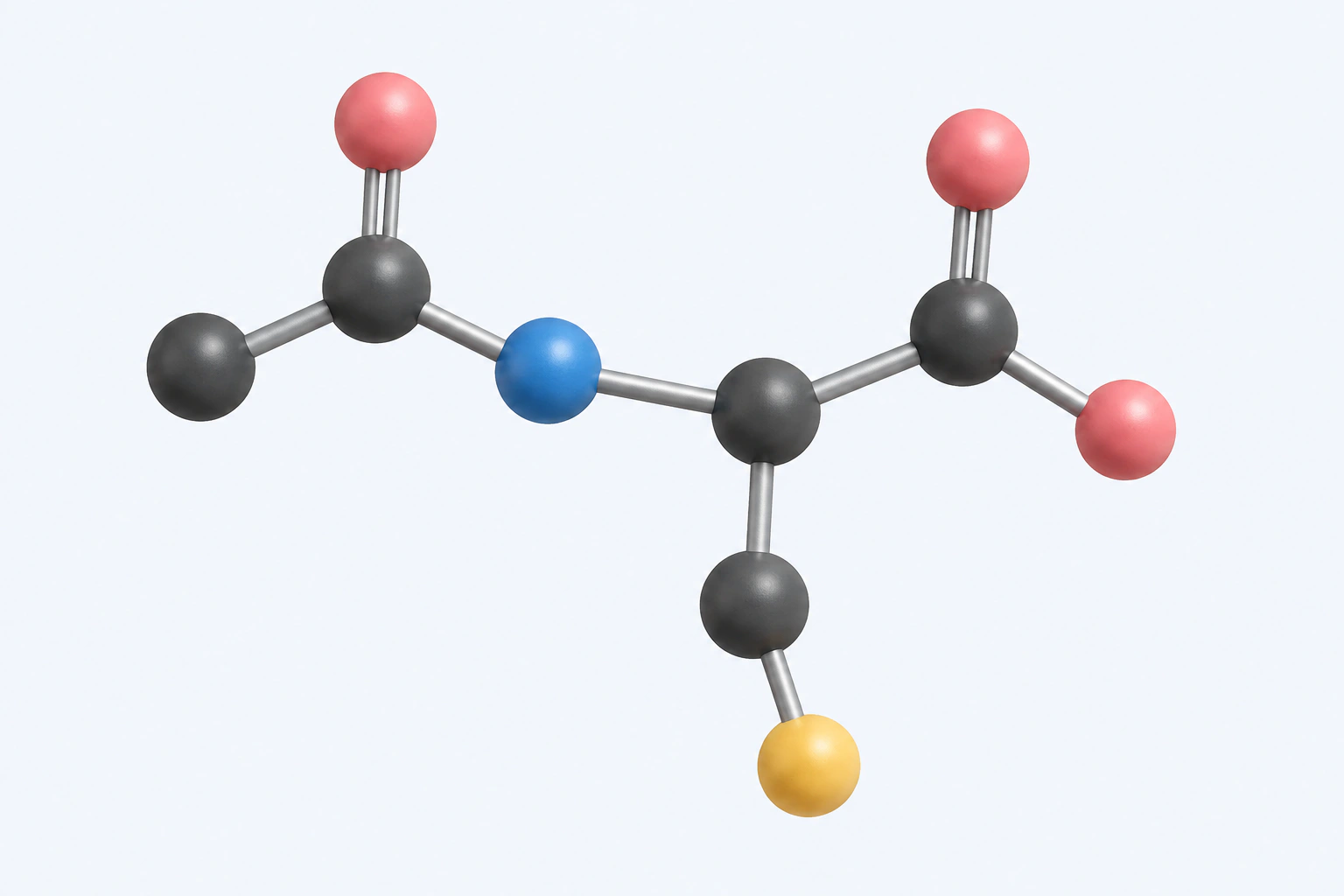
Heavy-atom connectivity orientation for neutral N-acetyl-L-cysteine. Hydrogens, visually proven stereochemistry, ionic or salt state, measured conformation, metal binding, formulation, dose, concentration, pathway, biomarker, treatment, and disease claims are intentionally omitted; this is an educational reconstruction.
Scientific media record5 verified identifiers
- Subject
- N-Acetyl-L-Cysteinehost-defense
- Identifiers
- WikiBiome:n-acetyl-cysteinePubChem:12035ChEBI:28939MeSH:D000111InChIKey:PWKSKIMOESPYIA-BYPYZUCNSA-N
- Review
- Editorial review completeIdentifiers authority-verified · Accessibility validated · · n-acetyl-cysteine|n-acetyl-cysteine-host-defense-v1.webp
- Digital source
- Trained-algorithmic mediaCreated with a trained generative algorithm and reviewed by WikiBiome for subject identity, scientific framing, identifiers, provenance, and accessibility.
- Scientific basis
- N-Acetyl-L-cysteine — PubChemN-acetyl-L-cysteine — ChEBIAcetylcysteine — Medical Subject HeadingsN-Acetyl Cysteine
- License
- CC BY-SA 4.0Created
N-acetylcysteine (NAC) is the acetylated form of the amino acid L-cysteine and serves as the rate-limiting precursor for glutathione synthesis—the body's primary intracellular antioxidant and a critical cofactor for phase II detoxification of Heavy Metals.
In the microbiome context, NAC sits at the intersection of Oxidative Stress defense, metal detoxification, biofilm disruption, and glutamatergic neurotransmission.
Contents
1. Biochemical Mechanisms2. Disease Relevance3. Microbiome Considerations4. Cross-ReferencesBiochemical Mechanisms#
Glutathione Precursor#
NAC provides cysteine, which is the limiting substrate for gamma-glutamylcysteine synthetase—the first step in glutathione (GSH) synthesis. GSH conjugates with toxic metals (cadmium, lead, mercury, arsenic) via glutathione S-transferases, enabling their biliary and renal excretion.
In conditions where metal burden depletes glutathione reserves, NAC supplementation restores the detoxification capacity.
Metal Chelation Adjunct#
NAC's thiol group (-SH) directly chelates soft metals including mercury and cadmium, though with lower affinity than dedicated chelators like DMSA or EDTA. Its primary clinical value is not as a direct chelator but as a support for the glutathione system that handles the bulk of metal detoxification.
NAC also reduces oxidative damage caused by Fenton chemistry when iron or copper catalyze hydroxyl radical production.
Biofilm Disruption#
NAC disrupts bacterial and fungal biofilms by cleaving disulfide bonds in the extracellular polymeric substance (EPS) matrix. This property makes it relevant to conditions where Biofilm-protected pathobionts resist conventional treatment—including chronic sinusitis, COPD exacerbations, and potentially gut biofilms involving Candida albicans and Escherichia coli.
Glutamatergic Modulation#
NAC modulates the cystine-glutamate antiporter (system Xc-), exchanging extracellular cystine for intracellular glutamate. This normalizes extrasynaptic glutamate tone, which is relevant to neuropsychiatric conditions where glutamate excitotoxicity contributes to pathology.
Disease Relevance#
NAC's multi-target mechanism makes it relevant across several WikiBiome conditions.
Autism Spectrum Disorder—Pilot RCTs show NAC (900-2700 mg/day) reduces irritability; addresses glutathione depletion documented in ASD. Schizophrenia—Adjunctive NAC reduces negative symptoms in RCTs; modulates glutamatergic dysfunction. Long COVID—Improves fatigue and cognitive symptoms; addresses persistent oxidative stress.
Metal-burdened conditions—Supports glutathione-mediated excretion of cadmium, lead, and mercury. Parkinson's Disease—Preliminary benefit via glutathione restoration and reduction of iron-mediated oxidative stress.
Microbiome Considerations#
NAC's effects on the Gut Microbiome are complex. Its biofilm-disrupting properties may transiently alter microbial community structure. Oral NAC increases luminal cysteine availability, which could theoretically benefit sulfur-metabolizing bacteria including Desulfovibrio—an organism enriched in several disease states.
This potential downside warrants consideration in conditions where sulfate-reducing bacteria are already elevated.
Cross-References#
- Glutathione (GSH)—downstream product; the functional antioxidant
- oxidative stress—the pathological state NAC addresses
- Biofilm—NAC disrupts EPS matrix
- Cadmium—detoxified via GSH conjugation
- Lead—detoxified via GSH conjugation
- See also: interventions/nac-supplementation for clinical intervention details (Cureva)
References 8
Numbered by first appearance in the article, then reconciled with its declared source list.
- 1
Liu Z, Zhou X, Kuang L et al. (2025). Novel Insights into Immune-Gut Microbiota Interactions in Colorectal Cancer: A Mendelian Randomization Study. Infectious Agents and Cancer.
- 2
Bart A. Eijkelkamp, Jacqueline R. Morey, Stephanie L. Neville et al. (2014). Eijkelkamp et al. 2014 — Extracellular Zinc Competitively Inhibits Manganese Uptake in Streptococcus pneumoniae. PLoS ONE.
- 3
Achdout H, Vitner EB, Politi B et al. (2021). Increased lethality in influenza and SARS-CoV-2 coinfection is prevented by influenza immunity but not SARS-CoV-2 immunity. Nature Communications.
- 4
Flyvholm MA, Nielsen GD, Andersen A (1984). Nickel Content of Food and Estimation of Dietary Intake. Zeitschrift fur Lebensmittel-Untersuchung und Forschung.
- 5
Docimo G, Cangiano A, Romano RM et al. (2020). Docimo et al. 2020 — The Human Microbiota in Endocrinology: Implications for Pathophysiology, Treatment, and Prognosis in Thyroid Diseases. Frontiers in Endocrinology.
- 6
Adriel Latorre-Pérez, Marta Hernández, Jose Ramón Iglesias et al. (2021). Latorre-Pérez 2021 — The Spanish Gut Microbiome Reveals Links Between Microorganisms and Mediterranean Diet. Scientific Reports.
- 7
Huang X, Xu R, Yang Q et al. (2024). The depletion of gut microbiome impairs the beneficial effect of Gui-Shen-Wan in restoring mice ovarian function. Frontiers in Cellular and Infection Microbiology.
- 8
★Monisha Jaishankar, Tenzin Tseten, Naresh Anbalagan et al. (2014). Toxicity, Mechanism and Health Effects of Some Heavy Metals. Interdisciplinary Toxicology.
Article network
Connect the evidence
Publicly readable discussion by ORCID-authenticated researchers. Questions, interpretation, methods, corrections, and new evidence stay attached to this record.
No discussion yet. Start with a precise question or a source-backed observation.
Published page changes
This record shows only material changes published on this page, including changes to its content, evidence, conclusions, or author context. Internal processes and discussion activity are excluded. Pending, declined, and withdrawn proposals remain private.
- published revision
Added references: liu-2025-immune-gut-microbiota-crc-mr-mediation; eijkelkamp-2014-zinc-inhibits-manganese-pneumococcus; achdout-2021-influenza-sars-cov2-coinfection-lethality; flyvholm-1984-nickel-food-content; docimo-2020-human-microbiota-endocrinology-thyroid;…
Added references: liu-2025-immune-gut-microbiota-crc-mr-mediation; eijkelkamp-2014-zinc-inhibits-manganese-pneumococcus; achdout-2021-influenza-sars-cov2-coinfection-lethality; flyvholm-1984-nickel-food-content; docimo-2020-human-microbiota-endocrinology-thyroid; latorre-perez-2021-spanish-gut-microbiome-mediterranean-diet; huang-2024-gui-shen-wan-gut-microbiome-ovarian-function; jaishankar-2014-heavy-metal-toxicity-mechanisms. · WikiBiome Deploy Bot · +17 −11
Inspect exact Git diff ↗ - published revision
Created “N-Acetylcysteine (NAC)”: N-acetylcysteine (NAC) is the acetylated form of the amino acid L-cysteine and serves as the rate-limiting precursor for glutathione synthesis — the body's primary intracellular antioxidant and a…
Created “N-Acetylcysteine (NAC)”: N-acetylcysteine (NAC) is the acetylated form of the amino acid L-cysteine and serves as the rate-limiting precursor for glutathione synthesis — the body's primary intracellular antioxidant and a… Published sections: Overview; Glutathione Precursor; Metal Chelation Adjunct; Biofilm Disruption; Glutamatergic Modulation; Disease Relevance; Microbiome Considerations; Cross-References. · WikiBiome Deploy Bot · +71 −0
Inspect exact Git diff ↗