
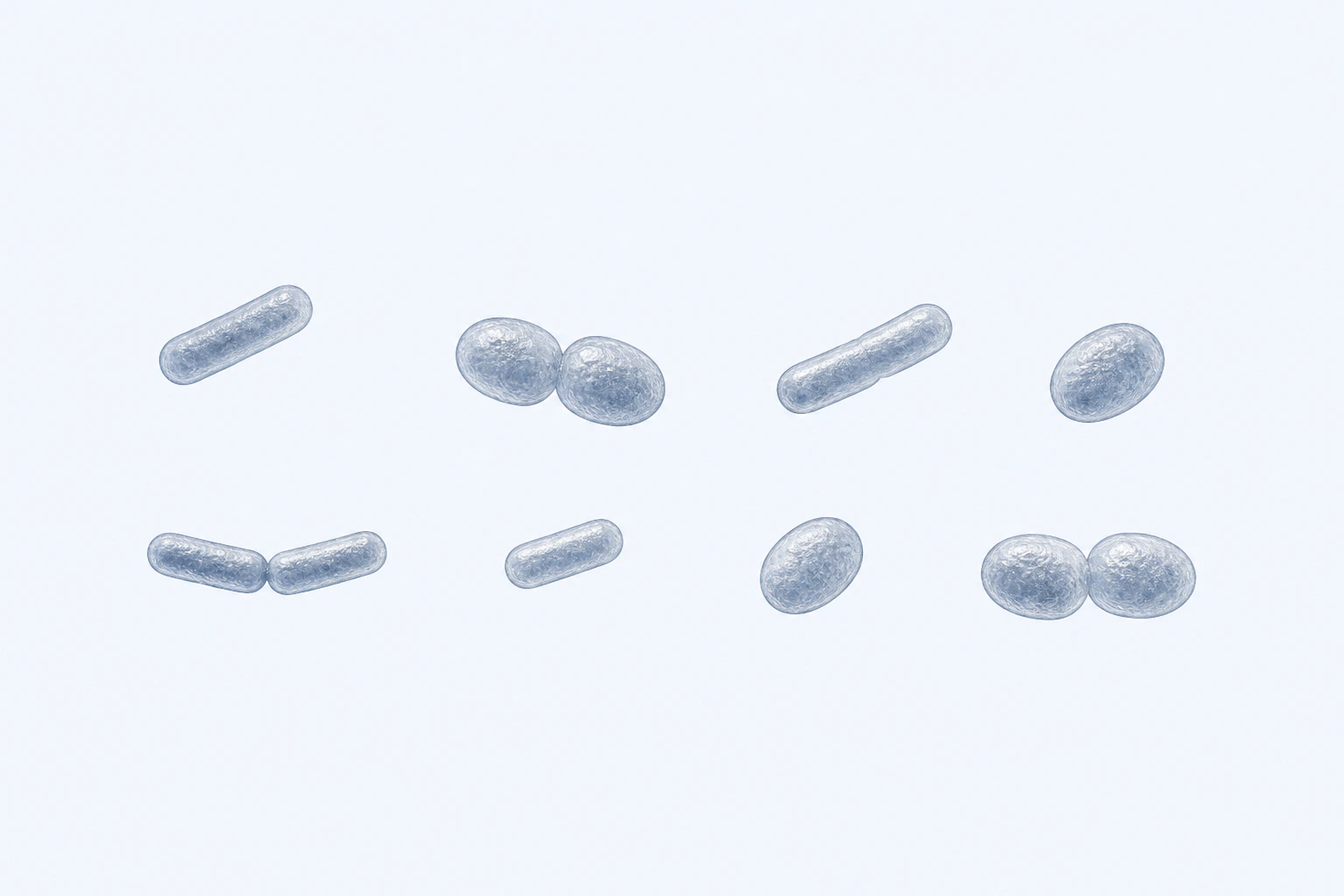
Source-supported short-rod and compact coccobacillary variation in Lactobacillus iners, shown as eleven bodies in five single and three paired groupings. This scientific reconstruction is representative, non-diagnostic, not a micrograph or Gram-stained field, and does not imply that shape alone identifies the species.
Scientific media record1 verified identifier
- Subject
- Lactobacillus inerstaxon · species
- Identifiers
- NCBITaxon:147802
- Review
- Editorial review completeIdentifiers authority-verified · Accessibility validated · · lactobacillus-iners|lactobacillus-iners-morphology-v1.webp
- Digital source
- Trained-algorithmic mediaCreated with a trained generative algorithm and reviewed by WikiBiome for subject identity, scientific framing, identifiers, provenance, and accessibility.
- Scientific basis
- Lactobacillus iners — NCBI TaxonomyLactobacillus iners — LPSNLactobacillus iners sp. nov.Lactobacillus iners type strainLactobacillus iners microscopy and pleomorphism
- License
- CC BY-SA 4.0Created
Lactobacillus iners is a Gram-positive, facultatively anaerobic bacterium that dominates the vaginal microbiome of many women worldwide, defining Community State Type III (CST-III) in vaginal microbiome classification. For decades, all vaginal Lactobacillus species were assumed to be protective.
The accumulating evidence tells a different story: L. iners is increasingly recognized as a Dysbiosis marker rather than a guardian of vaginal health.
This distinction matters enormously for clinical interpretation. A vaginal microbiome report showing "Lactobacillus-dominant" is reassuring only if the dominant species is Lactobacillus crispatus (CST-I).
When L. iners dominates, the microbiome is often in a transitional state—compatible with low diversity, active pathogen colonization, and progression toward bacterial vaginosis or disease.
Evidence map7 cited passagesInspect provenance +
Pathogen permissive: In women with tubal infertility and Chlamydia trachomatis infection, the vaginal microbiota was L. iners-dominated rather than L. crispatus-dominated, with significantly lower Shannon diversity. L. crispatus (not L. iners) is the species that restricts CT colonization (, case-control, n=25).
Failure to suppress S. aureus: In PCOS vaginal microbiomes, L. iners did not correlate with S. aureus suppression, reinforcing that it lacks the antimicrobial activity of L. crispatus (, cross-sectional).
Endometriosis: L. iners significantly reduced in endometriosis-associated chronic pelvic pain patients alongside L. jensenii and L. reuteri, while pathogenic Clostridia expanded (, cross-sectional). Separately, L. iners was implicated in endometriosis vaginal microbiota-N-glycome studies (, case-control).
Ovarian cancer (serous histology): L. iners enriched in the lower reproductive tract of serous ovarian cancer patients alongside Facklamia hominis, Anaerococcus senegalensis, and Actinomyces turicensis. Consistent with L. iners as a dysbiosis marker rather than a eubiosis marker (, cross-sectional).
PCOS: Part of the altered vaginal microbiome in PCOS patients, where shotgun sequencing confirmed dysbiosis with reduced Lactobacillus diversity. Pathobionts including Streptococcus pyogenes and Clostridium perfringens were enriched in PCOS groups (, cross-sectional).
Tubal infertility: L. iners-dominated vaginal microbiota was associated with C. trachomatis infection and significantly lower diversity compared to healthy controls (, case-control, n=25).
| Study | Finding | Evidence Level | |-------|---------|---------------| | | L. iners-dominant in CT-infected infertile women; L. crispatus restricts CT | Case-control | | | No S. aureus suppression; dysbiosis marker in PCOS | Cross-sectional | | | Enriched in serous OC lower reproductive tract | Cross-sectional | | | Reduced in endometriosis-associated CPP
Contents
1. Metal Dependencies2. Key Enzymes and Virulence Factors3. Ecological Role4. Conditions Associated5. Key Studies6. Cross-ReferencesMetal Dependencies#
Manganese: L. iners relies on manganese-dependent enzymes for Oxidative Stress defense. Unlike L. crispatus, which produces robust hydrogen peroxide, L. iners produces minimal H2O2—a critical functional deficit.
Iron: Required for basic metabolic processes, though L. iners has a streamlined genome with reduced biosynthetic capacity compared to other vaginal lactobacilli.
Key Enzymes and Virulence Factors#
The key distinction between L. iners and protective vaginal lactobacilli lies in its enzymatic profile. Inerolysin: A cholesterol-dependent cytolysin (CDC) unique to L. iners. This pore-forming toxin can damage vaginal epithelial cells and may contribute to the breakdown of the mucosal barrier.
No other vaginal Lactobacillus produces a CDC.
L-lactate dehydrogenase: L. iners produces only L-lactic acid, whereas L. crispatus produces both D- and L-lactic acid. D-lactic acid is the form with stronger antimicrobial activity and is associated with greater protection against HIV and other sexually transmitted infections.
Absent H2O2 production: L. iners produces little to no hydrogen peroxide, eliminating a key antimicrobial mechanism that other vaginal lactobacilli use to suppress pathobionts.
Minimal bacteriocin production: Unlike L. crispatus, L. iners has a reduced genome (~1.3 Mb, among the smallest of lactobacilli) with limited capacity for antimicrobial peptide synthesis.
Ecological Role#
L. iners occupies a paradoxical ecological position—it is a Lactobacillus that does not protect. Transitional state indicator: L. iners-dominant communities are frequently the transitional state between L. crispatus dominance (healthy) and BV-associated polymicrobial dysbiosis. Women can shift rapidly from CST-III to CST-IV (BV) and back.
Pathogen permissive: In women with tubal infertility and Chlamydia trachomatis infection, the vaginal microbiota was L. iners-dominated rather than L. crispatus-dominated, with significantly lower Shannon diversity. L. crispatus (not L. iners) is the species that restricts CT colonization (,[1]Chen 2021 — Alterations of vaginal microbiota in women with infertility and Chlamydia trachomatis infectionChen H, Wang L, Zhao L et al. · 2021Open reference 1 ↓ case-control, n=25).
Failure to suppress S. aureus: In PCOS vaginal microbiomes, L. iners did not correlate with S. aureus suppression, reinforcing that it lacks the antimicrobial activity of L. crispatus (,[2]Zheng 2024 — Differential enrichment of bacteria and phages in vaginal microbiomes in PCOS and obesity: shotgun sequencing analysisZheng S, Chen H, Yang H et al. · 2024Open reference 2 ↓ cross-sectional).
Conditions Associated#
Enriched in:#
Endometriosis: L. iners significantly reduced in endometriosis-associated chronic pelvic pain patients alongside L. jensenii and L. reuteri, while pathogenic Clostridia expanded (,[3]The role of the vaginal microbiome in distinguishing female chronic pelvic pain caused by endometriosis/adenomyosisChao X, Liu Y, Fan Q et al. · 2021Open reference 3 ↓ cross-sectional). Separately, L. iners was implicated in endometriosis vaginal microbiota-N-glycome studies (,[4]MacSharry 2024 — Endometriosis Specific Vaginal Microbiota Links to Urine and Serum N-GlycomeJohn MacSharry, Zsuzsanna Kovacs, Yongjing Xie et al. · 2024Open reference 4 ↓ case-control).
Ovarian cancer (serous histology): L. iners enriched in the lower reproductive tract of serous ovarian cancer patients alongside Facklamia hominis, Anaerococcus senegalensis, and Actinomyces turicensis. Consistent with L. iners as a dysbiosis marker rather than a eubiosis marker (,[5]Asangba 2023 — Diagnostic and prognostic potential of the microbiome in ovarian cancer treatment responseAsangba AE, Chen J, Goergen KM et al. · 2023Open reference 5 ↓ cross-sectional).
PCOS: Part of the altered vaginal microbiome in PCOS patients, where shotgun sequencing confirmed dysbiosis with reduced Lactobacillus diversity. Pathobionts including Streptococcus pyogenes and Clostridium perfringens were enriched in PCOS groups (,[2]Zheng 2024 — Differential enrichment of bacteria and phages in vaginal microbiomes in PCOS and obesity: shotgun sequencing analysisZheng S, Chen H, Yang H et al. · 2024Open reference 2 ↓ cross-sectional).
Tubal infertility: L. iners-dominated vaginal microbiota was associated with C. trachomatis infection and significantly lower diversity compared to healthy controls (,[1]Chen 2021 — Alterations of vaginal microbiota in women with infertility and Chlamydia trachomatis infectionChen H, Wang L, Zhao L et al. · 2021Open reference 1 ↓ case-control, n=25).
Key Studies#
| Study | Finding | Evidence Level |
|---|---|---|
| [1]Chen 2021 — Alterations of vaginal microbiota in women with infertility and Chlamydia trachomatis infectionChen H, Wang L, Zhao L et al. · 2021Open reference 1 ↓ | L. iners-dominant in CT-infected infertile women; L. crispatus restricts CT | Case-control |
| [2]Zheng 2024 — Differential enrichment of bacteria and phages in vaginal microbiomes in PCOS and obesity: shotgun sequencing analysisZheng S, Chen H, Yang H et al. · 2024Open reference 2 ↓ | No S. aureus suppression; dysbiosis marker in PCOS | Cross-sectional |
| [5]Asangba 2023 — Diagnostic and prognostic potential of the microbiome in ovarian cancer treatment responseAsangba AE, Chen J, Goergen KM et al. · 2023Open reference 5 ↓ | Enriched in serous OC lower reproductive tract | Cross-sectional |
| [3]The role of the vaginal microbiome in distinguishing female chronic pelvic pain caused by endometriosis/adenomyosisChao X, Liu Y, Fan Q et al. · 2021Open reference 3 ↓ | Reduced in endometriosis-associated CPP | Cross-sectional |
| [4]MacSharry 2024 — Endometriosis Specific Vaginal Microbiota Links to Urine and Serum N-GlycomeJohn MacSharry, Zsuzsanna Kovacs, Yongjing Xie et al. · 2024Open reference 4 ↓ | Implicated in endometriosis vaginal dysbiosis | Case-control |
Cross-References#
- Lactobacillus crispatus—truly protective vaginal Lactobacillus; the standard against which L. iners falls short
- Endometriosis—vaginal microbiome disruption
- Ovarian Cancer—enriched in serous histology
- polycystic-ovary-syndrome—vaginal dysbiosis component
- Chlamydia trachomatis—pathogen not suppressed by L. iners
- Bacterial Vaginosis—transitional state toward BV
- vaginal-microbiome—community state type classification
References 5
Numbered by first appearance in the article, then reconciled with its declared source list.
- 1
Chen H, Wang L, Zhao L et al. (2021). Chen 2021 — Alterations of vaginal microbiota in women with infertility and Chlamydia trachomatis infection. Frontiers in Cellular and Infection Microbiology.
- 2
Zheng S, Chen H, Yang H et al. (2024). Zheng 2024 — Differential enrichment of bacteria and phages in vaginal microbiomes in PCOS and obesity: shotgun sequencing analysis. Frontiers in Microbiomes.
- 3
Chao X, Liu Y, Fan Q et al. (2021). The role of the vaginal microbiome in distinguishing female chronic pelvic pain caused by endometriosis/adenomyosis. Annals of Translational Medicine.
- 4
John MacSharry, Zsuzsanna Kovacs, Yongjing Xie et al. (2024). MacSharry 2024 — Endometriosis Specific Vaginal Microbiota Links to Urine and Serum N-Glycome. Scientific Reports.
- 5
Asangba AE, Chen J, Goergen KM et al. (2023). Asangba 2023 — Diagnostic and prognostic potential of the microbiome in ovarian cancer treatment response. Scientific Reports.
Article network
Connect the evidence
Publicly readable discussion by ORCID-authenticated researchers. Questions, interpretation, methods, corrections, and new evidence stay attached to this record.
No discussion yet. Start with a precise question or a source-backed observation.
Published page changes
This record shows only material changes published on this page, including changes to its content, evidence, conclusions, or author context. Internal processes and discussion activity are excluded. Pending, declined, and withdrawn proposals remain private.
- published revision
Created “Lactobacillus iners”: Lactobacillus iners is a Gram-positive, facultatively anaerobic bacterium that dominates the vaginal microbiome of many women worldwide, defining Community State Type III (CST-III) in vaginal…
Created “Lactobacillus iners”: Lactobacillus iners is a Gram-positive, facultatively anaerobic bacterium that dominates the vaginal microbiome of many women worldwide, defining Community State Type III (CST-III) in vaginal… Published sections: Lactobacillus iners; Metal Dependencies; Key Enzymes and Virulence Factors; Ecological Role; Enriched in:; Key Studies; Cross-References. · WikiBiome Deploy Bot · +78 −0
Inspect exact Git diff ↗