
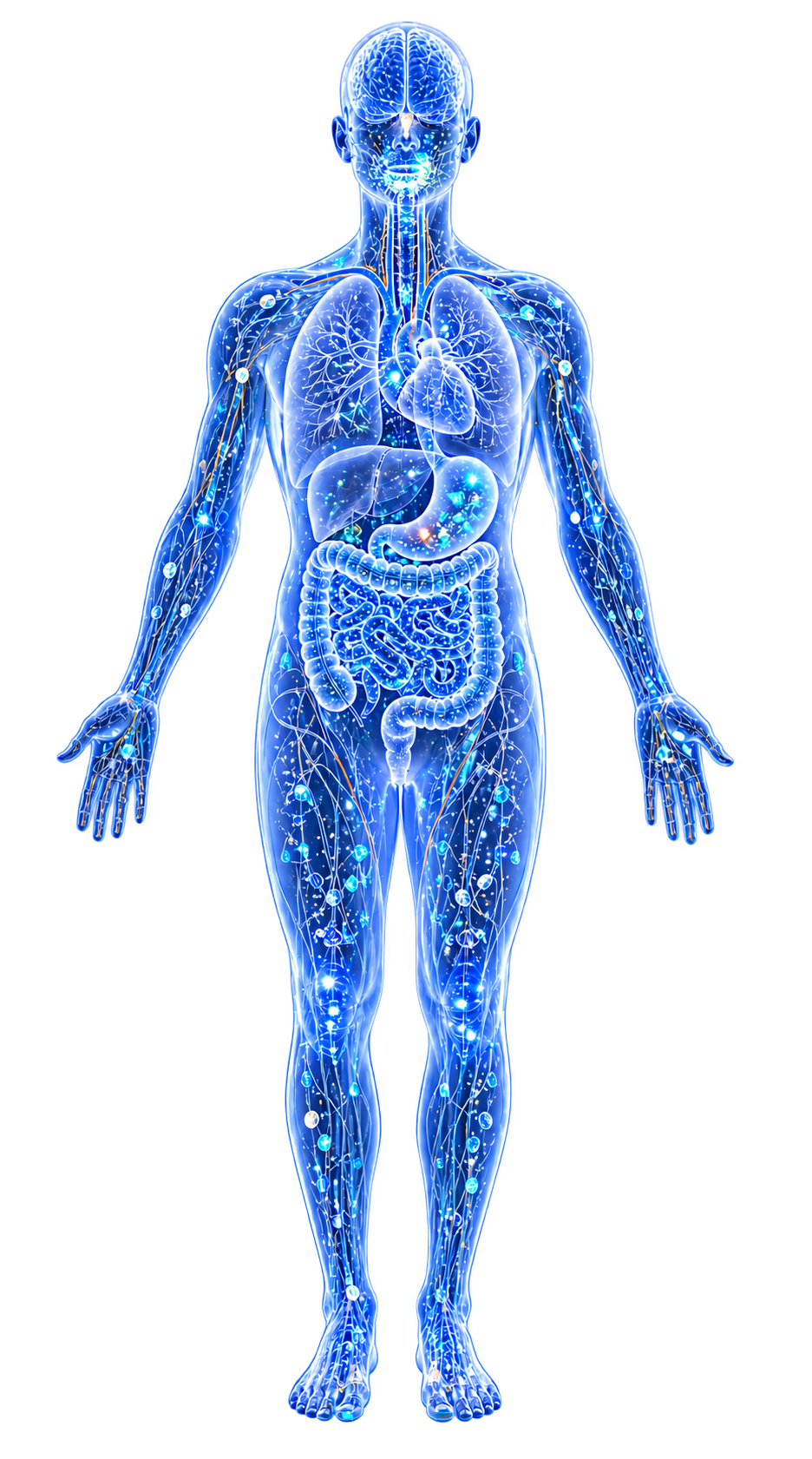
Hyperparathyroidism is the overproduction of parathyroid hormone (PTH), a master regulator of calcium homeostasis. While primary hyperparathyroidism (from parathyroid adenoma) is well described, the WikiBiome framework highlights secondary hyperparathyroidism—the compensatory PTH elevation driven by heavy metal interference with vitamin D metabolism and calcium handling.
This metal-driven pathway links environmental exposure to bone disease, kidney damage, and immune dysregulation.
Evidence map2 cited passagesInspect provenance +
PTH: 77.03 pg/ml in RA vs. 49.35 pg/ml in controls (p<0.001)—a clinically significant secondary hyperparathyroidism.
Strong inverse correlations between vitamin D and metals: VitD-Lead (r=-0.969), VitD-Cd (r=-0.901), VitD-Cr (r=-0.925).
Contents
1. The Metal-Vitamin D-PTH Axis2. PTH and Metal Metabolism3. CKD-Related Hyperparathyroidism4. Gut Microbiome Connections5. Open Questions6. Cross-ReferencesThe Metal-Vitamin D-PTH Axis#
A proposed mechanism connects heavy metal exposure to secondary hyperparathyroidism through vitamin D disruption:
`` Heavy metal exposure (Pb, Cd, Cr, Al) │ ▼ Impaired renal 1-alpha hydroxylation of 25(OH)D │ ▼ Vitamin D deficiency (reduced 1,25(OH)2D) │ ▼ Reduced intestinal calcium absorption │ ▼ Low serum calcium → PTH elevation (secondary hyperparathyroidism) │ ▼ Bone resorption → osteopenia/osteoporosis ``
Evidence in Rheumatic Disease#
In Rheumatoid Arthritis patients. PTH: 77.03 pg/ml in RA vs. 49.35 pg/ml in controls (p<0.001)—a clinically significant secondary hyperparathyroidism.[1]Impact of heavy metals on serum vitamin D3 and PTH in fibromyalgia and rheumatoid arthritis and their correlation to disease activityHaddad R, Elbeialy A, El Sawy S et al. · 2024Open reference 1 ↓
Strong inverse correlations between vitamin D and metals: VitD-Lead (r=-0.969), VitD-cadmium (Cd) (r=-0.901), VitD-chromium (Cr) (r=-0.925).[1]Impact of heavy metals on serum vitamin D3 and PTH in fibromyalgia and rheumatoid arthritis and their correlation to disease activityHaddad R, Elbeialy A, El Sawy S et al. · 2024Open reference 1 ↓ The metal-VitD-bone axis explains why RA patients have both elevated inflammatory markers and vitamin D deficiency—the metals drive both.
This connects to the signature narrative: mucosal-primed autoimmune response targets joints, Metal-Driven Inflammation drives further metal redistribution (ceruloplasmin/copper (Cu) elevation), metals interfere with vitamin D activation, VitD deficiency removes the immune tolerance brake, and secondary hyperparathyroidism accelerates bone destruction.
PTH and Metal Metabolism#
PTH itself modulates metal handling. PTH enhances intestinal Calcium absorption, but this mechanism also increases absorption of toxic metals that use calcium channels (Lead, Cadmium)—a Mis-Metallation risk.
PTH mobilizes calcium from bone, simultaneously releasing bone-stored lead and cadmium. The lead (Pb)-calcium (Ca) mimicry is bidirectional: lead replaces calcium in bone storage, and PTH-driven bone resorption releases stored lead back into circulation.
This creates a dangerous feedback loop in lead-exposed individuals: `` Lead exposure → bone storage of Pb ↓ Metal-driven VitD deficiency → secondary hyperparathyroidism ↓ PTH-driven bone resorption → Pb mobilization from bone ↓ Re-elevated blood Pb → further VitD disruption ``
Gut Microbiome Connections#
The relationship between hyperparathyroidism and the gut microbiome operates through:
- Calcium absorption: Gut microbiome composition affects calcium bioavailability through pH modulation, phytate degradation, and Oxalates metabolism.
- Vitamin D metabolism: Emerging evidence suggests gut bacteria influence vitamin D receptor expression and vitamin D metabolite levels.
- Parathyroid hormone and gut permeability: PTH elevation is associated with increased intestinal permeability in CKD, potentially amplifying endotoxemia.
- Metal mobilization: PTH-driven bone resorption releases stored toxic metals, which then reshape the gut microbiome.
Open Questions#
Unresolved questions identified by the current evidence record.
01Can metal chelation reverse secondary hyperparathyroidism in RA patients?+
The current WikiBiome record identifies this as an unresolved evidence gap.
02Does the PTH-driven lead mobilization from bone create a measurable re-exposure event?+
The current WikiBiome record identifies this as an unresolved evidence gap.
03Can targeted vitamin D supplementation overcome metal-driven 1-alpha hydroxylase inhibition?+
The current WikiBiome record identifies this as an unresolved evidence gap.
04Does the gut microbiome influence PTH secretion or parathyroid gland function directly?+
The current WikiBiome record identifies this as an unresolved evidence gap.
Cross-References#
- Rheumatoid Arthritis—secondary hyperparathyroidism in RA (PTH 77 vs. 49 pg/ml)
- Chronic Kidney Disease—CKD-MBD as primary cause of secondary hyperparathyroidism
- Calcium—PTH's primary regulatory target
- Vitamin D Supplementation—intervention for PTH normalization
- Lead—lead (Pb)-calcium (Ca) mimicry; bone storage and mobilization
- Cadmium—cadmium (Cd) interference with renal vitamin D activation
- Mis-Metallation—toxic metals entering through calcium channels
- Fibromyalgia—shared metal-VitD-PTH disruption
References 6
Numbered by first appearance in the article, then reconciled with its declared source list.
- 1
Haddad R, Elbeialy A, El Sawy S et al. (2024). Impact of heavy metals on serum vitamin D3 and PTH in fibromyalgia and rheumatoid arthritis and their correlation to disease activity. Research Square (Preprint).
- 2
Elbeialy A, El Sawy S, Elzomor H et al. (2024). Environmental pollution impact on the severity of some rheumatic diseases: a comparative analytical study on inflammatory and non-inflammatory samples. BMC Rheumatology.
- 3
Paola Romagnani, Giuseppe Remuzzi, Richard Glassock et al. (2017). Chronic Kidney Disease (Disease Primer). Nature Reviews Disease Primers.
- 4
Viola N, Colleo A, Casula M et al. (2025). Viola et al. 2025 — Graves' Disease: Is It Time for Targeted Therapy? A Narrative Review. Medicina.
- 5
Weider T, Genoni A, Broccolo F et al. (2022). Weider et al. 2022 — High Prevalence of Common Human Viruses in Thyroid Tissue. Frontiers in Endocrinology.
- 6
Briffa J, Sinagra E, Blundell R (2020). Heavy Metal Pollution in the Environment and Their Toxicological Effects on Humans. Heliyon.
Article network
Connect the evidence
Publicly readable discussion by ORCID-authenticated researchers. Questions, interpretation, methods, corrections, and new evidence stay attached to this record.
No discussion yet. Start with a precise question or a source-backed observation.
Activity and accepted changes
Accepted researcher context, editorial status, public discussion, and upstream Git revisions are shown together. Pending, declined, and withdrawn proposals remain private.
- published revision
Backfill gut microbiome concept links
Karen Pendergrass · +1 −1
Inspect exact Git diff ↗ - published revision
Backfill inflammation concept links
Karen Pendergrass · +1 −1
Inspect exact Git diff ↗ - published revision
massive wiki expansion: 149 stubs fixed, 100+ new pages, Rule 15 scan, keystone papers
WikiBiome Deploy Bot · +15 −11
Inspect exact Git diff ↗ - published revision
nightly maintenance: 94 stub demotions, 181 source_count fixes, 22 auto-discovered stubs, 5 adversarial audits, 3 boundary fixes, 3 evidence-level corrections
WikiBiome Deploy Bot · +2 −0
Inspect exact Git diff ↗ - published revision
pre-overnight checkpoint 2026-04-18
WikiBiome Deploy Bot · +106 −0
Inspect exact Git diff ↗