
 metals · microbes · host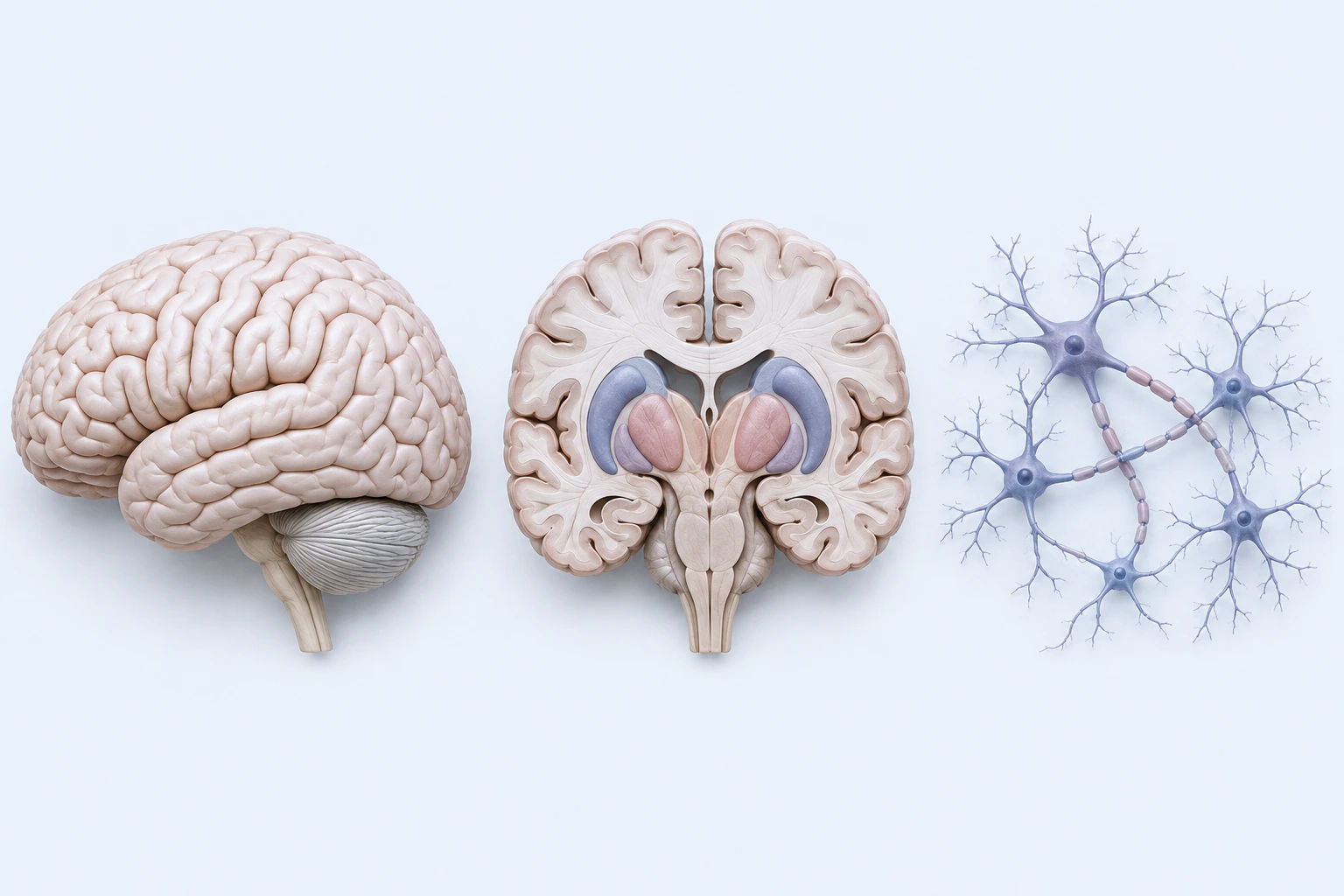
Neutral neuroanatomical orientation for Huntington disease. The reconstruction does not depict a patient, named nucleus, atrophy, lesion, gene result, mechanism, symptom pattern, stage, severity, prognosis, or diagnosis.
Scientific media record1 verified identifier
- Subject
- Huntington Diseasecondition
- Identifiers
- MeSH:D006816
- Review
- Editorial review completeIdentifiers authority-verified · Accessibility validated · · huntingtons-disease|huntingtons-disease-pathology-v1.webp
- Digital source
- Trained-algorithmic mediaCreated with a trained generative algorithm and reviewed by WikiBiome for subject identity, scientific framing, identifiers, provenance, and accessibility.
- License
- CC BY-SA 4.0Created
Huntington's disease (HD) is an autosomal dominant neurodegenerative disorder caused by CAG trinucleotide repeat expansion in the HTT gene, producing mutant huntingtin protein (mHTT) with an extended polyglutamine tract. While the genetic cause is well-established, the mechanisms of selective neuronal death in the striatum and cortex remain incompletely understood.
Emerging evidence suggests that metal accumulation and brain-associated microbial communities may modify disease progression independently of the primary genetic lesion.
Evidence map1 cited passagesInspect provenance +
Post-mortem examination of HD brain tissue has revealed fungal elements including Candida species in multiple brain regions, paralleling findings by the same research group (Carrasco laboratory) in alzheimers disease, parkinsons disease, and ALS. Whether these represent true colonization, blood-brain barrier breach during disease, or post-mortem contaminatio
One disease. Five evidence layers.
A generated systems view of the metals, organisms, host sequestration signals, ecological conditions, and microbial functions indexed for Huntington's Disease.
Evidence layer
Taxonomic signature
Organisms reported as enriched or depleted, with their indexed functional context kept beside the name.No structured taxa indexed yet.
No structured taxa indexed yet.
Evidence layer
Nutritional immunity
Host metal-withholding, inflammatory, antioxidant, and microbial-metabolite signals indexed in the signature.Elevated host signals
0No structured signals indexed yet.
Depleted protective signals
0No structured signals indexed yet.
Evidence layer
Ecological state
The environmental conditions that connect the organism-level observations into a system.No structured ecological features indexed yet.
Evidence layer
Virulence functions
Microbial structures, enzymes, and acquisition systems implicated by the linked evidence.No structured virulence functions indexed yet.
The disease record, in full.
The original WikiBiome disease narrative remains intact beneath the generated signature atlas.
Microbiome Associations#
Brain Microbiota#
Post-mortem examination of HD brain tissue has revealed fungal elements including Candida species in multiple brain regions, paralleling findings by the same research group (Carrasco laboratory) in Alzheimer's Disease, Parkinson's Disease, and ALS.[1]Alonso 2021 -- Brain Microbiota in Huntington's Disease PatientsRuth Alonso, Diana Pisa, Luis Carrasco · 2021Open reference 1 ↓
Whether these represent true colonization, blood-brain barrier breach during disease, or post-mortem contamination remains debated—but the consistency of findings across neurodegenerative diseases and across multiple independent studies suggests biological significance.
Gut Microbiome#
HD patients and presymptomatic gene carriers show altered Gut Microbiome composition compared to healthy controls. Intestinimonas has been reported as enriched in HD, consistent with its enrichment in other inflammatory and neurodegenerative states.
Gut-brain axis disruption in HD may contribute to the gastrointestinal symptoms (weight loss, dysphagia, altered motility) that precede or accompany motor decline.
Metal Associations#
Metal accumulation in the HD brain is increasingly documented. Iron—Elevated in the caudate nucleus and putamen (the regions most affected in HD). Iron accumulation accelerates oxidative damage via Fenton chemistry and promotes Alpha-Synuclein-independent protein aggregation.
Neuroimaging studies show iron deposition correlating with disease severity and motor dysfunction.
Manganese—Accumulates in the basal ganglia; manganese neurotoxicity preferentially affects the same striatal circuits destroyed in HD, raising the possibility that environmental manganese exposure modifies age of onset or progression rate.
Copper—Mutant huntingtin interacts abnormally with copper, and copper dyshomeostasis has been reported in HD models. Copper-mediated Oxidative Stress may compound iron-driven damage.
The convergence of metal accumulation in the same brain regions where mHTT causes selective neuronal death suggests that metals may not merely accompany neurodegeneration but actively accelerate it—particularly in individuals with subthreshold genetic risk (intermediate CAG repeats).
Associated Conditions#
HD shares neuropathological and metallomic features with other neurodegenerative diseases. Parkinson's Disease—Shared iron and manganese accumulation in basal ganglia; overlapping brain fungal findings; both show gut-brain axis disruption. Alzheimer's Disease—Shared iron and copper dysregulation; overlapping Candida detection in brain tissue; protein aggregation mechanisms.
Environmental Factors#
Dietary and occupational manganese exposure may modify HD progression. Manganese-contaminated groundwater, soy-based infant formula (high manganese (Mn) content), and occupational exposure in welding or mining are potential environmental modifiers for genetically susceptible individuals.
Open Questions#
Unresolved questions identified by the current evidence record.
01Do brain-associated fungi in HD represent active infection, dormant colonization, or translocation through a compromised BBB?+
The current WikiBiome record identifies this as an unresolved evidence gap.
02Does iron chelation therapy (deferiprone) slow HD progression, as has been explored in PD?+
The current WikiBiome record identifies this as an unresolved evidence gap.
03Is the gut microbiome a modifiable risk factor for age of onset in HD gene carriers?+
The current WikiBiome record identifies this as an unresolved evidence gap.
04Does manganese exposure interact with CAG repeat length to determine disease severity?+
The current WikiBiome record identifies this as an unresolved evidence gap.
Cross-References#
- Alzheimer's Disease—shared metal dysregulation and brain fungal findings
- Parkinson's Disease—shared basal ganglia metal accumulation
- Candida albicans—detected in HD brain tissue
- Iron—accumulates in HD-affected brain regions
- Neuroinflammation—shared neuroinflammatory pathway with other neurodegenerative diseases
- Gut-Brain Axis—route for microbiome influence on neurodegeneration
References 4
Numbered by first appearance in the article, then reconciled with its declared source list.
- 1
Ruth Alonso, Diana Pisa, Luis Carrasco (2021). Alonso 2021 -- Brain Microbiota in Huntington's Disease Patients. Frontiers in Microbiology.
- 2
Khatoon S, Kalam N, Rashid S et al. (2023). Effects of gut microbiota on neurodegenerative diseases. Frontiers in Aging Neuroscience.
- 3
Alonso-Garcia P, Martin R, Martinez-Pinilla E (2021). Gut microbial imbalance and neurodegenerative proteinopathies: from molecular mechanisms to prospects of clinical applications. Exploration of Neuroprotective Therapy.
- 4
Jinyu Wang, Cuiping Xia, Zhaoxin Xia et al. (2025). Wang 2025 — Disruption of Zinc Homeostasis Reverses Tigecycline Resistance in Klebsiella pneumoniae. Frontiers in Cellular and Infection Microbiology.
Article network
Connect the evidence
Publicly readable discussion by ORCID-authenticated researchers. Questions, interpretation, methods, corrections, and new evidence stay attached to this record.
No discussion yet. Start with a precise question or a source-backed observation.
Published page changes
This record shows only material changes published on this page, including changes to its content, evidence, conclusions, or author context. Internal processes and discussion activity are excluded. Pending, declined, and withdrawn proposals remain private.
- published revision
Added references: khatoon-2023-gut-microbiota-neurodegenerative; alonso-garcia-2021-gut-microbiota-proteinopathies; wang-2025-zinc-ionophore-pbt2-tigecycline-resistance-klebsiella.
WikiBiome Deploy Bot · +12 −11
Inspect exact Git diff ↗ - published revision
Created “Huntington's Disease”: Huntington's disease (HD) is an autosomal dominant neurodegenerative disorder caused by CAG trinucleotide repeat expansion in the HTT gene, producing mutant huntingtin protein (mHTT) with an extended…
Created “Huntington's Disease”: Huntington's disease (HD) is an autosomal dominant neurodegenerative disorder caused by CAG trinucleotide repeat expansion in the HTT gene, producing mutant huntingtin protein (mHTT) with an extended… Published sections: Overview; Brain Microbiota; Gut Microbiome; Metal Associations; Associated Conditions; Environmental Factors; Open Questions; Cross-References. · WikiBiome Deploy Bot · +98 −0
Inspect exact Git diff ↗