

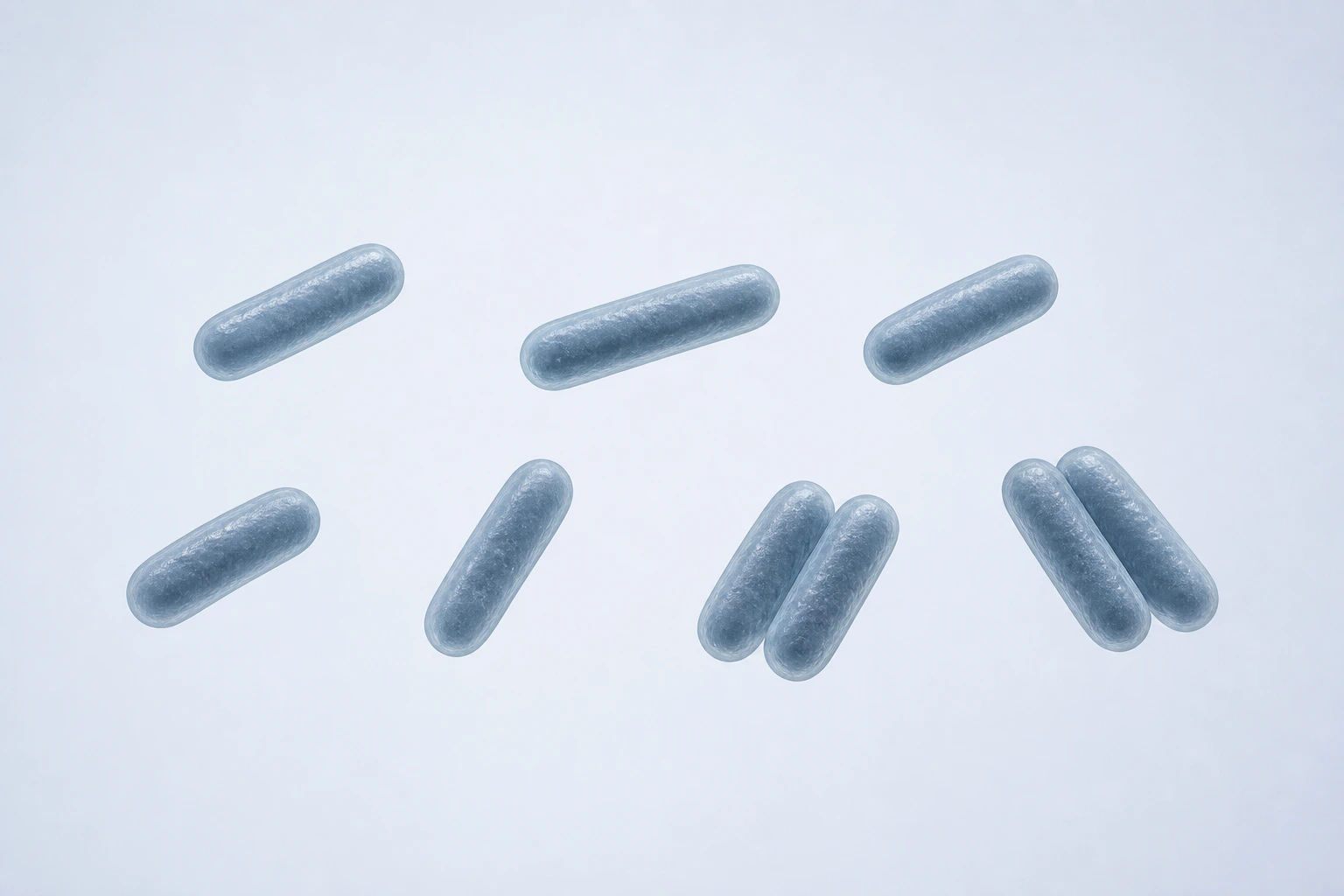
Type-species-anchored Intestinimonas vegetative rods, shown as nine bodies in five single and two paired groupings. This genus-level scientific reconstruction is representative, non-diagnostic, does not assert a universal sporulation form, and is not a micrograph.
Scientific media record1 verified identifier
- Subject
- Intestinimonastaxon · genus
- Identifiers
- NCBITaxon:1392389
- Review
- Editorial review completeIdentifiers authority-verified · Accessibility validated · · intestinimonas|intestinimonas-morphology-v1.webp
- Digital source
- Trained-algorithmic mediaCreated with a trained generative algorithm and reviewed by WikiBiome for subject identity, scientific framing, identifiers, provenance, and accessibility.
- Scientific basis
- Intestinimonas — NCBI TaxonomyIntestinimonas — LPSNIntestinimonas butyriciproducens — LPSNIntestinimonas butyriciproducens gen. nov., sp. nov.Intestinimonas butyriciproducens primary descriptionIntestinimonas butyriciproducens type strain
- License
- CC BY-SA 4.0Created
A Gram-positive, obligate anaerobic genus within the Firmicutes phylum (family Oscillospiraceae or Ruminococcaceae depending on classification) that possesses a unique metabolic capability: Butyrate production from lysine fermentation rather than from dietary fiber.
This substrate-level distinction separates Intestinimonas from the major fiber-dependent butyrate producers (Lachnospiraceae, Faecalibacterium) and places it at the intersection of protein metabolism, thyroid autoimmunity, and metal-microbiome interactions. Two independent Mendelian randomization studies have identified Intestinimonas as a causal risk factor for Hashimoto's thyroiditis.
Evidence map10 cited passagesInspect provenance +
Intestinimonas is among the genera significantly downregulated by cadmium exposure in animal models, alongside blautia, Clostridium XIVb, and other SCFA producers. This cadmium sensitivity means that environmental Cd exposure could paradoxically both eliminate a HT risk taxon and deplete a butyrate producer—the net clinical effect depends on the specific
Steroid metabolism association: In CRC tumor tissue, Intestinimonas abundance correlates with steroid biosynthesis and terpenoid pathways, suggesting metabolic interactions with host steroid metabolism.
OR = 1.20 (p = 0.034)
OR = 1.25 (p = 0.010)
Intestinimonas abundance in CRC tumor tissue correlates with steroid biosynthesis and terpenoid pathways, suggesting metabolic interactions with the tumor microenvironment.
Increased Intestinimonas has been reported in HD patients alongside decreased bilophila.
(Mendelian randomization)—First MR evidence for Intestinimonas as HT risk factor (OR 1.20).
(Mendelian randomization)—Independent replication of Intestinimonas-HT association (OR 1.25).
(animal model)—Demonstrated cadmium-mediated depletion of Intestinimonas.
(cross-sectional)—Tumor-tissue association with steroid biosynthesis pathways.
Contents
1. Taxonomy2. Metal Dependencies3. Key Enzymes and Metabolic Features4. Ecological Role5. Conditions Associated6. Key Studies7. Cross-ReferencesTaxonomy#
Intestinimonas butyriciproducens—the type species; first isolated from human feces. Family assignment varies by classification: Oscillospiraceae or Ruminococcaceae, order Clostridiales (or Oscillospirales in revised schemes), class Clostridia. Distinct from the related genus Intestinibacter (Peptostreptococcaceae), which has different disease associations (Graves' disease vs.
Hashimoto's).
Metal Dependencies#
Iron. Iron-sulfur cluster proteins in ferredoxins support the electron transfer chain required for lysine-to-butyrate fermentation. The lysine fermentation pathway is less iron-intensive than the complex respiratory chains of siderophore-producing pathogens, but still requires baseline iron availability.
Cadmium Sensitivity#
Intestinimonas is among the genera significantly downregulated by cadmium exposure in animal models, alongside Blautia, Clostridium XIVb, and other SCFA producers.[1]Heavy Metal Exposure Causes Changes in the Metabolic Health-Associated Gut Microbiome and MetabolitesXuanji Li, Asker Daniel Brejnrod, Madeleine Ernst et al. · 2019Open reference 1 ↓
This cadmium sensitivity means that environmental cadmium (Cd) exposure could paradoxically both eliminate a HT risk taxon and deplete a butyrate producer—the net clinical effect depends on the specific disease context.
Key Enzymes and Metabolic Features#
Lysine fermentation pathway: Intestinimonas converts lysine to butyrate through a dedicated pathway (lysine → 3-amino-butyryl-CoA → crotonyl-CoA → butyryl-CoA → butyrate). This is significant because it means butyrate production can occur independent of dietary fiber intake.
Butyryl-CoA dehydrogenase: Shared with other butyrate producers; converts butyryl-CoA to butyrate with concomitant ATP generation.
Steroid metabolism association: In CRC tumor tissue, Intestinimonas abundance correlates with steroid biosynthesis and terpenoid pathways,[2]Metabolomics and 16S rRNA Sequencing of Human Colorectal Cancers and Adjacent MucosaLoke MF, Chua EG, Gan HM et al. · 2018Open reference 2 ↓ suggesting metabolic interactions with host steroid metabolism.
Ecological Role#
In the Healthy Gut#
Intestinimonas occupies a specialized niche as a protein-derived butyrate producer. While fiber-dependent butyrate producers dominate in individuals consuming plant-rich diets, Intestinimonas may be more relevant in protein-rich dietary contexts where lysine is abundant. This positions it as a butyrate source that is diet-independent of fiber intake.
In Thyroid Autoimmunity#
The mechanism linking Intestinimonas to Hashimoto's thyroiditis is not yet established, but possibilities include. Molecular mimicry: bacterial antigens cross-reacting with thyroid antigens. Metabolite-driven immune dysregulation: butyrate from lysine fermentation may have different immunological effects than fiber-derived butyrate.
LPS-mediated thyroid Metal-Driven Inflammation.
Conditions Associated#
Hashimoto's Thyroiditis (Causal Risk Factor)#
Intestinimonas is causally associated with increased HT risk in two independent MR studies. OR = 1.20 (p = 0.034).[3]Role of immune cells in mediating the effect of gut microbiota on Hashimoto's thyroiditis: a 2-sample Mendelian randomization studyPei XQ, Wang WH, Gao YH et al. · 2024Open reference 3 ↓ OR = 1.25 (p = 0.010).[4]Zheng 2025 — Gut-thyroid axis causality with AITD: bidirectional Mendelian randomizationTing Zheng, Xin Li, Hongyu Xiang · 2025Open reference 4 ↓
This consistency across independent datasets and instruments strengthens the causal inference. Intestinimonas is positioned alongside Turicibacter (OR 1.16) as a risk-increasing taxon in the HT signature.
Colorectal Cancer (Tumor-Associated)#
Intestinimonas abundance in CRC tumor tissue correlates with steroid biosynthesis and terpenoid pathways,[2]Metabolomics and 16S rRNA Sequencing of Human Colorectal Cancers and Adjacent MucosaLoke MF, Chua EG, Gan HM et al. · 2018Open reference 2 ↓ suggesting metabolic interactions with the tumor microenvironment.
Huntington's Disease#
Increased Intestinimonas has been reported in HD patients alongside decreased Bilophila.[5]Effects of gut microbiota on neurodegenerative diseasesKhatoon S, Kalam N, Rashid S et al. · 2023Open reference 5 ↓
Key Studies#
[3]Role of immune cells in mediating the effect of gut microbiota on Hashimoto's thyroiditis: a 2-sample Mendelian randomization studyPei XQ, Wang WH, Gao YH et al. · 2024Open reference 3 ↓ (Mendelian randomization)—First MR evidence for Intestinimonas as HT risk factor (OR 1.20).[4]Zheng 2025 — Gut-thyroid axis causality with AITD: bidirectional Mendelian randomizationTing Zheng, Xin Li, Hongyu Xiang · 2025Open reference 4 ↓ (Mendelian randomization)—Independent replication of Intestinimonas-HT association (OR 1.25).
[1]Heavy Metal Exposure Causes Changes in the Metabolic Health-Associated Gut Microbiome and MetabolitesXuanji Li, Asker Daniel Brejnrod, Madeleine Ernst et al. · 2019Open reference 1 ↓ (animal model)—Demonstrated cadmium-mediated depletion of Intestinimonas.[2]Metabolomics and 16S rRNA Sequencing of Human Colorectal Cancers and Adjacent MucosaLoke MF, Chua EG, Gan HM et al. · 2018Open reference 2 ↓ (cross-sectional)—Tumor-tissue association with steroid biosynthesis pathways.
Cross-References#
- Hashimoto's Thyroiditis—causal risk factor via MR (two independent studies)
- Turicibacter—co-identified as HT risk taxon
- Intestinibacter—related but distinct genus; Graves' disease association
- Cadmium—environmental cadmium (Cd) depletes Intestinimonas
- butyrate—end product of lysine fermentation pathway
- Colorectal Cancer—tumor-tissue metabolic associations
- Blautia—co-depleted by cadmium exposure
References 5
Numbered by first appearance in the article, then reconciled with its declared source list.
- 1
Xuanji Li, Asker Daniel Brejnrod, Madeleine Ernst et al. (2019). Heavy Metal Exposure Causes Changes in the Metabolic Health-Associated Gut Microbiome and Metabolites. Environment International.
- 2
Loke MF, Chua EG, Gan HM et al. (2018). Metabolomics and 16S rRNA Sequencing of Human Colorectal Cancers and Adjacent Mucosa. PLOS ONE.
- 3
Pei XQ, Wang WH, Gao YH et al. (2024). Role of immune cells in mediating the effect of gut microbiota on Hashimoto's thyroiditis: a 2-sample Mendelian randomization study. Frontiers in Microbiology.
- 4
Ting Zheng, Xin Li, Hongyu Xiang (2025). Zheng 2025 — Gut-thyroid axis causality with AITD: bidirectional Mendelian randomization. Endokrynologia Polska.
- 5
Khatoon S, Kalam N, Rashid S et al. (2023). Effects of gut microbiota on neurodegenerative diseases. Frontiers in Aging Neuroscience.
Article network
Connect the evidence
Publicly readable discussion by ORCID-authenticated researchers. Questions, interpretation, methods, corrections, and new evidence stay attached to this record.
No discussion yet. Start with a precise question or a source-backed observation.
Published page changes
This record shows only material changes published on this page, including changes to its content, evidence, conclusions, or author context. Internal processes and discussion activity are excluded. Pending, declined, and withdrawn proposals remain private.
- published revision
Created “Intestinimonas”: A Gram-positive, obligate anaerobic genus within the Firmicutes phylum (family Oscillospiraceae or Ruminococcaceae depending on classification) that possesses a unique metabolic capability: butyrate…
Created “Intestinimonas”: A Gram-positive, obligate anaerobic genus within the Firmicutes phylum (family Oscillospiraceae or Ruminococcaceae depending on classification) that possesses a unique metabolic capability: butyrate… Published sections: Intestinimonas; Taxonomy; Metal Dependencies; Cadmium Sensitivity; Key Enzymes and Metabolic Features; In the Healthy Gut; In Thyroid Autoimmunity; Hashimoto's Thyroiditis (Causal Risk Factor); Colorectal Cancer (Tumor-Associated); Huntington's Disease; Key Studies; Cross-References. · WikiBiome Deploy Bot · +91 −0
Inspect exact Git diff ↗