

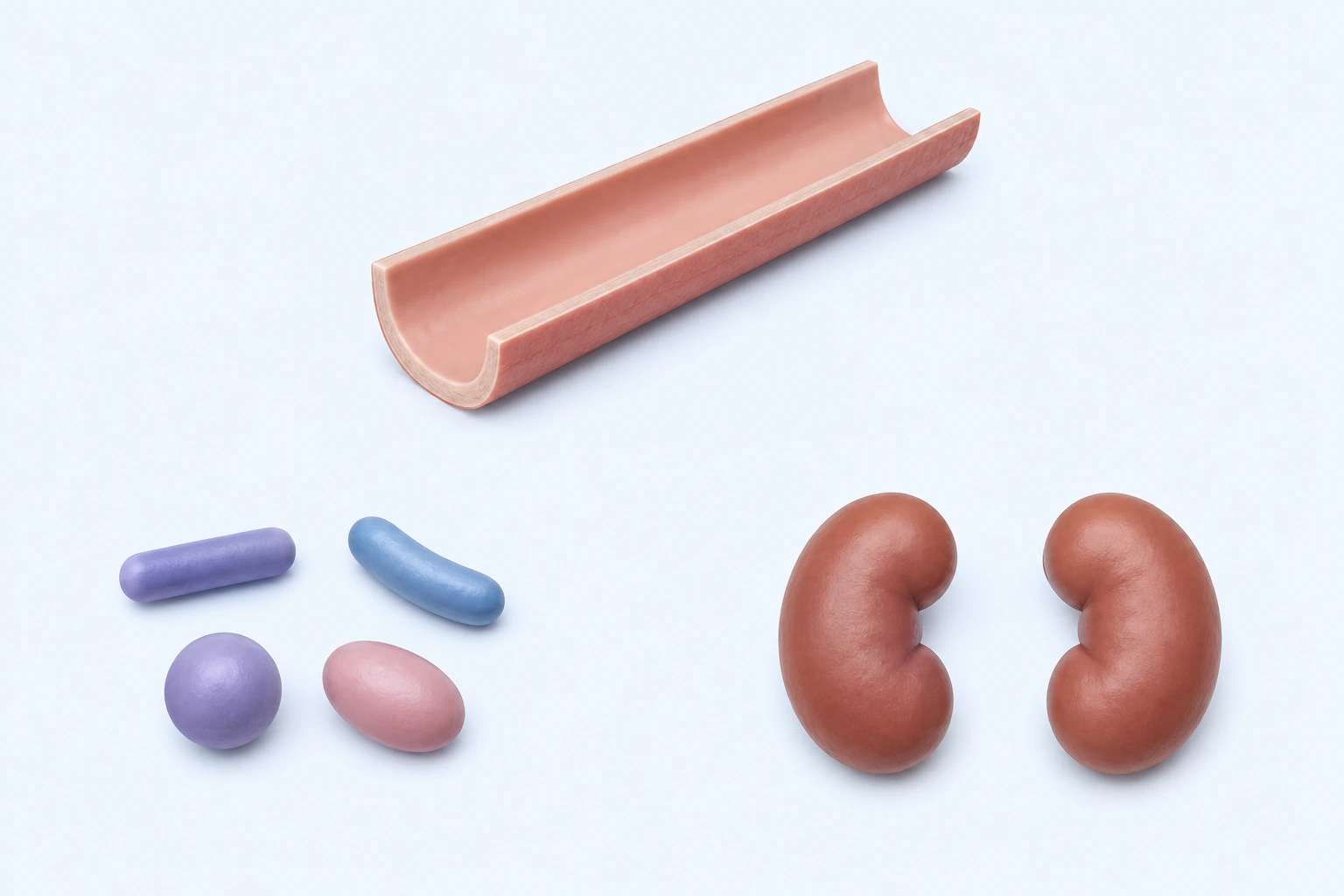
Separated gastrointestinal, non-taxonomic microbial, and paired-kidney component models for the emerging gut-kidney research domain. This reconstruction does not show an anatomical conduit, toxin mechanism, disease finding, diagnosis, or treatment.
Scientific media record5 verified identifiers
- Subject
- Gut-Kidney Axisbiological-process
- Identifiers
- WikiBiome:gut-kidney-axisrelated-MeSH:D000069196related-MeSH:D007668related-MeSH:D000076662related-UBERON:0002113
- Review
- Editorial review completeIdentifiers authority-verified · Accessibility validated · · gut-kidney-axis|gut-kidney-axis-mechanism-v1.webp
- Digital source
- Trained-algorithmic mediaCreated with a trained generative algorithm and reviewed by WikiBiome for subject identity, scientific framing, identifiers, provenance, and accessibility.
- Scientific basis
- Gut-Kidney AxisGastrointestinal Microbiome — Medical Subject HeadingsKidney — Medical Subject HeadingsHost Microbial Interactions — Medical Subject Headingskidney — UBERONColonic contribution to uremic solutesAberrant gut microbiota alters host metabolome and impacts renal failure in humans and rodentsGut microbiota generation of protein-bound uremic toxins and related metabolites is not altered at different stages of chronic kidney disease
- License
- CC BY-SA 4.0Created
The gut-kidney axis describes the bidirectional relationship between the Gut Microbiome and kidney function. As kidney disease progresses, the resulting biochemical changes (uremia, altered pH, fluid shifts) reshape the gut microbiome.
The dysbiotic microbiome, in turn, generates uremic toxins and inflammatory mediators that accelerate kidney damage—creating a vicious cycle that is the hallmark of Chronic Kidney Disease progression.
This axis is distinctive in the WikiBiome knowledge graph because it illustrates the amplification loop principle: the disease changes the microbiome, and the changed microbiome worsens the disease. Metals add a third dimension, as declining kidney function impairs metal excretion, increasing metal-driven toxicity and microbial selection pressure.
Evidence map3 cited passagesInspect provenance +
As kidney function declines:
Indoxyl sulfate exemplifies the gut-kidney axis:
Metal-resistant bacteria: CKD gut bacteria carry more metal resistance genes (cadA, czc operons), suggesting metal-driven selection pressure in the uremic gut
Contents
1. The Vicious Cycle2. Uremic Toxins of Microbial Origin3. Metal Dimension4. Intestinal Barrier Disruption5. Therapeutic Implications6. Open Questions7. Cross-ReferencesThe Vicious Cycle#
`` Kidney Dysfunction │ ├─→ Uremia alters gut environment (pH, urea, fluid) │ │ │ ▼ │ Gut Dysbiosis │ │ │ ├─→ Uremic toxin production (IS, pCS, TMAO) │ ├─→ Increased intestinal permeability │ └─→ Reduced SCFA production │ │ │ ▼ └──── Accelerated kidney damage ◄────┘ ``
CKD Changes the Gut#
As kidney function declines:[1]Alobaidi 2025 — The Gut-Kidney Axis in CKD: Mechanisms, Microbial Metabolites, and Microbiome-Targeted TherapeuticsSami Alobaidi · 2025Open reference 1 ↓
- Urea influx: Elevated blood urea diffuses into the intestinal lumen, where bacterial Urease hydrolyzes it to Ammonia. Ammonia raises luminal pH, favoring Proteobacteria over acid-producing commensals.
- Fluid and electrolyte shifts: Altered colonic transit and fluid handling change the gut microenvironment
- Dietary restrictions: CKD dietary protocols (low potassium, low phosphorus) inadvertently reduce fiber intake, starving Butyrate-producing bacteria
- Medications: Phosphate binders, antibiotics, and iron supplements reshape the microbiome
- Impaired metal excretion: Cadmium, lead, and other nephrotoxic metals accumulate, exerting selective pressure on gut bacteria (see Chronic Kidney Disease)
The Dysbiotic Microbiome Damages Kidneys#
The CKD-associated microbiome is characterized by:
- Enriched: Proteobacteria (Enterobacteriaceae, Escherichia coli), Desulfovibrio, urease-positive organisms
- Depleted: Bifidobacterium, Lactobacillus, Faecalibacterium prausnitzii, Roseburia—SCFA producers
- Functional shift: From saccharolytic (fiber-fermenting, SCFA-producing) to proteolytic (amino acid-fermenting, uremic toxin-producing)
Uremic Toxins of Microbial Origin#
The most clinically significant products of the dysbiotic CKD microbiome:
| Toxin | Precursor | Bacterial Source | Kidney Effect | |
|---|---|---|---|---|
| Indoxyl sulfate (IS) | Tryptophan → indole | Escherichia coli, Clostridium | Tubular injury, fibrosis, Oxidative Stress | |
| p-Cresyl sulfate (pCS) | Tyrosine → p-cresol | Clostridioides, Blautia | Tubular damage, cardiovascular toxicity | |
| [[tmao | TMAO]] | Choline, carnitine → TMA | Proteobacteria | Renal fibrosis, atherosclerosis |
| Phenylacetylglutamine | Phenylalanine | Clostridium, Bacteroides | Cardiovascular events | |
| Hippuric acid | Polyphenols → benzoic acid | Multiple taxa | Moderate nephrotoxicity |
These toxins accumulate as kidney filtration declines, reaching concentrations 10-100 times normal in end-stage renal disease (ESRD). They cannot be efficiently cleared by conventional hemodialysis because they are protein-bound.
Indoxyl Sulfate: The Paradigm Toxin#
Indoxyl sulfate exemplifies the gut-kidney axis:[2]Chen et al. 2019 — Microbiome-Metabolome Reveals the Contribution of Gut-Kidney Axis on Kidney DiseaseYuan-Yuan Chen, Dan-Qian Chen, Lin Chen et al. · 2019Open reference 2 ↓
- Gut bacteria convert dietary tryptophan to indole via tryptophanase
- Indole is absorbed and hepatically sulfated to indoxyl sulfate
- Normally, kidneys excrete IS via organic anion transporters (OAT1/OAT3)
- In CKD, IS accumulates and directly injures proximal tubular cells
- IS activates NF-kB and AhR pathways, driving Metal-Driven Inflammation and fibrosis
- Kidney injury worsens → less IS excretion → more accumulation
Metal Dimension#
The gut-kidney axis intersects with metallomics in ways unique to CKD. Cadmium accumulation: The kidney is the primary target organ for cadmium toxicity. As CKD progresses, cadmium excretion fails and tissue levels rise, driving further damage.
Lead retention: Blood lead increases 4x more per unit GFR decline in Black individuals than White—a racial disparity with environmental justice implications.
Iron supplementation paradox: CKD patients often receive IV iron, which feeds gut Proteobacteria and may worsen Dysbiosis.
Metal-resistant bacteria: CKD gut bacteria carry more metal resistance genes (cadA, czc operons), suggesting metal-driven selection pressure in the uremic gut.[3]Miranda 2022 — Characterization of Metal(loid)s and Antibiotic Resistance in Bacteria of Human Gut Microbiota from CKD SubjectsMaría V. Miranda, Fernanda C. González, Osvaldo S. Paredes-Godoy et al. · 2022Open reference 3 ↓
Intestinal Barrier Disruption#
CKD erodes the intestinal barrier through multiple mechanisms:
- Uremic toxins directly damage tight junction proteins
- Ammonia from bacterial urease activity disrupts epithelial integrity
- Reduced butyrate production removes the primary fuel for colonocytes
- The resulting increased intestinal permeability allows bacterial translocation and endotoxemia, driving systemic inflammation (CRP, IL-6, TNF-alpha) that accelerates both kidney and cardiovascular disease
Therapeutic Implications#
Understanding the gut-kidney axis opens intervention opportunities. Dietary fiber: Shifting the microbiome from proteolytic to saccharolytic metabolism reduces uremic toxin production. Probiotics/synbiotics: Restoring SCFA-producing taxa.
AST-120 (oral adsorbent): Binds indole in the gut lumen, reducing IS production.
Targeted dietary amino acid restriction: Reducing tryptophan and tyrosine substrates for uremic toxin production. FMT: Preliminary evidence of microbiome restoration in CKD animal models.
Open Questions#
Unresolved questions identified by the current evidence record.
01Can early microbiome intervention slow CKD progression from stage 2 to stage 5?+
The current WikiBiome record identifies this as an unresolved evidence gap.
02Do uremic toxin levels predict dialysis timing better than eGFR alone?+
The current WikiBiome record identifies this as an unresolved evidence gap.
03How do metal-resistant gut bacteria contribute to antibiotic treatment failure in CKD patients?+
The current WikiBiome record identifies this as an unresolved evidence gap.
04Can protein-bound uremic toxins be targeted through microbiome engineering rather than dialysis?+
The current WikiBiome record identifies this as an unresolved evidence gap.
Cross-References#
- Chronic Kidney Disease—primary disease context
- Trimethylamine N-Oxide (TMAO)—cardiovascular-renal toxin
- Indoles—tryptophan-derived signaling molecules
- dysbiosis—microbial community disruption
- Intestinal Permeability—barrier dysfunction
- butyrate—protective SCFA depleted in CKD
References 11
Numbered by first appearance in the article, then reconciled with its declared source list.
- 1
Sami Alobaidi (2025). Alobaidi 2025 — The Gut-Kidney Axis in CKD: Mechanisms, Microbial Metabolites, and Microbiome-Targeted Therapeutics. Frontiers in Medicine.
- 2
Yuan-Yuan Chen, Dan-Qian Chen, Lin Chen et al. (2019). Chen et al. 2019 — Microbiome-Metabolome Reveals the Contribution of Gut-Kidney Axis on Kidney Disease. Journal of Translational Medicine.
- 3
María V. Miranda, Fernanda C. González, Osvaldo S. Paredes-Godoy et al. (2022). Miranda 2022 — Characterization of Metal(loid)s and Antibiotic Resistance in Bacteria of Human Gut Microbiota from CKD Subjects. Biological Research.
- 4
Denise Mafra, Natalia A. Borges, Livia Alvarenga et al. (2022). Fermented Food: Should Patients with Cardiometabolic Diseases Go Back to an Early Neolithic Diet?. Critical Reviews in Food Science and Nutrition.
- 5
Natalia A. Borges, Amanda F. Barros, Lia S. Nakao et al. (2016). Protein-Bound Uremic Toxins from Gut Microbiota and Inflammatory Markers in CKD. Journal of Renal Nutrition.
- 6
Denise Mafra, Natalia A. Borges, Bo Lindholm et al. (2021). Food as Medicine: Targeting the Uraemic Phenotype in Chronic Kidney Disease. Nature Reviews Nephrology.
- 7
Lu, Huang, Wang et al. (2019). Lu et al. 2019 — Constipation and ESRD Risk in CKD. BMC Nephrology.
- 8
Qiu-Li Zhang, Dietrich Rothenbacher (2008). Zhang & Rothenbacher 2008 — Prevalence of CKD in Population-Based Studies: Systematic Review. BMC Public Health.
- 9
Wehedy, Ghali, Matboli (2022). Wehedy et al. 2022 — The Human Microbiome in CKD: A Double-Edged Sword. Frontiers in Medicine.
- 10
Jie Yu, Yulu Li, Bin Zhu et al. (2025). Research Progress on the Kidney-Gut-Brain Axis in Brain Dysfunction in Maintenance Hemodialysis Patients. Frontiers in Medicine.
- 11
Jean A. Hall, Matthew I. Jackson, Dennis E. Jewell et al. (2020). Hall et al. 2020 — CKD in Cats Alters Response of the Plasma Metabolome and Fecal Microbiome to Dietary Fiber. PLOS ONE.
Article network
Mentioned here 18
Pages linking here 5
Connect the evidence
Publicly readable discussion by ORCID-authenticated researchers. Questions, interpretation, methods, corrections, and new evidence stay attached to this record.
No discussion yet. Start with a precise question or a source-backed observation.
Published page changes
This record shows only material changes published on this page, including changes to its content, evidence, conclusions, or author context. Internal processes and discussion activity are excluded. Pending, declined, and withdrawn proposals remain private.
- published revision
Added references: mafra-2022-fermented-food-cardiometabolic-diseases; borges-2016-uremic-toxins-inflammatory-markers-ckd; mafra-2021-food-as-medicine-uraemic-phenotype-ckd; lu-2019-constipation-esrd-risk-ckd; zhang-2008-ckd-prevalence-population-systematic-review;…
Added references: mafra-2022-fermented-food-cardiometabolic-diseases; borges-2016-uremic-toxins-inflammatory-markers-ckd; mafra-2021-food-as-medicine-uraemic-phenotype-ckd; lu-2019-constipation-esrd-risk-ckd; zhang-2008-ckd-prevalence-population-systematic-review; wehedy-2022-human-microbiome-ckd-double-edged-sword; yu-2025-kidney-gut-brain-axis-hemodialysis-brain-dysfunction; hall-2020-ckd-cats-dietary-fiber-metabolome-microbiome. Removed references: alobaidi-2025-gut-kidney-axis-ckd-mechanisms-therapeutics; chen-2019-microbiome-metabolome-gut-kidney-axis. · WikiBiome Deploy Bot · +35 −29
Inspect exact Git diff ↗ - published revision
Created “Gut-Kidney Axis”: The gut-kidney axis describes the bidirectional relationship between the gut microbiome and kidney function. As kidney disease progresses, the resulting biochemical changes (uremia, altered pH, fluid…
Created “Gut-Kidney Axis”: The gut-kidney axis describes the bidirectional relationship between the gut microbiome and kidney function. As kidney disease progresses, the resulting biochemical changes (uremia, altered pH, fluid… Published sections: Overview; The Vicious Cycle; CKD Changes the Gut; The Dysbiotic Microbiome Damages Kidneys; Uremic Toxins of Microbial Origin; Indoxyl Sulfate: The Paradigm Toxin; Metal Dimension; Intestinal Barrier Disruption; Therapeutic Implications; Open Questions; Cross-References. · WikiBiome Deploy Bot · +126 −0
Inspect exact Git diff ↗