
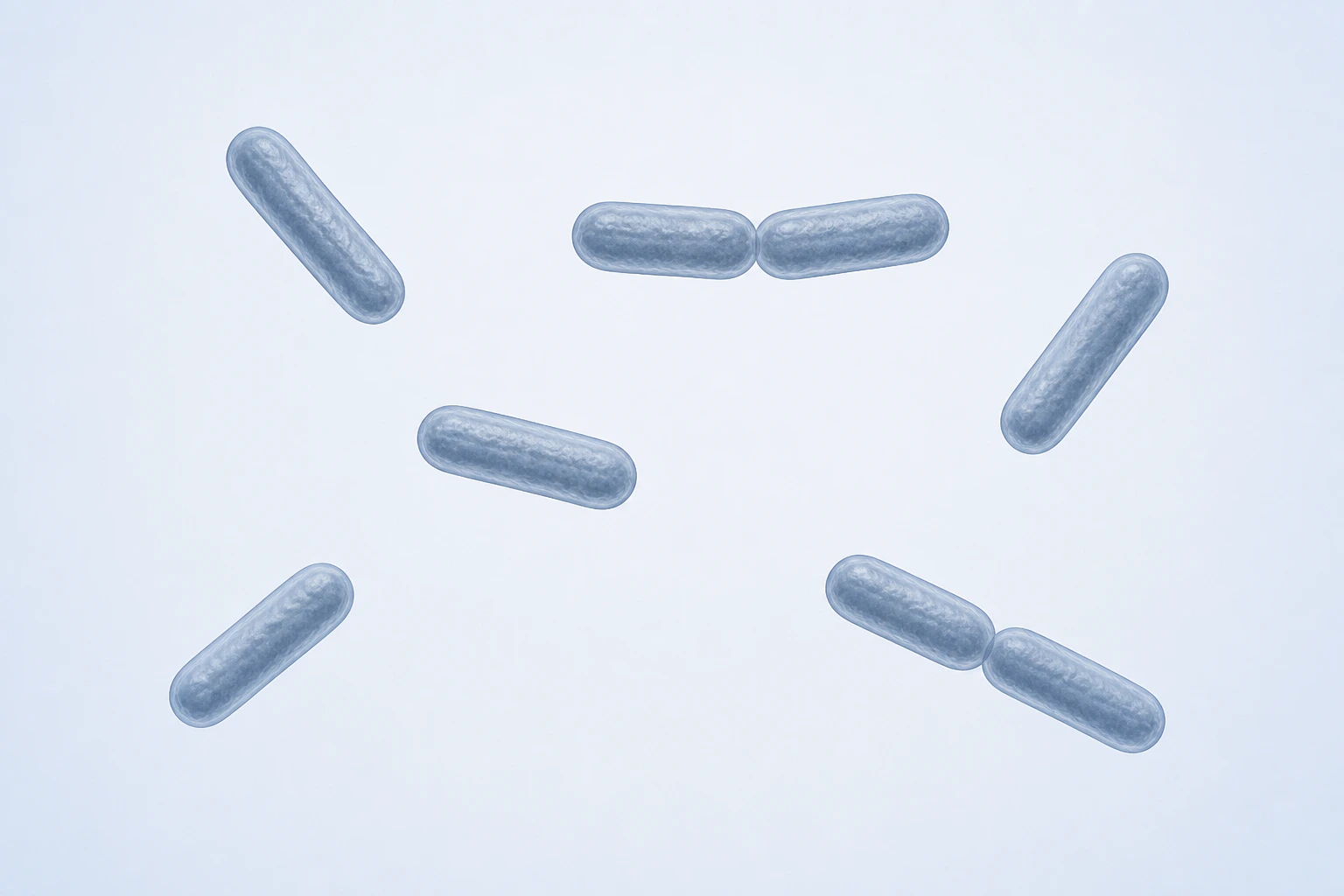
Selected type-species-anchored Escherichia rod forms, shown as eight bodies in four single and two paired groupings. This reconstruction is representative, non-diagnostic, and not a micrograph.
Scientific media record1 verified identifier
- Subject
- Escherichiataxon · genus
- Identifiers
- NCBITaxon:561
- Review
- Editorial review completeIdentifiers authority-verified · Accessibility validated · · escherichia|escherichia-morphology-v1.webp
- Digital source
- Trained-algorithmic mediaCreated with a trained generative algorithm and reviewed by WikiBiome for subject identity, scientific framing, identifiers, provenance, and accessibility.
- Scientific basis
- Escherichia — NCBI TaxonomyEscherichia — LPSNEscherichia coli type strain — BacDiveEscherichia coli and the coliform bacteria
- License
- CC BY-SA 4.0Created
Escherichia is a genus of Gram-negative, facultatively anaerobic bacteria in the Enterobacteriaceae family. The primary species E. coli is simultaneously the most studied bacterium in biology and one of the most consistently enriched organisms in disease-associated microbiomes.
In 16S rRNA studies, Escherichia is inseparable from Shigella and reported as the Escherichia/Shigella complex—the single most reliable marker of gut Dysbiosis across conditions in this wiki (230+ source mentions).
For the species page, see Escherichia coli. For the pathogenic variant, see Adherent-Invasive Escherichia coli (AIEC).
Evidence map8 cited passagesInspect provenance +
Enterobactin: Kd ~10^-49 M—the strongest iron chelator known. Countered by host lipocalin 2.
inflammation-driven hepcidin elevation sequesters systemic iron but floods the gut lumen with unabsorbed dietary iron—selectively favoring Escherichia expansion via siderophore advantage.
NiFe hydrogenases (Hya, Hyb, Hyc, Hyd): Oxidize H2 for energy during anaerobic respiration, providing competitive advantage in the inflamed gut.
IBD: Enriched in both Crohn's and UC; AIEC strains colonize ileal mucosa.
CRC: Enriched in tumor tissue; certain strains produce colibactin (genotoxin).
CVD: Part of Enterobacteriaceae bloom in atherosclerosis.
ASD: Enriched in gut microbiota of ASD children.
Estrogen recirculation: Possesses beta-glucuronidase activity, deconjugating estrogens in the gut and contributing to the estrobolome.
Metal Dependencies#
Iron—Siderophore Arsenal#
Escherichia possesses the most comprehensive iron acquisition toolkit among enteric bacteria.
Enterobactin: Kd ~10^-49 M—the strongest iron chelator known. Countered by host Lipocalin-2.[1]Bushman 2025 — The Exploitation of Nutrient Metals by Bacteria for Survival and Infection in the GutSummer D Bushman, Eric P Skaar, N Luisa Hiller · 2025Open reference 1 ↓ Salmochelin: Glucosylated enterobactin evading lipocalin-2 (in UPEC and some intestinal strains).
Aerobactin: Hydroxamate siderophore providing backup iron acquisition.
Yersiniabactin: Dual iron/nickel metallophore (in pathogenic strains). Feo system: Ferrous iron transport under anaerobic conditions.
Metal-Driven Inflammation-driven Hepcidin elevation sequesters systemic iron but floods the gut lumen with unabsorbed dietary iron—selectively favoring Escherichia expansion via siderophore advantage.[2]Khorsand 2022 — Overrepresentation of Enterobacteriaceae and Escherichia coli is the major gut microbiome signature in Crohn's and UC: comprehensive metagenomic analysis of IBDMDB datasetsBabak Khorsand, Hamid Asadzadeh Aghdaei, Ehsan Nazemalhosseini-Mojarad et al. · 2022Open reference 2 ↓
Nickel#
- NiFe hydrogenases (Hya, Hyb, Hyc, Hyd): Oxidize H2 for energy during anaerobic respiration, providing competitive advantage in the inflamed gut.[3]Role of Nickel in Microbial PathogenesisRobert J. Maier, Stéphane L. Benoit · 2019Open reference 3 ↓
The Universal Dysbiosis Bloom#
Escherichia/Shigella enrichment is the single most reproducible microbiome finding across disease states. IBD: Enriched in both Crohn's and UC; AIEC strains colonize ileal mucosa.[2]Khorsand 2022 — Overrepresentation of Enterobacteriaceae and Escherichia coli is the major gut microbiome signature in Crohn's and UC: comprehensive metagenomic analysis of IBDMDB datasetsBabak Khorsand, Hamid Asadzadeh Aghdaei, Ehsan Nazemalhosseini-Mojarad et al. · 2022Open reference 2 ↓[4]Wang 2024 — Integrated 16S rRNA sequencing and metagenomics insights into microbial dysbiosis and distinct virulence factors in inflammatory bowel diseaseHaijing Wang, Yuanjun Wang, Libin Yang et al. · 2024Open reference 4 ↓
CRC: Enriched in tumor tissue; certain strains produce colibactin (genotoxin).[5]Microbiota disbiosis is associated with colorectal cancerZhiguang Gao, Bomin Guo, Renyuan Gao et al. · 2015Open reference 5 ↓ CVD: Part of Enterobacteriaceae bloom in atherosclerosis.[6]The gut microbiome in atherosclerotic cardiovascular diseaseZhuye Jie, Huihua Xia, Shi-Long Zhong et al. · 2017Open reference 6 ↓ ASD: Enriched in gut microbiota of ASD children.[7]Strati 2017 — New Evidences on the Altered Gut Microbiota in Autism Spectrum DisordersFrancesco Strati, Duccio Cavalieri, Davide Albanese et al. · 2017Open reference 7 ↓
Neurodegeneration: Produces curli amyloid fibers (CsgA) that cross-seed amyloid-beta aggregation—a direct microbial-to-neurodegeneration pathway (see Microbial Metallomics). Estrogen recirculation: Possesses beta-glucuronidase activity, deconjugating estrogens in the gut and contributing to the Estrobolome.[8]Kaliannan et al. 2018 — Estrogen-Mediated Gut Microbiome Alterations Influence Sexual Dimorphism in Metabolic Syndrome in MiceKanakaraju Kaliannan, Ruairi C. Robertson, Kiera Murphy et al. · 2018Open reference 8 ↓
Cross-References#
- Escherichia coli—species page
- Adherent-Invasive Escherichia coli (AIEC)—pathogenic AIEC variant
- Shigella—reported together in 16S as Escherichia/Shigella complex
- Enterobacteriaceae—family-level context
- Iron—siderophore-dependent virulence
- Siderophores—enterobactin, salmochelin, aerobactin
- Nickel—NiFe-hydrogenase for gut colonization
- Estrobolome—beta-glucuronidase activity
- Microbial Metallomics—curli-amyloid cross-seeding in neurodegeneration
References 8
Numbered by first appearance in the article, then reconciled with its declared source list.
- 1
Summer D Bushman, Eric P Skaar, N Luisa Hiller (2025). Bushman 2025 — The Exploitation of Nutrient Metals by Bacteria for Survival and Infection in the Gut. PLOS Pathogens.
- 2
Babak Khorsand, Hamid Asadzadeh Aghdaei, Ehsan Nazemalhosseini-Mojarad et al. (2022). Khorsand 2022 — Overrepresentation of Enterobacteriaceae and Escherichia coli is the major gut microbiome signature in Crohn's and UC: comprehensive metagenomic analysis of IBDMDB datasets. Frontiers in Cellular and Infection Microbiology.
- 3
★Robert J. Maier, Stéphane L. Benoit (2019). Role of Nickel in Microbial Pathogenesis. Inorganics.
- 4
Haijing Wang, Yuanjun Wang, Libin Yang et al. (2024). Wang 2024 — Integrated 16S rRNA sequencing and metagenomics insights into microbial dysbiosis and distinct virulence factors in inflammatory bowel disease. Frontiers in Microbiology.
- 5
Zhiguang Gao, Bomin Guo, Renyuan Gao et al. (2015). Microbiota disbiosis is associated with colorectal cancer. Frontiers in Microbiology.
- 6
Zhuye Jie, Huihua Xia, Shi-Long Zhong et al. (2017). The gut microbiome in atherosclerotic cardiovascular disease. Nature Communications.
- 7
Francesco Strati, Duccio Cavalieri, Davide Albanese et al. (2017). Strati 2017 — New Evidences on the Altered Gut Microbiota in Autism Spectrum Disorders. Microbiome.
- 8
Kanakaraju Kaliannan, Ruairi C. Robertson, Kiera Murphy et al. (2018). Kaliannan et al. 2018 — Estrogen-Mediated Gut Microbiome Alterations Influence Sexual Dimorphism in Metabolic Syndrome in Mice. Microbiome.
Article network
Connect the evidence
Publicly readable discussion by ORCID-authenticated researchers. Questions, interpretation, methods, corrections, and new evidence stay attached to this record.
No discussion yet. Start with a precise question or a source-backed observation.
Activity and accepted changes
Accepted researcher context, editorial status, public discussion, and upstream Git revisions are shown together. Pending, declined, and withdrawn proposals remain private.
- published revision
Backfill inflammation concept links
Karen Pendergrass · +1 −1
Inspect exact Git diff ↗ - published revision
Complete corpus-wide Dysbiosis linking
Karen Pendergrass · +1 −1
Inspect exact Git diff ↗ - published revision
Complete Hydrogenase contextual coverage
Karen Pendergrass · +1 −1
Inspect exact Git diff ↗ - published revision
massive wiki expansion: 149 stubs fixed, 100+ new pages, Rule 15 scan, keystone papers
WikiBiome Deploy Bot · +76 −0
Inspect exact Git diff ↗