
 metals · microbes · host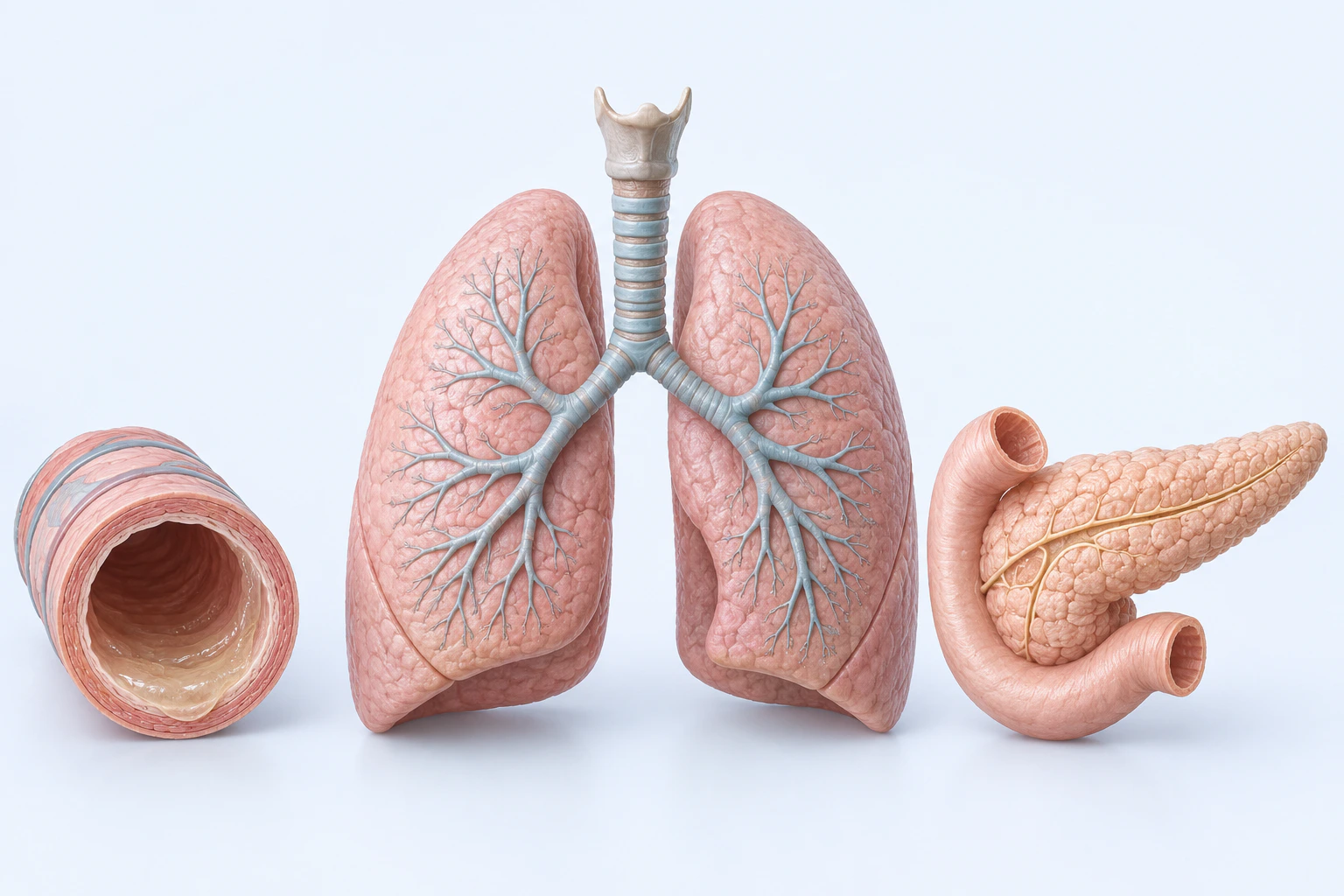
Multisystem exocrine orientation for cystic fibrosis, including airway, lungs, and pancreas. This reconstruction does not depict a patient, infection, genotype, universal pulmonary appearance, stage, treatment response, or diagnosis.
Scientific media record1 verified identifier
- Subject
- Cystic Fibrosiscondition
- Identifiers
- MeSH:D003550
- Review
- Editorial review completeIdentifiers authority-verified · Accessibility validated · · cystic-fibrosis|cystic-fibrosis-pathology-v1.webp
- Digital source
- Trained-algorithmic mediaCreated with a trained generative algorithm and reviewed by WikiBiome for subject identity, scientific framing, identifiers, provenance, and accessibility.
- Scientific basis
- Cystic Fibrosis — MeSHCystic Fibrosis
- License
- CC BY-SA 4.0Created
Cystic fibrosis (CF) is an autosomal recessive disorder caused by mutations in the CFTR gene, producing defective chloride and bicarbonate transport across epithelial membranes. While the genetic defect affects multiple organ systems, chronic lung infection is the primary cause of morbidity and mortality.
The CF lung microbiome—and particularly the iron ecology that sustains its dominant pathogen, Pseudomonas aeruginosa—represents one of the most thoroughly studied examples of how metal availability shapes microbial community structure and disease progression.
Evidence map2 cited passagesInspect provenance +
PrrF sRNA iron regulation—P. aeruginosa uses PrrF small RNAs to coordinate iron metabolism, regulating iron storage proteins and peroxide resistance. Under iron limitation, PrrF represses iron-using pathways to conserve scarce iron; understanding this regulation is critical for anti-virulence drug development.
Zinc starvation as host defense—The host deploys nutritional immunity by restricting zinc availability in CF airways via calprotectin. P. aeruginosa responds by upregulating zinc import systems (znuABC) and producing the metallophore pseudopaline (zrmABCD).
One disease. Five evidence layers.
A generated systems view of the metals, organisms, host sequestration signals, ecological conditions, and microbial functions indexed for Cystic Fibrosis.
Evidence layer
Taxonomic signature
Organisms reported as enriched or depleted, with their indexed functional context kept beside the name.No structured taxa indexed yet.
No structured taxa indexed yet.
Evidence layer
Nutritional immunity
Host metal-withholding, inflammatory, antioxidant, and microbial-metabolite signals indexed in the signature.Elevated host signals
0No structured signals indexed yet.
Depleted protective signals
0No structured signals indexed yet.
Evidence layer
Ecological state
The environmental conditions that connect the organism-level observations into a system.No structured ecological features indexed yet.
Evidence layer
Virulence functions
Microbial structures, enzymes, and acquisition systems implicated by the linked evidence.No structured virulence functions indexed yet.
The disease record, in full.
The original WikiBiome disease narrative remains intact beneath the generated signature atlas.
Microbiome Associations#
The CF lung harbors a polymicrobial community that evolves over the patient's lifetime. Pseudomonas aeruginosa—The dominant CF pathogen by adulthood; forms tenacious biofilms in the dehydrated mucus layer. Its siderophores pyoverdine and pyochelin aggressively scavenge iron from host transferrin and lactoferrin, providing the metabolic fuel for chronic colonization.
Staphylococcus aureus—Often dominates in childhood CF; uses different iron acquisition strategies (staphyloferrin, hemolysins) but occupies a similar ecological niche. Burkholderia cepacia complex—Opportunistic colonizer associated with rapid lung function decline; carries formidable siderophore systems.
Aspergillus—Fungal colonization is common; forms interkingdom biofilms with bacteria, providing Functional Shielding against host defenses.
The CF lung microbiome typically shows decreasing diversity over time, converging toward P. aeruginosa dominance as the organism adapts through mutations in iron regulation, quorum sensing, and mucoid phenotype conversion.
Metal Associations#
Iron ecology is the defining metal story in CF. Iron excess in CF airways—Thick, dehydrated mucus traps iron. Chronic Metal-Driven Inflammation releases iron from damaged tissue.
Repeated antibiotic courses kill commensals but leave iron available for resistant pathobionts.
Siderophore competition—P. aeruginosa produces two siderophores: pyoverdine (high-affinity iron(III) (Fe3+) chelator) and pyochelin (lower affinity but broader metal range). These directly compete with host Lactoferrin and Transferrin for iron—a canonical Siderophore Competition battleground.
PrrF sRNA iron regulation—P. aeruginosa uses PrrF small RNAs to coordinate iron metabolism, regulating iron storage proteins and peroxide resistance. Under iron limitation, PrrF represses iron-using pathways to conserve scarce iron; understanding this regulation is critical for anti-virulence drug development.[1]Ouattara 2025 — Iron and Peroxide Regulation of the PrrF sRNAs and a Conserved Dps-Like Protein in Pseudomonas aeruginosa and Pseudomonas fluorescensKhady O Ouattara, Amanda G Oglesby · 2025Open reference 1 ↓
Zinc starvation as host defense—The host deploys nutritional immunity by restricting zinc availability in CF airways via calprotectin. P. aeruginosa responds by upregulating zinc import systems (znuABC) and producing the metallophore pseudopaline (zrmABCD).[2]Michetti 2025 — Modelling Host-Pathogen Interactions: Galleria mellonella as a Platform to Study Pseudomonas aeruginosa Response to Host-Imposed Zinc StarvationEmma Michetti, Tulasi Abinya Mandava, Valerio Secli et al. · 2025Open reference 2 ↓
Gallium as Therapeutic Iron Mimic#
Gallium (Ga3+) mimics iron(III) (Fe3+) in size and charge but is redox-inactive. When P. aeruginosa takes up gallium via its siderophore systems, the bacterium cannot use it for iron-dependent metabolism, effectively poisoning its own iron acquisition machinery.
A Phase 1/2 trial (NCT01093521) demonstrated that inhaled gallium nitrate reduced P. aeruginosa burden and improved lung function in CF patients—one of the most direct clinical applications of the metal-as-Achilles-heel concept.
Environmental Factors#
Indoor air quality, particularly mold exposure (Aspergillus, Alternaria), contributes to fungal colonization of CF lungs. Water sources (contaminated plumbing harbors Pseudomonas) and cross-infection between CF patients are major environmental risk factors.
Open Questions#
Unresolved questions identified by the current evidence record.
01Can gallium-based therapies be combined with iron chelation to create a dual-strategy attack on P. aeruginosa iron metabolism?+
The current WikiBiome record identifies this as an unresolved evidence gap.
02Does the Gut Microbiome influence CF lung disease progression via the gut-lung axis?+
The current WikiBiome record identifies this as an unresolved evidence gap.
03Can zinc-based nutritional immunity strategies complement iron restriction approaches?+
The current WikiBiome record identifies this as an unresolved evidence gap.
Cross-References#
- Pseudomonas aeruginosa—dominant CF pathogen with siderophore-based iron piracy
- Gallium—therapeutic iron mimic for CF lung infections
- Iron—the central ecological currency in CF airways
- Siderophores and Metallophores—bacterial iron acquisition systems
- Biofilm—biofilm formation in CF lung mucus
- Zinc-Metalloprotease—P. aeruginosa virulence in CF
References 7
Numbered by first appearance in the article, then reconciled with its declared source list.
- 1
Khady O Ouattara, Amanda G Oglesby (2025). Ouattara 2025 — Iron and Peroxide Regulation of the PrrF sRNAs and a Conserved Dps-Like Protein in Pseudomonas aeruginosa and Pseudomonas fluorescens. bioRxiv.
- 2
Emma Michetti, Tulasi Abinya Mandava, Valerio Secli et al. (2025). Michetti 2025 — Modelling Host-Pathogen Interactions: Galleria mellonella as a Platform to Study Pseudomonas aeruginosa Response to Host-Imposed Zinc Starvation. Microbiology.
- 3
Liu Y, Zhang W, Liu Z et al. (2024). Serum Copper Assessment in Patients with Polycystic Ovary Syndrome and Tubal Infertility: A Retrospective 5-Year Study. Food Science & Nutrition.
- 4
Smovrsnik T, Virant-Klun I, Pinter B (2023). Heavy Metals and Essential Elements in Association with Oxidative Stress in Women with Polycystic Ovary Syndrome -- A Systematic Review. Antioxidants.
- 5
Tatarchuk TF, Kosei NV, Vetokh HV et al. (2016). Serum Micro- and Macroelements Levels in Women with Polycystic Ovary Syndrome Associated with Pelvic Inflammatory Disease. Reproductive Endocrinology.
- 6
Kamila Pokorska-Niewiada, Agnieszka Brodowska, Jacek Brodowski et al. (2022). Levels of Trace Elements in Erythrocytes as Endocrine Disruptors in Obese and Nonobese Women with Polycystic Ovary Syndrome. International Journal of Environmental Research and Public Health.
- 7
Khan KN, Fujishita A, Masumoto H et al. (2016). Molecular detection of intrauterine microbial colonization in women with endometriosis. European Journal of Obstetrics and Gynecology and Reproductive Biology.
Article network
Connect the evidence
Publicly readable discussion by ORCID-authenticated researchers. Questions, interpretation, methods, corrections, and new evidence stay attached to this record.
No discussion yet. Start with a precise question or a source-backed observation.
Activity and accepted changes
Accepted researcher context, editorial status, public discussion, and upstream Git revisions are shown together. Pending, declined, and withdrawn proposals remain private.
- published revision
Backfill gut microbiome concept links
Karen Pendergrass · +1 −1
Inspect exact Git diff ↗ - published revision
Backfill inflammation concept links
Karen Pendergrass · +1 −1
Inspect exact Git diff ↗ - published revision
massive wiki expansion: 149 stubs fixed, 100+ new pages, Rule 15 scan, keystone papers
WikiBiome Deploy Bot · +17 −15
Inspect exact Git diff ↗ - published revision
maintenance: 409 source fixes, 34 entity updates, 17 concept updates, 30 analysis outputs
WikiBiome Deploy Bot · +84 −0
Inspect exact Git diff ↗