

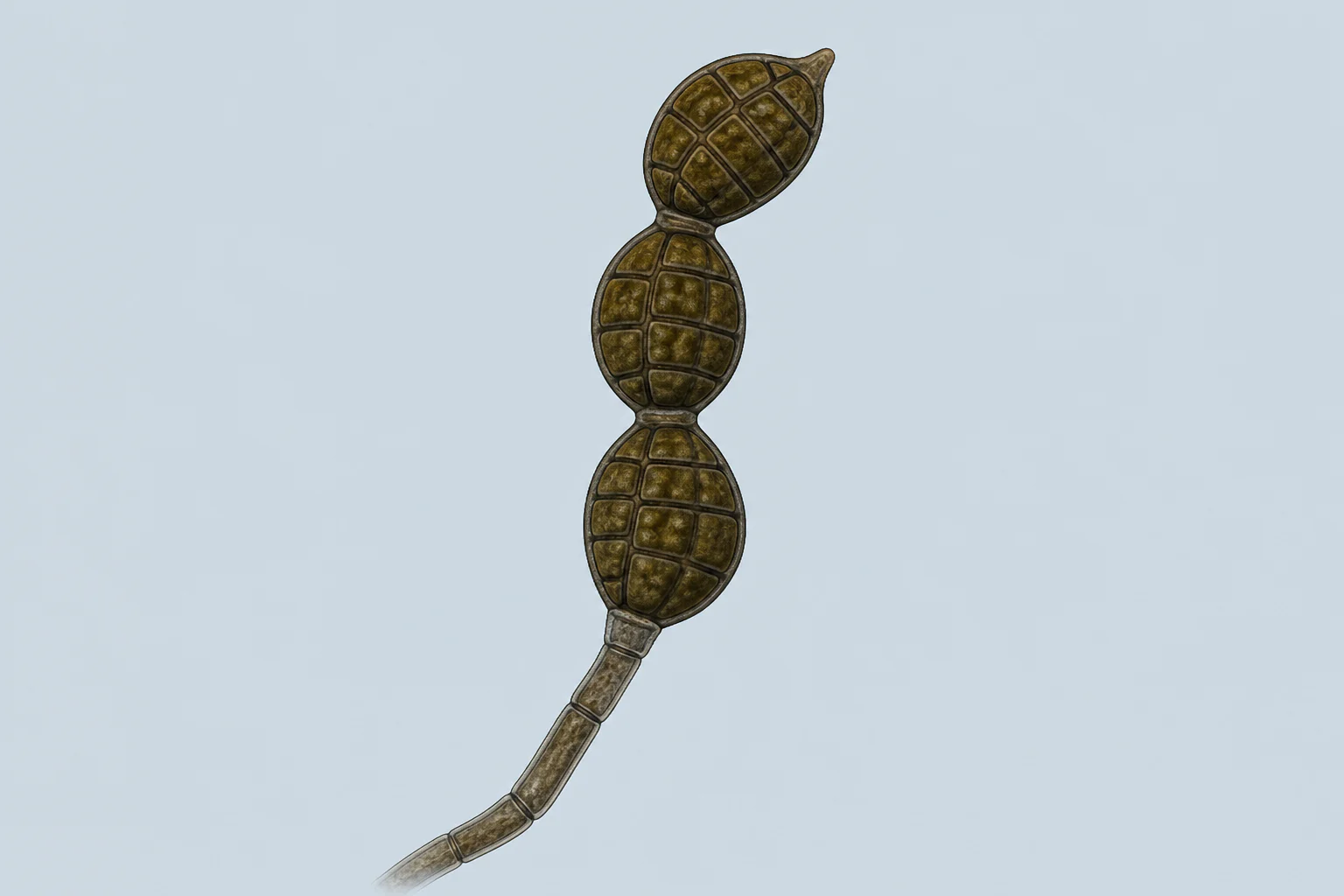
Representative Alternaria sporulating morphology, showing multicellular muriform conidia with transverse and longitudinal septa. Conidial form varies across sections and species; this reconstruction is not diagnostic.
Scientific media record1 verified identifier
- Subject
- Alternariataxon · genus
- Identifiers
- NCBITaxon:5598
- Review
- Editorial review completeIdentifiers authority-verified · Accessibility validated · · alternaria|alternaria-morphology-v1.webp
- Digital source
- Trained-algorithmic mediaCreated with a trained generative algorithm and reviewed by WikiBiome for subject identity, scientific framing, identifiers, provenance, and accessibility.
- Scientific basis
- Alternaria — NCBI TaxonomyAlternaria sp. conidia and septate hyphaeAlternaria taxonomic revision
- License
- CC BY-SA 4.0Created
Alternaria is a ubiquitous environmental mold genus comprising over 300 species, with A. alternata as the most common human-associated species. Primarily recognized as an outdoor allergen and plant pathogen, Alternaria is increasingly documented as a component of the human gut mycobiome—particularly under conditions that reduce gastric acidity.
In the WikiBiome framework, Alternaria is relevant as a mycotoxin producer (alternariol), a PPI-associated gut colonizer, and a participant in the interkingdom dynamics that shape mucosal immunity.
Evidence map1 cited passagesInspect provenance +
PPI-associated enrichment: Alternaria was enriched in both short-term and long-term PPI-treated GERD patients, alongside aspergillus and other environmental fungi. Reduced gastric acidity allows viable conidia to survive transit and reach the intestine.
Contents
1. Metal Dependencies2. Key Enzymes and Virulence Factors3. Ecological Role4. Conditions Associated5. Cross-ReferencesMetal Dependencies#
Alternaria requires zinc, copper, and iron for its metalloenzymes. Zinc—Cofactor for zinc-finger transcription factors regulating secondary metabolite production (including mycotoxin biosynthesis) and for extracellular proteases. Copper—Required for laccase and tyrosinase enzymes involved in melanin biosynthesis, a key virulence factor providing UV protection and immune evasion.
Iron—Essential for cytochrome P450 enzymes and siderophore-mediated iron acquisition from plant hosts and environmental substrates.
Key Enzymes and Virulence Factors#
Melanin biosynthesis—DHN-melanin (1,8-dihydroxynaphthalene pathway) provides protection against Oxidative Stress, UV radiation, and host immune defenses. Melanized conidia are more resistant to macrophage killing.
Cellulase and pectinase—Cell wall-degrading enzymes primarily evolved for plant pathogenesis; may contribute to mucosal tissue degradation in immunocompromised hosts.
Alternariol (AOH) and alternariol monomethyl ether (AME)—Mycotoxins with genotoxic, estrogenic, and immunomodulatory properties. AOH inhibits topoisomerase II, induces DNA strand breaks, and acts as a weak estrogen receptor agonist.
Ecological Role#
Environmental Reservoir#
Alternaria conidia are among the most abundant outdoor airborne fungal spores worldwide. Primary sources include decaying vegetation, agricultural crops (tomatoes, grains, apples, citrus), and soil. Dietary exposure occurs through contaminated grains, fruits, and vegetables—alternariol contamination is documented in wheat, sunflower seeds, tomatoes, and fruit juices.
Gut Mycobiome#
In the gastrointestinal tract, Alternaria is typically a transient colonizer—ingested with food and unable to establish permanent colonization under normal gastric acid conditions. However, acid suppression creates a permissive environment.
PPI-associated enrichment: Alternaria was enriched in both short-term and long-term PPI-treated GERD patients, alongside Aspergillus and other environmental fungi.[1]Shi 2023 — PPI-Induced Fungal Dysbiosis in Patients with Gastroesophageal Reflux DiseaseYichao Shi, Jianfeng Li, Shuntian Cai et al. · 2023Open reference 1 ↓ Reduced gastric acidity allows viable conidia to survive transit and reach the intestine.
Fecal mycobiota shifts: GERD patients showed distinct fecal fungal communities regardless of PPI status, with Alternaria and Aspergillus more abundant compared to healthy controls.
Respiratory Significance#
Alternaria is a major trigger for allergic asthma, allergic rhinitis, and hypersensitivity pneumonitis. Its conidia release serine proteases and Alt a 1 allergen that activate epithelial innate immunity and drive Th2 polarization.
This respiratory significance connects to the gut through the gut-lung axis—systemic immune priming from gut fungal colonization may modulate respiratory allergic responses.
Conditions Associated#
| Condition | Role |
|---|---|
| Gastroesophageal Reflux Disease (GERD) (PPI-treated) | Enriched in gut mycobiome under acid suppression |
| Allergic asthma | Major outdoor allergen; Alt a 1 drives Th2 immunity |
| Cystic Fibrosis | Airway colonizer in CF patients |
| Food contamination | Alternariol mycotoxin in grains and produce |
Cross-References#
Aspergillus—co-enriched with Alternaria under PPI therapy; fellow environmental mold. Gastroesophageal Reflux Disease (GERD)—PPI-associated fungal Dysbiosis. Candida albicans—dominant gut fungus that may interact with Alternaria colonization.
Cystic Fibrosis—airway fungal colonization. Estrobolome—alternariol's weak estrogenic activity intersects with microbial estrogen metabolism.
References 6
Numbered by first appearance in the article, then reconciled with its declared source list.
- 1
Yichao Shi, Jianfeng Li, Shuntian Cai et al. (2023). Shi 2023 — PPI-Induced Fungal Dysbiosis in Patients with Gastroesophageal Reflux Disease. Frontiers in Cellular and Infection Microbiology.
- 2
Xiaopeng Li, Jiahui Feng, Zhanggui Wang et al. (2023). Features of combined gut bacteria and fungi from a Chinese cohort of colorectal cancer, colorectal adenoma, and post-operative patients. Frontiers in Microbiology.
- 3
Eduardo De Pablo-Fernandez, Huw R Morris, Andrew J Lees et al. (2024). De Pablo-Fernandez 2024 -- The Faecal Metabolome and Mycobiome in Parkinson's Disease. npj Parkinson's Disease.
- 4
Hiroki Mizutani, Shunsuke Fukui, Kazuki Oosuka et al. (2025). Biliary microbiome profiling via 16 S rRNA amplicon sequencing in patients with cholangiocarcinoma, pancreatic carcinoma and choledocholithiasis. Scientific Reports.
- 5
Agnieszka Krawczyk, Tomasz Kasperski, Tomasz Gosiewski et al. (2025). Krawczyk 2025 — Effects of Fecal Microbiota Transplantation on the Abundance and Diversity of Selected Fungal and Archaeal Species in the Gut Microbiota in the Rat Model of Schizophrenia. Pharmacological Reports.
- 6
Tomasz Gosiewski, Dominika Salamon, Magdalena Szopa et al. (2014). Gosiewski 2014 — Quantitative Evaluation of Fungi of the Genus Candida in Feces of Adult Patients with Type 1 and 2 Diabetes. Gut Pathogens.
Article network
Mentioned here 7
Pages linking here 1
Connect the evidence
Publicly readable discussion by ORCID-authenticated researchers. Questions, interpretation, methods, corrections, and new evidence stay attached to this record.
No discussion yet. Start with a precise question or a source-backed observation.
Published page changes
This record shows only material changes published on this page, including changes to its content, evidence, conclusions, or author context. Internal processes and discussion activity are excluded. Pending, declined, and withdrawn proposals remain private.
- published revision
Added references: li-2023-combined-gut-bacteria-fungi-crc-adenoma-chinese-cohort; de-pablo-fernandez-2024-faecal-metabolome-mycobiome-parkinsons; mizutani-2025-biliary-microbiome-16s-rrna-pdac-cca; krawczyk-2025-fmt-fungal-archaeal-species-rat-schizophrenia-model;…
Added references: li-2023-combined-gut-bacteria-fungi-crc-adenoma-chinese-cohort; de-pablo-fernandez-2024-faecal-metabolome-mycobiome-parkinsons; mizutani-2025-biliary-microbiome-16s-rrna-pdac-cca; krawczyk-2025-fmt-fungal-archaeal-species-rat-schizophrenia-model; gosiewski-2014-candida-feces-t1d-t2d-pilot-study. · WikiBiome Deploy Bot · +16 −13
Inspect exact Git diff ↗ - published revision
Created “Alternaria”: Alternaria is a ubiquitous environmental mold genus comprising over 300 species, with A. alternata as the most common human-associated species. Primarily recognized as an outdoor allergen and plant…
Created “Alternaria”: Alternaria is a ubiquitous environmental mold genus comprising over 300 species, with A. alternata as the most common human-associated species. Primarily recognized as an outdoor allergen and plant… Published sections: Overview; Metal Dependencies; Key Enzymes and Virulence Factors; Environmental Reservoir; Gut Mycobiome; Respiratory Significance; Conditions Associated; Cross-References. · WikiBiome Deploy Bot · +98 −0
Inspect exact Git diff ↗