

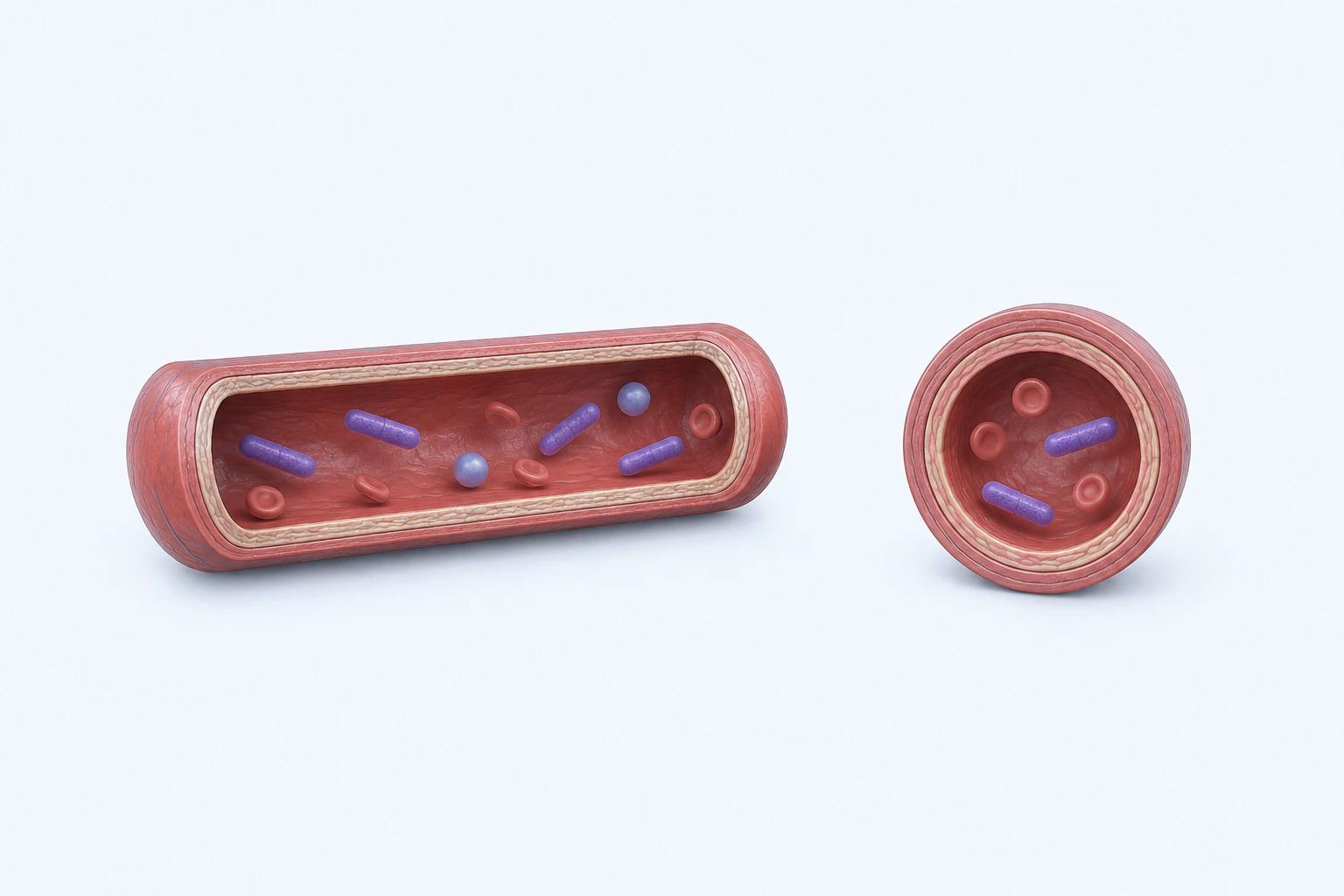
Sparse bloodstream-context orientation for bacteremia. The illustrative forms do not identify an organism, quantify burden, show a culture result, depict sepsis, or provide diagnosis or treatment guidance.
Scientific media record2 verified identifiers
- Subject
- Bacteremiacondition
- Identifiers
- MeSH:D016470WikiBiome:bacteremia
- Review
- Editorial review completeIdentifiers authority-verified · Accessibility validated · · bacteremia|bacteremia-mechanism-v2.webp
- Digital source
- Trained-algorithmic mediaCreated with a trained generative algorithm and reviewed by WikiBiome for subject identity, scientific framing, identifiers, provenance, and accessibility.
- Scientific basis
- Bacteremia — MeSHSepsis — MeSHBacteremia
- License
- CC BY-SA 4.0Created
Bacteremia is the presence of viable bacteria in the bloodstream. In the WikiBiome framework, bacteremia results from bacterial translocation across compromised barriers—the gut epithelium (→ portal bacteremia) or the oral mucosa (→ systemic bacteremia during dental procedures or periodontitis).
It is distinct from Endotoxemia (LPS translocation) in that viable organisms, not just their products, enter the blood.
Evidence map4 cited passagesInspect provenance +
Gut translocation: Barrier failure from dysbiosis, metal damage (cadmium, lead), or inflammation allows gut bacteria to enter the portal circulation → liver → systemic spread.
COVID-19: SARS-CoV-2-induced gut dysbiosis and barrier disruption leads to bacterial translocation and bacteremia, contributing to cytokine storm severity.
Oral translocation: Chewing, dental procedures, or severe periodontitis cause transient bacteremia from oral pathogens (porphyromonas gingivalis, Streptococcus) into the systemic circulation → cardiovascular disease risk.
Perioperative: Post-surgical bacteremia from gut translocation; synbiotics may reduce incidence.
Key Pathways#
Gut translocation: Barrier failure from Dysbiosis, metal damage (Cadmium, Lead), or Metal-Driven Inflammation allows gut bacteria to enter the portal circulation → liver → systemic spread.[1]Liu 2023 — Environmental cadmium exposure alters the internal microbiota and metabolome of Sprague–Dawley ratsLiu S, Deng X, Li Z et al. · 2023Open reference 1 ↓
COVID-19: SARS-CoV-2-induced gut dysbiosis and barrier disruption leads to bacterial translocation and bacteremia, contributing to cytokine storm severity.[2]Bernard-Raichon et al. 2022 — Gut microbiome dysbiosis in antibiotic-treated COVID-19 patients is associated with microbial translocation and bacteremiaLucie Bernard-Raichon, Mericien Venzon, Jon Klein et al. · 2022Open reference 2 ↓
Oral translocation: Chewing, dental procedures, or severe periodontitis cause transient bacteremia from oral pathogens (Porphyromonas gingivalis, Streptococcus) into the systemic circulation → Cardiovascular Disease risk.[3]The oral microbiome in the pathophysiology of cardiovascular diseaseAndrea Tonelli, Evelyn N. Lumngwena, Ntobeko A. B. Ntusi · 2023Open reference 3 ↓
Perioperative: Post-surgical bacteremia from gut translocation; synbiotics may reduce incidence.[4]Synergistic immunomodulatory effect of synbiotics pre- and postoperative resection of pancreatic ductal adenocarcinoma: a randomized controlled studySara Maher, Hesham A. Elmeligy, Tarek Aboushousha et al. · 2024Open reference 4 ↓
Cross-References#
- Endotoxemia—LPS translocation (without viable bacteria)
- Intestinal Permeability—barrier failure enabling translocation
- Porphyromonas gingivalis—oral-to-systemic translocation
- Systemic Inflammation—downstream consequence
References 4
Numbered by first appearance in the article, then reconciled with its declared source list.
- 1
Liu S, Deng X, Li Z et al. (2023). Liu 2023 — Environmental cadmium exposure alters the internal microbiota and metabolome of Sprague–Dawley rats. Frontiers in Veterinary Science.
- 2
Lucie Bernard-Raichon, Mericien Venzon, Jon Klein et al. (2022). Bernard-Raichon et al. 2022 — Gut microbiome dysbiosis in antibiotic-treated COVID-19 patients is associated with microbial translocation and bacteremia. Nature Communications.
- 3
Andrea Tonelli, Evelyn N. Lumngwena, Ntobeko A. B. Ntusi (2023). The oral microbiome in the pathophysiology of cardiovascular disease. Nature Reviews Cardiology.
- 4
Sara Maher, Hesham A. Elmeligy, Tarek Aboushousha et al. (2024). Synergistic immunomodulatory effect of synbiotics pre- and postoperative resection of pancreatic ductal adenocarcinoma: a randomized controlled study. Cancer Immunology, Immunotherapy.
Article network
Connect the evidence
Publicly readable discussion by ORCID-authenticated researchers. Questions, interpretation, methods, corrections, and new evidence stay attached to this record.
No discussion yet. Start with a precise question or a source-backed observation.
Published page changes
This record shows only material changes published on this page, including changes to its content, evidence, conclusions, or author context. Internal processes and discussion activity are excluded. Pending, declined, and withdrawn proposals remain private.
- published revision
Created “Bacteremia”: Bacteremia is the presence of viable bacteria in the bloodstream. In the WikiBiome framework, bacteremia results from bacterial translocation across compromised barriers — the gut epithelium (→ portal…
Created “Bacteremia”: Bacteremia is the presence of viable bacteria in the bloodstream. In the WikiBiome framework, bacteremia results from bacterial translocation across compromised barriers — the gut epithelium (→ portal… Published sections: Overview; Key Pathways; Cross-References. · WikiBiome Deploy Bot · +37 −0
Inspect exact Git diff ↗