

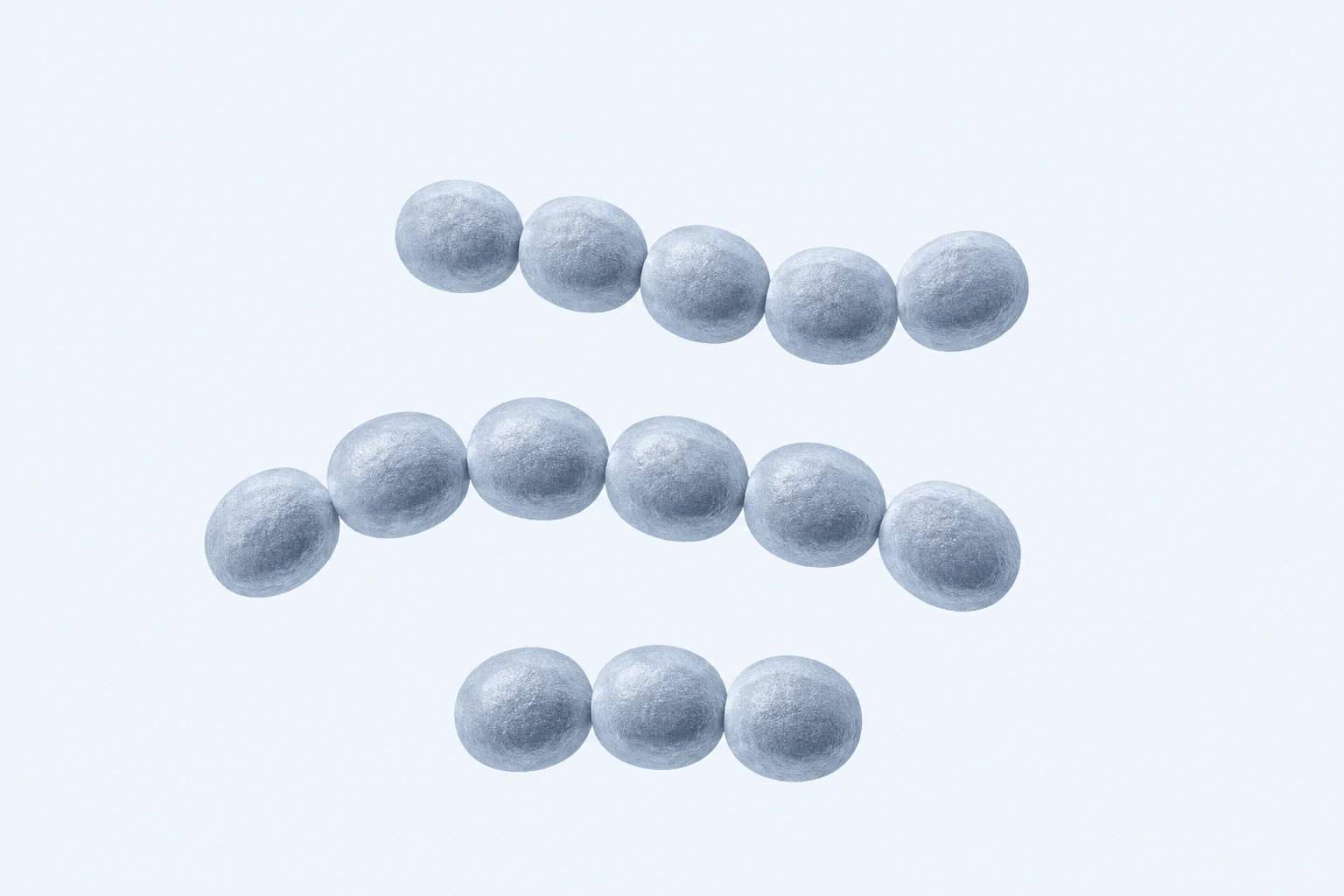
Type-strain-anchored Streptococcus salivarius reconstruction with fourteen cocci in three chains. Representative, non-diagnostic, not visually separable from other streptococci, and not a micrograph.
Scientific media record1 verified identifier
- Subject
- Streptococcus salivariustaxon · species
- Identifiers
- NCBITaxon:1304
- Review
- Editorial review completeIdentifiers authority-verified · Accessibility validated · · streptococcus-salivarius|streptococcus-salivarius-morphology-v1.webp
- Digital source
- Trained-algorithmic mediaCreated with a trained generative algorithm and reviewed by WikiBiome for subject identity, scientific framing, identifiers, provenance, and accessibility.
- Scientific basis
- Streptococcus salivarius — NCBI TaxonomyStreptococcus salivarius — LPSNStreptococcus — Medical Microbiology
- License
- CC BY-SA 4.0Created
Streptococcus salivarius is a Gram-positive, facultatively anaerobic bacterium and one of the earliest colonizers of the human oral cavity. It dominates the tongue dorsum and saliva, representing up to 10% of the cultivable oral flora.
S. salivarius occupies a paradoxical position in the WikiBiome framework: specific strains (K12, M18) are among the most validated oral probiotics, producing bacteriocins that suppress pharyngeal pathogens, while its detection in the gut—particularly in neonates or in disease states—often signals oral-gut microbial translocation, a marker of barrier compromise.
Evidence map2 cited passagesInspect provenance +
In preterm neonates, enrichment of S. salivarius (along with Rothia mucilaginosa) was detected in the gut microbiome before NEC onset, suggesting oral-origin organisms as early warning biomarkers for necrotizing enterocolitis
In fibromyalgia, S. salivarius was among 19 differentially abundant zOTUs in a multi-omics diagnostic signature
Contents
1. Metal Dependencies2. Key Enzymes and Functional Features3. Ecological Role4. Conditions Associated5. Cross-ReferencesMetal Dependencies#
S. salivarius relies primarily on manganese for its superoxide dismutase and central metabolic enzymes, a common strategy among streptococci that reduces dependence on iron.
This manganese preference gives S. salivarius intrinsic tolerance to iron-limited environments—but also allows it to thrive when iron is supplemented, as documented with iron phosphate binders in Chronic Kidney Disease.
Key Enzymes and Functional Features#
Salivaricin A and B—Lanthibiotic bacteriocins (BLIS: bacteriocin-like inhibitory substances) that inhibit Streptococcus pyogenes, Streptococcus pneumoniae, and Streptococcus mutans. The K12 strain produces salivaricin A2 and B; the M18 strain targets cariogenic bacteria.
Urease—Some strains express urease that hydrolyzes urea to Ammonia, raising local pH. In the oral cavity this may protect against acid-mediated caries; in the gut this activity can contribute to ammonia production relevant to hepatic encephalopathy.
EPS production—Produces fructans (levan, inulin-type fructooligosaccharides) that serve as prebiotics for other commensals.
Ecological Role#
In the oral cavity, S. salivarius is a pioneer colonizer that establishes competitive exclusion against pathogenic streptococci. Its bacteriocin production creates a protective zone on the tongue and pharyngeal surfaces that reduces Group A streptococcal pharyngitis and halitosis.
In the gut, S. salivarius detection carries different significance depending on context. In healthy adults, it represents normal oral-gut transit at low abundance.
In preterm neonates, enrichment of S. salivarius (along with Rothia mucilaginosa) was detected in the Gut Microbiome before NEC onset, suggesting oral-origin organisms as early warning biomarkers for Necrotizing Enterocolitis.[1]Liu 2022 — Gut microbiota and SCFAs as early predictive biomarkers for neonatal NEC (pilot)Xiao-Chen Liu, Ting-Ting Du, Xiong Gao et al. · 2022Open reference 1 ↓
In Fibromyalgia, S. salivarius was among 19 differentially abundant zOTUs in a multi-omics diagnostic signature.[2]Duran-Gonzalez 2025 — Multi-Omics Diagnosis of FibromyalgiaDuran-Gonzalez et al. · 2025Open reference 2 ↓ In Chronic Kidney Disease, sucroferric oxyhydroxide (iron phosphate binder) notably enriches S. salivarius, suggesting iron tolerance enables expansion under high-iron conditions.
Conditions Associated#
| Condition | Context |
|---|---|
| Pharyngeal health | Probiotic strains K12/M18 reduce streptococcal pharyngitis recurrence |
| Necrotizing Enterocolitis | Pre-NEC gut enrichment as oral-gut translocation marker |
| Fibromyalgia | Differentially abundant in multi-omics diagnostic signature |
| Pancreatic cancer | 31-fold enrichment in fecal microbiota of PC patients vs. controls |
Cross-References#
- Rothia—co-enriched with S. salivarius pre-NEC; fellow oral-gut translocation marker
- Necrotizing Enterocolitis—pre-NEC oral-gut translocation significance
- Fibromyalgia—diagnostic signature component
- Chronic Kidney Disease—iron-tolerant expansion under phosphate binder therapy
- Streptococcus—genus overview
References 5
Numbered by first appearance in the article, then reconciled with its declared source list.
- 1
Xiao-Chen Liu, Ting-Ting Du, Xiong Gao et al. (2022). Liu 2022 — Gut microbiota and SCFAs as early predictive biomarkers for neonatal NEC (pilot). Frontiers in Microbiology.
- 2
Duran-Gonzalez et al. (2025). Duran-Gonzalez 2025 — Multi-Omics Diagnosis of Fibromyalgia. Frontiers in Microbiology.
- 3
Liu H, Liu H, Liu C et al. (2022). Liu et al. 2022 — Gut Microbiome and the Role of Metabolites in the Study of Graves' Disease. Frontiers in Molecular Biosciences.
- 4
Laurence Genton, Vladimir Lazarevic, Ozren Stojanovic et al. (2021). Metataxonomic and Metabolic Impact of Fecal Microbiota Transplantation From Patients With Pancreatic Cancer Into Germ-Free Mice: A Pilot Study. Frontiers in Cellular and Infection Microbiology.
- 5
C. Iannuccelli, M. Favretti, G. Dolcini et al. (2025). Iannuccelli 2025 — Fibromyalgia: One Year in Review 2025. Clinical and Experimental Rheumatology.
Article network
Connect the evidence
Publicly readable discussion by ORCID-authenticated researchers. Questions, interpretation, methods, corrections, and new evidence stay attached to this record.
No discussion yet. Start with a precise question or a source-backed observation.
Published page changes
This record shows only material changes published on this page, including changes to its content, evidence, conclusions, or author context. Internal processes and discussion activity are excluded. Pending, declined, and withdrawn proposals remain private.
- published revision
Added references: jiang-2023-gut-microbiome-metabolites-graves; genton-2021-fmt-pancreatic-cancer-germ-free-mice; iannuccelli-2025-fibromyalgia-year-review-2025.
WikiBiome Deploy Bot · +12 −11
Inspect exact Git diff ↗ - published revision
Created “Streptococcus salivarius”: Streptococcus salivarius is a Gram-positive, facultatively anaerobic bacterium and one of the earliest colonizers of the human oral cavity. It dominates the tongue dorsum and saliva, representing up…
Created “Streptococcus salivarius”: Streptococcus salivarius is a Gram-positive, facultatively anaerobic bacterium and one of the earliest colonizers of the human oral cavity. It dominates the tongue dorsum and saliva, representing up… Published sections: Overview; Metal Dependencies; Key Enzymes and Functional Features; Ecological Role; Conditions Associated; Cross-References. · WikiBiome Deploy Bot · +87 −0
Inspect exact Git diff ↗