

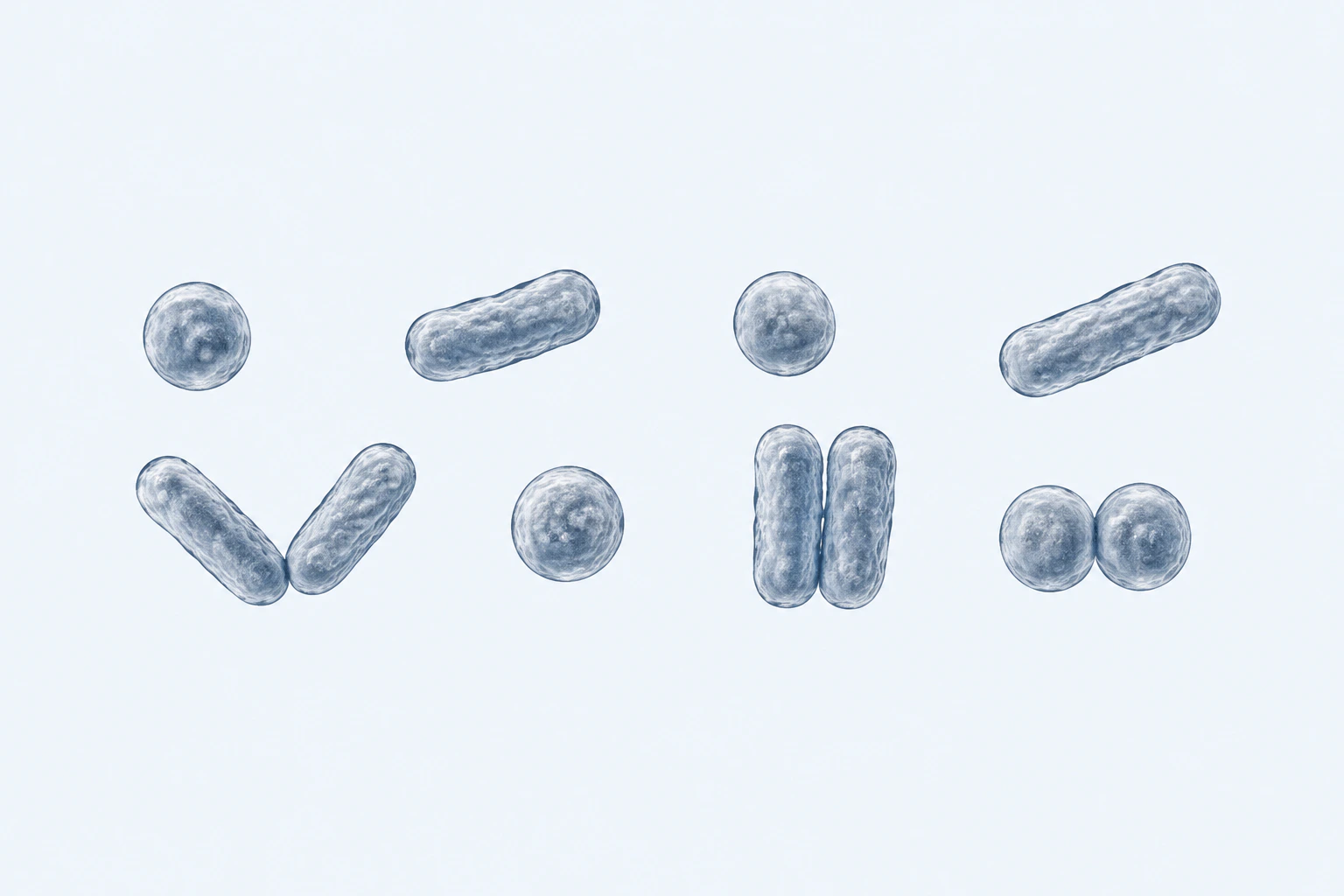
Type-species-anchored Rothia reconstruction with eleven pleomorphic bodies in five single and three paired groupings, including restrained V and palisade arrangements. This genus plate is representative, non-universal, non-diagnostic, and not a micrograph.
Scientific media record1 verified identifier
- Subject
- Rothiataxon · genus
- Identifiers
- NCBITaxon:32207
- Review
- Editorial review completeIdentifiers authority-verified · Accessibility validated · · rothia|rothia-morphology-v1.webp
- Digital source
- Trained-algorithmic mediaCreated with a trained generative algorithm and reviewed by WikiBiome for subject identity, scientific framing, identifiers, provenance, and accessibility.
- Scientific basis
- Rothia — NCBI TaxonomyRothia — LPSNLaboratory identification of Rothia dentocariosaRothia dentocariosa type strain — BacDive
- License
- CC BY-SA 4.0Created
Rothia is a genus of Gram-positive, facultatively anaerobic bacteria in the family Micrococcaceae (phylum Actinobacteria). The most commonly identified species in microbiome studies are Rothia dentocariosa and Rothia mucilaginosa, both of which are primary inhabitants of the oral cavity—found in saliva, dental plaque, and the pharynx.
Rothia is a normal commensal of the human mouth but can become pathogenic in immunocompromised hosts.
From a WikiBiome perspective, Rothia is significant because it bridges oral and systemic health through two mechanisms: its nitrate-reducing activity influences systemic nitric oxide biology, and its detection in the gut, peritoneum, or duodenum often signals oral-gut microbial translocation—a hallmark of disrupted mucosal barriers.
Evidence map10 cited passagesInspect provenance +
In Crohn's disease, Rothia was enriched alongside Fusobacterium, Streptococcus, and Collinsella in CD-specific metagenomics (, cross-sectional).
Thonzonium bromide, a repurposed drug for dental caries, specifically disrupted Rothia in oral swabs of rodent models, demonstrating its central role in oral biofilm ecology (, animal-model).
Crohn's disease: Enriched in CD alongside other oral-origin taxa; part of the facultative anaerobe expansion pattern seen in IBD (, cross-sectional).
Cerebral palsy with epilepsy: Significantly enriched (0.62 +/- 0.82%) in CPE children alongside Streptococcus, Veillonella, and other oral-origin taxa; paradoxical high diversity reflecting pathobiont expansion (, cross-sectional).
GERD/NERD: Rothia sp. was a discriminatory taxon for non-erosive reflux disease (NERD) by LEfSe analysis (, cross-sectional).
Pancreatic cancer: Found in duodenal microbiota of PC patients alongside Bifidobacterium, Enterococcus, and Neisseria (, expert-opinion).
Endometriosis: Rothia significantly decreased in peritoneal fluid extracellular vesicles from women with advanced endometriosis, alongside Propionibacterium and Actinomyces (, cross-sectional).
Chronic kidney disease: Mendelian randomization identifies Rothia species as causally protective against elevated urinary albumin-to-creatinine ratio (UACR) (IVW OR = 0.99, 95% CI 0.99-1, p = 0.03), possibly by inhibiting inflammatory pathways that damage the glomerular filtration barrier (, quasi-experimental).
Colorectal cancer: Rothia dentocariosa and Rothia mucilaginosa were among the top 10 CRC-associated salivary microbes in an Iranian cohort, present in CRC patients but absent from healthy controls. This supports oral microbiome-based cancer screening (, cross-sectional).
| Study | Finding | Evidence Level | |-------|---------|---------------| | | Causally protective against elevated UACR in CKD | Quasi-experimental | | | R. dentocariosa and R. mucilaginosa as salivary CRC biomarkers | Cross-sectional | | | Enriched in Crohn's disease metagenomics | Cross-sectional | | | Depleted in peritoneal fluid in endometriosis | Cross-s
Contents
1. Metal Dependencies2. Key Enzymes and Virulence Factors3. Ecological Role4. Conditions Associated5. Key Studies6. Cross-ReferencesMetal Dependencies#
Iron: Required for cytochrome-based electron transport in aerobic and anaerobic respiration. Rothia species possess siderophore uptake systems for iron acquisition.
Manganese: R. mucilaginosa uses manganese-dependent superoxide dismutase (MnSOD) for Oxidative Stress defense, enabling survival in oxygen-variable environments from the aerobic oral cavity to the microaerobic gut.
Key Enzymes and Virulence Factors#
Nitrate reductase: Rothia is among the key oral nitrate-reducing bacteria that convert dietary nitrate (from leafy greens) to nitrite, which is subsequently reduced to nitric oxide (NO) in the stomach. This enterosalivary nitrate-nitrite-NO pathway contributes to blood pressure regulation and antimicrobial defense.
Its disruption (e.g., by antiseptic mouthwash) has been linked to hypertension.
Urease: Some Rothia strains produce urease, enabling survival in acidic environments and contributing to nitrogen cycling in the oral cavity. Biofilm formation: Rothia participates in multi-species oral biofilms and can contribute to dental caries when ecological balance is disrupted.
Ecological Role#
Rothia occupies a unique position as an oral ecosystem engineer with systemic reach. In the healthy oral cavity, Rothia is a dominant member of the supragingival plaque community and a key partner in the nitrate reduction cascade.
Its detection in gut, duodenal, or peritoneal samples is often a marker of oral-gut translocation—indicating that oral bacteria have survived gastric transit (often due to PPI use or achlorhydria) and colonized distal sites.
In Crohn's disease, Rothia was enriched alongside Fusobacterium, Streptococcus, and Collinsella in CD-specific metagenomics (,[1]Diagnosis of Crohn's Disease and Ulcerative Colitis Using the MicrobiomeKang DY, Park JL, Yeo MK et al. · 2023Open reference 1 ↓ cross-sectional).
Thonzonium bromide, a repurposed drug for dental caries, specifically disrupted Rothia in oral swabs of rodent models, demonstrating its central role in oral biofilm ecology (,[2]Impact of the Repurposed Drug Thonzonium Bromide on Host Oral-Gut MicrobiomesAurea Simon-Soro, Dongyeop Kim, Yong Li et al. · 2021Open reference 2 ↓ animal-model).
Conditions Associated#
Enriched in:#
Crohn's disease: Enriched in CD alongside other oral-origin taxa; part of the facultative anaerobe expansion pattern seen in IBD (,[1]Diagnosis of Crohn's Disease and Ulcerative Colitis Using the MicrobiomeKang DY, Park JL, Yeo MK et al. · 2023Open reference 1 ↓ cross-sectional).
Cerebral palsy with epilepsy: Significantly enriched (0.62 +/- 0.82%) in CPE children alongside Streptococcus, Veillonella, and other oral-origin taxa; paradoxical high diversity reflecting pathobiont expansion (,[3]Huang 2019 — Distinct Gut Microbiota Composition and Functional Category in Children With Cerebral Palsy and EpilepsyCongfu Huang, Yinhu Li, Xin Feng et al. · 2019Open reference 3 ↓ cross-sectional).
GERD/NERD: Rothia sp. was a discriminatory taxon for non-erosive reflux disease (NERD) by LEfSe analysis (,[4]Analysis of gastric microbiota and Helicobacter pylori infection in gastroesophageal reflux diseaseSugihartono T, Fauzia KA, Miftahussurur M et al. · 2022Open reference 4 ↓ cross-sectional). Pancreatic cancer: Found in duodenal microbiota of PC patients alongside Bifidobacterium, Enterococcus, and Neisseria (,[5]Microbiome as a biomarker and therapeutic target in pancreatic cancerGhazaleh Pourali, Danial Kazemi, Amir Shayan Chadeganipour et al. · 2024Open reference 5 ↓ expert-opinion).
Depleted in:#
- Endometriosis: Rothia significantly decreased in peritoneal fluid extracellular vesicles from women with advanced endometriosis, alongside Propionibacterium and Actinomyces (,[6]Altered Composition of Microbiota in Women with Ovarian Endometrioma: Microbiome Analyses of Extracellular Vesicles in the Peritoneal FluidLee SR, Lee JC, Kim SH et al. · 2021Open reference 6 ↓ cross-sectional).
Protective associations:#
- Chronic kidney disease: Mendelian randomization identifies Rothia species as causally protective against elevated urinary albumin-to-creatinine ratio (UACR) (IVW OR = 0.99, 95% CI 0.99-1, p = 0.03), possibly by inhibiting inflammatory pathways that damage the glomerular filtration barrier (,[7]Liu 2026 — Causal Association between Oral Microbiome and Chronic Kidney Disease: Two-Sample Mendelian RandomizationZhiwei Liu, Zhiyao Liu, Weixia Sun et al. · 2026Open reference 7 ↓ quasi-experimental).
Oral biomarker:#
- Colorectal cancer: Rothia dentocariosa and Rothia mucilaginosa were among the top 10 CRC-associated salivary microbes in an Iranian cohort, present in CRC patients but absent from healthy controls. This supports oral microbiome-based cancer screening (,[8]16S rRNA Sequencing Analysis of the Oral and Fecal Microbiota in Colorectal Cancer Positives Versus Colorectal Cancer Negatives in Iranian PopulationRezasoltani S, Looha MA, Aghdaei HA et al. · 2024Open reference 8 ↓ cross-sectional).
Key Studies#
| Study | Finding | Evidence Level |
|---|---|---|
| [7]Liu 2026 — Causal Association between Oral Microbiome and Chronic Kidney Disease: Two-Sample Mendelian RandomizationZhiwei Liu, Zhiyao Liu, Weixia Sun et al. · 2026Open reference 7 ↓ | Causally protective against elevated UACR in CKD | Quasi-experimental |
| [8]16S rRNA Sequencing Analysis of the Oral and Fecal Microbiota in Colorectal Cancer Positives Versus Colorectal Cancer Negatives in Iranian PopulationRezasoltani S, Looha MA, Aghdaei HA et al. · 2024Open reference 8 ↓ | R. dentocariosa and R. mucilaginosa as salivary CRC biomarkers | Cross-sectional |
| [1]Diagnosis of Crohn's Disease and Ulcerative Colitis Using the MicrobiomeKang DY, Park JL, Yeo MK et al. · 2023Open reference 1 ↓ | Enriched in Crohn's disease metagenomics | Cross-sectional |
| [6]Altered Composition of Microbiota in Women with Ovarian Endometrioma: Microbiome Analyses of Extracellular Vesicles in the Peritoneal FluidLee SR, Lee JC, Kim SH et al. · 2021Open reference 6 ↓ | Depleted in peritoneal fluid in endometriosis | Cross-sectional |
| [2]Impact of the Repurposed Drug Thonzonium Bromide on Host Oral-Gut MicrobiomesAurea Simon-Soro, Dongyeop Kim, Yong Li et al. · 2021Open reference 2 ↓ | Disrupted by thonzonium bromide in oral biofilm | Animal model |
Cross-References#
- Streptococcus—co-occurring oral-translocation genus
- Veillonella—co-occurring oral commensal; co-enriched in CPE
- Haemophilus—fellow oral-gut bridging organism
- Crohn's Disease—oral-origin taxa enrichment
- Endometriosis—peritoneal microbiota depletion
- Chronic Kidney Disease—oral-kidney axis protection
- Colorectal Cancer—salivary biomarker potential
- Nitric Oxide—nitrate reduction pathway
References 9
Numbered by first appearance in the article, then reconciled with its declared source list.
- 1
Kang DY, Park JL, Yeo MK et al. (2023). Diagnosis of Crohn's Disease and Ulcerative Colitis Using the Microbiome. BMC Microbiology.
- 2
Aurea Simon-Soro, Dongyeop Kim, Yong Li et al. (2021). Impact of the Repurposed Drug Thonzonium Bromide on Host Oral-Gut Microbiomes. npj Biofilms and Microbiomes.
- 3
Congfu Huang, Yinhu Li, Xin Feng et al. (2019). Huang 2019 — Distinct Gut Microbiota Composition and Functional Category in Children With Cerebral Palsy and Epilepsy. Frontiers in Pediatrics.
- 4
Sugihartono T, Fauzia KA, Miftahussurur M et al. (2022). Analysis of gastric microbiota and Helicobacter pylori infection in gastroesophageal reflux disease. Gut Pathogens.
- 5
Ghazaleh Pourali, Danial Kazemi, Amir Shayan Chadeganipour et al. (2024). Microbiome as a biomarker and therapeutic target in pancreatic cancer. BMC Microbiology.
- 6
Lee SR, Lee JC, Kim SH et al. (2021). Altered Composition of Microbiota in Women with Ovarian Endometrioma: Microbiome Analyses of Extracellular Vesicles in the Peritoneal Fluid. International Journal of Molecular Sciences.
- 7
Zhiwei Liu, Zhiyao Liu, Weixia Sun et al. (2026). Liu 2026 — Causal Association between Oral Microbiome and Chronic Kidney Disease: Two-Sample Mendelian Randomization. Archives of Medical Science.
- 8
Rezasoltani S, Looha MA, Aghdaei HA et al. (2024). 16S rRNA Sequencing Analysis of the Oral and Fecal Microbiota in Colorectal Cancer Positives Versus Colorectal Cancer Negatives in Iranian Population. Gut Pathogens.
- 9
Baiqiang Lin, Fuya Zhao, Yang Liu et al. (2022). Lin 2022 — Probiotics alleviate oral-gut microbiota dysbiosis in thyroid cancer patients after thyroidectomy: RCT. Frontiers in Endocrinology.
Article network
Connect the evidence
Publicly readable discussion by ORCID-authenticated researchers. Questions, interpretation, methods, corrections, and new evidence stay attached to this record.
No discussion yet. Start with a precise question or a source-backed observation.
Published page changes
This record shows only material changes published on this page, including changes to its content, evidence, conclusions, or author context. Internal processes and discussion activity are excluded. Pending, declined, and withdrawn proposals remain private.
- published revision
Created “Rothia”: Rothia is a genus of Gram-positive, facultatively anaerobic bacteria in the family Micrococcaceae (phylum Actinobacteria). The most commonly identified species in microbiome studies are Rothia…
Created “Rothia”: Rothia is a genus of Gram-positive, facultatively anaerobic bacteria in the family Micrococcaceae (phylum Actinobacteria). The most commonly identified species in microbiome studies are Rothia… Published sections: Rothia; Metal Dependencies; Key Enzymes and Virulence Factors; Ecological Role; Enriched in:; Depleted in:; Protective associations:; Oral biomarker:; Key Studies; Cross-References. · WikiBiome Deploy Bot · +89 −0
Inspect exact Git diff ↗