

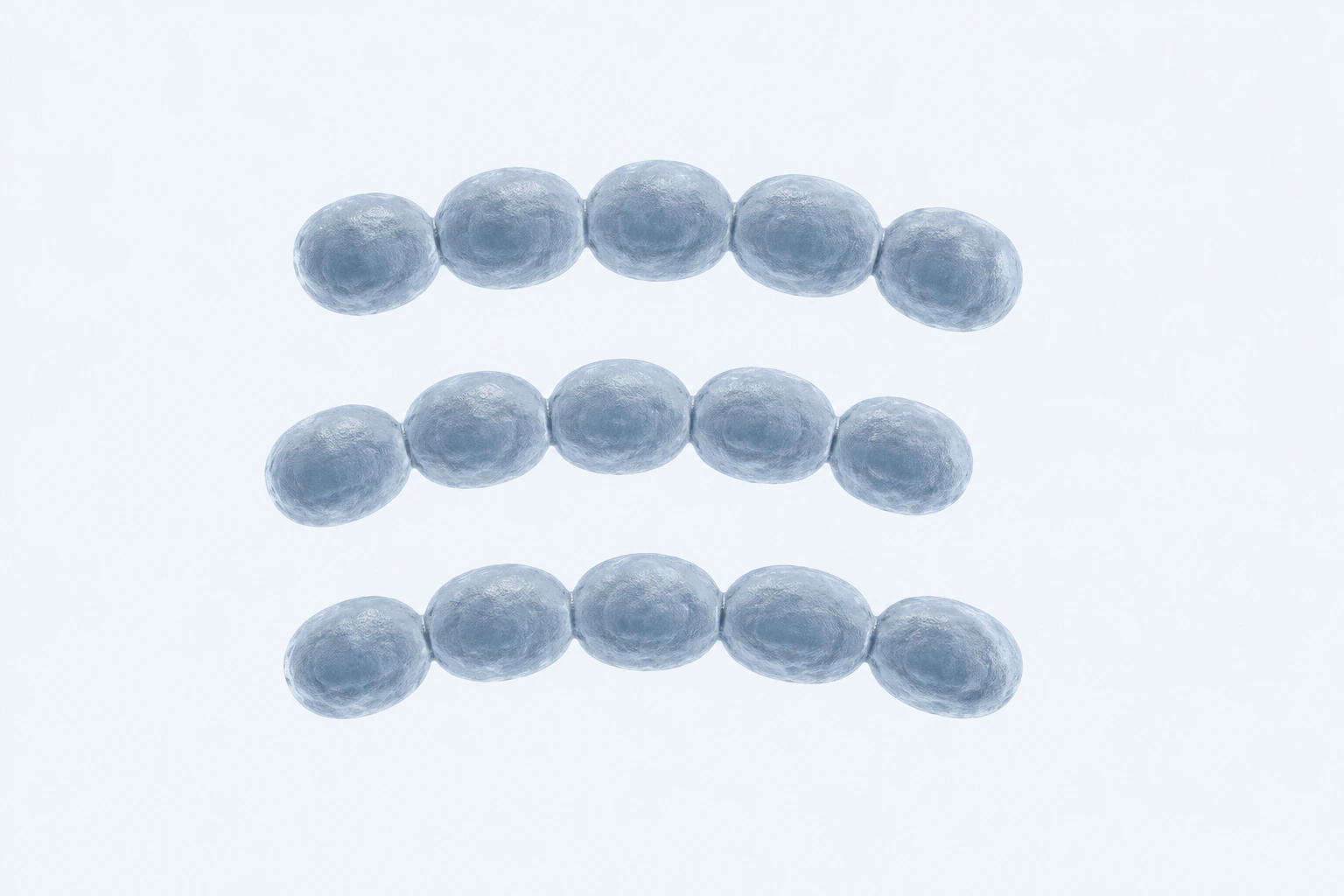
Type-strain-anchored Streptococcus mutans reconstruction with fifteen cocci in three chains. Representative, non-diagnostic, and not a micrograph; plaque and extracellular matrix are not depicted.
Scientific media record1 verified identifier
- Subject
- Streptococcus mutanstaxon · species
- Identifiers
- NCBITaxon:1309
- Review
- Editorial review completeIdentifiers authority-verified · Accessibility validated · · streptococcus-mutans|streptococcus-mutans-morphology-v1.webp
- Digital source
- Trained-algorithmic mediaCreated with a trained generative algorithm and reviewed by WikiBiome for subject identity, scientific framing, identifiers, provenance, and accessibility.
- Scientific basis
- Streptococcus mutans — NCBI TaxonomyStreptococcus mutans — LPSNStreptococcus — Medical Microbiology
- License
- CC BY-SA 4.0Created
The primary architect of dental caries—the most prevalent chronic infectious disease worldwide. S. mutans is a Gram-positive, facultative anaerobe that colonizes tooth surfaces and produces the acid-rich, metal-managed biofilms known as dental plaque.
What sets this organism apart from other oral streptococci is not merely its acid production, but its uniquely sophisticated zinc resistance system that allows it to persist in the oral cavity even when the host deploys zinc as an antimicrobial weapon.
For the genus-level page covering all pathogenic and commensal streptococci, see Streptococcus.
Evidence map7 cited passagesInspect provenance +
S. mutans requires manganese and iron for core metabolic functions, importing both through the SloABC ABC transporter regulated by the metalloregulator SloR (, in-vitro). A second manganese transporter, MntH (Nramp-type), provides redundancy. Manganese serves as the cofactor for superoxide dismutase and other oxidative stress defense enzymes, while iron supp
Zinc is simultaneously an essential nutrient and a potent antimicrobial threat to S. mutans. Excess zinc is toxic because it binds to non-cognate metalloproteins (mis metallation) and interferes with uptake of manganese and iron (, in-vitro). However, S. mutans has evolved ZccE, a zinc exporter unique to this species among streptococci, that confers remarkab
S. mitis ATCC 49456 produces 4-5 times more hydrogen peroxide than other oral streptococci via the SpxB pyruvate oxidase pathway, nearly abolishing S. mutans biofilm formation in coculture (, in-vitro). The mechanism is explicitly metal-dependent: H2O2 causes mis metallation by damaging iron-sulfur clusters and oxidizing metal-binding sites in proteins. Sinc
Autism spectrum disorder—Enriched in the oral microbiome of ASD children (, systematic-review-meta-analysis); mechanism unclear but may relate to altered oral-gut axis
(in-vitro)—Comprehensive review of zinc antimicrobial mechanisms against S. mutans; identifies ZccE as the critical resistance determinant explaining the clinical failure of zinc-only anti-caries strategies.
(in-vitro)—Demonstrates near-complete elimination of S. mutans biofilm by S. mitis H2O2 production; explicitly identifies mismetallation as damage mechanism.
(expert-opinion, keystone)—Systematic map of metal transport in pathogenic streptococci; identifies ZccE as unique to S. mutans and maps the full SloR/AdcR/CopY metalloregulatory network.
Contents
1. Metal Dependencies2. Key Enzymes and Virulence Factors3. Ecological Role4. Conditions Associated5. Key Studies6. Cross-ReferencesMetal Dependencies#
Manganese and Iron: Essential Cofactors#
S. mutans requires Manganese and Iron for core metabolic functions, importing both through the SloABC ABC transporter regulated by the metalloregulator SloR (,[1]Katrak 2026 — Oral Hygiene Agents at Work: Effects on Streptococcus mutans and Caries RiskCallahan Katrak, Sydney Reed, Miranda Carter et al. · 2026Open reference 1 ↓ in-vitro). A second manganese transporter, MntH (Nramp-type), provides redundancy.
Manganese serves as the cofactor for superoxide dismutase and other Oxidative Stress defense enzymes, while iron supports glycolytic enzymes critical for the acid production that drives tooth demineralization.
Zinc: Resistance as Survival Strategy#
Zinc is simultaneously an essential nutrient and a potent antimicrobial threat to S. mutans. Excess zinc is toxic because it binds to non-cognate metalloproteins (Mis-Metallation) and interferes with uptake of manganese and iron (,[1]Katrak 2026 — Oral Hygiene Agents at Work: Effects on Streptococcus mutans and Caries RiskCallahan Katrak, Sydney Reed, Miranda Carter et al. · 2026Open reference 1 ↓ in-vitro).
However, S. mutans has evolved ZccE, a zinc exporter unique to this species among streptococci, that confers remarkably high zinc tolerance (,[2]Metal Homeostasis in Pathogenic StreptococciAkbari MS, Doran KS, Burcham LR · 2022Open reference 2 ↓ expert-opinion). A ZccE-deletion mutant is highly susceptible to zinc, confirming that this single exporter is the primary defense against zinc toxicity.
This zinc resistance explains a persistent clinical puzzle: despite promising in vitro data showing zinc inhibits S. mutans acid production, ATPase activity, and sugar transport, clinical studies have consistently failed to show significant anti-caries effects of zinc alone.
Zinc concentrations in oral hygiene products (30-150 mM) create sustained elevated oral zinc levels, but ZccE-mediated resistance is sufficient to overcome therapeutic concentrations in vivo.
Key Enzymes and Virulence Factors#
| System | Metal | Function |
|---|---|---|
| ZccE (P-type ATPase) | Zinc export | Unique zinc resistance; primary defense against zinc toxicity |
| SloABC | iron (Fe)/manganese (Mn) import | Essential metal acquisition via ABC transporter |
| MntH | manganese import | Nramp-type redundant manganese transporter |
| AdcABC | zinc (Zn) import | Zinc acquisition under zinc-limiting conditions |
| CopY/CopA | copper (Cu) export | Copper efflux system |
| F0F1-ATPase | H+ pump | Acid tolerance; inhibited by zinc and fluoride |
| Enolase | magnesium (Mg)/manganese-dependent | Glycolytic enzyme; inhibited by fluoride |
| Glucosyltransferases | — | Biofilm matrix (glucan) production |
Ecological Role#
In Healthy Oral Ecosystems#
S. mutans typically comprises a small fraction of the oral microbiome in healthy individuals, held in check by competing commensals—particularly hydrogen peroxide-producing species like Streptococcus mitis. The ecological balance depends on metal availability, pH, and carbohydrate supply.
H2O2-Mediated Ecological Control#
S. mitis ATCC 49456 produces 4-5 times more hydrogen peroxide than other oral streptococci via the SpxB pyruvate oxidase pathway, nearly abolishing S. mutans biofilm formation in coculture (,[3]Williams 2025 — A Strain of Streptococcus mitis Inhibits Biofilm Formation of Caries Pathogens via Abundant Hydrogen Peroxide ProductionIsabella Williams, Jacob S Tuckerman, Daniel I Peters et al. · 2025Open reference 3 ↓ in-vitro).
The mechanism is explicitly metal-dependent: H2O2 causes Mis-Metallation by damaging iron-sulfur clusters and oxidizing metal-binding sites in proteins. Since S. mutans lacks Catalase, it cannot detoxify H2O2, making it vulnerable to this iron-dependent oxidative attack.
The transcriptomic response of S. mutans to S. mitis coculture reveals upregulation of iron transport genes (SMU_995-998) and ABC transporters, consistent with H2O2-mediated damage to iron-containing proteins triggering a compensatory iron acquisition response.
In Dysbiotic Oral Ecosystems#
When the ecological balance tips—through high-sugar diets, reduced salivary flow, or loss of competing commensals—S. mutans expands and dominates. Its acid production drops local pH below 5.5, the critical threshold for enamel demineralization.
The resulting acidic biofilm environment further selects against acid-sensitive commensals, creating a self-reinforcing dysbiotic loop.
Conditions Associated#
Dental caries—Primary etiological agent; acid production drives tooth demineralization.
Autism spectrum disorder—Enriched in the oral microbiome of ASD children (,[4]Fakhruddin 2025 — Autism and the Oral Microbiome: Systematic ReviewKausar Sadia Fakhruddin, Iman Kamal, Tatia Maglaperidze et al. · 2025Open reference 4 ↓ systematic-review-meta-analysis); mechanism unclear but may relate to altered oral-gut axis.
Infective endocarditis—Occasional cause following dental procedures with bacteremia.
Key Studies#
[1]Katrak 2026 — Oral Hygiene Agents at Work: Effects on Streptococcus mutans and Caries RiskCallahan Katrak, Sydney Reed, Miranda Carter et al. · 2026Open reference 1 ↓ (in-vitro)—Comprehensive review of zinc antimicrobial mechanisms against S. mutans; identifies ZccE as the critical resistance determinant explaining the clinical failure of zinc-only anti-caries strategies.
[3]Williams 2025 — A Strain of Streptococcus mitis Inhibits Biofilm Formation of Caries Pathogens via Abundant Hydrogen Peroxide ProductionIsabella Williams, Jacob S Tuckerman, Daniel I Peters et al. · 2025Open reference 3 ↓ (in-vitro)—Demonstrates near-complete elimination of S. mutans biofilm by S. mitis H2O2 production; explicitly identifies mismetallation as damage mechanism.
[2]Metal Homeostasis in Pathogenic StreptococciAkbari MS, Doran KS, Burcham LR · 2022Open reference 2 ↓ (expert-opinion, keystone)—Systematic map of metal transport in pathogenic streptococci; identifies ZccE as unique to S. mutans and maps the full SloR/AdcR/CopY metalloregulatory network.
Cross-References#
- Streptococcus—Genus-level page with metal homeostasis across all species
- Zinc—Antimicrobial mechanism through mismetallation; ZccE-mediated resistance
- Manganese—Essential cofactor for SOD and metabolic enzymes
- Iron—Iron transport upregulated under H2O2 stress
- Mis-Metallation—Zinc toxicity via non-cognate metalloprotein binding; H2O2-mediated iron-sulfur cluster destruction
- Biofilm—Dental plaque as metal-managed polymicrobial biofilm
- Oral Microbiome—Ecological competition with H2O2-producing commensals
- Candida albicans—S. mutans enhances Candida biofilms via glucosyltransferases
References 4
Numbered by first appearance in the article, then reconciled with its declared source list.
- 1
Callahan Katrak, Sydney Reed, Miranda Carter et al. (2026). Katrak 2026 — Oral Hygiene Agents at Work: Effects on Streptococcus mutans and Caries Risk. Frontiers in Cellular and Infection Microbiology.
- 2
Akbari MS, Doran KS, Burcham LR (2022). Metal Homeostasis in Pathogenic Streptococci. Microorganisms.
- 3
Isabella Williams, Jacob S Tuckerman, Daniel I Peters et al. (2025). Williams 2025 — A Strain of Streptococcus mitis Inhibits Biofilm Formation of Caries Pathogens via Abundant Hydrogen Peroxide Production. Applied and Environmental Microbiology.
- 4
Kausar Sadia Fakhruddin, Iman Kamal, Tatia Maglaperidze et al. (2025). Fakhruddin 2025 — Autism and the Oral Microbiome: Systematic Review. International Dental Journal.
Article network
Mentioned here 10
Pages linking here 1
Connect the evidence
Publicly readable discussion by ORCID-authenticated researchers. Questions, interpretation, methods, corrections, and new evidence stay attached to this record.
No discussion yet. Start with a precise question or a source-backed observation.
Published page changes
This record shows only material changes published on this page, including changes to its content, evidence, conclusions, or author context. Internal processes and discussion activity are excluded. Pending, declined, and withdrawn proposals remain private.
- published revision
Created “Streptococcus mutans”: The primary architect of dental caries -- the most prevalent chronic infectious disease worldwide. S. mutans is a Gram-positive, facultative anaerobe that colonizes tooth surfaces and produces the…
Created “Streptococcus mutans”: The primary architect of dental caries -- the most prevalent chronic infectious disease worldwide. S. mutans is a Gram-positive, facultative anaerobe that colonizes tooth surfaces and produces the… Published sections: Streptococcus mutans; Manganese and Iron: Essential Cofactors; Zinc: Resistance as Survival Strategy; Key Enzymes and Virulence Factors; In Healthy Oral Ecosystems; H2O2-Mediated Ecological Control; In Dysbiotic Oral Ecosystems; Conditions Associated; Key Studies; Cross-References. · WikiBiome Deploy Bot · +91 −0
Inspect exact Git diff ↗