
 metals · microbes · host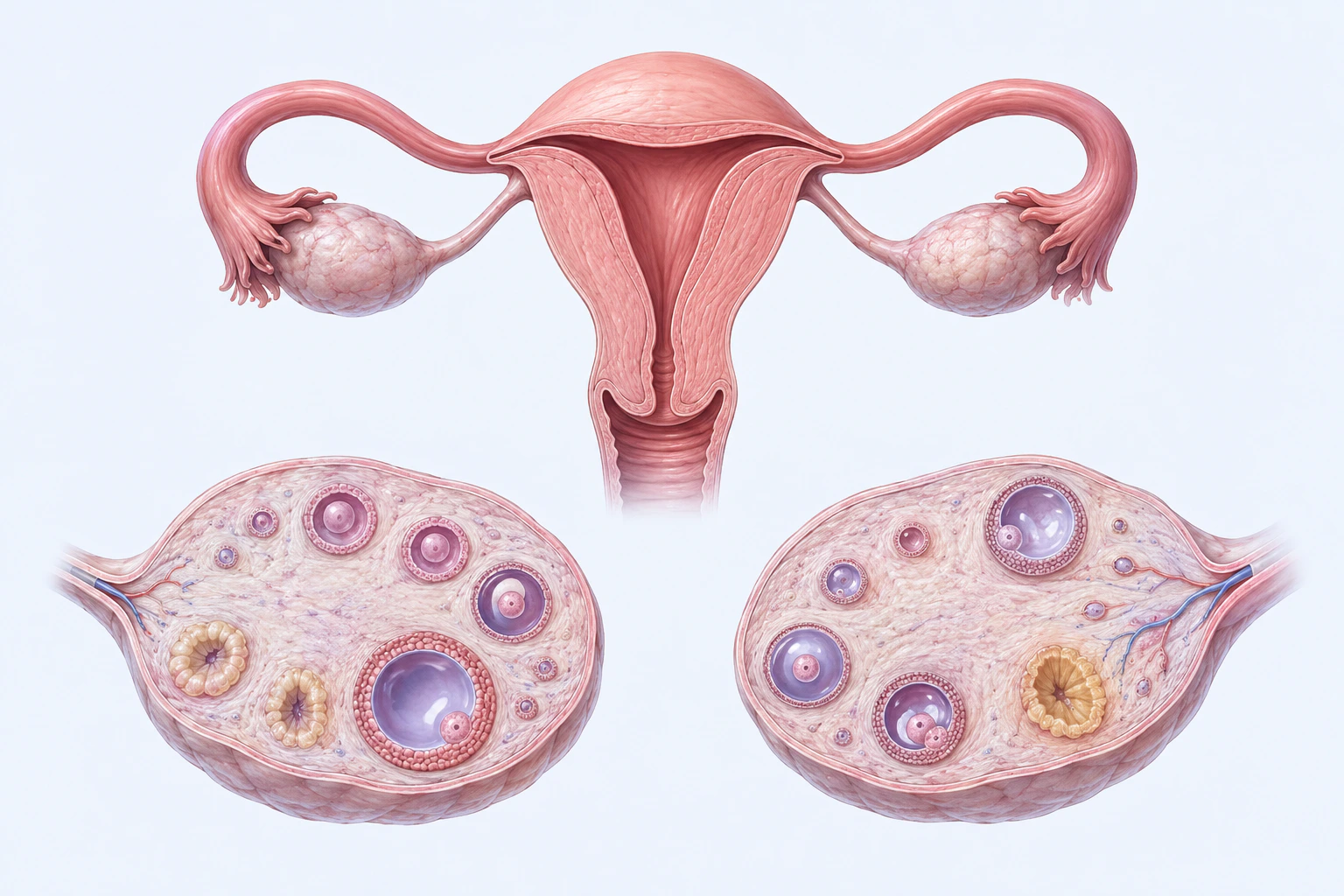
Primary ovarian insufficiency orientation without follicle-count, reserve, permanence, cause, fertility, menopause, or diagnostic claims.
Scientific media record1 verified identifier
- Subject
- Primary Ovarian Insufficiencycondition
- Identifiers
- MeSH:D016649
- Review
- Editorial review completeIdentifiers authority-verified · Accessibility validated · · premature-ovarian-insufficiency|premature-ovarian-insufficiency-pathology-v1.webp
- Digital source
- Trained-algorithmic mediaCreated with a trained generative algorithm and reviewed by WikiBiome for subject identity, scientific framing, identifiers, provenance, and accessibility.
- License
- CC BY-SA 4.0Created
Premature ovarian insufficiency (POI), previously called premature ovarian failure, is the loss of ovarian function before age 40, characterized by elevated follicle-stimulating hormone (FSH > 25 IU/L on two occasions), irregular or absent menstruation, and estrogen deficiency.
Beyond infertility, POI increases cardiovascular disease risk, osteoporosis risk, and neurocognitive decline risk due to premature estrogen loss. While genetic and autoimmune causes account for some cases, a significant proportion remains idiopathic—and the Gut-Gonadal Axis is emerging as a potential explanatory framework.
Evidence map1 cited passagesInspect provenance +
Bacteroides enrichment—Elevated Bacteroides species in POI patients; in mouse models, bacteroides fragilis gavage caused ovarian fibrosis, providing causal evidence that specific gut bacteria can directly damage ovarian tissue
One disease. Five evidence layers.
A generated systems view of the metals, organisms, host sequestration signals, ecological conditions, and microbial functions indexed for Premature Ovarian Insufficiency.
Evidence layer
Taxonomic signature
Organisms reported as enriched or depleted, with their indexed functional context kept beside the name.No structured taxa indexed yet.
No structured taxa indexed yet.
Evidence layer
Nutritional immunity
Host metal-withholding, inflammatory, antioxidant, and microbial-metabolite signals indexed in the signature.Elevated host signals
0No structured signals indexed yet.
Depleted protective signals
0No structured signals indexed yet.
Evidence layer
Ecological state
The environmental conditions that connect the organism-level observations into a system.No structured ecological features indexed yet.
Evidence layer
Virulence functions
Microbial structures, enzymes, and acquisition systems implicated by the linked evidence.No structured virulence functions indexed yet.
The disease record, in full.
The original WikiBiome disease narrative remains intact beneath the generated signature atlas.
Microbiome Associations#
POI patients show distinct Gut Microbiome alterations compared to age-matched controls. Bacteroides enrichment—Elevated Bacteroides species in POI patients; in mouse models, Bacteroides fragilis gavage caused ovarian fibrosis, providing causal evidence that specific gut bacteria can directly damage ovarian tissue.[1]Association between premature ovarian insufficiency and gut microbiotaWu J, Zhuo Y, Liu Y et al. · 2021Open reference 1 ↓
Prevotella enrichment—Enriched in POI; gram-negative anaerobe associated with gut Metal-Driven Inflammation and altered sex hormone profiles. Dialister enrichment—Correlates with FSH and LH levels, suggesting a direct gut-endocrine connection.
Faecalibacterium prausnitzii depletion—Loss of this major Butyrate producer reduces the anti-inflammatory SCFA buffer, potentially contributing to ovarian inflammation. Beta-Glucuronidase producers—Enrichment of beta-glucuronidase-producing taxa disrupts estrogen metabolism through deconjugation and enterohepatic recirculation, part of the broader Estrobolome dysregulation.
Metal Associations#
Cadmium—A potent metalloestrogen that binds the estrogen receptor and disrupts ovarian folliculogenesis. cadmium (Cd) accumulates in ovarian tissue and accelerates follicular atresia. Dietary cadmium exposure from rice, leafy vegetables, and shellfish represents a chronic low-dose insult to ovarian function.
Lead—Crosses the blood-follicle barrier and interferes with steroidogenesis. Prenatal and childhood lead exposure may reduce ovarian reserve decades before clinical POI manifests.
Mercury—Accumulates in ovarian tissue; associated with reduced AMH (anti-Mullerian hormone) levels, a marker of ovarian reserve.
The metalloestrogen concept is particularly relevant to POI: cadmium and other metals that mimic estrogen at the receptor level may paradoxically suppress endogenous estrogen production through negative feedback on the HPO axis, while simultaneously disrupting the gut microbiome communities that regulate estrogen recirculation.
Associated Conditions#
Female Infertility—POI is a major cause of female infertility; shared microbiome and metal signatures. Endometriosis—Shared estrobolome dysregulation and beta-glucuronidase enrichment. Polycystic Ovary Syndrome—Opposite hormonal phenotype (hyperandrogenism vs. hypogonadism) but shared gut Dysbiosis patterns.
Environmental Factors#
Endocrine-disrupting chemicals—BPA, phthalates, and organochlorine pesticides compound metal-driven ovarian damage. Smoking—Accelerates follicular depletion; cadmium in cigarette smoke is a direct ovarian toxicant. Diet—Cadmium-contaminated grains (especially rice) and mercury in seafood represent dietary metalloestrogen exposure.
Open Questions#
Unresolved questions identified by the current evidence record.
01Can gut microbiome restoration (targeting Bacteroides reduction and Faecalibacterium restoration) slow POI progression?+
The current WikiBiome record identifies this as an unresolved evidence gap.
02Does cadmium chelation improve ovarian reserve markers (AMH, antral follicle count) in POI patients?+
The current WikiBiome record identifies this as an unresolved evidence gap.
03Is the Bacteroides-ovarian fibrosis pathway reversible, or does it represent permanent tissue damage?+
The current WikiBiome record identifies this as an unresolved evidence gap.
Cross-References#
- Female Infertility—broader reproductive condition including POI
- Gut-Gonadal Axis—framework for microbiome-ovarian communication
- Beta-Glucuronidase—estrogen-deconjugating enzyme enriched in POI
- Estrobolome—collective microbial estrogen-metabolizing gene set
- Cadmium—metalloestrogen that disrupts ovarian function
- Bacteroides fragilis—causes ovarian fibrosis in mouse models
References 4
Numbered by first appearance in the article, then reconciled with its declared source list.
- 1
Wu J, Zhuo Y, Liu Y et al. (2021). Association between premature ovarian insufficiency and gut microbiota. BMC Pregnancy and Childbirth.
- 2
Jiang L, Fei H, Tong J et al. (2021). Hormone Replacement Therapy Reverses Gut Microbiome and Serum Metabolome Alterations in Premature Ovarian Insufficiency. Frontiers in Endocrinology.
- 3
Corkins MR, AAP Committee on Nutrition (2019). Corkins 2019 — Aluminum Effects on Infants and Children. Pediatrics.
- 4
Zhu F, Li F, Zhang R et al. (2026). Indole-3-carbinol alleviates cisplatin-induced ovarian damage by inhibiting ovarian fibrosis through the TGF-beta1/Smad pathway. Journal of Ovarian Research.
Article network
Connect the evidence
Publicly readable discussion by ORCID-authenticated researchers. Questions, interpretation, methods, corrections, and new evidence stay attached to this record.
No discussion yet. Start with a precise question or a source-backed observation.
Published page changes
This record shows only material changes published on this page, including changes to its content, evidence, conclusions, or author context. Internal processes and discussion activity are excluded. Pending, declined, and withdrawn proposals remain private.
- published revision
Added references: corkins-2019-aluminum-effects-infants-children; zhu-2026-indole-3-carbinol-cisplatin-ovarian-fibrosis.
WikiBiome Deploy Bot · +19 −19
Inspect exact Git diff ↗ - published revision
Created “Premature Ovarian Insufficiency”: Premature ovarian insufficiency (POI), previously called premature ovarian failure, is the loss of ovarian function before age 40, characterized by elevated follicle-stimulating hormone (FSH > 25 IU/L…
Created “Premature Ovarian Insufficiency”: Premature ovarian insufficiency (POI), previously called premature ovarian failure, is the loss of ovarian function before age 40, characterized by elevated follicle-stimulating hormone (FSH > 25 IU/L… Published sections: Overview; Microbiome Associations; Metal Associations; Associated Conditions; Environmental Factors; Open Questions; Cross-References. · WikiBiome Deploy Bot · +96 −0
Inspect exact Git diff ↗