

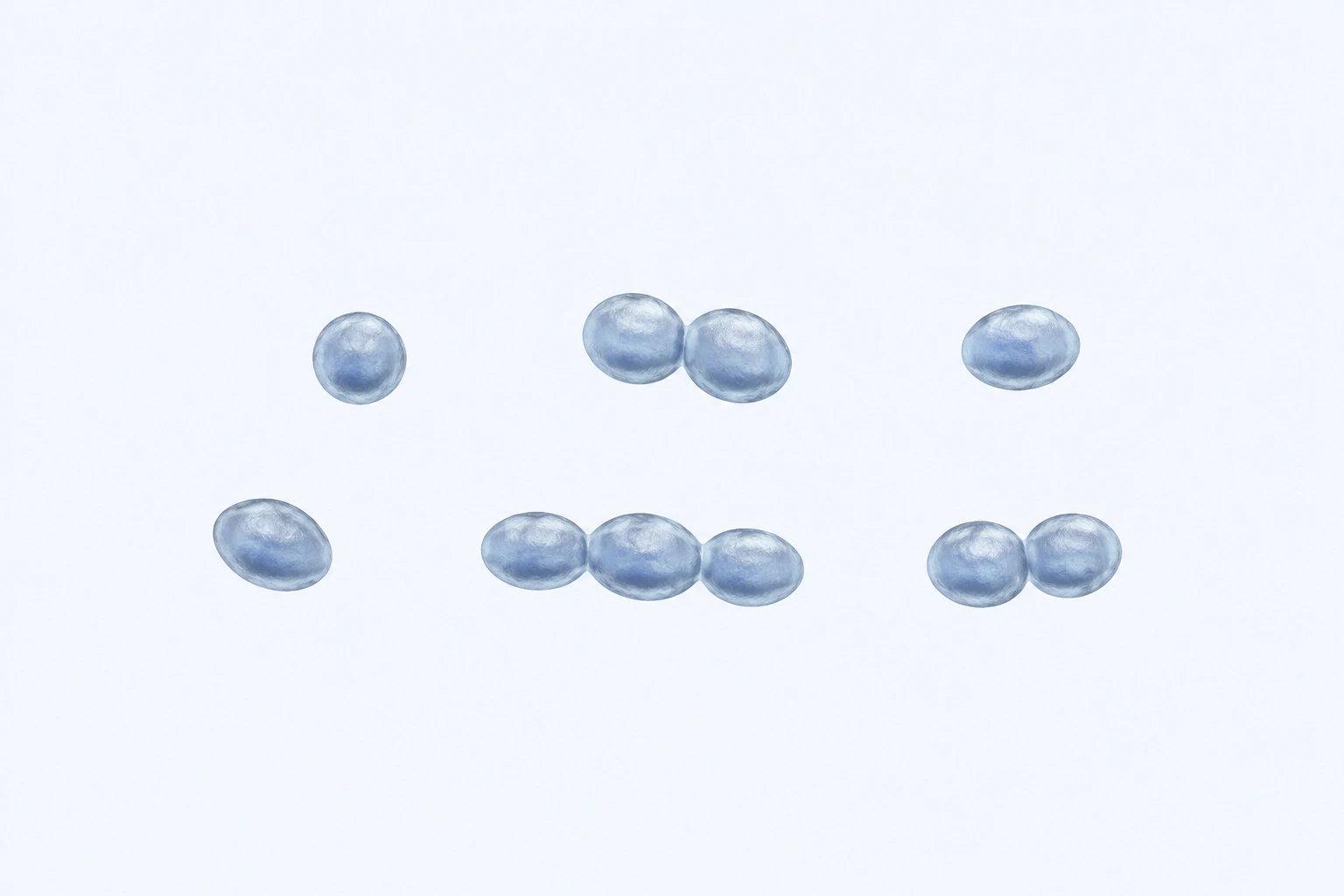
Type-strain-anchored Peptostreptococcus anaerobius reconstruction showing ten pleomorphic coccobacillary bodies in three single, two paired, and one three-body chain grouping. This species plate is representative, non-diagnostic, and not a micrograph.
Scientific media record1 verified identifier
- Subject
- Peptostreptococcus anaerobiustaxon · species
- Identifiers
- NCBITaxon:1261
- Review
- Editorial review completeIdentifiers authority-verified · Accessibility validated · · peptostreptococcus-anaerobius|peptostreptococcus-anaerobius-morphology-v1.webp
- Digital source
- Trained-algorithmic mediaCreated with a trained generative algorithm and reviewed by WikiBiome for subject identity, scientific framing, identifiers, provenance, and accessibility.
- Scientific basis
- Peptostreptococcus anaerobius — NCBI TaxonomyPeptostreptococcus anaerobius — LPSNGram-positive anaerobic cocciPeptostreptococcus anaerobius type strain — BacDive
- License
- CC BY-SA 4.0Created
A Gram-positive, obligate anaerobic bacterium within the Firmicutes phylum (family Peptostreptococcaceae) that has emerged as a consistently enriched organism in the colorectal cancer tumor microenvironment.
While Fusobacterium nucleatum receives the most attention as a CRC-associated bacterium, P. anaerobius operates through a distinct pro-tumorigenic mechanism involving TLR2/TLR4 signaling, NF-kB activation, and cholesterol biosynthesis pathway upregulation—making it a complementary driver of colorectal carcinogenesis rather than a redundant player.
Evidence map4 cited passagesInspect provenance +
P. anaerobius is specifically enriched in tumor tissue compared to adjacent normal mucosa. Its tumor tropism may be driven by:
P. anaerobius is enriched in the CRC tumor microenvironment and is cataloged alongside streptococcus gallolyticus, enterotoxigenic bacteroides fragilis, pks+ escherichia coli, fusobacterium nucleatum, and enterococcus faecalis as one of six bacteria with well-characterized pro-tumorigenic mechanisms.
(cross-sectional)—Identified P. anaerobius enrichment in the CRC tumor microenvironment.
(review)—Cataloged the specific pro-tumorigenic mechanisms of P. anaerobius alongside five other CRC-associated bacteria.
Contents
1. Taxonomy2. Metal Dependencies3. Key Enzymes and Virulence Factors4. Ecological Role5. Conditions Associated6. Key Studies7. Cross-ReferencesTaxonomy#
Peptostreptococcus anaerobius—the type species of the genus. Family Peptostreptococcaceae, order Clostridiales, class Clostridia. Distinguished from the related genus Parvimonas (formerly Peptostreptococcus micros) and Peptostreptococcus stomatis, which has its own CRC associations.
Metal Dependencies#
Iron. Iron-sulfur cluster proteins support anaerobic energy metabolism in P. anaerobius. The tumor microenvironment provides abundant iron from hemorrhage, neovascularization, and macrophage-mediated iron recycling—conditions that likely favor P. anaerobius colonization.
Iron availability in colorectal tumors may partly explain the selective enrichment of iron-dependent anaerobes like P. anaerobius alongside Fusobacterium nucleatum and Bacteroides fragilis.
Key Enzymes and Virulence Factors#
Surface protein interactions with TLR2 and TLR4: P. anaerobius activates innate immune receptors on colonic epithelial cells and macrophages, triggering NF-kB-dependent inflammatory signaling. Unlike bacterial toxins that directly damage cells, this mechanism hijacks the host inflammatory response to create a pro-tumorigenic microenvironment.
Cholesterol biosynthesis pathway activation: P. anaerobius colonization upregulates cholesterol biosynthesis in colonic epithelial cells, promoting cell proliferation. Cholesterol is a critical membrane component for rapidly dividing cancer cells.
Putrescine biosynthesis: Production of the polyamine putrescine contributes to cell proliferation signaling in the tumor microenvironment. ROS generation: P. anaerobius promotes reactive oxygen species production in colonocytes, contributing to DNA damage and genomic instability.
Ecological Role#
In the Healthy Gut#
P. anaerobius is a low-abundance commensal in the oral cavity and gut. It is commonly isolated from mixed anaerobic infections (abscesses, peritonitis) but is not typically a dominant member of the healthy colonic microbiota.
In the Tumor Microenvironment#
P. anaerobius is specifically enriched in tumor tissue compared to adjacent normal mucosa.[1]Microbiota disbiosis is associated with colorectal cancerZhiguang Gao, Bomin Guo, Renyuan Gao et al. · 2015Open reference 1 ↓ Its tumor tropism may be driven by. Iron availability from tumor hemorrhage.
Hypoxic conditions that favor obligate anaerobes. Nutrient-rich necrotic tissue providing amino acid substrates.
Conditions Associated#
Colorectal Cancer#
P. anaerobius is enriched in the CRC tumor microenvironment[1]Microbiota disbiosis is associated with colorectal cancerZhiguang Gao, Bomin Guo, Renyuan Gao et al. · 2015Open reference 1 ↓ and is cataloged alongside Streptococcus gallolyticus, enterotoxigenic Bacteroides fragilis, pks+ Escherichia coli, Fusobacterium nucleatum, and Enterococcus faecalis as one of six bacteria with well-characterized pro-tumorigenic mechanisms.[2]Immune System, Microbiota, and Microbial Metabolites: The Unresolved Triad in Colorectal Cancer MicroenvironmentHanus M, Parada-Venegas D, Landskron G et al. · 2021Open reference 2 ↓
The mechanistic triad. Immune modulation—TLR2/TLR4 activation → NF-kB → pro-inflammatory cytokines → tumor-promoting Metal-Driven Inflammation. Metabolic reprogramming—cholesterol biosynthesis upregulation → enhanced cell proliferation.
Genotoxicity—ROS production → DNA damage → genomic instability.
Key Studies#
[1]Microbiota disbiosis is associated with colorectal cancerZhiguang Gao, Bomin Guo, Renyuan Gao et al. · 2015Open reference 1 ↓ (cross-sectional)—Identified P. anaerobius enrichment in the CRC tumor microenvironment.[2]Immune System, Microbiota, and Microbial Metabolites: The Unresolved Triad in Colorectal Cancer MicroenvironmentHanus M, Parada-Venegas D, Landskron G et al. · 2021Open reference 2 ↓ (review)—Cataloged the specific pro-tumorigenic mechanisms of P. anaerobius alongside five other CRC-associated bacteria.
Cross-References#
- Colorectal Cancer—the primary disease association
- Fusobacterium nucleatum—co-enriched CRC pathobiont; complementary mechanism
- Streptococcus gallolyticus—classic CRC-associated bacterium
- Bacteroides fragilis—enterotoxigenic strains contribute to CRC via BFT toxin
- Enterococcus faecalis—superoxide-producing CRC contributor
- Iron—tumor microenvironment iron availability drives selective colonization
- Peptostreptococcus stomatis—related species with its own CRC associations
References 8
Numbered by first appearance in the article, then reconciled with its declared source list.
- 1
Zhiguang Gao, Bomin Guo, Renyuan Gao et al. (2015). Microbiota disbiosis is associated with colorectal cancer. Frontiers in Microbiology.
- 2
Hanus M, Parada-Venegas D, Landskron G et al. (2021). Immune System, Microbiota, and Microbial Metabolites: The Unresolved Triad in Colorectal Cancer Microenvironment. Frontiers in Immunology.
- 3
Marius Troeseid, Susanne Dam Nielsen, Ivan Vujkovic-Cvijin (2024). Gut microbiome and cardiometabolic comorbidities in people living with HIV. Microbiome.
- 4
Youwen Qin, Xin Tong, Wei-Jian Mei et al. (2024). Consistent signatures in the human gut microbiome of old- and young-onset colorectal cancer. Nature Communications.
- 5
Zangeneh Z, Abdi-Ali A, Khamooshian K et al. (2021). Bacterial Variation in the Oral Microbiota in Multiple Sclerosis Patients. PLoS ONE.
- 6
Saito K, Koido S, Odamaki T et al. (2019). Metagenomic Analyses of the Gut Microbiota Associated with Colorectal Adenoma. PLOS ONE.
- 7
Qian Yang, Yaping Wang, Xinyi Wei et al. (2020). Yang 2020 — Vaginal Microbiome Alterations in HPV16 Infection by Shotgun Metagenomics. Frontiers in Cellular and Infection Microbiology.
- 8
Filipe T. Lira Neto, Marina C. Viana, Federica Cariati et al. (2024). Neto 2024 — Effect of Environmental Factors on Seminal Microbiome and Impact on Sperm Quality. Frontiers in Endocrinology.
Article network
Connect the evidence
Publicly readable discussion by ORCID-authenticated researchers. Questions, interpretation, methods, corrections, and new evidence stay attached to this record.
No discussion yet. Start with a precise question or a source-backed observation.
Activity and accepted changes
Accepted researcher context, editorial status, public discussion, and upstream Git revisions are shown together. Pending, declined, and withdrawn proposals remain private.
- published revision
Strengthen TLR4 and link high-leverage contexts
Karen Pendergrass · +1 −1
Inspect exact Git diff ↗ - published revision
Backfill inflammation concept links
Karen Pendergrass · +1 −1
Inspect exact Git diff ↗ - published revision
massive wiki expansion: 149 stubs fixed, 100+ new pages, Rule 15 scan, keystone papers
WikiBiome Deploy Bot · +20 −14
Inspect exact Git diff ↗ - published revision
nightly maintenance: 94 stub demotions, 181 source_count fixes, 22 auto-discovered stubs, 5 adversarial audits, 3 boundary fixes, 3 evidence-level corrections
WikiBiome Deploy Bot · +2 −0
Inspect exact Git diff ↗ - published revision
pre-overnight checkpoint 2026-04-18
WikiBiome Deploy Bot · +83 −0
Inspect exact Git diff ↗