

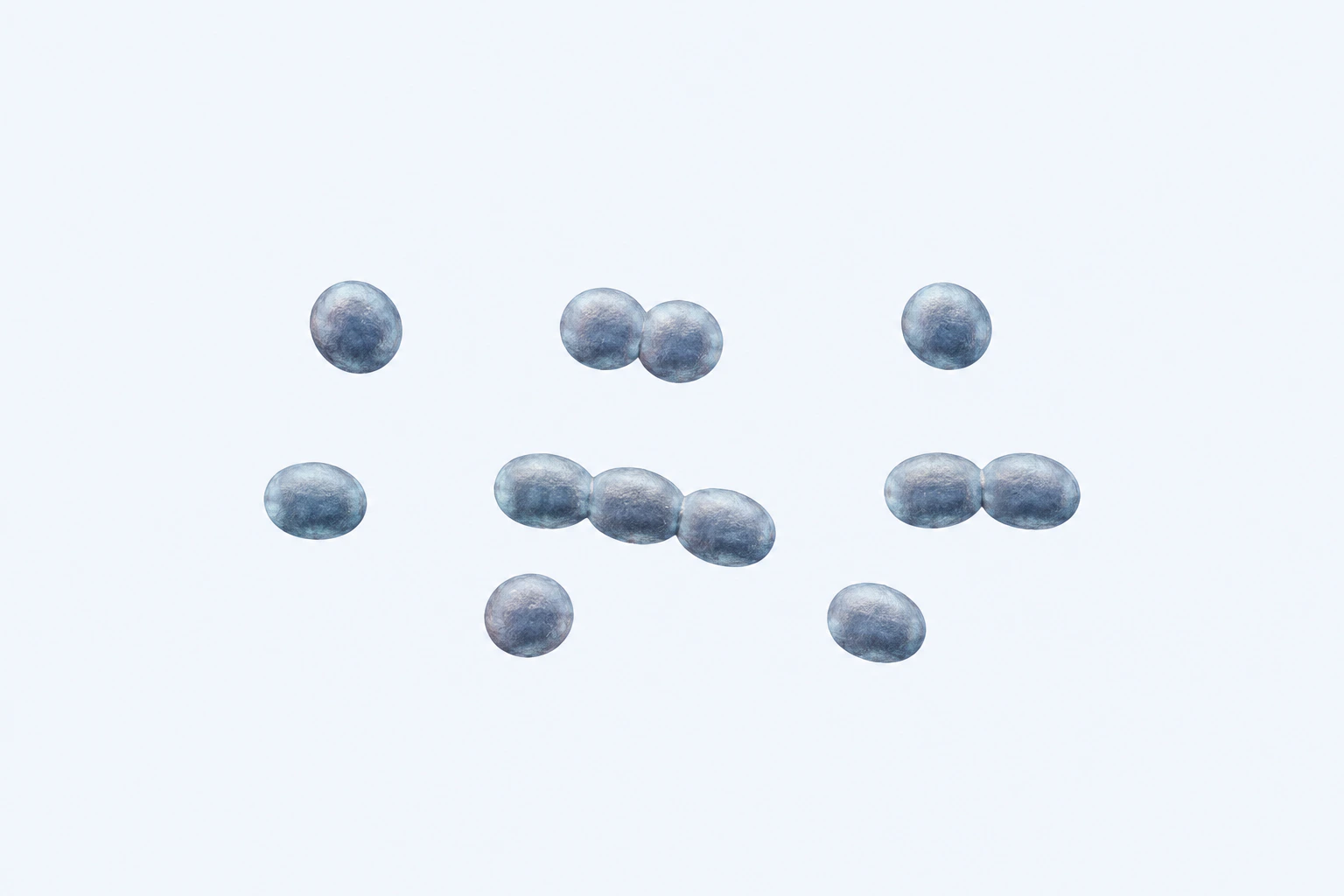
Type-species-anchored Peptostreptococcus reconstruction showing twelve coccoid-to-short-coccobacillary bodies in five single, two paired, and one three-body chain grouping. This genus plate is representative, non-universal, non-diagnostic, and not a micrograph.
Scientific media record1 verified identifier
- Subject
- Peptostreptococcustaxon · genus
- Identifiers
- NCBITaxon:1257
- Review
- Editorial review completeIdentifiers authority-verified · Accessibility validated · · peptostreptococcus|peptostreptococcus-morphology-v1.webp
- Digital source
- Trained-algorithmic mediaCreated with a trained generative algorithm and reviewed by WikiBiome for subject identity, scientific framing, identifiers, provenance, and accessibility.
- Scientific basis
- Peptostreptococcus — NCBI TaxonomyPeptostreptococcus — LPSNProposal to restrict the genus Peptostreptococcus to Peptostreptococcus anaerobius
- License
- CC BY-SA 4.0Created
A Gram-positive, obligate anaerobic genus that has emerged as one of the most consistently enriched taxa in Colorectal Cancer. The key pathogenic species P. anaerobius promotes colorectal carcinogenesis through multiple mechanisms including cholesterol biosynthesis induction, reactive oxygen species (ROS) generation, and NF-kB Signaling Pathway activation.
The genus also plays a role in periodontal disease, connecting oral and gut pathology.
Evidence map11 cited passagesInspect provenance +
Low-abundance member of the normal gut microbiota that expands dramatically under dysbiotic conditions, particularly in the CRC tumor microenvironment.
Iron-dependent organism; its expansion in CRC may be facilitated by the iron-rich environment of bleeding tumors and the disrupted nutritional immunity landscape of the tumor microenvironment.
Part of the oral-gut translocation pathway—normally abundant in the oral cavity, Peptostreptococcus can colonize the colon when oral barrier function is compromised or gastric acid is suppressed.
Cholesterol biosynthesis: P. anaerobius activates cholesterol biosynthesis pathways in colonic epithelial cells, promoting cell proliferation. This connects to the broader observation that altered lipid metabolism characterizes CRC progression.
ROS generation: Induces reactive oxygen species in host cells, contributing to DNA damage, genomic instability, and mutagenesis—hallmarks of carcinogenesis.
NF-kB activation: Triggers nf kappa b signaling in colonic epithelial and immune cells, driving chronic inflammation that supports tumor initiation and progression.
Immune modulation: Promotes a pro-tumor immune microenvironment by recruiting myeloid-derived suppressor cells (MDSCs) and polarizing tumor-associated macrophages.
Among the top 3 most consistently enriched genera in CRC across the Islam 2022 meta-analysis of 27 CRC studies, alongside fusobacterium and porphyromonas.
Enriched in both old-onset and young-onset CRC, demonstrating a consistent CRC-microbiome signature.
Listed in the Hanus 2021 comprehensive catalog of bacteria involved in colorectal carcinogenesis alongside F. nucleatum, enterotoxigenic B. fragilis, and pks+ escherichia coli.
In the oral cavity, Peptostreptococcus was higher in healthy controls than in MS patients, with potential protective effects via indoleacrylic acid production that increases IL-10 secretion.
Contents
1. Role in Gut Ecosystem2. Mechanisms of CRC Promotion3. Disease Associations4. Key Metabolites5. ConnectionsRole in Gut Ecosystem#
Low-abundance member of the normal gut microbiota that expands dramatically under dysbiotic conditions, particularly in the CRC tumor microenvironment.[1]Reproducible and opposing gut microbiome signatures distinguish autoimmune diseases and cancers: a systematic review and meta-analysisMd Zohorul Islam, Melissa Tran, Tao Xu et al. · 2022Open reference 1 ↓
Iron-dependent organism; its expansion in CRC may be facilitated by the iron-rich environment of bleeding tumors and the disrupted Nutritional Immunity (Metal Sequestration) landscape of the tumor microenvironment.[2]Beyond Taxonomic Analysis of Microbiomes: A Functional Approach for Revisiting Microbiome Changes in Colorectal CancerNorouzi-Beirami MH, Marashi SA, Banaei-Moghaddam AM et al. · 2020Open reference 2 ↓
Part of the oral-gut translocation pathway—normally abundant in the oral cavity, Peptostreptococcus can colonize the colon when oral barrier function is compromised or gastric acid is suppressed.[3]Bacterial Variation in the Oral Microbiota in Multiple Sclerosis PatientsZangeneh Z, Abdi-Ali A, Khamooshian K et al. · 2021Open reference 3 ↓
Mechanisms of CRC Promotion#
Cholesterol biosynthesis: P. anaerobius activates cholesterol biosynthesis pathways in colonic epithelial cells, promoting cell proliferation.[4]Immune System, Microbiota, and Microbial Metabolites: The Unresolved Triad in Colorectal Cancer MicroenvironmentHanus M, Parada-Venegas D, Landskron G et al. · 2021Open reference 4 ↓ This connects to the broader observation that altered lipid metabolism characterizes CRC progression.
ROS generation: Induces reactive oxygen species in host cells, contributing to DNA damage, genomic instability, and mutagenesis—hallmarks of carcinogenesis.[4]Immune System, Microbiota, and Microbial Metabolites: The Unresolved Triad in Colorectal Cancer MicroenvironmentHanus M, Parada-Venegas D, Landskron G et al. · 2021Open reference 4 ↓[2]Beyond Taxonomic Analysis of Microbiomes: A Functional Approach for Revisiting Microbiome Changes in Colorectal CancerNorouzi-Beirami MH, Marashi SA, Banaei-Moghaddam AM et al. · 2020Open reference 2 ↓
NF-kB activation: Triggers NF-kB Signaling Pathway signaling in colonic epithelial and immune cells, driving chronic Metal-Driven Inflammation that supports tumor initiation and progression.[4]Immune System, Microbiota, and Microbial Metabolites: The Unresolved Triad in Colorectal Cancer MicroenvironmentHanus M, Parada-Venegas D, Landskron G et al. · 2021Open reference 4 ↓
Immune modulation: Promotes a pro-tumor immune microenvironment by recruiting myeloid-derived suppressor cells (MDSCs) and polarizing tumor-associated macrophages.[5]A Systematic Review of Microbial Markers for Risk Prediction of Colorectal NeoplasiaYu L, Zhao G, Wang L et al. · 2022Open reference 5 ↓
Disease Associations#
Colorectal Cancer#
Among the top 3 most consistently enriched genera in CRC across the Islam 2022 meta-analysis of 27 CRC studies, alongside Fusobacterium and Porphyromonas.[1]Reproducible and opposing gut microbiome signatures distinguish autoimmune diseases and cancers: a systematic review and meta-analysisMd Zohorul Islam, Melissa Tran, Tao Xu et al. · 2022Open reference 1 ↓
Enriched in both old-onset and young-onset CRC, demonstrating a consistent CRC-microbiome signature.[6]Consistent signatures in the human gut microbiome of old- and young-onset colorectal cancerYouwen Qin, Xin Tong, Wei-Jian Mei et al. · 2024Open reference 6 ↓
Listed in the Hanus 2021 comprehensive catalog of bacteria involved in colorectal carcinogenesis alongside F. nucleatum, enterotoxigenic B. fragilis, and pks+ Escherichia coli.[4]Immune System, Microbiota, and Microbial Metabolites: The Unresolved Triad in Colorectal Cancer MicroenvironmentHanus M, Parada-Venegas D, Landskron G et al. · 2021Open reference 4 ↓
Periodontal Disease#
Core member of the subgingival pathogenic consortium in periodontitis. Oral Peptostreptococcus may translocate to the gut, contributing to the oral-gut-axis in CRC development.
Multiple Sclerosis—Oral Microbiome#
- In the oral cavity, Peptostreptococcus was higher in healthy controls than in MS patients, with potential protective effects via indoleacrylic acid production that increases IL-10 secretion.[3]Bacterial Variation in the Oral Microbiota in Multiple Sclerosis PatientsZangeneh Z, Abdi-Ali A, Khamooshian K et al. · 2021Open reference 3 ↓
Key Metabolites#
Indoleacrylic acid—tryptophan derivative; increases IL-10 (anti-inflammatory) in oral context. ROS-inducing factors—promote oxidative DNA damage in colonic epithelium. Cholesterol pathway activators—drive epithelial proliferation in CRC.
Connections#
- Colorectal Cancer—one of the most consistently CRC-enriched genera; multi-mechanism carcinogenesis
- Fusobacterium—co-enriched CRC pathogen; complementary pro-tumor mechanisms
- Porphyromonas—co-enriched in CRC; shared oral-gut translocation pathway
- Iron—iron-dependent growth; benefits from iron-rich tumor microenvironment
- NF-kB Signaling Pathway—activates NF-kB pro-inflammatory signaling in CRC
- Oxidative Stress—ROS generation contributes to genomic instability
- inflammation—chronic inflammation driver via NF-kB and immune cell recruitment
- Escherichia coli—pks+ E. coli is a fellow CRC-promoting pathobiont
- Dysbiosis—expansion reflects cancer-associated dysbiotic state
References 6
Numbered by first appearance in the article, then reconciled with its declared source list.
- 1
Md Zohorul Islam, Melissa Tran, Tao Xu et al. (2022). Reproducible and opposing gut microbiome signatures distinguish autoimmune diseases and cancers: a systematic review and meta-analysis. Microbiome.
- 2
Norouzi-Beirami MH, Marashi SA, Banaei-Moghaddam AM et al. (2020). Beyond Taxonomic Analysis of Microbiomes: A Functional Approach for Revisiting Microbiome Changes in Colorectal Cancer. Frontiers in Microbiology.
- 3
Zangeneh Z, Abdi-Ali A, Khamooshian K et al. (2021). Bacterial Variation in the Oral Microbiota in Multiple Sclerosis Patients. PLoS ONE.
- 4
Hanus M, Parada-Venegas D, Landskron G et al. (2021). Immune System, Microbiota, and Microbial Metabolites: The Unresolved Triad in Colorectal Cancer Microenvironment. Frontiers in Immunology.
- 5
Yu L, Zhao G, Wang L et al. (2022). A Systematic Review of Microbial Markers for Risk Prediction of Colorectal Neoplasia. British Journal of Cancer.
- 6
Youwen Qin, Xin Tong, Wei-Jian Mei et al. (2024). Consistent signatures in the human gut microbiome of old- and young-onset colorectal cancer. Nature Communications.
Article network
Connect the evidence
Publicly readable discussion by ORCID-authenticated researchers. Questions, interpretation, methods, corrections, and new evidence stay attached to this record.
No discussion yet. Start with a precise question or a source-backed observation.
Activity and accepted changes
Accepted researcher context, editorial status, public discussion, and upstream Git revisions are shown together. Pending, declined, and withdrawn proposals remain private.
- published revision
Backfill inflammation concept links
Karen Pendergrass · +2 −2
Inspect exact Git diff ↗ - published revision
massive wiki expansion: 149 stubs fixed, 100+ new pages, Rule 15 scan, keystone papers
WikiBiome Deploy Bot · +9 −9
Inspect exact Git diff ↗ - published revision
nightly maintenance: 94 stub demotions, 181 source_count fixes, 22 auto-discovered stubs, 5 adversarial audits, 3 boundary fixes, 3 evidence-level corrections
WikiBiome Deploy Bot · +1 −0
Inspect exact Git diff ↗ - published revision
pre-overnight checkpoint 2026-04-18
WikiBiome Deploy Bot · +1 −1
Inspect exact Git diff ↗ - published revision
Add 11 deepened microbe entities and 9 new OC/CVD/infertility source pages
WikiBiome Deploy Bot · +7 −7
Inspect exact Git diff ↗ - published revision
WikiBiome update — 2026-04-15 17:23
WikiBiome Deploy Bot · +0 −1
Inspect exact Git diff ↗ - published revision
wiki: bulk entity upgrades, new article pages, and site regeneration
WikiBiome Deploy Bot · +6 −0
Inspect exact Git diff ↗ - published revision
WikiBiome update — integrity fixes, metallomic diet pages, cross-condition analyses
WikiBiome Deploy Bot · +17 −9
Inspect exact Git diff ↗ - published revision
WikiBiome update — 2026-04-10 13:49
WikiBiome Deploy Bot · +59 −0
Inspect exact Git diff ↗