

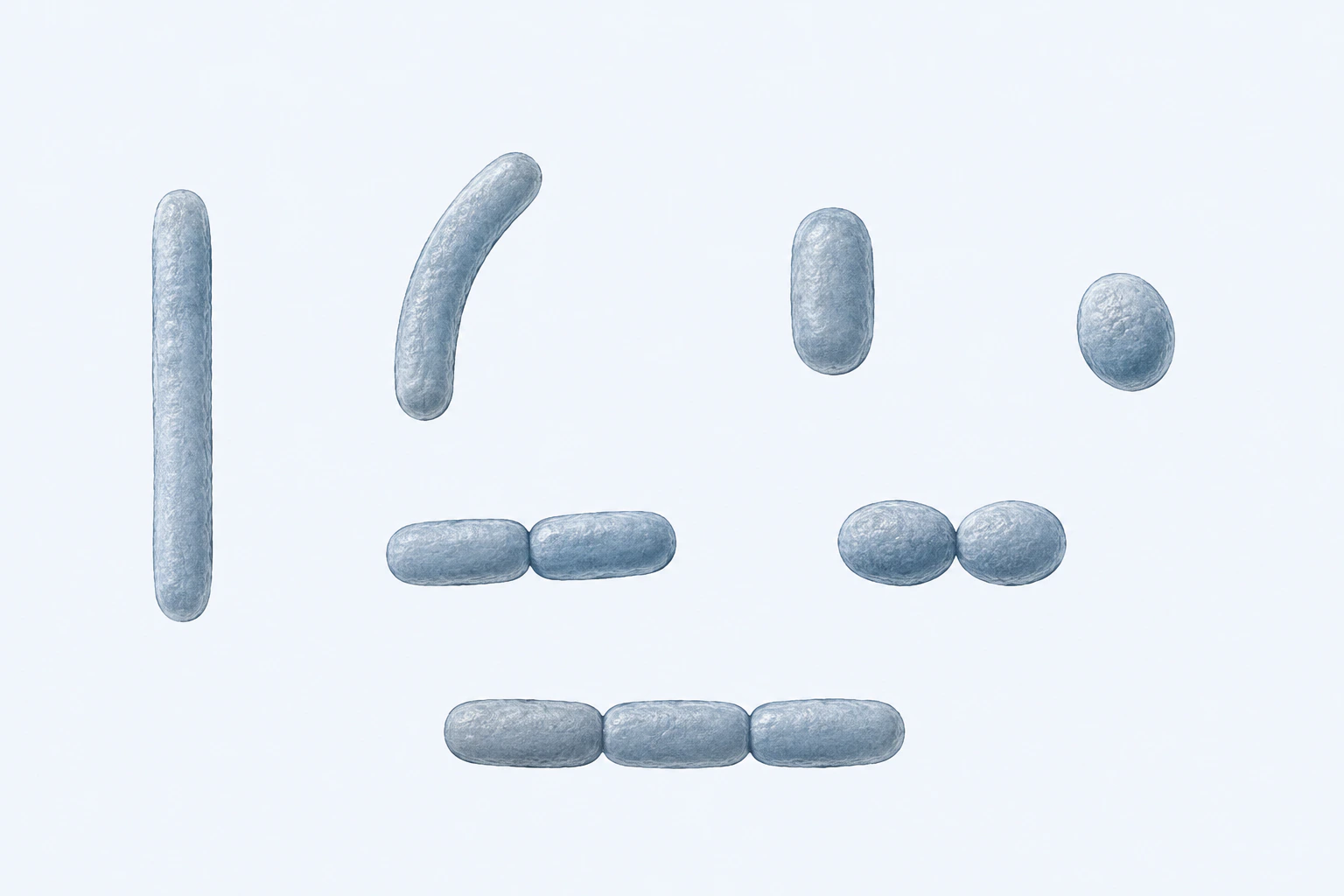
Selected current Oscillospiraceae descendant forms, shown as eleven bodies in four single, two paired, and one three-body chain grouping. This family-level scientific diversity reconstruction is representative, non-exhaustive, non-universal, non-diagnostic, and not a micrograph.
Scientific media record1 verified identifier
- Subject
- Oscillospiraceaetaxon · family
- Identifiers
- NCBITaxon:216572
- Review
- Editorial review completeIdentifiers authority-verified · Accessibility validated · · oscillospiraceae|oscillospiraceae-microbial-community-v1.webp
- Digital source
- Trained-algorithmic mediaCreated with a trained generative algorithm and reviewed by WikiBiome for subject identity, scientific framing, identifiers, provenance, and accessibility.
- Scientific basis
- Oscillospiraceae — NCBI TaxonomyOscillospiraceae — LPSNRuminococcaceae family proposalOscillibacter valericigenes genomeIntestinimonas butyriciproducens gen. nov., sp. nov.Oscillospira and related uncultured bacteria
- License
- CC BY-SA 4.0Created
A family of Gram-positive obligate anaerobes (formerly classified as the genus Oscillospira, now reclassified into Oscillibacter and related genera within Oscillospiraceae) that serve as keystone Butyrate producers in the healthy human distal colonic microbiota (Konikoff and Gophna 2016).
Members of this family are consistently and significantly depleted in obesity, inflammatory bowel disease, colorectal cancer, and other dysbiotic states,[1]Heavy Metals, Microbial Metallomics, and the US Obesity Epidemic: A Mechanistic Examination of a Population-Level Metabolic DisruptionKaren Pendergrass · 2026Open reference 1 ↓[2]Toxic and Essential Metals: Metabolic Interactions with the Gut Microbiota and Health ImplicationsQinheng Zhu, Boyan Chen, Fu Zhang et al. · 2024Open reference 2 ↓ with their loss correlating with reduced fecal butyrate and impaired intestinal barrier function.
Oscillospiraceae represent a prime target for next-generation probiotic development due to their metabolic role, rarity in culture collections, and therapeutic potential in restoring SCFA-mediated immune homeostasis (Yang et al. 2021).
Evidence map6 cited passagesInspect provenance +
A family of Gram-positive obligate anaerobes (formerly classified as the genus Oscillospira, now reclassified into Oscillibacter and related genera within Oscillospiraceae) that serve as keystone butyrate producers in the healthy human distal colonic microbiota (Konikoff and Gophna 2016). Members of this family are consistently and significantly depleted in
Mechanistic link: Loss of butyrate producers → reduced SCFA → impaired barrier function → increased LPS translocation → systemic inflammation → insulin resistance → obesity perpetuation.
Iron paradox: Although obligate anaerobes, Oscillospiraceae are outcompeted in iron-replete dysbiotic states by metal-tolerant pathobionts; heavy metal exposure (Cd, Ni) selectively eliminates SCFA-producing taxa including Oscillospiraceae while enriching metal-tolerant Proteobacteria.
Depleted in both Crohn's and Ulcerative Colitis: Reduced fecal abundance during flares; partial recovery during remission.
Mechanistic contribution: Loss of SCFA producers → reduced epithelial energy → barrier dysfunction → increased paracellular permeability → antigen breach → immune activation.
Significantly depleted in CRC tissue and feces: Compared to polyp-free controls.
Contents
1. Taxonomy and Reclassification2. Butyrate Synthesis and Metabolic Role3. Iron and Zinc Dependencies4. Disease Associations and Depletion Patterns5. Culturability and Probiotic Potential6. Ecological Context and Community Function7. Ecological Modulators8. ConnectionsTaxonomy and Reclassification#
Traditional name: Oscillospira (based on spiral morphology; genus no longer valid). Current classification: Family Oscillospiraceae, containing genera Oscillibacter, Subdoligranulum, and others. Key species: Oscillibacter valericigenes, Subdoligranulum variabile—most frequently detected in 16S surveys.
Morphology: Large (5-10 μm), elongated rods; gram-positive cell wall (though some strains stain variable); obligate anaerobes; difficult to culture (fastidious growth requirements).
Butyrate Synthesis and Metabolic Role#
Butyrate Synthesis Pathway#
Oscillospiraceae use the acetyl-CoA pathway for butyrate synthesis. Two acetyl-CoA molecules → acetoacetyl-CoA (via thiophorase) → butyryl-CoA (via butyryl-CoA dehydrogenase) → butyrate. This is distinct from the phosphotransferase system (PTS) used by Roseburia and Faecalibacterium, which utilize lactate or glucose-derived substrates.
Oscillospiraceae ferment diverse carbohydrate substrates (cellulose, hemicellulose, inulin, resistant starch) when available.
Butyrate Bioavailability and Host Effects#
Intestinal epithelial fuel: Colonocytes derive 60-80% of energy from butyrate oxidation; butyrate deficiency impairs epithelial energetics.
Histone deacetylase (HDAC) inhibition: Butyrate inhibits HDAC classes 1 and 2, increasing histone acetylation and gene expression related to barrier function genes, tight junction proteins (claudins, occludin, ZO-1), and anti-inflammatory markers.
GPR43 and GPR109A signaling: Butyrate activates these G-protein-coupled receptors on epithelial cells and immune cells (dendritic cells, T cells), promoting IL-10-producing regulatory T cells (Tregs) and suppressing pro-inflammatory Th17 differentiation.
Colonic pH: Butyrate fermentation lowers pH, creating selective pressure against pathogens and favoring beneficial anaerobes.
Iron and Zinc Dependencies#
Metal Requirements#
Oscillospiraceae require iron and zinc for core metabolic enzymes. Iron: Essential cofactor for cytochrome oxidase, ferredoxin, and other electron transport components. Zinc: Cofactor for proteases, RNA polymerase, and metabolic regulatory enzymes.
In iron-deficient, zinc-restricted microenvironments, Oscillospiraceae are outcompeted; in metal-replete dysbiotic states, they remain suppressed by dominant pathobionts.
Metal Availability and Dysbiosis Link#
Iron availability paradox: While obligate anaerobes, Oscillospiraceae require basal iron for respiratory chain remnants and other enzymes.
In dysbiotic, bleeding gut with elevated Hepcidin (Metal-Driven Inflammation-driven), iron sequestration is ineffective, allowing pathobionts Fusobacterium varium, Bacteroides fragilis to thrive while Oscillospiraceae remain outcompeted due to altered competitive balance (not iron limitation per se, but ecological shift).
Selective iron/zinc supplementation or restoration of Dysbiosis-related iron overload may indirectly support Oscillospiraceae recovery by tipping competitive interactions.
Disease Associations and Depletion Patterns#
Obesity#
Consistent depletion: Reduced abundance in obese microbiota vs. lean controls; reduction correlates with severity of adiposity (Konikoff and Gophna 2016; Tavella et al. 2021).
Mechanistic link: Loss of butyrate producers → reduced SCFA → impaired barrier function → increased LPS translocation → systemic inflammation → insulin resistance → obesity perpetuation.[1]Heavy Metals, Microbial Metallomics, and the US Obesity Epidemic: A Mechanistic Examination of a Population-Level Metabolic DisruptionKaren Pendergrass · 2026Open reference 1 ↓[3]Effects of Heavy Metals on Gut Barrier Integrity and Gut MicrobiotaSweta Ghosh, Syam P. Nukavarpu, Venkatakrishna Rao Jala · 2024Open reference 3 ↓
Iron paradox: Although obligate anaerobes, Oscillospiraceae are outcompeted in iron-replete dysbiotic states by metal-tolerant pathobionts; heavy metal exposure (cadmium (Cd), nickel (Ni)) selectively eliminates SCFA-producing taxa including Oscillospiraceae while enriching metal-tolerant Proteobacteria.[1]Heavy Metals, Microbial Metallomics, and the US Obesity Epidemic: A Mechanistic Examination of a Population-Level Metabolic DisruptionKaren Pendergrass · 2026Open reference 1 ↓[2]Toxic and Essential Metals: Metabolic Interactions with the Gut Microbiota and Health ImplicationsQinheng Zhu, Boyan Chen, Fu Zhang et al. · 2024Open reference 2 ↓
Temporal association: Oscillospiraceae depletion may precede weight gain in longitudinal studies, suggesting causal role (or shared cause with other dysbiosis markers).
Inflammatory Bowel Disease (IBD)#
Depleted in both Crohn's and Ulcerative Colitis: Reduced fecal abundance during flares; partial recovery during remission.[2]Toxic and Essential Metals: Metabolic Interactions with the Gut Microbiota and Health ImplicationsQinheng Zhu, Boyan Chen, Fu Zhang et al. · 2024Open reference 2 ↓ Disease activity correlation: Lower Oscillospiraceae abundance predicts worse disease outcomes and flare risk.
Mechanistic contribution: Loss of SCFA producers → reduced epithelial energy → barrier dysfunction → increased paracellular permeability → antigen breach → immune activation.[3]Effects of Heavy Metals on Gut Barrier Integrity and Gut MicrobiotaSweta Ghosh, Syam P. Nukavarpu, Venkatakrishna Rao Jala · 2024Open reference 3 ↓
Interkingdom context: Reduced Oscillospiraceae allows Candida albicans and Fusobacterium varium expansion, perpetuating dysbiotic state.
Colorectal Cancer (CRC)#
Significantly depleted in CRC tissue and feces: Compared to polyp-free controls.[4]Characteristics of the gut virome in patients with premalignant colorectal adenomaPan Zhang, Xiaofeng Tuo, Jiong Jiang et al. · 2025Open reference 4 ↓
Mechanistic relevance: Loss of butyrate-driven anti-inflammatory differentiation → increased Th17/Treg imbalance → elevated IL-17, TNF-α → chronic colonic inflammation → adenoma initiation and progression.
Other Dysbiotic Conditions#
Type 2 Diabetes: Reduced Oscillospiraceae; associated with insulin resistance independent of obesity. Atopic Dermatitis: Dysbiotic microbiota with Oscillospiraceae depletion; reduced SCFA production linked to impaired Th1 polarization and exaggerated Th2 response. Celiac Disease: Reduced Oscillospiraceae in untreated patients; partial recovery on gluten-free diet.
Culturability and Probiotic Potential#
Fastidiousness and Culture Challenges#
Oscillospiraceae are difficult to culture in standard media. Most isolates require. Complex anaerobic conditions (< 0.1% O2; often using Hungate tubes or anaerobic chambers).
Specific substrates (cellulose, resistant starch, inulin).
Refined medium compositions (YCFA - yeast casitone fatty acid medium, or similar). Extended incubation periods (7-14 days). Result: Limited representation in culture collections; fewer genetic tools available compared to model organisms like E. coli or Faecalibacterium prausnitzii.
Next-Generation Probiotic Candidates#
Multiple research groups are isolating and characterizing Oscillospiraceae strains for probiotic development.
High butyrate production; validated metabolic function. Already resident in healthy microbiota (not xenobiotic); familiar to host immune system. No known pathogenic potential (unlike some Bacillus or Clostridium strains).
Fragility in storage and formulation; oxygen sensitivity. Heterogeneous strain performance; some isolates more fit than others. Regulatory pathway undefined (new genera for probiotics; not yet FDA-approved as dietary supplement or biotherapeutic).
Ecological Context and Community Function#
Keystone Species Role#
Oscillospiraceae abundance often correlates with overall microbiota diversity and presence of other butyrate producers. In healthy microbiota, form mutualistic relationships with amylolytic bacteria that break down complex carbohydrates, releasing simple sugars that Oscillospiraceae ferment to SCFA.
Loss of Oscillospiraceae is associated with loss of functional butyrate synthesis even when other SCFA producers are present (suggesting non-redundant ecological niche).
Resilience and Dysbiosis Recovery#
Restoration of Oscillospiraceae is a key marker of microbiota recovery after dysbiotic insults (antibiotics, high-fat diet, inflammation). In studies where dysbiosis is reversed (dietary intervention, FMT, targeted probiotics), Oscillospiraceae reappear alongside improved barrier function and reduced inflammation.
Lag time: Recovery often takes weeks to months; slower than some faster-growing genera, reflecting tradeoff between fastidiousness and metabolic efficiency.
Ecological Modulators#
Dietary Prebiotic Approaches#
Inulin and fructooligosaccharides (FOS): Selectively fermented by Oscillospiraceae (and Bifidobacterium); promote abundance recovery. Resistant starch: Whole-food source (green banana, cooled potatoes) that favors Oscillospiraceae and other complex carbohydrate fermenters. High-fiber diet: Supports Oscillospiraceae-dominant state and reduces dysbiotic pathobionts.
Probiotic Strain Development#
- Combination probiotics pairing Oscillospiraceae isolates with fast-growers (Bifidobacterium, Lactobacillus) may improve colonization by providing more rapid butyrate production and pH reduction before Oscillospiraceae establish.
Dysbiosis Context#
- Reducing bioavailable luminal iron removes a competitive advantage for iron-dependent pathogens, indirectly supporting Oscillospiraceae recovery.
Connections#
- butyrate—primary metabolite; essential fuel for colonocytes and HDAC inhibitor
- short-chain fatty acid producer; GPR43/GPR109A signaling links to immune homeostasis
- butyrate-driven IL-10-producing Tregs; Th17 suppression
- nutritional immunity—SCFA-driven tight junction protein expression and epithelial energetics
- Obesity—consistently depleted; marker and possible contributor to dysbiosis
- Inflammatory Bowel Disease (IBD)—depleted in IBD; disease activity correlates with reduced abundance
- Colorectal Cancer—depleted in CRC tissue; reduced SCFA linked to chronic colonic inflammation
- dysbiosis—depletion is hallmark of multiple disease-associated dysbiotic states
- Iron—essential cofactor; iron bioavailability influences competitive dynamics
- Zinc—essential cofactor; metal availability may modulate Oscillospiraceae fitness
- prime candidate for therapeutic development due to metabolic function and safety profile
References 6
Numbered by first appearance in the article, then reconciled with its declared source list.
- 1
★Karen Pendergrass (2026). Heavy Metals, Microbial Metallomics, and the US Obesity Epidemic: A Mechanistic Examination of a Population-Level Metabolic Disruption. Zenodo Preprint.
- 2
★Qinheng Zhu, Boyan Chen, Fu Zhang et al. (2024). Toxic and Essential Metals: Metabolic Interactions with the Gut Microbiota and Health Implications. Frontiers in Nutrition.
- 3
★Sweta Ghosh, Syam P. Nukavarpu, Venkatakrishna Rao Jala (2024). Effects of Heavy Metals on Gut Barrier Integrity and Gut Microbiota. Microbiota and Host.
- 4
Pan Zhang, Xiaofeng Tuo, Jiong Jiang et al. (2025). Characteristics of the gut virome in patients with premalignant colorectal adenoma. Journal of Translational Medicine.
- 5
Da Teng, Wenjuan Jia, Wenlong Wang et al. (2024). Causality of the gut microbiome and atherosclerosis-related lipids: a bidirectional Mendelian Randomization study. BMC Cardiovascular Disorders.
- 6
Svensson A, Brunkwall L, Roth B et al. (2021). Associations Between Endometriosis and Gut Microbiota. Reproductive Sciences.
Article network
Mentioned here 14
Pages linking here 7
Connect the evidence
Publicly readable discussion by ORCID-authenticated researchers. Questions, interpretation, methods, corrections, and new evidence stay attached to this record.
No discussion yet. Start with a precise question or a source-backed observation.
Activity and accepted changes
Accepted researcher context, editorial status, public discussion, and upstream Git revisions are shown together. Pending, declined, and withdrawn proposals remain private.
- published revision
Backfill inflammation concept links
Karen Pendergrass · +1 −1
Inspect exact Git diff ↗ - published revision
Complete corpus-wide Dysbiosis linking
Karen Pendergrass · +2 −2
Inspect exact Git diff ↗ - published revision
Complete Tight junctions contextual coverage
Karen Pendergrass · +1 −1
Inspect exact Git diff ↗ - published revision
massive wiki expansion: 149 stubs fixed, 100+ new pages, Rule 15 scan, keystone papers
WikiBiome Deploy Bot · +34 −34
Inspect exact Git diff ↗ - published revision
nightly maintenance: 94 stub demotions, 181 source_count fixes, 22 auto-discovered stubs, 5 adversarial audits, 3 boundary fixes, 3 evidence-level corrections
WikiBiome Deploy Bot · +1 −0
Inspect exact Git diff ↗ - published revision
Add 11 deepened microbe entities and 9 new OC/CVD/infertility source pages
WikiBiome Deploy Bot · +4 −4
Inspect exact Git diff ↗ - published revision
Deep citation pass: 25 new sources + major entity citations
WikiBiome Deploy Bot · +4 −3
Inspect exact Git diff ↗ - published revision
Citation integrity pass: 38 citations added, 24 parenthesized citations fixed
WikiBiome Deploy Bot · +4 −4
Inspect exact Git diff ↗ - published revision
WikiBiome update — 2026-04-15 17:23
WikiBiome Deploy Bot · +17 −17
Inspect exact Git diff ↗ - published revision
wiki: bulk entity upgrades, new article pages, and site regeneration
WikiBiome Deploy Bot · +6 −0
Inspect exact Git diff ↗ - published revision
WikiBiome update — integrity fixes, metallomic diet pages, cross-condition analyses
WikiBiome Deploy Bot · +5 −3
Inspect exact Git diff ↗ - published revision
WikiBiome update — 2026-04-10 17:16
WikiBiome Deploy Bot · +147 −0
Inspect exact Git diff ↗