
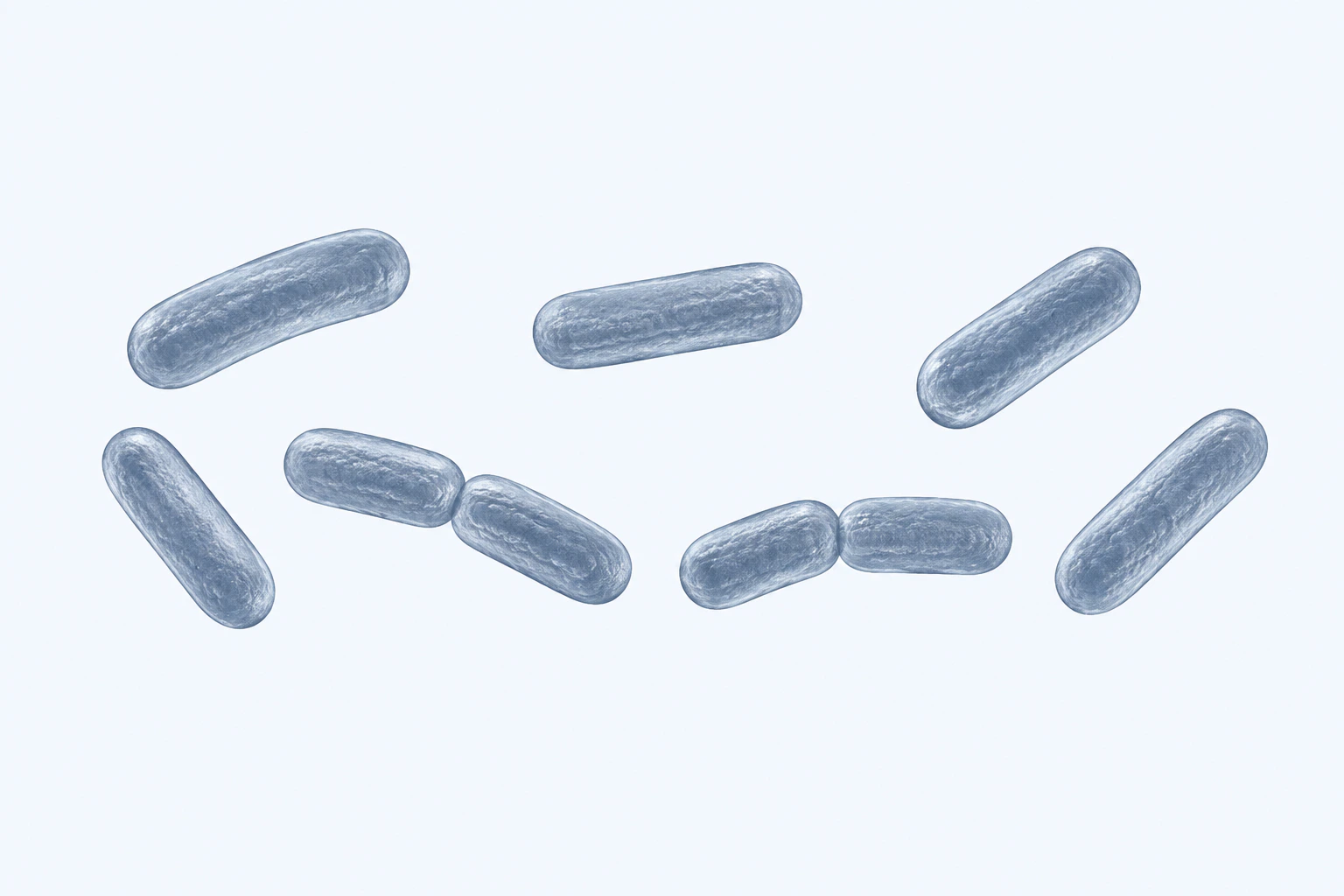
Type-species-anchored Megamonas large plump rods, shown as nine bodies in five single and two paired groupings. This genus-level scientific reconstruction is representative, non-universal, non-diagnostic, and not a micrograph.
Scientific media record1 verified identifier
- Subject
- Megamonastaxon · genus
- Identifiers
- NCBITaxon:158846
- Review
- Editorial review completeIdentifiers authority-verified · Accessibility validated · · megamonas|megamonas-morphology-v1.webp
- Digital source
- Trained-algorithmic mediaCreated with a trained generative algorithm and reviewed by WikiBiome for subject identity, scientific framing, identifiers, provenance, and accessibility.
- Scientific basis
- Megamonas — NCBI TaxonomyMegamonas — LPSNMegamonas hypermegale type strainMegamonas hypermegale original description
- License
- CC BY-SA 4.0Created
Megamonas is a genus of obligate anaerobic, Gram-negative bacteria in the family Veillonellaceae (class Negativicutes, phylum Firmicutes). The type species is Megamonas hypermegale, with M. funiformis also well-characterized.
It is a common member of the human gut microbiota—particularly abundant in Asian populations—and is a significant carbohydrate fermenter producing propionate and valerate as primary short-chain fatty acid end-products.[1]He 2023 — Altered Gut Microbiota and Short-Chain Fatty Acids in Chinese Children with Constipated Autism Spectrum DisorderJianquan He, Xiuhua Gong, Bing Hu et al. · 2023Open reference 1 ↓
What makes Megamonas notable in the WikiBiome context is its contradictory directionality across conditions: enriched in some diseases, depleted in others, with no simple "good vs. bad" classification. This context-dependence makes it a useful marker for understanding disease-specific ecological shifts rather than a universal indicator of health or Dysbiosis.
Evidence map16 cited passagesInspect provenance +
Megamonas is a genus of obligate anaerobic, Gram-negative bacteria in the family Veillonellaceae (class Negativicutes, phylum Firmicutes). The type species is Megamonas hypermegale, with M. funiformis also well-characterized. It is a common member of the human gut microbiota—particularly abundant in Asian populations—and is a significant carbohydrate fer
Enrichment in constipated ASD children was associated with elevated propionate levels.
Enrichment in ASD more broadly was associated with elevated valeric acid.
M. funiformis emerged as an indicator of healthier dietary patterns in ASD children, suggesting its metabolic role may be diet-dependent.
Autism spectrum disorder (4 independent studies): Consistently overrepresented in ASD children across Chinese cohorts. Associated with elevated valeric acid and elevated propionate in constipated ASD. Functional profiling associates with SCFA production and metabolic alterations. However, M. funiformis was also an indicator of healthier diet patterns in ASD,
Hashimoto's thyroiditis: Increased alongside decreased Bifidobacterium and Klebsiella, part of a consistent HT dysbiosis pattern. Significant genus-level differences with gender-specific and hormone-regulated patterns.
Prostate cancer: Men with high serum testosterone (455 ng/dL) showed increased Megamonas (r=0.46, p=0.009), suggesting a testosterone-microbiome axis.
Graves' disease: Both GD and HT groups had lower Megamonas vs. healthy controls (Kruskal-Wallis significant). Consistent reduction across thyroid diseases.
Thyroid cancer: Decreased alongside Roseburia and Bacteroides.
Heart failure: Depleted in both decompensated and compensated HF vs. controls (P<0.001).
Colorectal adenoma/cancer: Healthy microbiome characterized by preponderance of Megamonas and Sphingobium; depleted in adenoma and CRC progression.
Schizophrenia: Listed as a dominant genus in schizophrenia patients alongside Faecalibacterium, Ruminococcus, and Akkermansia.
Chronic kidney disease: Abundance positively correlated with cognitive performance (attention, executive function) in hemodialysis patients.
Male reproductive function: Implicated in reproductive dysfunction signatures.
Hormonal influence—thyroid hormone levels differ dramatically (hypothyroid in HT, hyperthyroid in GD), and Megamonas shows gender-specific and hormone-regulated patterns.
The testosterone connection—the prostate cancer finding (Megamonas correlated with testosterone, r=0.46) suggests hormonal regulation of this genus, which could explain thyroid hormone-dependent shifts.
Contents
1. SCFA Production Profile2. Conditions Associated3. The Thyroid Paradox4. Ecological Role5. Cross-ReferencesSCFA Production Profile#
Unlike the dominant Butyrate producers (Faecalibacterium prausnitzii, Roseburia), Megamonas primarily produces propionate and valerate.
Enrichment in constipated ASD children was associated with elevated propionate levels.[1]He 2023 — Altered Gut Microbiota and Short-Chain Fatty Acids in Chinese Children with Constipated Autism Spectrum DisorderJianquan He, Xiuhua Gong, Bing Hu et al. · 2023Open reference 1 ↓ Enrichment in ASD more broadly was associated with elevated valeric acid.[2]Liu 2019 — Altered Gut Microbiota and Short Chain Fatty Acids in Chinese Children with Autism Spectrum DisorderSimeng Liu, Enyao Li, Zhenyu Sun et al. · 2019Open reference 2 ↓
M. funiformis emerged as an indicator of healthier dietary patterns in ASD children, suggesting its metabolic role may be diet-dependent.[3]Wu 2025 — Distinct Diet-Microbiome Associations in Autism Spectrum DisorderYuqi Wu, Oscar Wong, Sizhe Chen et al. · 2025Open reference 3 ↓
The propionate connection is significant—Propionic Acid at elevated concentrations has been linked to ASD-like behavioral changes in animal models, while at normal concentrations it supports colonocyte health and immune regulation. The dose-response and context may determine whether Megamonas enrichment is beneficial or pathological.
Conditions Associated#
Enriched#
Autism spectrum disorder (4 independent studies): Consistently overrepresented in ASD children across Chinese cohorts. Associated with elevated valeric acid[2]Liu 2019 — Altered Gut Microbiota and Short Chain Fatty Acids in Chinese Children with Autism Spectrum DisorderSimeng Liu, Enyao Li, Zhenyu Sun et al. · 2019Open reference 2 ↓ and elevated propionate in constipated ASD.[1]He 2023 — Altered Gut Microbiota and Short-Chain Fatty Acids in Chinese Children with Constipated Autism Spectrum DisorderJianquan He, Xiuhua Gong, Bing Hu et al. · 2023Open reference 1 ↓
Functional profiling associates with SCFA production and metabolic alterations.[4]Deng 2022 — Gastrointestinal Symptoms Have a Minor Impact on Autism Spectrum Disorder and Associations with Gut Microbiota and Short-Chain Fatty AcidsWenlin Deng, Siqi Wang, Fang Li et al. · 2022Open reference 4 ↓ However, M. funiformis was also an indicator of healthier diet patterns in ASD, complicating the pathological narrative.[3]Wu 2025 — Distinct Diet-Microbiome Associations in Autism Spectrum DisorderYuqi Wu, Oscar Wong, Sizhe Chen et al. · 2025Open reference 3 ↓
Hashimoto's thyroiditis: Increased alongside decreased Bifidobacterium and Klebsiella, part of a consistent HT dysbiosis pattern.[5]Mendoza-Leon et al. 2023 — Gut Microbiota Short-Chain Fatty Acids and Their Impact on the Host Thyroid Function and DiseasesMendoza-Leon MJ, Mangalam AK, Regaldiz A et al. · 2023Open reference 5 ↓ Significant genus-level differences with gender-specific and hormone-regulated patterns.[6]Analysis of gut microbiota diversity in Hashimoto's thyroiditis patientsLiu J, Qin X, Lin B et al. · 2022Open reference 6 ↓
Prostate cancer: Men with high serum testosterone (>455 ng/dL) showed increased Megamonas (r=0.46, p=0.009), suggesting a testosterone-microbiome axis.[7]Trecarten 2025 — Obesity, Dietary Interventions and Microbiome Alterations in Prostate CancerShaun Trecarten, Michael A. Liss, Jill Hamilton-Reeves et al. · 2025Open reference 7 ↓
Depleted#
Graves' disease: Both GD and HT groups had lower Megamonas vs. healthy controls (Kruskal-Wallis significant).[8]Alterations and Mechanism of Gut Microbiota in Graves' Disease and Hashimoto's ThyroiditisZhao H, Yuan L, Zhu D et al. · 2022Open reference 8 ↓ Consistent reduction across thyroid diseases.[9]Fang & Ning 2024 — Recent Advances in Gut Microbiota and Thyroid Disease: Pathogenesis and TherapeuticsFang L, Ning J · 2024Open reference 9 ↓
Thyroid cancer: Decreased alongside Roseburia and Bacteroides.[10]Wang & Zhu 2025 — Gut Microbiome Versus Thyroid Cancer: Association and Clinical Implications (Review)Wang M, Zhu Y · 2025Open reference 10 ↓[9]Fang & Ning 2024 — Recent Advances in Gut Microbiota and Thyroid Disease: Pathogenesis and TherapeuticsFang L, Ning J · 2024Open reference 9 ↓ Heart failure: Depleted in both decompensated and compensated HF vs. controls (P<0.001).[11]Gut Microbiome and Plasma Microbiome-Related Metabolites in Patients With Decompensated and Compensated Heart FailureTomohiro Hayashi, Tomoya Yamashita, Hikaru Watanabe et al. · 2019Open reference 11 ↓
Colorectal adenoma/cancer: Healthy microbiome characterized by preponderance of Megamonas and Sphingobium; depleted in adenoma and CRC progression.[12]Metagenomic Analyses of the Gut Microbiota Associated with Colorectal AdenomaSaito K, Koido S, Odamaki T et al. · 2019Open reference 12 ↓
Other Associations#
Schizophrenia: Listed as a dominant genus in schizophrenia patients alongside Faecalibacterium, Ruminococcus, and Akkermansia.[13]The Gut Microbiome is Associated with Brain Structure and Function in SchizophreniaLi S, Song J, Ke P et al. · 2021Open reference 13 ↓ Chronic kidney disease: Abundance positively correlated with cognitive performance (attention, executive function) in hemodialysis patients.[14]Gao et al. 2024 — Intestinal Flora and Cognitive Function in Maintenance Hemodialysis PatientsQiuyi Gao, Dianshi Li, Yue Wang et al. · 2024Open reference 14 ↓
Male reproductive function: Implicated in reproductive dysfunction signatures.[15]Lv 2024 — Gut Microbiota Is Involved in Male Reproductive Function: A ReviewShuya Lv, Jingrong Huang, Yadan Luo et al. · 2024Open reference 15 ↓
The Thyroid Paradox#
The most striking pattern is the contradictory directionality within thyroid diseases: Megamonas is enriched in Hashimoto's thyroiditis but depleted in Graves' disease and thyroid cancer. Both are autoimmune thyroid conditions with distinct immunological mechanisms (Th1-dominant destruction in HT vs. stimulatory autoantibodies in GD). The divergent Megamonas patterns may reflect:
- Different immune environments selecting for different ecological niches—HT's chronic destruction may create conditions favoring Megamonas carbohydrate fermentation, while GD's stimulatory state does not.
- Hormonal influence—thyroid hormone levels differ dramatically (hypothyroid in HT, hyperthyroid in GD), and Megamonas shows gender-specific and hormone-regulated patterns.[6]Analysis of gut microbiota diversity in Hashimoto's thyroiditis patientsLiu J, Qin X, Lin B et al. · 2022Open reference 6 ↓
- The testosterone connection—the prostate cancer finding (Megamonas correlated with testosterone, r=0.46)[7]Trecarten 2025 — Obesity, Dietary Interventions and Microbiome Alterations in Prostate CancerShaun Trecarten, Michael A. Liss, Jill Hamilton-Reeves et al. · 2025Open reference 7 ↓ suggests hormonal regulation of this genus, which could explain thyroid hormone-dependent shifts.
This contradiction needs resolution by future studies measuring Megamonas alongside thyroid hormone panels and immune markers simultaneously.
Ecological Role#
Megamonas occupies a specific niche as an obligate anaerobe fermenting complex carbohydrates to propionate and valerate.
Its depletion in heart failure, CRC, and thyroid cancer—and its association with cognitive function in CKD and healthy diet patterns in ASD—suggests that under normal conditions it contributes to a healthy fermentative ecosystem.
Its enrichment in ASD and HT may reflect compensatory overgrowth when other fermenters are displaced, or it may directly contribute to pathology through excess propionate production.
Cross-References#
- Propionic Acid—primary SCFA product; excess linked to ASD-like behavior in animal models
- Short-Chain Fatty Acids (SCFAs)—Megamonas as propionate/valerate producer
- Autism Spectrum Disorder—enriched across 4 independent studies
- Hashimoto's Thyroiditis—enriched; contradicts depletion in Graves'
- Graves' Disease—depleted; thyroid paradox
- heart failure—depleted (P<0.001)
- Colorectal Cancer—depleted; healthy marker in adenoma progression
- Schizophrenia—dominant genus in patients
- Gut-Brain Axis—cognitive correlation in CKD, ASD enrichment
References 15
Numbered by first appearance in the article, then reconciled with its declared source list.
- 1
Jianquan He, Xiuhua Gong, Bing Hu et al. (2023). He 2023 — Altered Gut Microbiota and Short-Chain Fatty Acids in Chinese Children with Constipated Autism Spectrum Disorder. Scientific Reports.
- 2
Simeng Liu, Enyao Li, Zhenyu Sun et al. (2019). Liu 2019 — Altered Gut Microbiota and Short Chain Fatty Acids in Chinese Children with Autism Spectrum Disorder. Scientific Reports.
- 3
Yuqi Wu, Oscar Wong, Sizhe Chen et al. (2025). Wu 2025 — Distinct Diet-Microbiome Associations in Autism Spectrum Disorder. Nature Communications.
- 4
Wenlin Deng, Siqi Wang, Fang Li et al. (2022). Deng 2022 — Gastrointestinal Symptoms Have a Minor Impact on Autism Spectrum Disorder and Associations with Gut Microbiota and Short-Chain Fatty Acids. Frontiers in Microbiology.
- 5
Mendoza-Leon MJ, Mangalam AK, Regaldiz A et al. (2023). Mendoza-Leon et al. 2023 — Gut Microbiota Short-Chain Fatty Acids and Their Impact on the Host Thyroid Function and Diseases. Frontiers in Endocrinology.
- 6
Liu J, Qin X, Lin B et al. (2022). Analysis of gut microbiota diversity in Hashimoto's thyroiditis patients. BMC Microbiology.
- 7
Shaun Trecarten, Michael A. Liss, Jill Hamilton-Reeves et al. (2025). Trecarten 2025 — Obesity, Dietary Interventions and Microbiome Alterations in Prostate Cancer. Frontiers in Immunology.
- 8
Zhao H, Yuan L, Zhu D et al. (2022). Alterations and Mechanism of Gut Microbiota in Graves' Disease and Hashimoto's Thyroiditis. Polish Journal of Microbiology.
- 9
Fang L, Ning J (2024). Fang & Ning 2024 — Recent Advances in Gut Microbiota and Thyroid Disease: Pathogenesis and Therapeutics. Frontiers in Cellular and Infection Microbiology.
- 10
Wang M, Zhu Y (2025). Wang & Zhu 2025 — Gut Microbiome Versus Thyroid Cancer: Association and Clinical Implications (Review). Oncology Letters.
- 11
Tomohiro Hayashi, Tomoya Yamashita, Hikaru Watanabe et al. (2019). Gut Microbiome and Plasma Microbiome-Related Metabolites in Patients With Decompensated and Compensated Heart Failure. Circulation Journal.
- 12
Saito K, Koido S, Odamaki T et al. (2019). Metagenomic Analyses of the Gut Microbiota Associated with Colorectal Adenoma. PLOS ONE.
- 13
Li S, Song J, Ke P et al. (2021). The Gut Microbiome is Associated with Brain Structure and Function in Schizophrenia. Scientific Reports.
- 14
Qiuyi Gao, Dianshi Li, Yue Wang et al. (2024). Gao et al. 2024 — Intestinal Flora and Cognitive Function in Maintenance Hemodialysis Patients. Aging Clinical and Experimental Research.
- 15
Shuya Lv, Jingrong Huang, Yadan Luo et al. (2024). Lv 2024 — Gut Microbiota Is Involved in Male Reproductive Function: A Review. Frontiers in Microbiology.
Article network
Connect the evidence
Publicly readable discussion by ORCID-authenticated researchers. Questions, interpretation, methods, corrections, and new evidence stay attached to this record.
No discussion yet. Start with a precise question or a source-backed observation.
Activity and accepted changes
Accepted researcher context, editorial status, public discussion, and upstream Git revisions are shown together. Pending, declined, and withdrawn proposals remain private.
- published revision
Complete corpus-wide Dysbiosis linking
Karen Pendergrass · +1 −1
Inspect exact Git diff ↗ - published revision
massive wiki expansion: 149 stubs fixed, 100+ new pages, Rule 15 scan, keystone papers
WikiBiome Deploy Bot · +75 −17
Inspect exact Git diff ↗ - published revision
cycle 1: health check + lint fixes + 8 ingests + 2 stubs + gestational-diabetes signature
WikiBiome Deploy Bot · +43 −0
Inspect exact Git diff ↗