

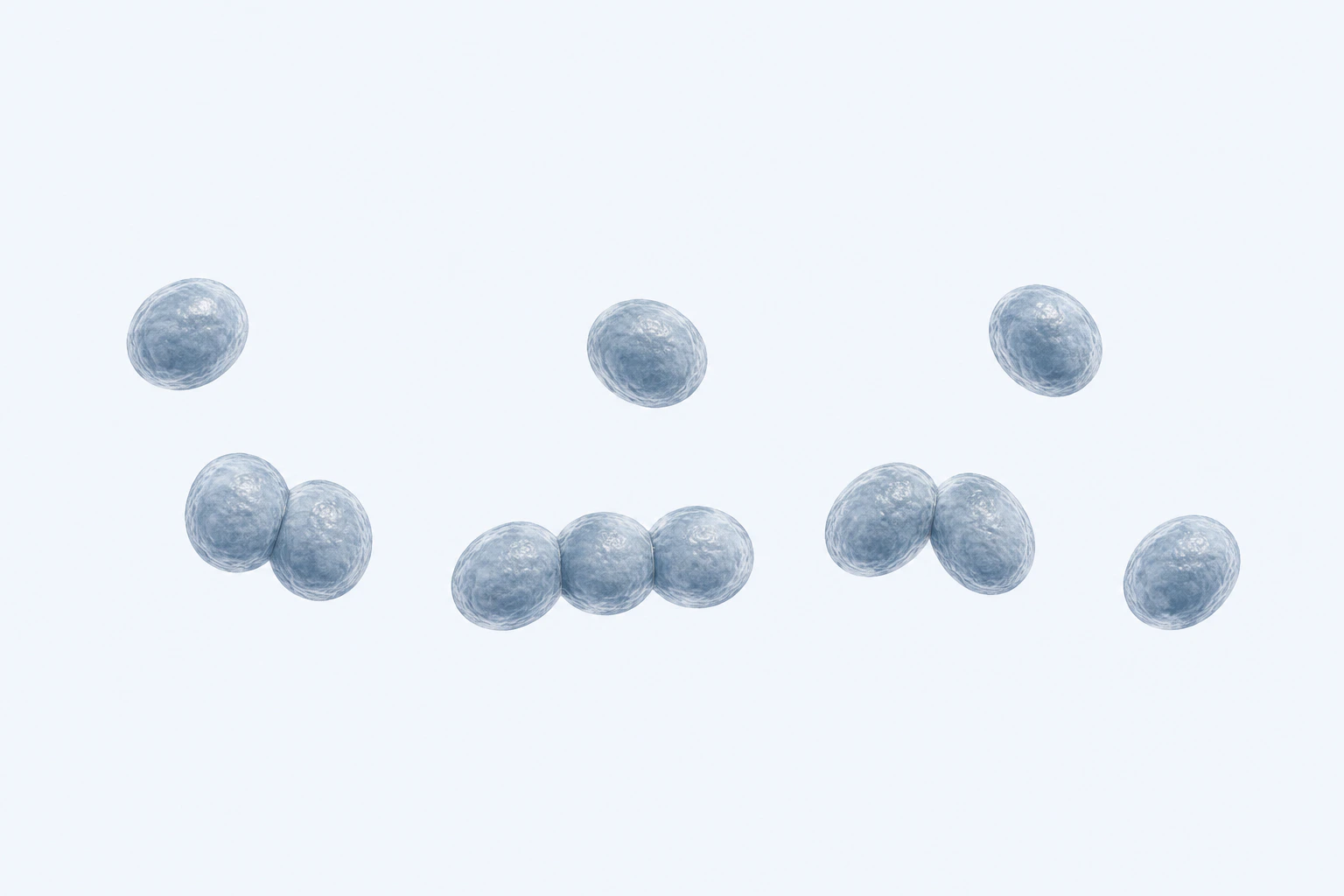
Type-species-anchored Lactococcus coccoid-to-ovoid cells, shown as eleven bodies in four single, two paired, and one short-chain grouping. This scientific reconstruction is representative, non-universal, non-diagnostic, and not a micrograph.
Scientific media record1 verified identifier
- Subject
- Lactococcustaxon · genus
- Identifiers
- NCBITaxon:1357
- Review
- Editorial review completeIdentifiers authority-verified · Accessibility validated · · lactococcus|lactococcus-morphology-v1.webp
- Digital source
- Trained-algorithmic mediaCreated with a trained generative algorithm and reviewed by WikiBiome for subject identity, scientific framing, identifiers, provenance, and accessibility.
- Scientific basis
- Lactococcus — NCBI TaxonomyLactococcus — LPSNLactococcus lactis — LPSNTransfer of Streptococcus lactis and related streptococci to LactococcusLactococcus lactis type strain
- License
- CC BY-SA 4.0Created
Lactococcus lactis is a Gram-positive, facultatively anaerobic, lactic acid bacterium best known as the workhorse of the dairy fermentation industry. It holds GRAS (Generally Recognized As Safe) status and has emerged as a versatile platform for probiotic and therapeutic protein delivery applications.
Evidence map6 cited passagesInspect provenance +
Homofermentative metabolism converts lactose to lactic acid with high efficiency.
Berberine supplementation in Graves' disease patients increased L. lactis abundance alongside clinical improvement. L. lactis was negatively correlated with FT3, FT4, and TRAb but positively correlated with TSH, suggesting a role in thyroid homeostasis.
Relatively higher abundance of Lactococcus observed in CRC patients in some cohorts, though its role in CRC pathogenesis is unclear and may reflect dietary confounders.
Depleted in Parkinson's disease patients, consistent with loss of beneficial lactic acid bacteria in neurodegenerative conditions.
Associated with diet and MS status in pediatric cohorts, particularly in the context of Mediterranean dietary patterns.
Altered abundance in ASD children with GI symptoms, sharing evolutionary lineage with Streptococcus within the Lactobacillales order.
Contents
1. Industrial and Food Applications2. Metal Dependencies3. Disease-Associated Microbiome Findings4. Biotherapeutic Delivery Platform5. ConnectionsIndustrial and Food Applications#
Primary starter culture for cheese production, fermented milk, buttermilk, and other dairy products. Produces nisin, a lantibiotic (antimicrobial peptide) effective against Gram-positive pathogens including Listeria, Staphylococcus, and Clostridium species. Nisin production has attracted interest as a natural food preservative and potential adjunct to antibiotic therapy.
Homofermentative metabolism converts lactose to lactic acid with high efficiency.[1]Characterization of the human gut virome in metabolic and autoimmune diseasesKosuke Fujimoto, Daichi Miyaoka, Satoshi Uematsu · 2022Open reference 1 ↓
Metal Dependencies#
Manganese: L. lactis relies on manganese (Mn)-superoxide dismutase (MnSOD) for Oxidative Stress defense, unlike most bacteria that use iron (Fe)-SOD. This manganese-dependency reduces its vulnerability to Iron-limitation strategies of Nutritional Immunity (Metal Sequestration).
Zinc: zinc (Zn)-dependent cell-envelope proteinases (PrtP) are essential for casein degradation during dairy fermentation. Zinc availability thus directly influences the proteolytic capacity and growth rate of L. lactis.
Disease-Associated Microbiome Findings#
Autoimmune Thyroid Disease#
- Berberine supplementation in Graves' disease patients increased L. lactis abundance alongside clinical improvement. L. lactis was negatively correlated with FT3, FT4, and TRAb but positively correlated with TSH, suggesting a role in thyroid homeostasis.[2]Han et al. 2022 — The Potential Prebiotic Berberine Combined With Methimazole Improved the Therapeutic Effect of Graves' Disease Patients Through Regulating the Intestinal MicrobiomeHan Z, Cen C, Ou Q et al. · 2022Open reference 2 ↓
Colorectal Cancer#
- Relatively higher abundance of Lactococcus observed in CRC patients in some cohorts, though its role in CRC pathogenesis is unclear and may reflect dietary confounders.[3]Microbiota disbiosis is associated with colorectal cancerZhiguang Gao, Bomin Guo, Renyuan Gao et al. · 2015Open reference 3 ↓
Neurodegenerative Disease#
- Depleted in Parkinson's disease patients, consistent with loss of beneficial lactic acid bacteria in neurodegenerative conditions.[4]Effects of gut microbiota on neurodegenerative diseasesKhatoon S, Kalam N, Rashid S et al. · 2023Open reference 4 ↓
Multiple Sclerosis#
- Associated with diet and MS status in pediatric cohorts, particularly in the context of Mediterranean dietary patterns.[5]Mediterranean Diet and Associations with the Gut Microbiota and Pediatric-Onset Multiple Sclerosis Using Trivariate AnalysisMirza AI, Zhu F, Knox N et al. · 2024Open reference 5 ↓
Autism Spectrum Disorder#
- Altered abundance in ASD children with GI symptoms, sharing evolutionary lineage with Streptococcus within the Lactobacillales order.[6]Wang 2023 — Gut Microbiota Signature in Children with ASD Who Suffered from Chronic Gastrointestinal SymptomsHui Wang, Shu Liu, Liqing Xie et al. · 2023Open reference 6 ↓
Biotherapeutic Delivery Platform#
L. lactis is increasingly used as a live biotherapeutic delivery platform.
Engineered strains can secrete anti-inflammatory cytokines (IL-10), trefoil factors, and antigenic proteins directly in the gut lumen. Its inability to colonize the gut permanently is actually advantageous for controlled, transient therapeutic delivery. Investigational applications include mucosal vaccine delivery and local treatment of Inflammatory Bowel Disease (IBD).
Connections#
- Probiotics—GRAS probiotic with established safety profile
- Manganese—manganese (Mn)-SOD dependency distinguishes it from iron (Fe)-dependent organisms
- Zinc—zinc (Zn)-dependent proteolytic system essential for dairy fermentation
- Nutritional Immunity (Metal Sequestration)—manganese-centered metabolism may evade iron-restriction strategies
- Inflammatory Bowel Disease (IBD)—engineered L. lactis as mucosal delivery platform
- foundational organism in dairy fermentation
- Bifidobacterium—co-occurring beneficial taxon in probiotic formulations
References 6
Numbered by first appearance in the article, then reconciled with its declared source list.
- 1
Kosuke Fujimoto, Daichi Miyaoka, Satoshi Uematsu (2022). Characterization of the human gut virome in metabolic and autoimmune diseases. Inflammation and Regeneration.
- 2
Han Z, Cen C, Ou Q et al. (2022). Han et al. 2022 — The Potential Prebiotic Berberine Combined With Methimazole Improved the Therapeutic Effect of Graves' Disease Patients Through Regulating the Intestinal Microbiome. Frontiers in Immunology.
- 3
Zhiguang Gao, Bomin Guo, Renyuan Gao et al. (2015). Microbiota disbiosis is associated with colorectal cancer. Frontiers in Microbiology.
- 4
Khatoon S, Kalam N, Rashid S et al. (2023). Effects of gut microbiota on neurodegenerative diseases. Frontiers in Aging Neuroscience.
- 5
Mirza AI, Zhu F, Knox N et al. (2024). Mediterranean Diet and Associations with the Gut Microbiota and Pediatric-Onset Multiple Sclerosis Using Trivariate Analysis. Communications Medicine.
- 6
Hui Wang, Shu Liu, Liqing Xie et al. (2023). Wang 2023 — Gut Microbiota Signature in Children with ASD Who Suffered from Chronic Gastrointestinal Symptoms. BMC Pediatrics.
Article network
Connect the evidence
Publicly readable discussion by ORCID-authenticated researchers. Questions, interpretation, methods, corrections, and new evidence stay attached to this record.
No discussion yet. Start with a precise question or a source-backed observation.
Activity and accepted changes
Accepted researcher context, editorial status, public discussion, and upstream Git revisions are shown together. Pending, declined, and withdrawn proposals remain private.
- published revision
Backfill oxidative stress concept links
Karen Pendergrass · +1 −1
Inspect exact Git diff ↗ - published revision
massive wiki expansion: 149 stubs fixed, 100+ new pages, Rule 15 scan, keystone papers
WikiBiome Deploy Bot · +5 −5
Inspect exact Git diff ↗ - published revision
nightly maintenance: 94 stub demotions, 181 source_count fixes, 22 auto-discovered stubs, 5 adversarial audits, 3 boundary fixes, 3 evidence-level corrections
WikiBiome Deploy Bot · +1 −0
Inspect exact Git diff ↗ - published revision
18 foundational sources + 10 microbe entities deepened
WikiBiome Deploy Bot · +1 −1
Inspect exact Git diff ↗ - published revision
Citation integrity pass: 38 citations added, 24 parenthesized citations fixed
WikiBiome Deploy Bot · +1 −1
Inspect exact Git diff ↗ - published revision
WikiBiome update — 2026-04-15 17:23
WikiBiome Deploy Bot · +1 −2
Inspect exact Git diff ↗ - published revision
wiki: bulk entity upgrades, new article pages, and site regeneration
WikiBiome Deploy Bot · +6 −0
Inspect exact Git diff ↗ - published revision
WikiBiome update — integrity fixes, metallomic diet pages, cross-condition analyses
WikiBiome Deploy Bot · +13 −6
Inspect exact Git diff ↗ - published revision
WikiBiome update — 2026-04-10 13:49
WikiBiome Deploy Bot · +61 −0
Inspect exact Git diff ↗