

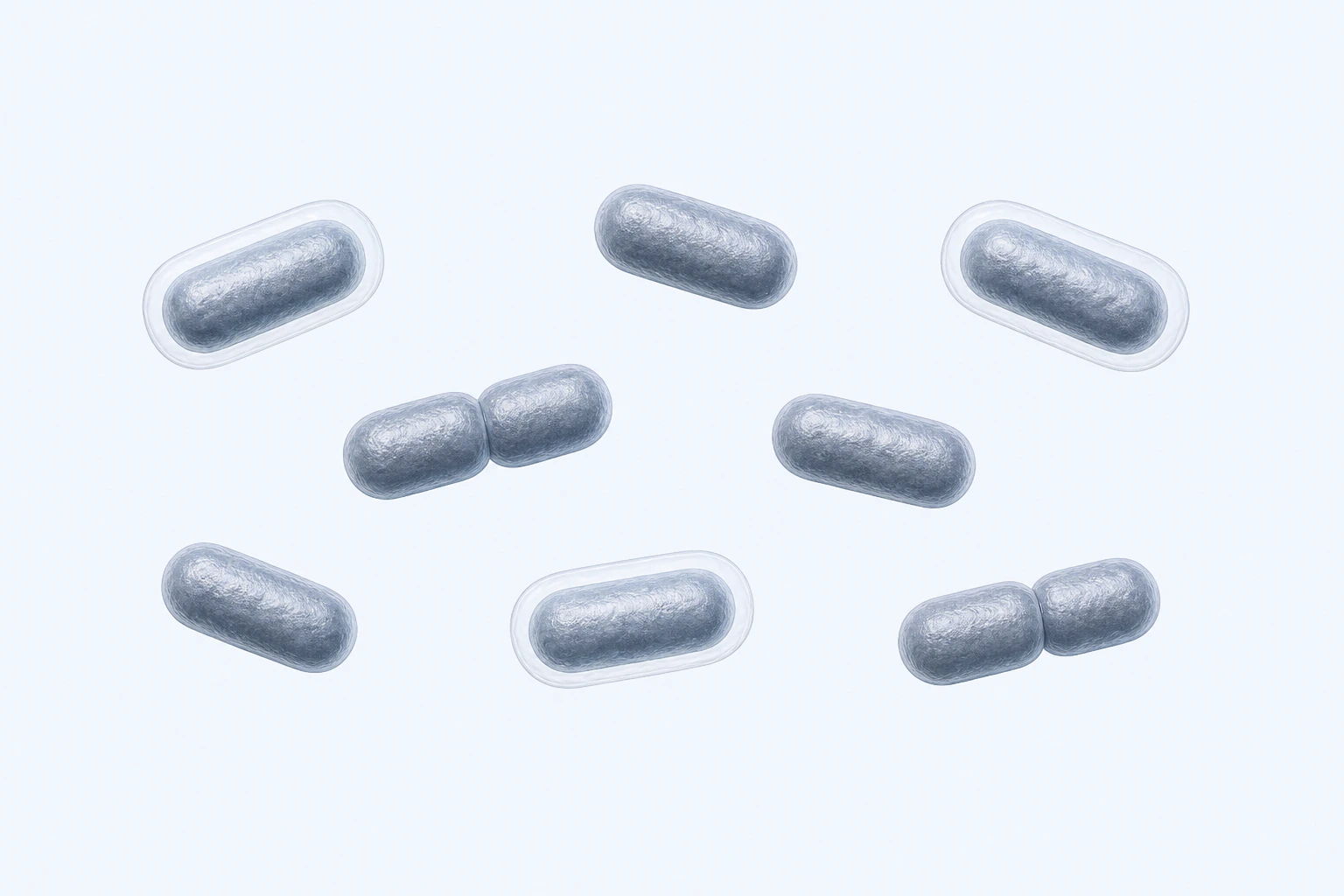
Type-species-anchored Klebsiella plump rods, shown as ten bodies in six single and two paired groupings with three selected capsule envelopes. This genus-level reconstruction is representative, non-diagnostic, not a universal genus form, and does not imply that bodies without an emphasized envelope lack capsules in nature. It is not a micrograph.
Scientific media record1 verified identifier
- Subject
- Klebsiellataxon · genus
- Identifiers
- NCBITaxon:570
- Review
- Editorial review completeIdentifiers authority-verified · Accessibility validated · · klebsiella|klebsiella-morphology-v1.webp
- Digital source
- Trained-algorithmic mediaCreated with a trained generative algorithm and reviewed by WikiBiome for subject identity, scientific framing, identifiers, provenance, and accessibility.
- Scientific basis
- Klebsiella — NCBI TaxonomyKlebsiella — LPSNEscherichia, Klebsiella, Enterobacter, Serratia, Citrobacter, and ProteusKlebsiella capsule ultrastructure
- License
- CC BY-SA 4.0Created
Klebsiella is a genus of Gram-negative, encapsulated, facultatively anaerobic bacteria in the Enterobacteriaceae family. With 141 file mentions across the vault, Klebsiella is one of the most frequently referenced opportunistic pathogens.
The dominant species is Klebsiella pneumoniae, but the genus-level page captures the shared biology—particularly the metal-dependent virulence and siderophore arsenal that drive Klebsiella's expansion during Dysbiosis.
For species-level detail, see Klebsiella pneumoniae.
Evidence map6 cited passagesInspect provenance +
Iron: Klebsiella produces multiple siderophores—enterobactin, yersiniabactin (a dual iron/nickel metallophore), and salmochelin—giving it one of the most comprehensive iron acquisition toolkits among enteric pathogens.
Nickel: NiFe hydrogenases support anaerobic hydrogen oxidation in the inflamed gut, providing competitive advantage.
Co-selection: Metal resistance genes co-located with carbapenem resistance on shared plasmids—environmental metal exposure drives the evolution of carbapenem-resistant Klebsiella (CR-KP), one of the most urgent AMR threats globally.
IBD: Enriched alongside E. coli in both Crohn's and UC.
NEC: Enriched in preterm infant gut before NEC onset; nickel in formula may fuel expansion.
CKD: Part of uremic toxin-producing Enterobacteriaceae enrichment.
Metal Dependencies#
Iron: Klebsiella produces multiple siderophores—enterobactin, yersiniabactin (a dual iron/nickel metallophore), and salmochelin—giving it one of the most comprehensive iron acquisition toolkits among enteric pathogens.[1]Bushman 2025 — The Exploitation of Nutrient Metals by Bacteria for Survival and Infection in the GutSummer D Bushman, Eric P Skaar, N Luisa Hiller · 2025Open reference 1 ↓
Nickel: NiFe hydrogenases support anaerobic hydrogen oxidation in the inflamed gut, providing competitive advantage.[2]Role of Nickel in Microbial PathogenesisRobert J. Maier, Stéphane L. Benoit · 2019Open reference 2 ↓[3]Nickel as a Catalytic Driver of Necrotizing Enterocolitis: Dietary Nickel, Microbial Metallomics, and the Activation of Nickel-Dependent Virulence Pathways in the Preterm GutKaren Pendergrass · 2026Open reference 3 ↓
Manganese: Required for superoxide dismutase (MnSOD) defense against the oxidative burst.
cobalt (Co)-selection: Metal resistance genes co-located with carbapenem resistance on shared plasmids—environmental metal exposure drives the evolution of carbapenem-resistant Klebsiella (CR-KP), one of the most urgent AMR threats globally.[4]Baker-Austin 2006 — Co-selection of Antibiotic and Metal ResistanceBaker-Austin C, Wright MS, Stepanauskas R et al. · 2006Open reference 4 ↓[5]Miranda 2022 — Characterization of Metal(loid)s and Antibiotic Resistance in Bacteria of Human Gut Microbiota from CKD SubjectsMaría V. Miranda, Fernanda C. González, Osvaldo S. Paredes-Godoy et al. · 2022Open reference 5 ↓
Dysbiosis Bloom#
Klebsiella expansion is part of the characteristic Enterobacteriaceae bloom during Metal-Driven Inflammation. IBD: Enriched alongside E. coli in both Crohn's and UC.[6]Khorsand 2022 — Overrepresentation of Enterobacteriaceae and Escherichia coli is the major gut microbiome signature in Crohn's and UC: comprehensive metagenomic analysis of IBDMDB datasetsBabak Khorsand, Hamid Asadzadeh Aghdaei, Ehsan Nazemalhosseini-Mojarad et al. · 2022Open reference 6 ↓[7]Wang 2024 — Integrated 16S rRNA sequencing and metagenomics insights into microbial dysbiosis and distinct virulence factors in inflammatory bowel diseaseHaijing Wang, Yuanjun Wang, Libin Yang et al. · 2024Open reference 7 ↓
NEC: Enriched in preterm infant gut before NEC onset; nickel in formula may fuel expansion.[3]Nickel as a Catalytic Driver of Necrotizing Enterocolitis: Dietary Nickel, Microbial Metallomics, and the Activation of Nickel-Dependent Virulence Pathways in the Preterm GutKaren Pendergrass · 2026Open reference 3 ↓ CKD: Part of uremic toxin-producing Enterobacteriaceae enrichment.[5]Miranda 2022 — Characterization of Metal(loid)s and Antibiotic Resistance in Bacteria of Human Gut Microbiota from CKD SubjectsMaría V. Miranda, Fernanda C. González, Osvaldo S. Paredes-Godoy et al. · 2022Open reference 5 ↓
Cross-References#
- Klebsiella pneumoniae—species page
- Enterobacteriaceae—family context
- Iron—siderophore-dependent virulence
- Siderophores—enterobactin, yersiniabactin (dual metallophore)
- Nickel—NiFe-hydrogenase for gut colonization
- Co-Selection—metal-carbapenem co-resistance
- Antimicrobial Resistance—CR-KP as critical AMR threat
References 7
Numbered by first appearance in the article, then reconciled with its declared source list.
- 1
Summer D Bushman, Eric P Skaar, N Luisa Hiller (2025). Bushman 2025 — The Exploitation of Nutrient Metals by Bacteria for Survival and Infection in the Gut. PLOS Pathogens.
- 2
★Robert J. Maier, Stéphane L. Benoit (2019). Role of Nickel in Microbial Pathogenesis. Inorganics.
- 3
Karen Pendergrass (2026). Nickel as a Catalytic Driver of Necrotizing Enterocolitis: Dietary Nickel, Microbial Metallomics, and the Activation of Nickel-Dependent Virulence Pathways in the Preterm Gut. Zenodo Preprint.
- 4
Baker-Austin C, Wright MS, Stepanauskas R et al. (2006). Baker-Austin 2006 — Co-selection of Antibiotic and Metal Resistance. Trends in Microbiology.
- 5
María V. Miranda, Fernanda C. González, Osvaldo S. Paredes-Godoy et al. (2022). Miranda 2022 — Characterization of Metal(loid)s and Antibiotic Resistance in Bacteria of Human Gut Microbiota from CKD Subjects. Biological Research.
- 6
Babak Khorsand, Hamid Asadzadeh Aghdaei, Ehsan Nazemalhosseini-Mojarad et al. (2022). Khorsand 2022 — Overrepresentation of Enterobacteriaceae and Escherichia coli is the major gut microbiome signature in Crohn's and UC: comprehensive metagenomic analysis of IBDMDB datasets. Frontiers in Cellular and Infection Microbiology.
- 7
Haijing Wang, Yuanjun Wang, Libin Yang et al. (2024). Wang 2024 — Integrated 16S rRNA sequencing and metagenomics insights into microbial dysbiosis and distinct virulence factors in inflammatory bowel disease. Frontiers in Microbiology.
Article network
Connect the evidence
Publicly readable discussion by ORCID-authenticated researchers. Questions, interpretation, methods, corrections, and new evidence stay attached to this record.
No discussion yet. Start with a precise question or a source-backed observation.
Activity and accepted changes
Accepted researcher context, editorial status, public discussion, and upstream Git revisions are shown together. Pending, declined, and withdrawn proposals remain private.
- published revision
Backfill inflammation concept links
Karen Pendergrass · +1 −1
Inspect exact Git diff ↗ - published revision
Complete corpus-wide Dysbiosis linking
Karen Pendergrass · +1 −1
Inspect exact Git diff ↗ - published revision
Complete Hydrogenase contextual coverage
Karen Pendergrass · +1 −1
Inspect exact Git diff ↗ - published revision
massive wiki expansion: 149 stubs fixed, 100+ new pages, Rule 15 scan, keystone papers
WikiBiome Deploy Bot · +58 −0
Inspect exact Git diff ↗