

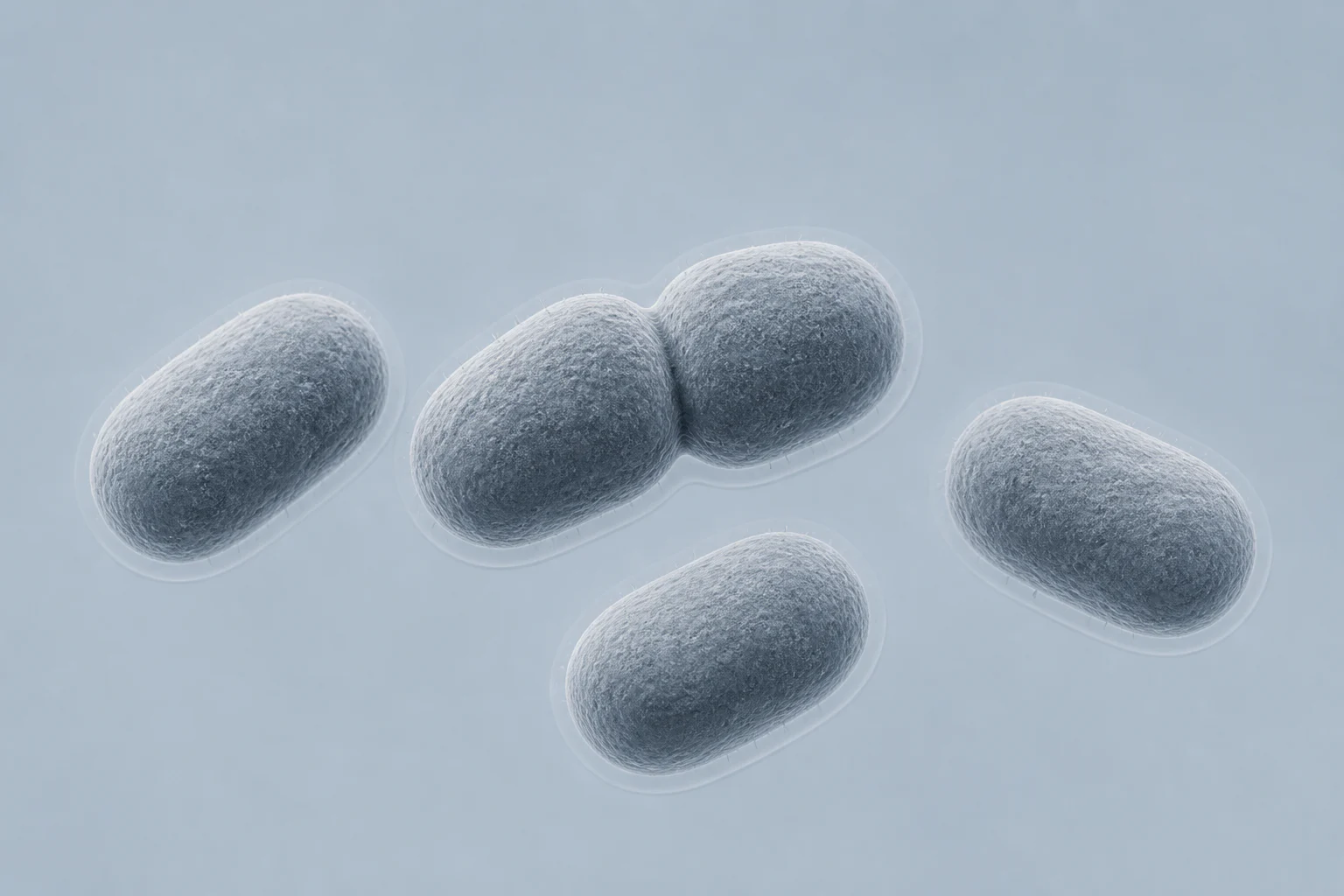
Representative A. baumannii coccobacilli with rounded ends and restrained capsular boundaries. The species is nonmotile, so no flagella are shown; this is an educational reconstruction, not a clinical micrograph.
Scientific media record1 verified identifier
- Subject
- Acinetobacter baumanniitaxon · species
- Identifiers
- NCBITaxon:470
- Review
- Editorial review completeIdentifiers authority-verified · Accessibility validated · · acinetobacter-baumannii|acinetobacter-baumannii-morphology-v1.webp
- Digital source
- Trained-algorithmic mediaCreated with a trained generative algorithm and reviewed by WikiBiome for subject identity, scientific framing, identifiers, provenance, and accessibility.
- License
- CC BY-SA 4.0Created
WHO Priority 1: Critical. A Gram-negative, strictly aerobic coccobacillus and one of the most dangerous nosocomial pathogens on the planet. A. baumannii belongs to the ESKAPE group and causes ventilator-associated pneumonia, wound infections, and bloodstream infections with mortality rates exceeding 50% in some intensive care settings.
What makes this organism so formidable is not simply its antibiotic resistance—it is the deep integration of metal homeostasis systems with both virulence and resistance, creating multiple interdependent vulnerabilities that the host immune system and novel therapeutics can exploit.
This page covers the species A. baumannii specifically; for the broader genus, see Acinetobacter.
Evidence map8 cited passagesInspect provenance +
A. baumannii depends on zinc for a recently discovered cell wall regulatory system. MigC (A1S0934), a COG0523 family GTPase, is a zinc-binding metallochaperone that interacts with and inhibits MurD, an essential peptidoglycan synthesis enzyme (, animal-model). MigC binds zinc with extremely high affinity (KZn1 = 7.0 x 10^10 M-1), increasing 20-fold with GDP
A. baumannii relies on species-specific siderophore uptake systems to acquire iron from the host environment (, expert-opinion). This iron dependency creates a structural vulnerability: siderophore-antibiotic conjugates can exploit the bacterium's own iron transport to deliver antibiotic payloads directly into the cell, achieving MICs 100-fold lower than pas
Cadmium exposure creates a cascade of metal dysregulation in A. baumannii. At 15 uM cadmium, zinc is depleted below detection while copper hyperaccumulates (, in-vitro). The cadmium resistome involves 67 genes with significant fitness changes, and the CzcE CDF transporter confers 30-fold cadmium resistance compared to wild type. This cross-metal toxicity sig
(animal-model)—Discovery of MigC zinc metallochaperone regulating cell wall biogenesis through MurD interaction; demonstrates calprotectin-sensitive zinc dependency as virulence determinant.
(in-vitro, keystone)—Maps the cadmium resistome (67 genes) and demonstrates cadmium-induced zinc depletion and copper hyperaccumulation; establishes cross-metal toxicity framework.
(expert-opinion)—Reviews multi-metal chelation as virulence disarmament strategy for A. baumannii and P. aeruginosa.
(in-vitro)—320 pyoverdine variants screened; specific structural variants potently inhibit A. baumannii through iron deprivation.
(expert-opinion)—Siderophore-antibiotic conjugates exploiting iron transport to bypass outer membrane.
Contents
1. Metal Dependencies2. Key Enzymes and Virulence Factors3. Ecological Role4. Conditions Associated5. Key Studies6. Cross-ReferencesMetal Dependencies#
Zinc: The Cell Wall Architect#
A. baumannii depends on Zinc for a recently discovered cell wall regulatory system. MigC (A1S_0934), a COG0523 family GTPase, is a zinc-binding metallochaperone that interacts with and inhibits MurD, an essential peptidoglycan synthesis enzyme (,[1]Critchlow 2025 — The Zinc Metalloprotein MigC Impacts Cell Wall Biogenesis Through Interactions with MurD in Acinetobacter baumanniiJeanette M. Critchlow, Joseph S. Rocchio, Melanie C. McKell et al. · 2025Open reference 1 ↓ animal-model).
MigC binds zinc with extremely high affinity (KZn1 = 7.0 x 10^10 M-1), increasing 20-fold with GDP and approximately 40-fold with GTP. When zinc is available, zinc (Zn)-MigC inhibits MurD (Ki = 32 +/- 6 uM, noncompetitive), modulating cell wall architecture.
When zinc is depleted—as occurs during host Nutritional Immunity (Metal Sequestration) via Calprotectin (S100A8/A9)—MigC function is lost, sensitizing the bacterium to beta-lactam antibiotics like ceftriaxone.
MurD itself requires Manganese or magnesium as catalytic cofactors, meaning that Mis-Metallation at this single enzyme can cascade into morphological changes, antibiotic susceptibility, and virulence attenuation. MigC-deficient cells show elongated morphology, thinner peptidoglycan, and reduced colonization in murine pneumonia models.
Iron: Siderophore Dependency#
A. baumannii relies on species-specific siderophore uptake systems to acquire Iron from the host environment (,[2]Golden et al. 2024 — Metal Chelation as Antibacterial Strategy Against Pseudomonas and AcinetobacterGolden, M., et al. · 2024Open reference 2 ↓ expert-opinion).
This iron dependency creates a structural vulnerability: siderophore-antibiotic conjugates can exploit the bacterium's own iron transport to deliver antibiotic payloads directly into the cell, achieving MICs 100-fold lower than passive diffusion (,[3]de Carvalho & Fernandes 2014 — Siderophores as Trojan Horses Against MDR Pathogensde Carvalho, C.C.C.R., Fernandes et al. · 2014Open reference 3 ↓ expert-opinion).
Natural pyoverdine variants from Pseudomonas also potently inhibit A. baumannii through competitive iron deprivation, with reduced potential for resistance evolution because the target is a fundamental metabolic requirement (,[4]Vollenweider et al. 2024 — Pyoverdines as Iron-Depriving AntimicrobialsVollenweider, V., et al. · 2024Open reference 4 ↓ in-vitro).
Key Enzymes and Virulence Factors#
| Enzyme/System | Metal | Function |
|---|---|---|
| MigC (COG0523 GTPase) | Zinc | Metallochaperone regulating MurD and cell wall biogenesis |
| MurD ligase | magnesium (Mg)/manganese (Mn) | Essential peptidoglycan synthesis |
| CzcE (CDF transporter) | cadmium (Cd) export | Primary cadmium resistance; upregulated approximately 480-fold by CadR |
| CzcCBA (RND efflux) | cadmium/zinc (Zn) export | Periplasm-to-extracellular cadmium and zinc translocation |
| CadR (MerR regulator) | cadmium sensor | Highly attuned cadmium-responsive transcription factor |
| Siderophore receptors | Iron | Species-specific iron acquisition from host |
Ecological Role#
A. baumannii is unusual among ESKAPE pathogens in being a strict aerobe, which limits gut colonization but enhances environmental persistence on dry hospital surfaces.
Its ecological strategy centers on rapid metal acquisition and robust metal efflux, allowing it to thrive in environments contaminated with Heavy Metals—the same environments where antibiotic resistance is co-selected.
Cadmium as a Selective Pressure#
Cadmium exposure creates a cascade of metal dysregulation in A. baumannii. At 15 uM cadmium, zinc is depleted below detection while copper hyperaccumulates (,[5]The Molecular Basis of Acinetobacter baumannii Cadmium Toxicity and ResistanceAlquethamy SF, Adams FG, Maharjan R et al. · 2021Open reference 5 ↓ in-vitro).
The cadmium resistome involves 67 genes with significant fitness changes, and the CzcE CDF transporter confers 30-fold cadmium resistance compared to wild type.
This cross-metal toxicity signature—where cadmium disrupts zinc and copper homeostasis simultaneously—illustrates how environmental metal exposure selects for organisms with sophisticated metal management, driving dysbiotic colonization in respiratory and wound settings.
Conditions Associated#
A. baumannii is primarily a healthcare-associated pathogen. Ventilator-associated pneumonia—the most common and lethal manifestation. Wound infections—particularly in combat and burn injuries.
Bloodstream infections—often catheter-related.
Urinary tract infections—catheter-associated.
The organism's ability to persist on hospital surfaces and medical devices, combined with its metal-antibiotic co-resistance phenotype, makes it a persistent threat in ICU environments.
Key Studies#
[1]Critchlow 2025 — The Zinc Metalloprotein MigC Impacts Cell Wall Biogenesis Through Interactions with MurD in Acinetobacter baumanniiJeanette M. Critchlow, Joseph S. Rocchio, Melanie C. McKell et al. · 2025Open reference 1 ↓ (animal-model)—Discovery of MigC zinc metallochaperone regulating cell wall biogenesis through MurD interaction; demonstrates calprotectin-sensitive zinc dependency as virulence determinant.
[5]The Molecular Basis of Acinetobacter baumannii Cadmium Toxicity and ResistanceAlquethamy SF, Adams FG, Maharjan R et al. · 2021Open reference 5 ↓ (in-vitro, keystone)—Maps the cadmium resistome (67 genes) and demonstrates cadmium-induced zinc depletion and copper hyperaccumulation; establishes cross-metal toxicity framework.
[2]Golden et al. 2024 — Metal Chelation as Antibacterial Strategy Against Pseudomonas and AcinetobacterGolden, M., et al. · 2024Open reference 2 ↓ (expert-opinion)—Reviews multi-metal chelation as virulence disarmament strategy for A. baumannii and P. aeruginosa.[4]Vollenweider et al. 2024 — Pyoverdines as Iron-Depriving AntimicrobialsVollenweider, V., et al. · 2024Open reference 4 ↓ (in-vitro)—320 pyoverdine variants screened; specific structural variants potently inhibit A. baumannii through iron deprivation.
[3]de Carvalho & Fernandes 2014 — Siderophores as Trojan Horses Against MDR Pathogensde Carvalho, C.C.C.R., Fernandes et al. · 2014Open reference 3 ↓ (expert-opinion)—Siderophore-antibiotic conjugates exploiting iron transport to bypass outer membrane.
Cross-References#
- Acinetobacter—Genus-level page with broader ecological and clinical context
- Zinc—Essential cofactor for MigC metallochaperone and numerous enzymes
- Iron—Siderophore-dependent acquisition; Trojan horse therapeutic target
- Cadmium—Cross-metal toxicity driver selecting for A. baumannii metal resistance
- Nutritional Immunity (Metal Sequestration)—Calprotectin-mediated zinc starvation as host defense
- Mis-Metallation—MurD cofactor disruption cascading into cell wall vulnerability
- Antimicrobial Resistance—Metal-antibiotic co-selection in hospital environments
- Pseudomonas aeruginosa—cobalt (Co)-targeted by metal chelation strategies
References 6
Numbered by first appearance in the article, then reconciled with its declared source list.
- 1
Jeanette M. Critchlow, Joseph S. Rocchio, Melanie C. McKell et al. (2025). Critchlow 2025 — The Zinc Metalloprotein MigC Impacts Cell Wall Biogenesis Through Interactions with MurD in Acinetobacter baumannii. PLOS Pathogens.
- 2
Golden, M., et al. (2024). Golden et al. 2024 — Metal Chelation as Antibacterial Strategy Against Pseudomonas and Acinetobacter. RSC Chemical Biology.
- 3
de Carvalho, C.C.C.R., Fernandes et al. (2014). de Carvalho & Fernandes 2014 — Siderophores as Trojan Horses Against MDR Pathogens. Frontiers in Microbiology.
- 4
Vollenweider, V., et al. (2024). Vollenweider et al. 2024 — Pyoverdines as Iron-Depriving Antimicrobials. eLife.
- 5
Alquethamy SF, Adams FG, Maharjan R et al. (2021). The Molecular Basis of Acinetobacter baumannii Cadmium Toxicity and Resistance. Applied and Environmental Microbiology.
- 6
Daiana A. Capdevila, Johnma J. Rondon, Katherine A. Edmonds et al. (2024). Capdevila 2024 — Bacterial Metallostasis: Metal Sensing, Metalloproteome Remodeling, and Metal Trafficking. Chemical Reviews.
Article network
Connect the evidence
Publicly readable discussion by ORCID-authenticated researchers. Questions, interpretation, methods, corrections, and new evidence stay attached to this record.
No discussion yet. Start with a precise question or a source-backed observation.
Published page changes
This record shows only material changes published on this page, including changes to its content, evidence, conclusions, or author context. Internal processes and discussion activity are excluded. Pending, declined, and withdrawn proposals remain private.
- published revision
Created “Acinetobacter baumannii”: WHO Priority 1: Critical. A Gram-negative, strictly aerobic coccobacillus and one of the most dangerous nosocomial pathogens on the planet. A. baumannii belongs to the ESKAPE group and causes…
Created “Acinetobacter baumannii”: WHO Priority 1: Critical. A Gram-negative, strictly aerobic coccobacillus and one of the most dangerous nosocomial pathogens on the planet. A. baumannii belongs to the ESKAPE group and causes… Published sections: Acinetobacter baumannii; Zinc: The Cell Wall Architect; Iron: Siderophore Dependency; Key Enzymes and Virulence Factors; Ecological Role; Cadmium as a Selective Pressure; Conditions Associated; Key Studies; Cross-References. · WikiBiome Deploy Bot · +87 −0
Inspect exact Git diff ↗