

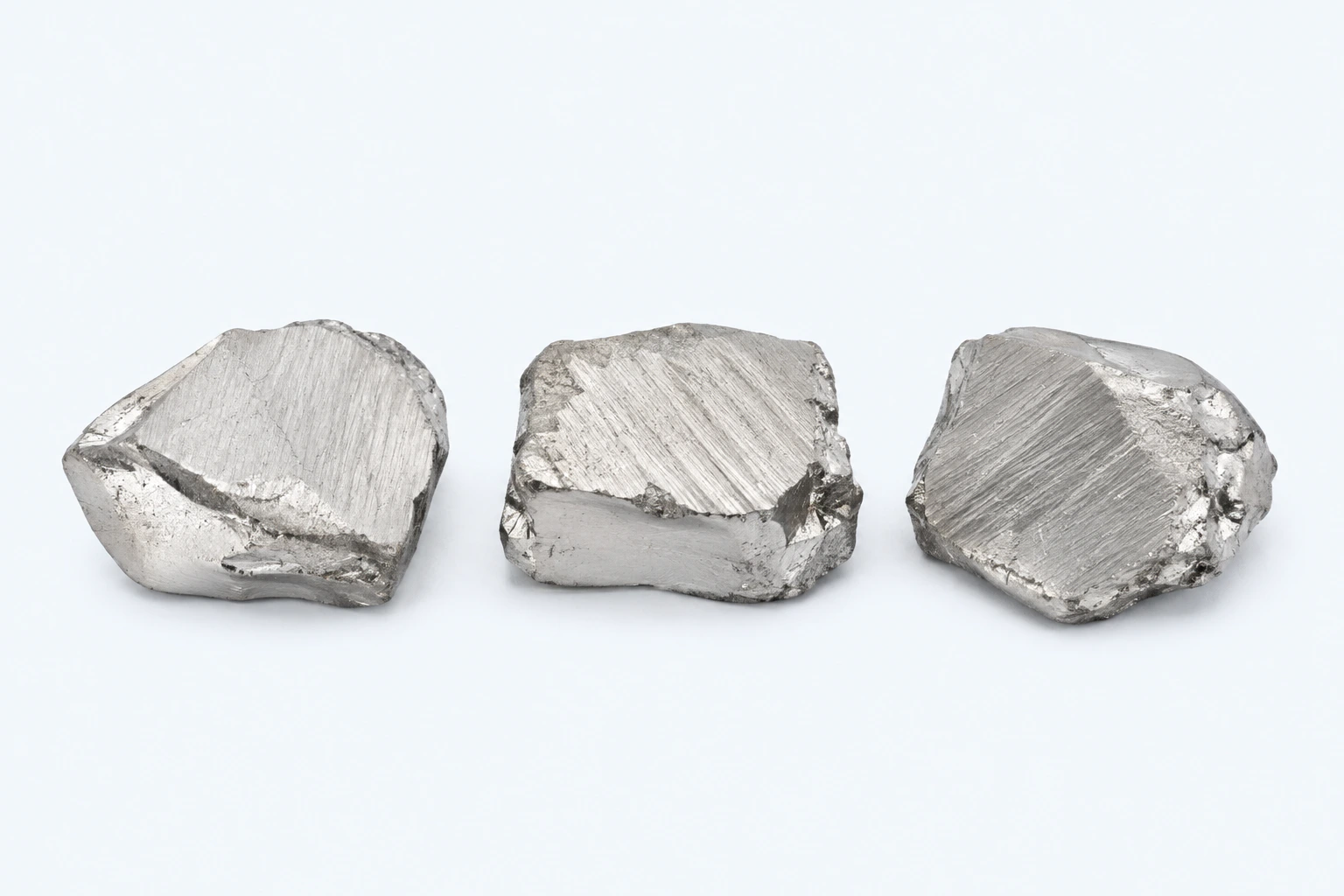
White elemental tin (Sn), shown as three representative soft silvery-white solid specimens. Tin has multiple allotropes; this plate represents metallic white tin and is not solder, gray-tin powder, analytical reference material, or a photograph.
Scientific media record2 verified identifiers
- Subject
- Tinelement
- Identifiers
- Atomic number 50PubChem CID:5352426
- Review
- Editorial review completeIdentifiers authority-verified · Accessibility validated · · tin|tin-technical-specimen-v1.webp
- Digital source
- Trained-algorithmic mediaCreated with a trained generative algorithm and reviewed by WikiBiome for subject identity, scientific framing, identifiers, provenance, and accessibility.
- Scientific basis
- Tin — PubChem ElementTin atom, PubChem CID 5352426
- License
- CC BY-SA 4.0Created
A non-essential metal with a dual toxicological profile: inorganic tin (from canned foods) causes primarily gastric irritation at high concentrations, while organotin compounds (tributyltin, trimethyltin) are far more toxic, acting as endocrine disruptors and neurotoxins.
Tin exposure is nearly ubiquitous in the US population and is primarily a food safety concern rather than an occupational or environmental one for the general public.
Evidence map17 cited passagesInspect provenance +
Inorganic tin salts are poorly absorbed from the GI tract and mainly excreted in feces.
Listed on the CERCLA National Priorities List of hazardous substances.
Adverse reactions reported from canned beverages (100-490 mg/kg tin) and canned tomato juice (140-400 mg/kg tin).
Baby food jars from Spain contained measurable tin; part of the multi-element risk assessment showing baby food consumption scenarios are not safe for some elements.
Tin detected in Brazilian infant formulas as part of toxic metal screening.
Fruit juices from Nigeria showed detectable tin among other trace metals.
US population data from NHANES 2011-2014 provides the most comprehensive exposure assessment:
Canned food consumption: Surprisingly, not consistently associated with urinary tin levels in this study, suggesting other exposure routes or that total urinary tin does not distinguish organic from inorganic forms.
Tin salts are corrosive; acute toxicity manifests as gastric irritation, nausea, vomiting, abdominal discomfort, and diarrhea within 0.5-3.0 hours of ingestion, resolving within 48 hours.
Toxicity depends more on tin concentration in the foodstuff than on total tin intake per body weight.
Regulatory thresholds: The EU SCF concurs with JECFA that tin levels of 150 mg/kg in beverages or 250 mg/kg in other canned foods may cause gastric irritation in some individuals.
No data available on whether infants are more sensitive than older children and adults.
ATSDR profile covers both inorganic and organotin health effects across inhalation, oral, and dermal routes at acute, intermediate, and chronic durations.
Tin was included in the 15-metal toenail panel in the Sister Study: no significant association with breast cancer risk.
EU SCF: Tin levels of 150 mg/kg (beverages) and 250 mg/kg (other foods) as thresholds for gastric irritation.
ATSDR: Comprehensive toxicological profile prepared under CERCLA/Superfund mandates.
EU Drinking Water Directive: Tin included in monitoring parameters.
Contents
1. Chemical Properties2. Sources of Exposure3. Population Exposure4. Health Effects5. Regulatory Framework6. ConnectionsChemical Properties#
Post-transition metal (Group 14); two common oxidation states: tin(II) (Sn2+) (stannous) and tin(4) (stannic). Density 7.3 g/cm3; melting point 232 C. Inorganic tin salts are poorly absorbed from the GI tract and mainly excreted in feces.[1]Opinion of the Scientific Committee on Food on Acute Risks Posed by Tin in Canned FoodsEuropean Commission Scientific Committee on Food · 2001Open reference 1 ↓
Organotin compounds (R-tin bonds) are lipophilic and far more bioavailable than inorganic forms. Listed on the CERCLA National Priorities List of hazardous substances.[2]Toxicological Profile for Tin and Tin CompoundsATSDR (Agency for Toxic Substances and Disease Registry), Carolyn Harper, Fernando Llados et al. · 2005Open reference 2 ↓
Sources of Exposure#
Canned Foods (Primary Route)#
Canned foods in unlacquered or partially lacquered tinplate cans are the principal source of inorganic tin exposure for the general population.
Tin leaches from can walls into acidic food contents (tomatoes, citrus juices, fruits). Adverse reactions reported from canned beverages (100-490 mg/kg tin) and canned tomato juice (140-400 mg/kg tin).[1]Opinion of the Scientific Committee on Food on Acute Risks Posed by Tin in Canned FoodsEuropean Commission Scientific Committee on Food · 2001Open reference 1 ↓ Modern lacquered cans substantially reduce leaching, but damage or incomplete coating allows migration.
Baby Food and Infant Formula#
Baby food jars from Spain contained measurable tin; part of the multi-element risk assessment showing baby food consumption scenarios are not safe for some elements.[3]Baby Food Jars as a Dietary Source of Essential (K, Na, Ca, Mg, Fe, Zn, Cu, Co, Mo, Mn) and Toxic Elements (Al, Cd, Pb, B, Ba, V, Sr, Li, Ni)Gonzalez-Suarez S, Paz-Montelongo S, Niebla-Canelo D et al. · 2022Open reference 3 ↓
Tin detected in Brazilian infant formulas as part of toxic metal screening.[4]Toxic Metals and Metalloids in Infant Formulas Marketed in Brazil, and Child Health Risks According to the Target Hazard Quotients and Target Cancer RiskCristine Couto de Almeida, Diego dos Santos Baiao, Paloma de Almeida Rodrigues et al. · 2022Open reference 4 ↓
Other Sources#
Organotin compounds: tributyltin (TBT) used as antifouling paint on ships (now largely banned); PVC stabilizers; agricultural fungicides. Fruit juices from Nigeria showed detectable tin among other trace metals.[5]Trace Metals and Contaminants in Commercial Fruit Juices Sold in South Eastern States, NigeriaOnyeneto T.C., Nwachukwu I.N., Nwogwugwu N.U. · 2015Open reference 5 ↓
Population Exposure#
US population data from NHANES 2011-2014 provides the most comprehensive exposure assessment.[6]Environmental Tin Exposure in a Nationally Representative Sample of U.S. Adults and Children: the National Health and Nutrition Examination Survey 2011-2014Lehmler HJ, Gadogbe M, Liu B et al. · 2018Open reference 6 ↓
Detection frequency: 87% in adults, 91% in children—exposure is nearly ubiquitous. Median urinary tin: 0.42 ug/L in adults; 0.60 ug/L in children. Age: The strongest predictor; levels in the >=60 year group are ~2-fold higher than the 20-39 group, suggesting bioaccumulation.
Children: 6-11 year olds have ~2-fold higher levels than 12-19 year olds. Race/ethnicity: Non-Hispanic Black individuals have the highest levels (0.74 ug/L). Income: Inverse association; low-income groups have significantly higher tin levels.
Canned food consumption: Surprisingly, not consistently associated with urinary tin levels in this study, suggesting other exposure routes or that total urinary tin does not distinguish organic from inorganic forms.[6]Environmental Tin Exposure in a Nationally Representative Sample of U.S. Adults and Children: the National Health and Nutrition Examination Survey 2011-2014Lehmler HJ, Gadogbe M, Liu B et al. · 2018Open reference 6 ↓
Health Effects#
Inorganic Tin—Gastric Irritation#
The primary health effect of inorganic tin exposure is acute GI disturbance. Tin salts are corrosive; acute toxicity manifests as gastric irritation, nausea, vomiting, abdominal discomfort, and diarrhea within 0.5-3.0 hours of ingestion, resolving within 48 hours.[1]Opinion of the Scientific Committee on Food on Acute Risks Posed by Tin in Canned FoodsEuropean Commission Scientific Committee on Food · 2001Open reference 1 ↓
Toxicity depends more on tin concentration in the foodstuff than on total tin intake per body weight.[1]Opinion of the Scientific Committee on Food on Acute Risks Posed by Tin in Canned FoodsEuropean Commission Scientific Committee on Food · 2001Open reference 1 ↓
Regulatory thresholds: The EU SCF concurs with JECFA that tin levels of 150 mg/kg in beverages or 250 mg/kg in other canned foods may cause gastric irritation in some individuals.[1]Opinion of the Scientific Committee on Food on Acute Risks Posed by Tin in Canned FoodsEuropean Commission Scientific Committee on Food · 2001Open reference 1 ↓
No data available on whether infants are more sensitive than older children and adults.[1]Opinion of the Scientific Committee on Food on Acute Risks Posed by Tin in Canned FoodsEuropean Commission Scientific Committee on Food · 2001Open reference 1 ↓ Low oral absorption means systemic toxicity from inorganic tin is rare.
Organotin Compounds—Endocrine Disruption and Neurotoxicity#
Organotin compounds are orders of magnitude more toxic than inorganic tin. Tributyltin (TBT): Endocrine disruptor; causes imposex in gastropod mollusks at ng/L concentrations; obesogen (promotes adipogenesis via PPARgamma/RXR activation); immunotoxic. Trimethyltin (TMT): Potent neurotoxin targeting the hippocampus and limbic system; causes seizures, cognitive impairment, and neuronal death.
ATSDR profile covers both inorganic and organotin health effects across inhalation, oral, and dermal routes at acute, intermediate, and chronic durations.[2]Toxicological Profile for Tin and Tin CompoundsATSDR (Agency for Toxic Substances and Disease Registry), Carolyn Harper, Fernando Llados et al. · 2005Open reference 2 ↓
Cancer#
- Tin was included in the 15-metal toenail panel in the Sister Study: no significant association with Breast Cancer risk.[7]Metals and Breast Cancer Risk: A Prospective Study Using Toenail BiomarkersNiehoff NM, O'Brien KM, Keil AP et al. · 2021Open reference 7 ↓
Regulatory Framework#
EU SCF: Tin levels of 150 mg/kg (beverages) and 250 mg/kg (other foods) as thresholds for gastric irritation.[1]Opinion of the Scientific Committee on Food on Acute Risks Posed by Tin in Canned FoodsEuropean Commission Scientific Committee on Food · 2001Open reference 1 ↓
ATSDR: Comprehensive toxicological profile prepared under CERCLA/Superfund mandates.[2]Toxicological Profile for Tin and Tin CompoundsATSDR (Agency for Toxic Substances and Disease Registry), Carolyn Harper, Fernando Llados et al. · 2005Open reference 2 ↓ EU Drinking Water Directive: Tin included in monitoring parameters.[8]Directive (EU) 2020/2184 on the Quality of Water Intended for Human Consumption (Recast)European Parliament, Council of the European Union · 2020Open reference 8 ↓ Codex Alimentarius: Maximum level of 250 mg/kg for canned foods (general) and 150 mg/kg for canned beverages.
Connections#
- tin in canned foods is the primary exposure route; regulatory limits are food-specific
- Breast Cancer—measured in toenail biomarker study; no association found
- canned food as primary route for general population
- Iron, Aluminum—co-measured in baby food and canned food safety assessments
- Cadmium, Lead—co-contaminants in food matrices
- organotin compounds (TBT) are established endocrine disruptors
References 9
Numbered by first appearance in the article, then reconciled with its declared source list.
- 1
European Commission Scientific Committee on Food (2001). Opinion of the Scientific Committee on Food on Acute Risks Posed by Tin in Canned Foods. SCF/CS/CNTM/OTH/18 Final (EU Scientific Opinion).
- 2
ATSDR (Agency for Toxic Substances and Disease Registry), Carolyn Harper, Fernando Llados et al. (2005). Toxicological Profile for Tin and Tin Compounds. ATSDR Toxicological Profile (U.S. Department of Health and Human Services).
- 3
Gonzalez-Suarez S, Paz-Montelongo S, Niebla-Canelo D et al. (2022). Baby Food Jars as a Dietary Source of Essential (K, Na, Ca, Mg, Fe, Zn, Cu, Co, Mo, Mn) and Toxic Elements (Al, Cd, Pb, B, Ba, V, Sr, Li, Ni). Applied Sciences.
- 4
Cristine Couto de Almeida, Diego dos Santos Baiao, Paloma de Almeida Rodrigues et al. (2022). Toxic Metals and Metalloids in Infant Formulas Marketed in Brazil, and Child Health Risks According to the Target Hazard Quotients and Target Cancer Risk. International Journal of Environmental Research and Public Health.
- 5
Onyeneto T.C., Nwachukwu I.N., Nwogwugwu N.U. (2015). Trace Metals and Contaminants in Commercial Fruit Juices Sold in South Eastern States, Nigeria. Annals of Biological Research.
- 6
Lehmler HJ, Gadogbe M, Liu B et al. (2018). Environmental Tin Exposure in a Nationally Representative Sample of U.S. Adults and Children: the National Health and Nutrition Examination Survey 2011-2014. Environmental Pollution.
- 7
Niehoff NM, O'Brien KM, Keil AP et al. (2021). Metals and Breast Cancer Risk: A Prospective Study Using Toenail Biomarkers. American Journal of Epidemiology.
- 8
European Parliament, Council of the European Union (2020). Directive (EU) 2020/2184 on the Quality of Water Intended for Human Consumption (Recast). Official Journal of the European Union (L 435/1).
- 9
Maria Assunta Meli, Donatella Desideri, Davide Sisti et al. (2024). Meli 2024 — Chemical characterization of baby food consumed in Italy. PLOS ONE.
Article network
Mentioned here 5
Connect the evidence
Publicly readable discussion by ORCID-authenticated researchers. Questions, interpretation, methods, corrections, and new evidence stay attached to this record.
No discussion yet. Start with a precise question or a source-backed observation.
Activity and accepted changes
Accepted researcher context, editorial status, public discussion, and upstream Git revisions are shown together. Pending, declined, and withdrawn proposals remain private.
- published revision
massive wiki expansion: 149 stubs fixed, 100+ new pages, Rule 15 scan, keystone papers
WikiBiome Deploy Bot · +16 −16
Inspect exact Git diff ↗ - published revision
WikiBiome update — 2026-04-15 17:23
WikiBiome Deploy Bot · +3 −3
Inspect exact Git diff ↗ - published revision
wiki: bulk entity upgrades, new article pages, and site regeneration
WikiBiome Deploy Bot · +6 −0
Inspect exact Git diff ↗ - published revision
WikiBiome update — integrity fixes, metallomic diet pages, cross-condition analyses
WikiBiome Deploy Bot · +19 −17
Inspect exact Git diff ↗ - published revision
WikiBiome v7 — interactive microbiome metallomics encyclopedia
Karen Pendergrass · +89 −0
Inspect exact Git diff ↗