

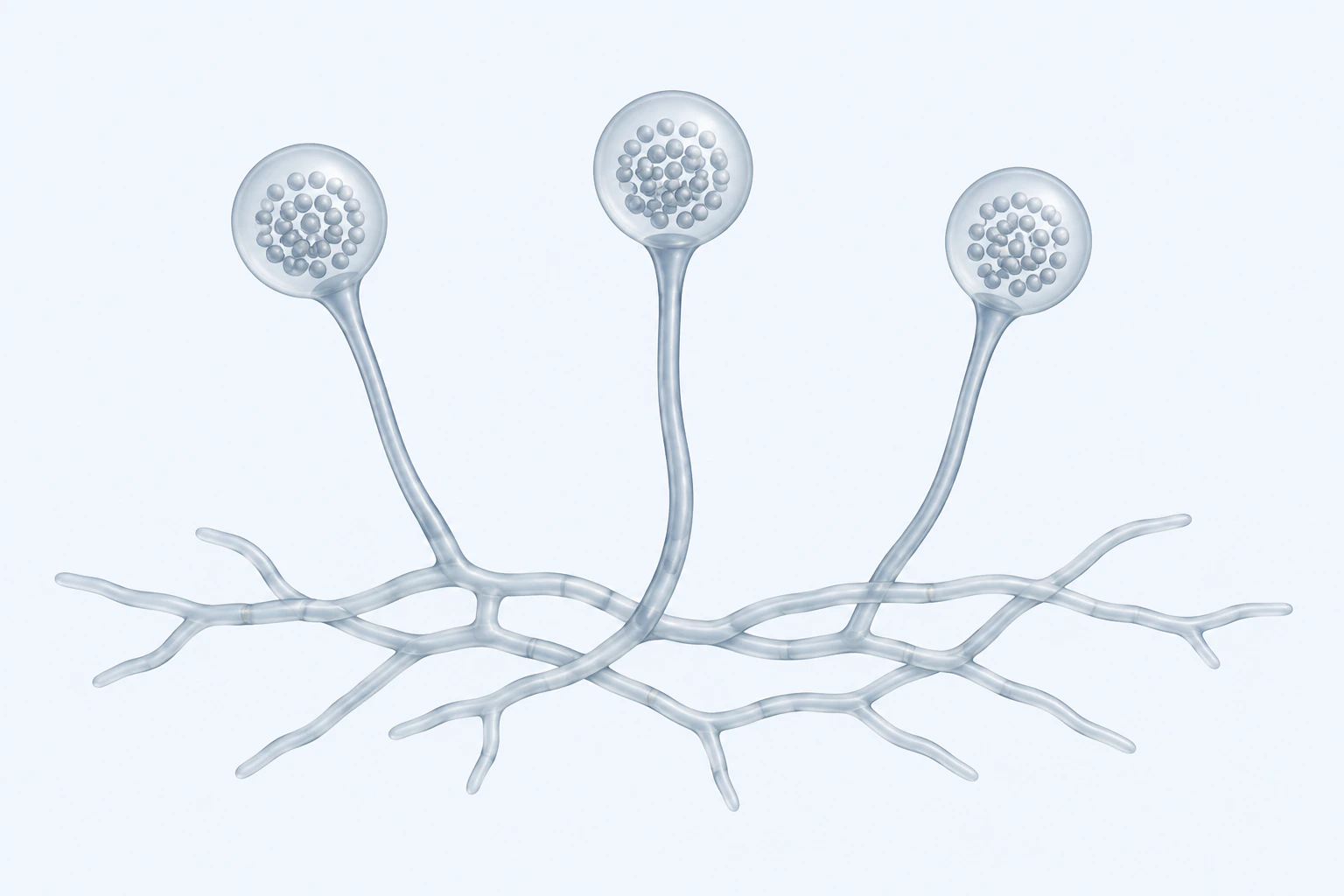
Type-species-anchored Mortierella reconstruction with one connected hyphal specimen, three upright sporangiophores, and three closed globose sporangia containing internal spores. Eleven visible transverse tonal seams exceed the prompt target of two; they are an accepted output-specific feature and do not imply a universal septation pattern. This scientific reconstruction is representative, non-diagnostic, and not a micrograph.
Scientific media record3 verified identifiers
- Subject
- Mortierellataxon · genus
- Review
- Editorial review completeIdentifiers authority-verified · Accessibility validated · · mortierella|mortierella-morphology-v2.webp
- Digital source
- Trained-algorithmic mediaCreated with a trained generative algorithm and reviewed by WikiBiome for subject identity, scientific framing, identifiers, provenance, and accessibility.
- Scientific basis
- Mortierella — NCBI TaxonomyMortierella — Index FungorumMortierella — MycoBankMortierella phylogeny and morphologyMortierella morphology and genome context
- License
- CC BY-SA 4.0Created
Mortierella is a genus of soil-dwelling fungi in the phylum Mortierellomycota (formerly placed in Zygomycota). While primarily known as environmental saprotrophs, Mortierella species have recently been identified as residents of the human gut mycobiome—the fungal component of the intestinal microbiota.
Their presence in the gut is increasingly recognized as a marker of metabolic and cardiovascular health.
What makes Mortierella remarkable in the WikiBiome context is its emerging role as a protective fungal marker. Unlike Candida and Malassezia, which consistently expand in cardiometabolic disease, Mortierella is depleted in hypertension and prehypertension, positioning it as the mycobiome's counterpart to bacterial health indicators like Faecalibacterium prausnitzii.
Evidence map8 cited passagesInspect provenance +
Depletion precedes disease: Mortierella was depleted in both prehypertension and hypertension states compared to normotensive controls, and its depletion was present even before clinical hypertension developed. This temporal pattern suggests Mortierella loss is an early event in cardiometabolic disease progression, not a consequence (, cross-sectional).
Immunomodulatory associations: Mortierella abundance was positively associated with serum immunoglobulin light chain (LC) lambda concentrations, suggesting it interacts with the immune system in ways that differ from pathogenic fungi like malassezia, which was positively correlated with both LC kappa and lambda (, cross-sectional).
PCOS-BMI interaction: In PCOS, Mortierella showed a striking BMI-dependent pattern: elevated in overweight PCOS patients (PCOS-HB) but not in normal-BMI PCOS. It negatively correlated with BMI but adversely correlated with LH, androstenedione, total testosterone, HDL-C, and DHEA, flagging it as a marker of metabolic-reproductive decoupling (, cross-sectional
Cardiometabolic progression: A comprehensive review identified Mortierella as potentially protective in hypertension alongside evidence that Malassezia and Candida are consistently pathology-associated (, expert-opinion).
Hypertension: Depleted in both pre-HTN and HTN compared to normotensive controls. Depletion present before clinical disease onset (, cross-sectional).
Prehypertension: Depletion already evident in the prehypertensive state, making it a candidate early biomarker (, cross-sectional).
PCOS (overweight subgroup): Uniquely elevated in overweight PCOS patients (PCOS-HB). This is the first study to demonstrate that fungal dysbiosis in PCOS is BMI-dependent. The enrichment may reflect metabolic substrate availability in overweight but metabolically active individuals (, cross-sectional, n=88).
| Study | Finding | Evidence Level | |-------|---------|---------------| | | Depleted in pre-HTN and HTN; positive LC lambda association | Cross-sectional | | | BMI-dependent enrichment in overweight PCOS; metabolic-reproductive decoupler | Cross-sectional | | | Protective in hypertension; contrasts with Candida/Malassezia pathology | Expert opinion |
Contents
1. Metal Dependencies2. Key Enzymes and Virulence Factors3. Ecological Role4. Conditions Associated5. Key Studies6. Cross-ReferencesMetal Dependencies#
Zinc: Mortierella species require zinc for their lipid metabolism enzymes, particularly the desaturases and elongases involved in polyunsaturated fatty acid (PUFA) synthesis. Iron: Required for cytochrome-dependent oxidative metabolism.
The genus is notable in industrial biotechnology for its ability to produce arachidonic acid (ARA, 20:4 omega-6) and other long-chain PUFAs. Mortierella alpina is used commercially for ARA production. Whether gut-resident Mortierella produces biologically significant PUFA quantities remains to be determined.
Key Enzymes and Virulence Factors#
Mortierella has no known virulence factors. Its enzymatic profile reflects a saprophytic, lipid-producing metabolism. Delta-6-desaturase and elongase: Key enzymes in the PUFA synthesis pathway.
These convert linoleic acid through gamma-linolenic acid to dihomo-gamma-linolenic acid and ultimately arachidonic acid.
Lipase activity: Enables breakdown of complex lipids in the gut environment.
Ecological Role#
In the gut mycobiome, Mortierella appears to play a stabilizing role.
Depletion precedes disease: Mortierella was depleted in both prehypertension and hypertension states compared to normotensive controls, and its depletion was present even before clinical hypertension developed. This temporal pattern suggests Mortierella loss is an early event in cardiometabolic disease progression, not a consequence (,[1]Gut Mycobiome Dysbiosis Contributes to the Development of Hypertension and Its Response to Immunoglobulin Light ChainsYeqing Zou, Anxing Ge, Brako Lydia et al. · 2022Open reference 1 ↓ cross-sectional).
Immunomodulatory associations: Mortierella abundance was positively associated with serum immunoglobulin light chain (LC) lambda concentrations, suggesting it interacts with the immune system in ways that differ from pathogenic fungi like Malassezia, which was positively correlated with both LC kappa and lambda (,[1]Gut Mycobiome Dysbiosis Contributes to the Development of Hypertension and Its Response to Immunoglobulin Light ChainsYeqing Zou, Anxing Ge, Brako Lydia et al. · 2022Open reference 1 ↓ cross-sectional).
PCOS-BMI interaction: In PCOS, Mortierella showed a striking BMI-dependent pattern: elevated in overweight PCOS patients (PCOS-HB) but not in normal-BMI PCOS.
It negatively correlated with BMI but adversely correlated with LH, androstenedione, total testosterone, HDL-C, and DHEA, flagging it as a marker of metabolic-reproductive decoupling (,[2]Yin 2022 — Alterations of bacteriome, mycobiome and metabolome characteristics in PCOS patients with normal/overweight individualsYin G, Chen F, Chen G et al. · 2022Open reference 2 ↓ cross-sectional, n=88).
Cardiometabolic progression: A comprehensive review identified Mortierella as potentially protective in hypertension alongside evidence that Malassezia and Candida are consistently pathology-associated (,[3]Gut Mycobiome in Cardiometabolic Disease Progression: Current Evidence and Future DirectionsXiaoyu Wei, Zixin Guo, Jingyang Wang et al. · 2025Open reference 3 ↓ expert-opinion).
Conditions Associated#
Depleted in:#
Hypertension: Depleted in both pre-HTN and HTN compared to normotensive controls. Depletion present before clinical disease onset (,[1]Gut Mycobiome Dysbiosis Contributes to the Development of Hypertension and Its Response to Immunoglobulin Light ChainsYeqing Zou, Anxing Ge, Brako Lydia et al. · 2022Open reference 1 ↓ cross-sectional). Prehypertension: Depletion already evident in the prehypertensive state, making it a candidate early biomarker (,[1]Gut Mycobiome Dysbiosis Contributes to the Development of Hypertension and Its Response to Immunoglobulin Light ChainsYeqing Zou, Anxing Ge, Brako Lydia et al. · 2022Open reference 1 ↓ cross-sectional).
Enriched in:#
- PCOS (overweight subgroup): Uniquely elevated in overweight PCOS patients (PCOS-HB). This is the first study to demonstrate that fungal Dysbiosis in PCOS is BMI-dependent. The enrichment may reflect metabolic substrate availability in overweight but metabolically active individuals (,[2]Yin 2022 — Alterations of bacteriome, mycobiome and metabolome characteristics in PCOS patients with normal/overweight individualsYin G, Chen F, Chen G et al. · 2022Open reference 2 ↓ cross-sectional, n=88).
Key Studies#
| Study | Finding | Evidence Level |
|---|---|---|
| [1]Gut Mycobiome Dysbiosis Contributes to the Development of Hypertension and Its Response to Immunoglobulin Light ChainsYeqing Zou, Anxing Ge, Brako Lydia et al. · 2022Open reference 1 ↓ | Depleted in pre-HTN and HTN; positive LC lambda association | Cross-sectional |
| [2]Yin 2022 — Alterations of bacteriome, mycobiome and metabolome characteristics in PCOS patients with normal/overweight individualsYin G, Chen F, Chen G et al. · 2022Open reference 2 ↓ | BMI-dependent enrichment in overweight PCOS; metabolic-reproductive decoupler | Cross-sectional |
| [3]Gut Mycobiome in Cardiometabolic Disease Progression: Current Evidence and Future DirectionsXiaoyu Wei, Zixin Guo, Jingyang Wang et al. · 2025Open reference 3 ↓ | Protective in hypertension; contrasts with Candida/Malassezia pathology | Expert opinion |
Cross-References#
- Malassezia—pathology-associated fungal counterpart (enriched where Mortierella depleted)
- Candida albicans—co-assessed gut fungus in PCOS and CVD mycobiome studies
- Hypertension—cardiovascular condition with mycobiome depletion
- polycystic-ovary-syndrome—BMI-dependent mycobiome signature
- Cardiovascular Disease—cardiometabolic protection
- gut-mycobiome—broader fungal community context
References 7
Numbered by first appearance in the article, then reconciled with its declared source list.
- 1
Yeqing Zou, Anxing Ge, Brako Lydia et al. (2022). Gut Mycobiome Dysbiosis Contributes to the Development of Hypertension and Its Response to Immunoglobulin Light Chains. Frontiers in Immunology.
- 2
Yin G, Chen F, Chen G et al. (2022). Yin 2022 — Alterations of bacteriome, mycobiome and metabolome characteristics in PCOS patients with normal/overweight individuals. Journal of Ovarian Research.
- 3
Xiaoyu Wei, Zixin Guo, Jingyang Wang et al. (2025). Gut Mycobiome in Cardiometabolic Disease Progression: Current Evidence and Future Directions. Frontiers in Microbiology.
- 4
Yeqing Zou, Anxing Ge, Brako Lydia et al. (2022). Gut Mycobiome Dysbiosis Contributes to the Development of Hypertension and Its Response to Immunoglobulin Light Chains. Frontiers in Immunology.
- 5
Yin G, Chen F, Chen G et al. (2022). Alterations of bacteriome, mycobiome and metabolome characteristics in PCOS patients with normal/overweight individuals. Journal of Ovarian Research.
- 6
Xiaoyu Wei, Zixin Guo, Jingyang Wang et al. (2025). Gut mycobiome in cardiometabolic disease progression: current evidence and future directions. Frontiers in Microbiology.
- 7
Yeqing Zou, Anxing Ge, Brako Lydia et al. (2022). Gut mycobiome dysbiosis contributes to the development of hypertension and its response to immunoglobulin light chains. Frontiers in Immunology.
Article network
Connect the evidence
Publicly readable discussion by ORCID-authenticated researchers. Questions, interpretation, methods, corrections, and new evidence stay attached to this record.
No discussion yet. Start with a precise question or a source-backed observation.
Published page changes
This record shows only material changes published on this page, including changes to its content, evidence, conclusions, or author context. Internal processes and discussion activity are excluded. Pending, declined, and withdrawn proposals remain private.
- published revision
Created “Mortierella”: Mortierella is a genus of soil-dwelling fungi in the phylum Mortierellomycota (formerly placed in Zygomycota). While primarily known as environmental saprotrophs, Mortierella species have recently…
Created “Mortierella”: Mortierella is a genus of soil-dwelling fungi in the phylum Mortierellomycota (formerly placed in Zygomycota). While primarily known as environmental saprotrophs, Mortierella species have recently… Published sections: Mortierella; Metal Dependencies; Key Enzymes and Virulence Factors; Ecological Role; Depleted in:; Enriched in:; Key Studies; Cross-References. · WikiBiome Deploy Bot · +78 −0
Inspect exact Git diff ↗