

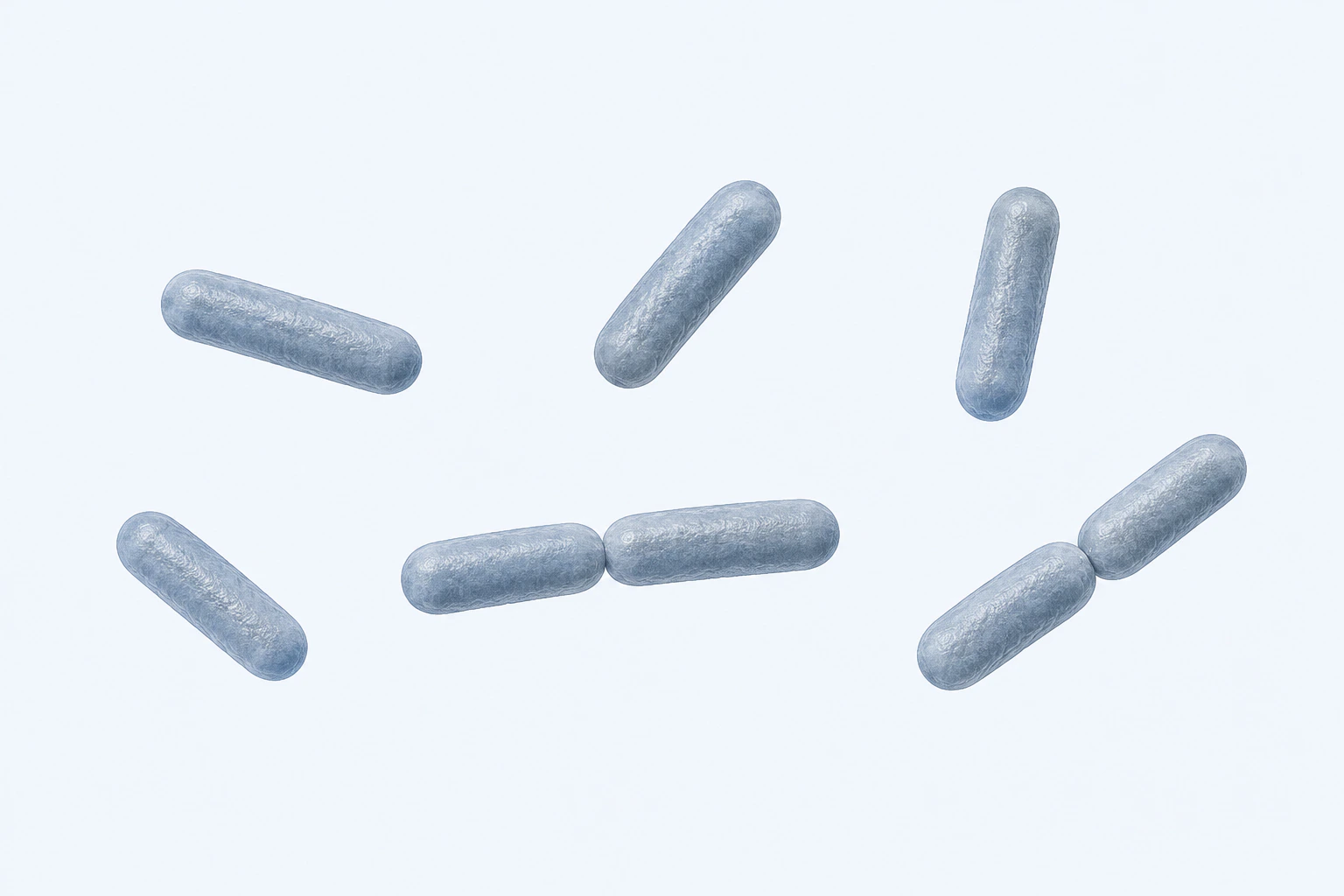
Type-strain-anchored Morganella morganii short rods, shown as eight bodies in four single and two paired groupings. This scientific reconstruction is representative, non-diagnostic, and not a micrograph.
Scientific media record1 verified identifier
- Subject
- Morganella morganiitaxon · species
- Identifiers
- NCBITaxon:582
- Review
- Editorial review completeIdentifiers authority-verified · Accessibility validated · · morganella-morganii|morganella-morganii-morphology-v1.webp
- Digital source
- Trained-algorithmic mediaCreated with a trained generative algorithm and reviewed by WikiBiome for subject identity, scientific framing, identifiers, provenance, and accessibility.
- Scientific basis
- Morganella morganii — NCBI TaxonomyMorganella morganii — LPSNMorganella morganii DSM 30164Morganella morganii clinical microbiology review
- License
- CC BY-SA 4.0Created
Morganella morganii is a Gram-negative, facultatively anaerobic rod belonging to the family Morganellaceae (formerly classified within Enterobacteriaceae). It inhabits the human gastrointestinal tract as a low-abundance commensal but becomes an opportunistic pathogen in immunocompromised hosts, causing urinary tract infections, wound infections, and sepsis.
Metal Dependencies#
M. morganii produces a potent nickel-dependent Urease that hydrolyzes urea to Ammonia, raising local pH. This pH shift increases the bioavailability of iron and zinc, creating a self-reinforcing niche. The organism also deploys siderophore systems for iron acquisition in competition with the host's Nutritional Immunity (Metal Sequestration) defenses.
Ecological Role#
In a healthy gut, M. morganii remains at trace abundance, outcompeted by dominant commensals. During Dysbiosis—particularly when iron availability rises or commensal diversity drops—it can expand rapidly. Its urease activity alkalinizes the local environment, potentially disrupting acid-tolerant beneficial taxa and favoring co-expansion of other Proteobacteria.
Conditions Associated#
M. morganii is clinically significant in nosocomial infections and has been detected at elevated levels in Gut Microbiome profiles of patients with Inflammatory Bowel Disease (IBD) and post-surgical complications. Its intrinsic resistance to multiple antibiotics, including ampicillin and first-generation cephalosporins, complicates treatment.
Cross-References#
- Nickel—urease cofactor
- Iron—siderophore competition
- Urease—key virulence enzyme
- Nutritional Immunity (Metal Sequestration)—host metal sequestration
References 3
Numbered by first appearance in the article, then reconciled with its declared source list.
- 1
Babak Khorsand, Hamid Asadzadeh Aghdaei, Ehsan Nazemalhosseini-Mojarad et al. (2022). Khorsand 2022 — Overrepresentation of Enterobacteriaceae and Escherichia coli is the major gut microbiome signature in Crohn's and UC: comprehensive metagenomic analysis of IBDMDB datasets. Frontiers in Cellular and Infection Microbiology.
- 2
Kang DY, Park JL, Yeo MK et al. (2023). Diagnosis of Crohn's Disease and Ulcerative Colitis Using the Microbiome. BMC Microbiology.
- 3
Khan F, Rizvi M, Shukla I et al. (2011). A Novel Approach for Identification of Members of Enterobacteriaceae Isolated from Clinical Samples. Biology and Medicine.
Article network
Mentioned here 8
Pages linking here 1
Connect the evidence
Publicly readable discussion by ORCID-authenticated researchers. Questions, interpretation, methods, corrections, and new evidence stay attached to this record.
No discussion yet. Start with a precise question or a source-backed observation.
Activity and accepted changes
Accepted researcher context, editorial status, public discussion, and upstream Git revisions are shown together. Pending, declined, and withdrawn proposals remain private.
- published revision
Backfill gut microbiome concept links
Karen Pendergrass · +1 −1
Inspect exact Git diff ↗ - published revision
Complete Ammonia contextual coverage
Karen Pendergrass · +1 −1
Inspect exact Git diff ↗ - published revision
Complete reviewed Urease contextual coverage
Karen Pendergrass · +2 −2
Inspect exact Git diff ↗ - published revision
massive wiki expansion: 149 stubs fixed, 100+ new pages, Rule 15 scan, keystone papers
WikiBiome Deploy Bot · +8 −7
Inspect exact Git diff ↗ - published revision
maintenance: 409 source fixes, 34 entity updates, 17 concept updates, 30 analysis outputs
WikiBiome Deploy Bot · +56 −0
Inspect exact Git diff ↗