

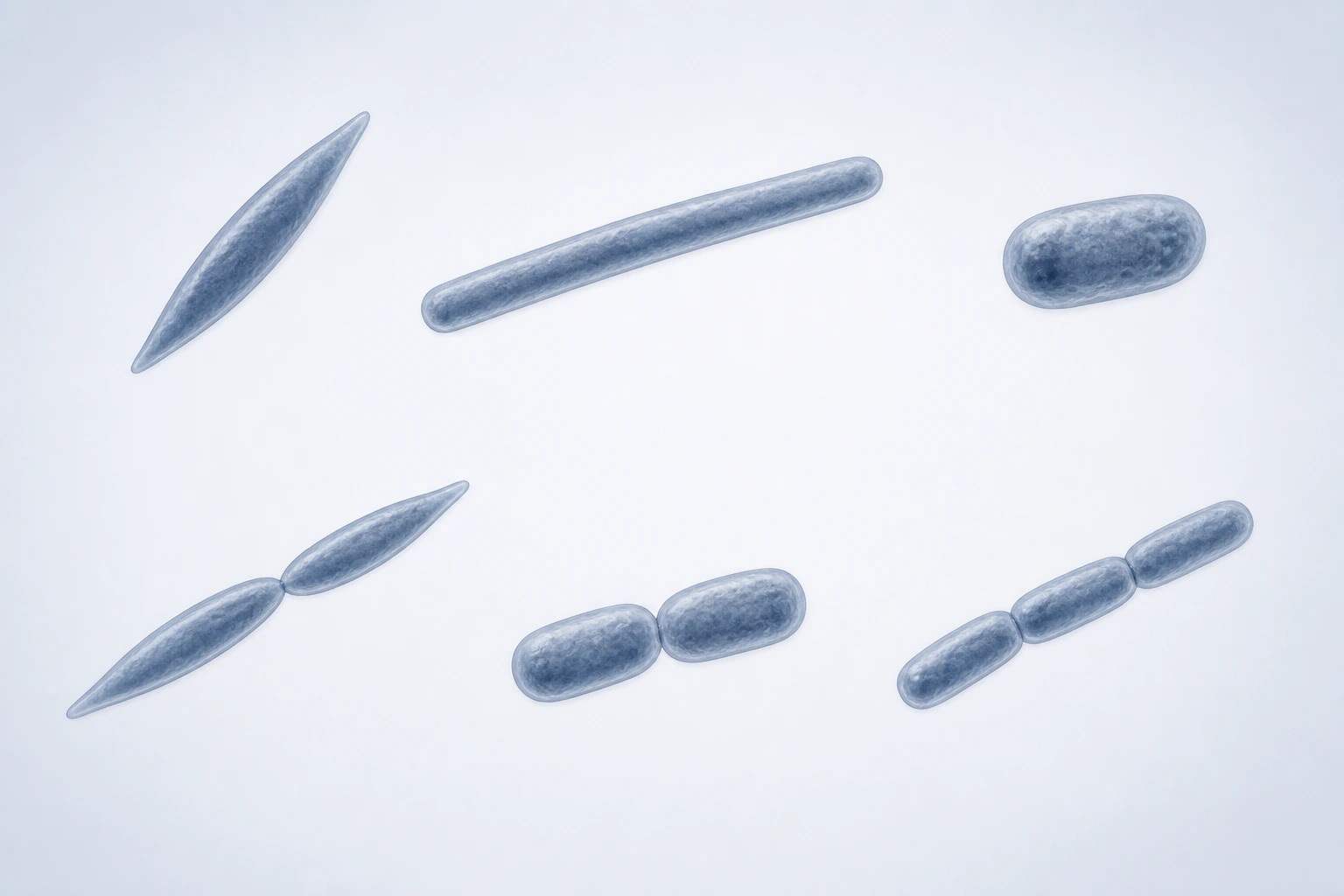
Selected descendant morphology diversity within Fusobacteriales, shown as ten bodies in six groupings. This order-level scientific reconstruction is representative, non-exhaustive, non-diagnostic, and never a universal order form or a micrograph.
Scientific media record1 verified identifier
- Subject
- Fusobacterialestaxon · order
- Identifiers
- NCBITaxon:203491
- Review
- Editorial review completeIdentifiers authority-verified · Accessibility validated · · fusobacteriales|fusobacteriales-microbial-community-v1.webp
- Digital source
- Trained-algorithmic mediaCreated with a trained generative algorithm and reviewed by WikiBiome for subject identity, scientific framing, identifiers, provenance, and accessibility.
- Scientific basis
- Fusobacteriales — NCBI TaxonomyFusobacteriales — LPSNFusobacterium — LPSNLeptotrichia buccalis — LPSNLeptotrichia buccalis type-strain genome
- License
- CC BY-SA 4.0Created
An order of Gram-negative, obligate anaerobic bacteria within the phylum Fusobacteriota (formerly Fusobacteria). This order-level page covers the broader taxonomic group that includes the well-characterized genus Fusobacterium and its key species Fusobacterium nucleatum.
While individual Fusobacterium species have established roles in colorectal cancer and periodontal disease, order-level Mendelian randomization data now implicate Fusobacteriales in the oral-gut-kidney axis, where these predominantly oral bacteria causally increase markers of glomerular injury.
Evidence map4 cited passagesInspect provenance +
Fusobacteriales causally increase urinary albumin-to-creatinine ratio (UACR), a marker of glomerular injury (IVW OR = 1.01, p = 0.04). The proposed mechanism: Fusobacteriales-derived LPS induces systemic inflammation and glomerular injury; bacterial metabolites promote renal oxidative stress and apoptosis. This suggests that good oral hygiene and dental care
Fusobacteriales are enriched in constipated ASD children alongside Escherichia/Shigella and Clostridium cluster XVIII, consistent with the pattern of oral-gut translocation in conditions involving gut barrier dysfunction.
(Mendelian randomization, n=64,164 CKD cases)—Established Fusobacteriales as a causal risk factor for elevated UACR, linking oral microbiome composition to kidney injury.
(review)—Documented Fusobacteriales enrichment in constipated ASD children.
Contents
1. Taxonomy2. Metal Dependencies3. Ecological Role4. Conditions Associated5. Key Studies6. Open Questions7. Cross-ReferencesTaxonomy#
Order Fusobacteriales, class Fusobacteriia, phylum Fusobacteriota. Key families: Fusobacteriaceae (includes Fusobacterium), Leptotrichiaceae. Predominantly oral residents, with translocation to the gut and other body sites in disease states.
Metal Dependencies#
Iron. Fusobacteriales are strongly iron-dependent. Fusobacterium nucleatum encodes multiple iron acquisition systems including ferrous iron transporters and outer membrane receptors for host iron-binding proteins. Iron availability in the tumor microenvironment and in the chronically inflamed gut provides a selective advantage for Fusobacteriales expansion.
The iron dependency connects Fusobacteriales to the broader pattern of iron-driven pathobiont selection seen across cancer and inflammatory conditions.
Ecological Role#
In the Healthy Oral Cavity#
Fusobacteriales are normal inhabitants of the oral cavity, particularly in subgingival plaque. Fusobacterium nucleatum serves as a "bridge organism" in dental biofilms, coaggregating with both early colonizers (Streptococcus) and late colonizers (Porphyromonas, Treponema), facilitating biofilm maturation.
In Disease—The Oral-Gut-Kidney Axis#
The clinical significance of Fusobacteriales extends beyond their oral habitat through a translocation pathway. Oral Dysbiosis (periodontal disease) → increased Fusobacteriales load. Oral-gut translocation → Fusobacteriales colonize the intestinal tract.
LPS-mediated systemic Metal-Driven Inflammation → endotoxemia contributes to distant organ injury.
Glomerular damage → Fusobacteriales-derived LPS induces renal Oxidative Stress and apoptosis.
Conditions Associated#
Chronic Kidney Disease#
Fusobacteriales causally increase urinary albumin-to-creatinine ratio (UACR), a marker of glomerular injury (IVW OR = 1.01, p = 0.04).[1]Liu 2026 — Causal Association between Oral Microbiome and Chronic Kidney Disease: Two-Sample Mendelian RandomizationZhiwei Liu, Zhiyao Liu, Weixia Sun et al. · 2026Open reference 1 ↓ The proposed mechanism: Fusobacteriales-derived LPS induces systemic inflammation and glomerular injury; bacterial metabolites promote renal oxidative stress and apoptosis.
This suggests that good oral hygiene and dental care are kidney-protective—reducing harmful oral Fusobacteriales through periodontal management may slow CKD progression.
Autism Spectrum Disorder#
Fusobacteriales are enriched in constipated ASD children alongside Escherichia/Shigella and Clostridium cluster XVIII,[2]Feng 2023 — Probiotics in Treatment of ASD: Gut-Brain Axis PerspectivesPengya Feng, Shuai Zhao, Yangyang Zhang et al. · 2023Open reference 2 ↓ consistent with the pattern of oral-gut translocation in conditions involving gut barrier dysfunction.
Colorectal Cancer#
The genus Fusobacterium nucleatum within this order is one of the best-established CRC-associated bacteria. See the species-level page for detailed coverage.
Key Studies#
[1]Liu 2026 — Causal Association between Oral Microbiome and Chronic Kidney Disease: Two-Sample Mendelian RandomizationZhiwei Liu, Zhiyao Liu, Weixia Sun et al. · 2026Open reference 1 ↓ (Mendelian randomization, n=64,164 CKD cases)—Established Fusobacteriales as a causal risk factor for elevated UACR, linking oral microbiome composition to kidney injury.
[2]Feng 2023 — Probiotics in Treatment of ASD: Gut-Brain Axis PerspectivesPengya Feng, Shuai Zhao, Yangyang Zhang et al. · 2023Open reference 2 ↓ (review)—Documented Fusobacteriales enrichment in constipated ASD children.
Open Questions#
Unresolved questions identified by the current evidence record.
01Do periodontal interventions slow UACR progression in CKD patients?+
The oral-kidney axis MR evidence predicts that Fusobacteriales control via dental management should reduce glomerular injury markers, but no RCT has tested this.
02Which Fusobacteriales species drive the CKD-UACR signal?+
The MR data are order-level; species-level resolution would identify more precise therapeutic targets.
Cross-References#
- Fusobacterium—the primary genus within this order
- Fusobacterium nucleatum—the best-characterized species; CRC and periodontal disease
- Chronic Kidney Disease—Fusobacteriales causally increase UACR
- Iron—essential metal dependency across the order
- Autism Spectrum Disorder—enriched in constipated ASD children
- Colorectal Cancer—Fusobacterium nucleatum is a major CRC-associated pathobiont
References 10
Numbered by first appearance in the article, then reconciled with its declared source list.
- 1
Zhiwei Liu, Zhiyao Liu, Weixia Sun et al. (2026). Liu 2026 — Causal Association between Oral Microbiome and Chronic Kidney Disease: Two-Sample Mendelian Randomization. Archives of Medical Science.
- 2
Pengya Feng, Shuai Zhao, Yangyang Zhang et al. (2023). Feng 2023 — Probiotics in Treatment of ASD: Gut-Brain Axis Perspectives. Frontiers in Microbiology.
- 3
Xiaopeng Li, Jiahui Feng, Zhanggui Wang et al. (2023). Features of combined gut bacteria and fungi from a Chinese cohort of colorectal cancer, colorectal adenoma, and post-operative patients. Frontiers in Microbiology.
- 4
Melika Shirdarreh, Yasamin Sadeghi, Tina Rahimi (2021). The Impact of Ketogenic Diet on Colorectal Cancer Progression and the Co-evolution of Gut Microbiota: A Research Protocol. URNCST Journal.
- 5
Georgina Quaranta, Mauro Pittiruti, Brunella Posteraro et al. (2019). Quaranta 2019 — FMT as a Potential Tool for Female Reproductive Tract Diseases (Review). Frontiers in Immunology.
- 6
Jhommara Bautista, Walter D. Cardona-Maya, Kelly Gancino-Guevara et al. (2025). Bautista 2025 — Reprogramming Prostate Cancer Through the Microbiome. Frontiers in Medicine.
- 7
Wehedy, Ghali, Matboli (2022). Wehedy et al. 2022 — The Human Microbiome in CKD: A Double-Edged Sword. Frontiers in Medicine.
- 8
Cuipeng Zhu, Kaiqi Li, Xiao-Xu Peng et al. (2022). Berberine a Traditional Chinese Drug Repurposing: Its Actions in Inflammation-Associated Ulcerative Colitis and Cancer Therapy. Frontiers in Immunology.
- 9
Catala-Valentin AR, Mikhail S, Bernard JN et al. (2021). Corruption of Bacterial-Host Homeostasis as a Potential Risk Factor and Biomarker for Upper Gastrointestinal Carcinogenesis. Journal of Gastroenterology and Hepatobiliary Medicine.
- 10
Shuya Lv, Jingrong Huang, Yadan Luo et al. (2024). Lv 2024 — Gut Microbiota Is Involved in Male Reproductive Function: A Review. Frontiers in Microbiology.
Article network
Connect the evidence
Publicly readable discussion by ORCID-authenticated researchers. Questions, interpretation, methods, corrections, and new evidence stay attached to this record.
No discussion yet. Start with a precise question or a source-backed observation.
Published page changes
This record shows only material changes published on this page, including changes to its content, evidence, conclusions, or author context. Internal processes and discussion activity are excluded. Pending, declined, and withdrawn proposals remain private.
- published revision
Added references: li-2023-combined-gut-bacteria-fungi-crc-adenoma-chinese-cohort; shirdarreh-2021-ketogenic-diet-crc-microbiota-protocol; quaranta-2019-fmt-female-reproductive-tract-diseases; bautista-2025-reprogramming-prostate-cancer-microbiome;…
Added references: li-2023-combined-gut-bacteria-fungi-crc-adenoma-chinese-cohort; shirdarreh-2021-ketogenic-diet-crc-microbiota-protocol; quaranta-2019-fmt-female-reproductive-tract-diseases; bautista-2025-reprogramming-prostate-cancer-microbiome; wehedy-2022-human-microbiome-ckd-double-edged-sword; zhu-2022-berberine-uc-cancer-therapy; catala-valentin-2021-bacterial-host-homeostasis-upper-gi-carcinogenesis; lv-2024-gut-microbiota-male-reproductive-function-review. Removed references: liu-2026-oral-microbiome-ckd-mendelian-randomization; feng-2023-probiotics-asd-gut-brain-axis-review. · WikiBiome Deploy Bot · +21 −15
Inspect exact Git diff ↗ - published revision
Created “Fusobacteriales”: An order of Gram-negative, obligate anaerobic bacteria within the phylum Fusobacteriota (formerly Fusobacteria). This order-level page covers the broader taxonomic group that includes the…
Created “Fusobacteriales”: An order of Gram-negative, obligate anaerobic bacteria within the phylum Fusobacteriota (formerly Fusobacteria). This order-level page covers the broader taxonomic group that includes the… Published sections: Fusobacteriales; Taxonomy; Metal Dependencies; In the Healthy Oral Cavity; In Disease -- The Oral-Gut-Kidney Axis; Chronic Kidney Disease; Autism Spectrum Disorder; Colorectal Cancer; Key Studies; Open Questions; Cross-References. · WikiBiome Deploy Bot · +82 −0
Inspect exact Git diff ↗