
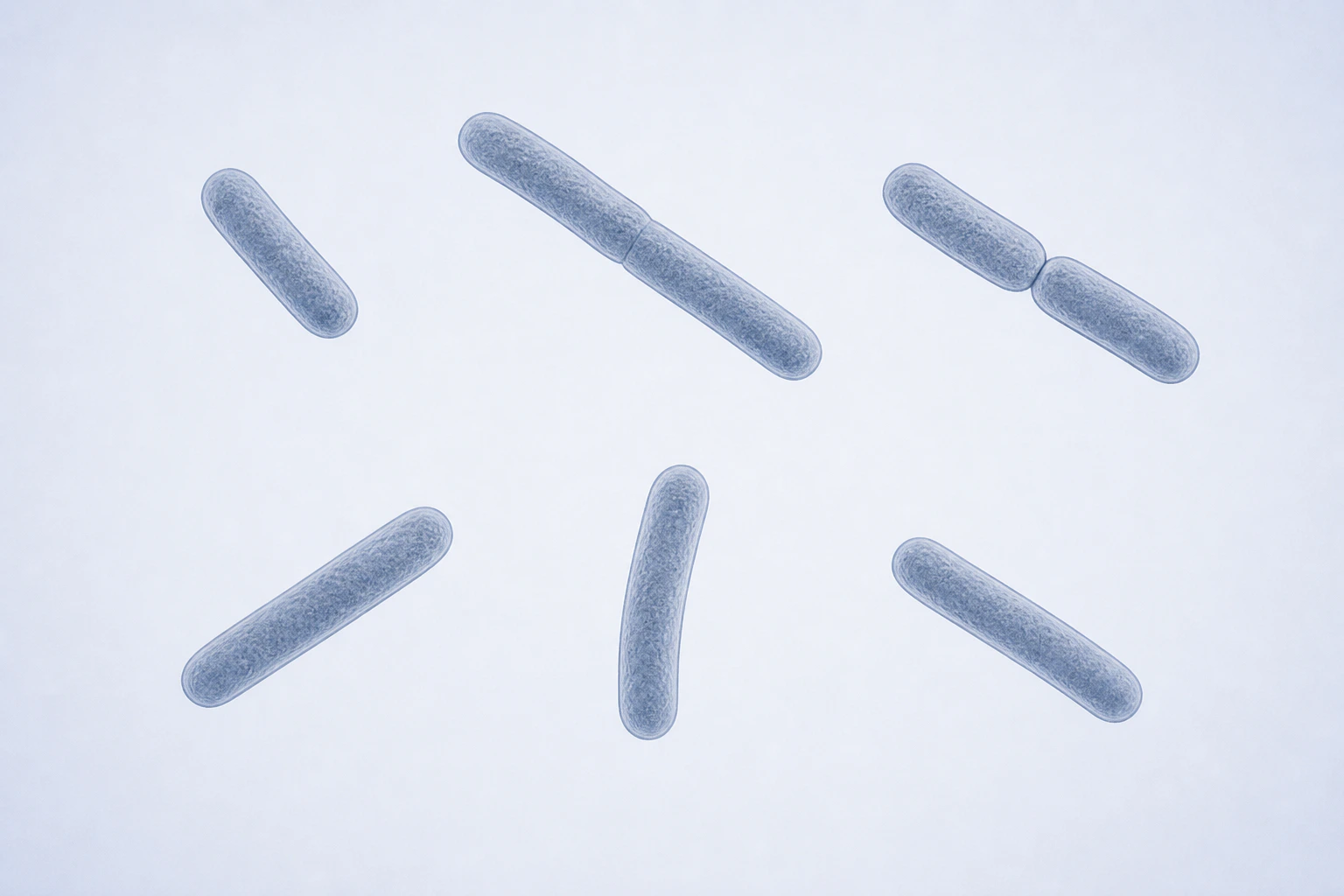
Selected type-species-anchored Flavonifractor straight-to-slightly-curved rods, shown as eight bodies in four single and two paired groupings. This genus-level scientific reconstruction is representative, non-diagnostic, and not a micrograph.
Scientific media record1 verified identifier
- Subject
- Flavonifractortaxon · genus
- Identifiers
- NCBITaxon:946234
- Review
- Editorial review completeIdentifiers authority-verified · Accessibility validated · · flavonifractor|flavonifractor-morphology-v1.webp
- Digital source
- Trained-algorithmic mediaCreated with a trained generative algorithm and reviewed by WikiBiome for subject identity, scientific framing, identifiers, provenance, and accessibility.
- Scientific basis
- Flavonifractor — NCBI TaxonomyFlavonifractor — LPSNFlavonifractor plautii — LPSNFlavonifractor plautii gen. nov., comb. nov.Flavonifractor plautii type strain — BacDive
- License
- CC BY-SA 4.0Created
A Gram-positive obligate anaerobe in the family Ruminococcaceae (Clostridium cluster IV) whose defining metabolic activity is the degradation of dietary flavonoids—the very polyphenols that serve as anti-inflammatory, antioxidant, and antimicrobial agents.
When Flavonifractor is enriched, it effectively neutralizes one of the body's key dietary defenses before those compounds can act systemically.
Evidence map9 cited passagesInspect provenance +
Flavonifractor plautii cleaves the C-ring of multiple flavonoid classes, converting them to inactive phenolic acids:
Uremic toxin contribution: In CKD, Flavonifractor enrichment correlates with progression. The phenolic acids produced from flavonoid degradation can serve as substrates for further microbial transformation into indole-related uremic toxins (indoxyl sulfate precursors via aromatic amino acid catabolism overlap), potentially contributing to uremic toxin burden
Significantly enriched in fibromyalgia patients versus healthy controls, with abundance correlating directly with symptom severity scores.
Confirmed as a reproducible finding in a meta-analysis of gut dysbiosis across chronic pain conditions.
FMT from fibromyalgia patients to germ-free mice induced mechanical pain hypersensitivity, implicating the microbiome causally—and Flavonifractor is among the enriched taxa transferred in those experiments.
Flavonifractor enrichment increases with CKD staging; enriched alongside Citrobacter as a dysbiotic marker while Faecalibacterium prausnitzii and Eubacterium rectale are depleted.
Flavonifractor also appears in ESRD (end-stage renal disease) microbiome analyses as part of the uremic dysbiosis pattern.
Present in MS-associated gut dysbiosis signatures, consistent with its pattern of enrichment in neuroinflammatory conditions.
Identified in ASD-associated gut microbiome signatures in Chinese pediatric cohorts.
Contents
1. Taxonomy and Classification2. Metal Dependencies and Enzyme Biochemistry3. Flavonoid Degradation Pathway4. Ecological Role5. Disease Associations6. Clinical Significance7. Key Wikipedia Differentiation8. Cross-ReferencesTaxonomy and Classification#
Flavonifractor plautii (formerly Clostridium orbiscindens) is the type and sole well-characterized species. Member of Ruminococcaceae within Clostridiales (Firmicutes phylum), placing it phylogenetically among the anaerobic fermenters of complex carbohydrates and plant-derived compounds. The genus name reflects its defining capability: flavoni- (flavonoid) + fractor (breaker).
Reclassification from Clostridium reflects broader reorganization of the paraphyletic Clostridium genus based on 16S rRNA phylogeny.
Metal Dependencies and Enzyme Biochemistry#
Flavonifractor encodes a suite of metal-dependent oxidoreductases that underpin its unique metabolic niche. Iron-dependent cytochrome b-like flavoprotein: Central to the electron transport chain supporting anaerobic aromatic ring reduction. Iron serves as the electron carrier within the heme cofactor, enabling the ring-opening reactions that deactivate flavonoids.
Cobalt-dependent corrinoid enzymes: Cobalt-containing B12-like cofactors participate in the reductive dehalogenation and carbon skeleton rearrangements involved in phenolic acid catabolism downstream of ring cleavage.
Enoate reductase (2-enoate reductase): An iron-sulfur cluster enzyme that reduces the C2=C3 double bond in flavonoids, a key step in the deactivation of chalcones and flavanones including naringenin and eriodictyol.
Chalcone isomerase: Converts chalcones to flavanones, feeding them into the reductase pathway.
The iron and cobalt requirements explain why Flavonifractor can thrive in iron-replete dysbiotic environments: conditions like CKD and inflammatory bowel states where iron dysregulation is common provide the cofactor availability that fuels its metabolic machinery.
Flavonoid Degradation Pathway#
Flavonifractor plautii cleaves the C-ring of multiple flavonoid classes, converting them to inactive phenolic acids.[1]Minerbi 2019 — Altered Microbiome Composition in FibromyalgiaMinerbi A, Gonzalez E, Brereton NJB et al. · 2019Open reference 1 ↓ Flavonols (quercetin, kaempferol, myricetin): ring-opened to protocatechuic acid and phloroglucinol derivatives. Flavanones (naringenin, hesperidin): reduced to dihydrochalcones and then to simple phenols.
Catechins (epicatechin, EGCG): A-ring dehydroxylation removes catechol functionality.
Isoflavones (genistein, daidzein): dearomatized to inactive equol precursors via enoate reductase.
This degradation occurs in the proximal colon before flavonoids can be absorbed by enterocytes or reach the distal gut where systemic exposure occurs. The result is a dramatic reduction in systemic polyphenol bioavailability—not a subtle effect, but wholesale destruction of the bioactive compounds.
Ecological Role#
In the Healthy Gut#
Low-abundance member of the Ruminococcaceae community in health; ecological competition from Butyrate producers like Faecalibacterium prausnitzii and Roseburia limits its expansion.
Functions as a minor scavenger of plant polyphenols not absorbed in the small intestine, contributing to the diversity of phenolic acid metabolites in the gut.
In a balanced community, flavonoid degradation by Flavonifractor is offset by the abundance of short-chain fatty acid producers, maintaining net anti-inflammatory tone.
In Dysbiosis#
Competitive release: When Faecalibacterium prausnitzii and butyrate producers decline—as in fibromyalgia, CKD, and post-antibiotic states—Flavonifractor expands into the vacated niche.
Polyphenol erosion: Its expansion removes a key class of dietary anti-inflammatory agents precisely when the patient's inflammatory burden is already elevated.
Uremic toxin contribution: In CKD, Flavonifractor enrichment correlates with progression.[2]Wang 2023 — Perturbed Gut Microbiome and Metabolomes Across CKD SeverityWang, Li, Zhang et al. · 2023Open reference 2 ↓
The phenolic acids produced from flavonoid degradation can serve as substrates for further microbial transformation into indole-related uremic toxins (indoxyl sulfate precursors via aromatic amino acid catabolism overlap), potentially contributing to uremic toxin burden.
Disease Associations#
Fibromyalgia#
Flavonifractor is one of the most consistently enriched taxa in fibromyalgia microbiome studies.
Significantly enriched in fibromyalgia patients versus healthy controls, with abundance correlating directly with symptom severity scores.[1]Minerbi 2019 — Altered Microbiome Composition in FibromyalgiaMinerbi A, Gonzalez E, Brereton NJB et al. · 2019Open reference 1 ↓ Confirmed as a reproducible finding in a meta-analysis of gut Dysbiosis across chronic pain conditions.[3]Goudman 2024 — Gut Dysbiosis in Chronic Pain (Meta-Analysis)Goudman et al. · 2024Open reference 3 ↓
FMT from fibromyalgia patients to germ-free mice induced mechanical pain hypersensitivity, implicating the microbiome causally—and Flavonifractor is among the enriched taxa transferred in those experiments.[4]Shtrozberg 2025 — Gut Microbiome in Fibromyalgia (Review)Shtrozberg et al. · 2025Open reference 4 ↓
The co-depletion of Faecalibacterium prausnitzii and Bifidobacterium alongside Flavonifractor enrichment creates a dual loss: loss of butyrate-mediated anti-nociception and loss of flavonoid-mediated anti-Metal-Driven Inflammation.
Chronic Kidney Disease#
Flavonifractor enrichment increases with CKD staging; enriched alongside Citrobacter as a dysbiotic marker while Faecalibacterium prausnitzii and Eubacterium rectale are depleted.[2]Wang 2023 — Perturbed Gut Microbiome and Metabolomes Across CKD SeverityWang, Li, Zhang et al. · 2023Open reference 2 ↓
The combined microbiome + metabolite diagnostic model achieving AUC 0.972 for mild CKD detection in this cohort included Flavonifractor among the discriminating features—meaning its abundance has early diagnostic signal, detectable before conventional biomarkers like creatinine change.
Flavonifractor also appears in ESRD (end-stage renal disease) microbiome analyses as part of the uremic dysbiosis pattern.[5]Zhang 2023 — Metagenome-Wide Analysis of ESRD Microbiome and Uremic ToxinsZhang, Liao, Mei et al. · 2023Open reference 5 ↓
Multiple Sclerosis#
Present in MS-associated gut dysbiosis signatures, consistent with its pattern of enrichment in neuroinflammatory conditions.[6]The Gut Microbiota in Multiple Sclerosis Varies with Disease ActivityThirion F, Sellebjerg F, Fan Y et al. · 2023Open reference 6 ↓ Its depletion of neuroprotective flavonoids may be particularly relevant in neuroinflammatory contexts where dietary polyphenols like quercetin have documented neuroprotective effects.
Autism Spectrum Disorder#
Identified in ASD-associated Gut Microbiome signatures in Chinese pediatric cohorts.[7]Wang 2023 — Gut Microbiota Signature in Children with ASD Who Suffered from Chronic Gastrointestinal SymptomsHui Wang, Shu Liu, Liqing Xie et al. · 2023Open reference 7 ↓ Whether this reflects a primary role or secondary enrichment driven by the restrictive dietary patterns common in ASD requires further investigation.
Clinical Significance#
Flavonifractor exemplifies a mechanism by which dysbiosis can neutralize dietary interventions before they act. A patient consuming a flavonoid-rich diet—berries, citrus, green tea, cruciferous vegetables—may derive limited anti-inflammatory benefit if their Flavonifractor abundance is high, because the compounds are enzymatically destroyed in the colon.
This has direct implications for precision nutrition: microbiome composition may need to be assessed before recommending polyphenol-based dietary strategies. The iron and cobalt dependencies of its key enzymes also suggest that iron excess in dysbiotic states may specifically fuel Flavonifractor expansion.
Key Wikipedia Differentiation#
Wikipedia describes Flavonifractor plautii as a bacterium capable of flavonoid degradation.
What is absent: the specific metal cofactor requirements of its reductase enzymes, its disease-specific enrichment data across fibromyalgia, CKD, MS, and ASD, its FMT-confirmed causal association with pain hypersensitivity, its role in eroding dietary anti-inflammatory defenses in exactly the patient populations who depend on them most, and its early diagnostic biomarker potential in CKD.
Cross-References#
- butyrate—SCFA production ecosystem disrupted by Flavonifractor enrichment (competitive displacement of butyrate producers)
- Faecalibacterium prausnitzii—anti-inflammatory commensal displaced when Flavonifractor expands
- Fibromyalgia—primary disease association with symptom severity correlation
- Chronic Kidney Disease—enriched at all stages; part of uremic dysbiosis
- Multiple Sclerosis—enriched in neuroinflammatory dysbiosis
- Iron—metal cofactor for key flavonoid-degrading oxidoreductases
- Nutritional Immunity (Metal Sequestration)—iron dysregulation in disease states fuels Flavonifractor expansion
- Quercetin (Cross-Condition)—dietary flavonoid degraded by Flavonifractor before it can exert anti-inflammatory effects
- Biomarkers—candidate marker for polyphenol non-response and CKD progression
References 7
Numbered by first appearance in the article, then reconciled with its declared source list.
- 1
Minerbi A, Gonzalez E, Brereton NJB et al. (2019). Minerbi 2019 — Altered Microbiome Composition in Fibromyalgia. Pain.
- 2
Wang, Li, Zhang et al. (2023). Wang 2023 — Perturbed Gut Microbiome and Metabolomes Across CKD Severity. Microbiome.
- 3
Goudman et al. (2024). Goudman 2024 — Gut Dysbiosis in Chronic Pain (Meta-Analysis). Frontiers in Immunology.
- 4
Shtrozberg et al. (2025). Shtrozberg 2025 — Gut Microbiome in Fibromyalgia (Review). Clinical and Experimental Rheumatology.
- 5
Zhang, Liao, Mei et al. (2023). Zhang 2023 — Metagenome-Wide Analysis of ESRD Microbiome and Uremic Toxins. Genome Biology.
- 6
Thirion F, Sellebjerg F, Fan Y et al. (2023). The Gut Microbiota in Multiple Sclerosis Varies with Disease Activity. Genome Medicine.
- 7
Hui Wang, Shu Liu, Liqing Xie et al. (2023). Wang 2023 — Gut Microbiota Signature in Children with ASD Who Suffered from Chronic Gastrointestinal Symptoms. BMC Pediatrics.
Article network
Mentioned here 12
Pages linking here 4
Connect the evidence
Publicly readable discussion by ORCID-authenticated researchers. Questions, interpretation, methods, corrections, and new evidence stay attached to this record.
No discussion yet. Start with a precise question or a source-backed observation.
Activity and accepted changes
Accepted researcher context, editorial status, public discussion, and upstream Git revisions are shown together. Pending, declined, and withdrawn proposals remain private.
- published revision
Backfill gut microbiome concept links
Karen Pendergrass · +1 −1
Inspect exact Git diff ↗ - published revision
Backfill inflammation concept links
Karen Pendergrass · +1 −1
Inspect exact Git diff ↗ - published revision
Complete corpus-wide Dysbiosis linking
Karen Pendergrass · +1 −1
Inspect exact Git diff ↗ - published revision
massive wiki expansion: 149 stubs fixed, 100+ new pages, Rule 15 scan, keystone papers
WikiBiome Deploy Bot · +14 −14
Inspect exact Git diff ↗ - published revision
Batch: fix 1025 broken wikilinks, wire 13 STOP pages, deepen PPD/GERD/T1D/8 microbes
WikiBiome Deploy Bot · +89 −28
Inspect exact Git diff ↗ - published revision
Health check fixes: 40 intervention pages + 14 entity Connections sections
WikiBiome Deploy Bot · +1 −0
Inspect exact Git diff ↗ - published revision
Health check gap fill: 15 missing pages identified and created
WikiBiome Deploy Bot · +56 −0
Inspect exact Git diff ↗