
Erysipelotrichaceae is a family within the phylum Firmicutes that has drawn increasing attention for its consistent enrichment in metabolic disorders. Members of this family are Gram-positive, obligate anaerobes found throughout the mammalian gastrointestinal tract, where they participate in lipid and cholesterol metabolism.
Multiple studies have identified Erysipelotrichaceae enrichment as a recurring feature of obesity and metabolic syndrome. Mendelian randomization analyses have linked elevated abundance of this family to altered lipid profiles, including higher LDL cholesterol and triglycerides (,[1]Causality of the gut microbiome and atherosclerosis-related lipids: a bidirectional Mendelian Randomization studyDa Teng, Wenjuan Jia, Wenlong Wang et al. · 2024Open reference 1 ↓ Mendelian randomization).
The family is also enriched in cardiovascular disease states, where its abundance correlates with pro-atherogenic metabolic pathways (,[2]Gut macrobiotic and its metabolic pathways modulate cardiovascular diseaseJunwen Zhu, Jin Lyu, Ruochi Zhao et al. · 2023Open reference 2 ↓ cross-sectional;,[3]The Gut Microbiota (Microbiome) in Cardiovascular Disease and Its Therapeutic RegulationMd. Mominur Rahman, Fahadul Islam, Md. Harun-Or-Rashid et al. · 2022Open reference 3 ↓ review).
Notably, Erysipelotrichaceae shifts have been observed in autoimmune thyroid conditions alongside other metabolic disruptions (,[4]Alterations and Mechanism of Gut Microbiota in Graves' Disease and Hashimoto's ThyroiditisZhao H, Yuan L, Zhu D et al. · 2022Open reference 4 ↓ cross-sectional), suggesting the family may serve as a broader marker of host metabolic dysregulation rather than a pathogen in any single disease.
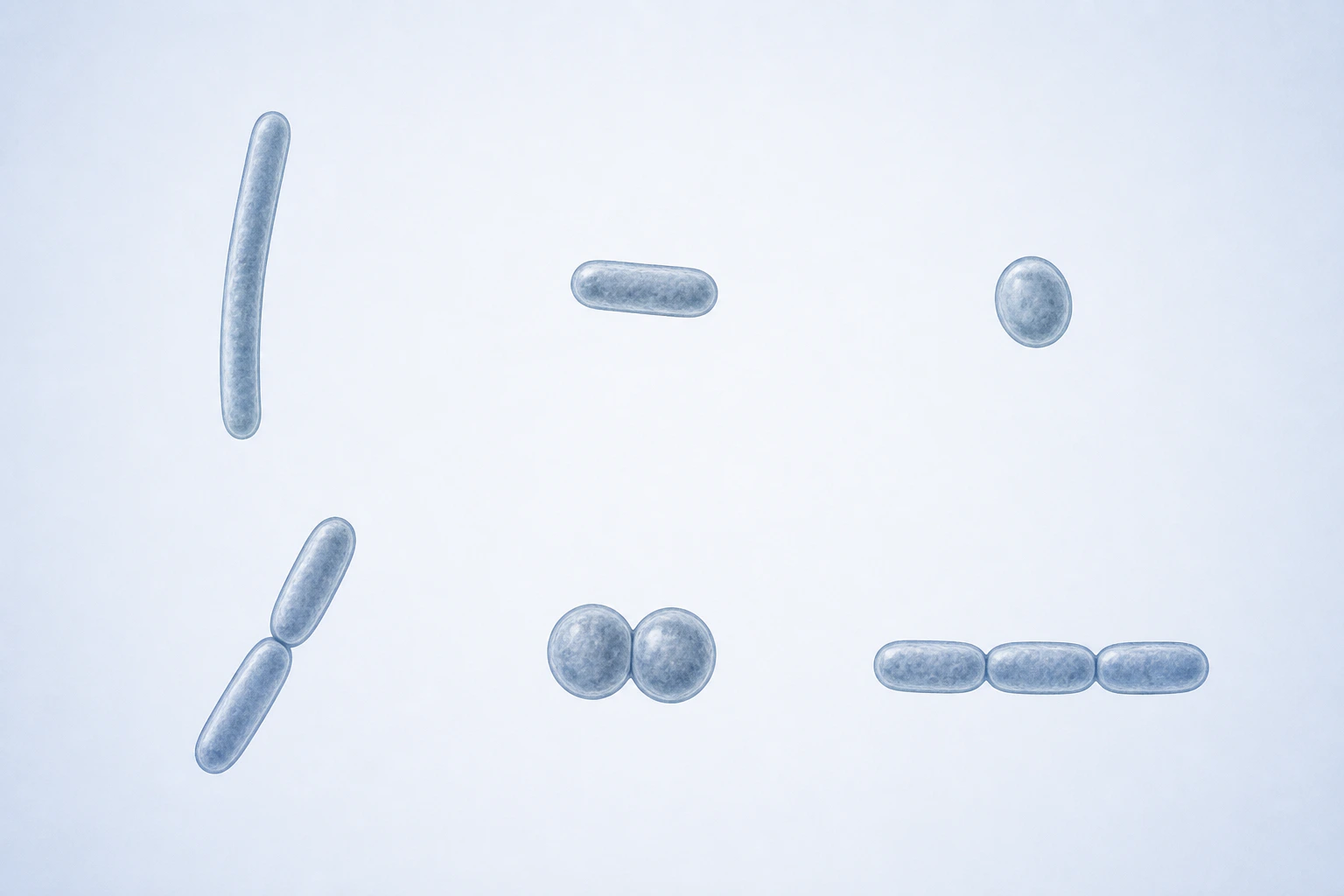
Selected Erysipelotrichaceae morphology diversity, shown as ten slender-rod, short-rod, and coccoid-to-ovoid bodies in six groupings. This is a representative higher-rank morphology-diversity reconstruction, not a universal family form; it is non-exhaustive, non-diagnostic, and not a micrograph.
Scientific media record1 verified identifier
- Subject
- Erysipelotrichaceaetaxon · family
- Identifiers
- NCBITaxon:128827
- Review
- Editorial review completeIdentifiers authority-verified · Accessibility validated · · erysipelotrichaceae|erysipelotrichaceae-microbial-community-v1.webp
- Digital source
- Trained-algorithmic mediaCreated with a trained generative algorithm and reviewed by WikiBiome for subject identity, scientific framing, identifiers, provenance, and accessibility.
- Scientific basis
- Erysipelotrichaceae — NCBI TaxonomyErysipelotrichaceae — LPSNErysipelotrichaceae emended family treatmentErysipelotrichaceae descendant morphology studyErysipelotrichaceae descendant morphology full text
- License
- CC BY-SA 4.0Created
Evidence map1 cited passagesInspect provenance +
Multiple studies have identified Erysipelotrichaceae enrichment as a recurring feature of obesity and metabolic syndrome. Mendelian randomization analyses have linked elevated abundance of this family to altered lipid profiles, including higher LDL cholesterol and triglycerides (, Mendelian randomization). The family is also enriched in cardiovascular diseas
Contents
1. Cross-ReferencesCross-References#
- Bacteroidetes (Bacteroidota)—often inversely correlated with Erysipelotrichaceae in metabolic disease
- Atherosclerosis—cardiovascular disease associations
- Obesity—primary condition of enrichment
- Metabolic Syndrome and Metal Exposure—associated metabolic context
References 4
Numbered by first appearance in the article, then reconciled with its declared source list.
- 1
Da Teng, Wenjuan Jia, Wenlong Wang et al. (2024). Causality of the gut microbiome and atherosclerosis-related lipids: a bidirectional Mendelian Randomization study. BMC Cardiovascular Disorders.
- 2
Junwen Zhu, Jin Lyu, Ruochi Zhao et al. (2023). Gut macrobiotic and its metabolic pathways modulate cardiovascular disease. Frontiers in Microbiology.
- 3
Md. Mominur Rahman, Fahadul Islam, Md. Harun-Or-Rashid et al. (2022). The Gut Microbiota (Microbiome) in Cardiovascular Disease and Its Therapeutic Regulation. Frontiers in Cellular and Infection Microbiology.
- 4
Zhao H, Yuan L, Zhu D et al. (2022). Alterations and Mechanism of Gut Microbiota in Graves' Disease and Hashimoto's Thyroiditis. Polish Journal of Microbiology.
Article network
Connect the evidence
Publicly readable discussion by ORCID-authenticated researchers. Questions, interpretation, methods, corrections, and new evidence stay attached to this record.
No discussion yet. Start with a precise question or a source-backed observation.
Activity and accepted changes
Accepted researcher context, editorial status, public discussion, and upstream Git revisions are shown together. Pending, declined, and withdrawn proposals remain private.
- published revision
massive wiki expansion: 149 stubs fixed, 100+ new pages, Rule 15 scan, keystone papers
WikiBiome Deploy Bot · +38 −0
Inspect exact Git diff ↗