

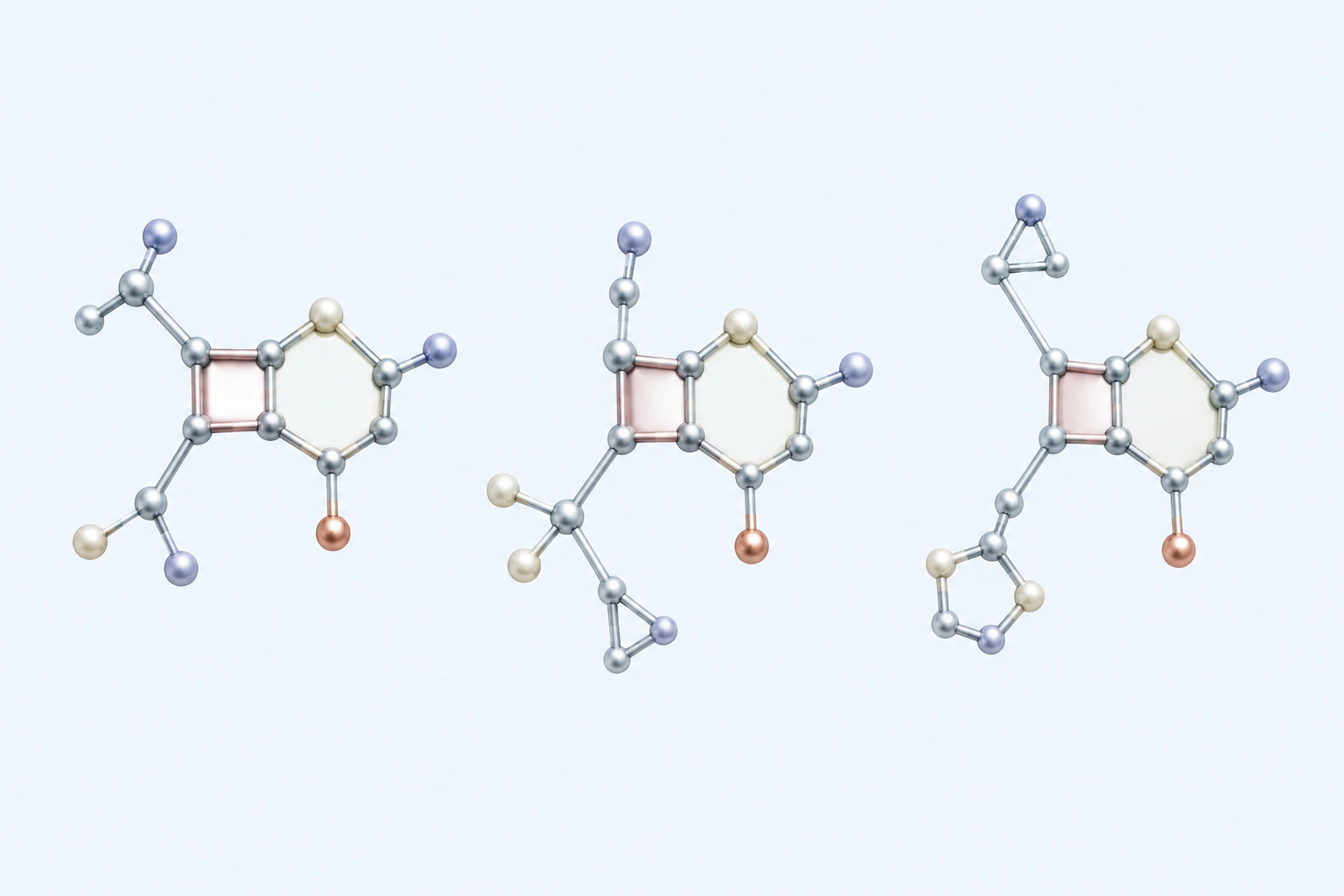
Cephalosporin class orientation. The generic tokens are not validated molecular structures or named drugs and do not establish generation, target binding, susceptibility, resistance, dosing, efficacy, allergy, or treatment guidance.
Scientific media record2 verified identifiers
- Subject
- Cephalosporinbiological-process
- Identifiers
- WikiBiome:cephalosporinMeSH:D002511
- Review
- Editorial review completeIdentifiers authority-verified · Accessibility validated · · cephalosporin|cephalosporin-mechanism-v1.webp
- Digital source
- Trained-algorithmic mediaCreated with a trained generative algorithm and reviewed by WikiBiome for subject identity, scientific framing, identifiers, provenance, and accessibility.
- Scientific basis
- Cephalosporins — Medical Subject HeadingsCephalosporin
- License
- CC BY-SA 4.0Created
Cephalosporins are a class of beta-lactam antibiotics (five generations) that inhibit bacterial cell wall synthesis by binding penicillin-binding proteins. They are among the most prescribed antibiotic classes and among the most disruptive to the Gut Microbiome.
Evidence map2 cited passagesInspect provenance +
Broad-spectrum cephalosporins (3rd/4th generation: ceftriaxone, cefepime) cause profound dysbiosis: deplete Firmicutes/Bacteroidetes commensals → Proteobacteria bloom → colonization resistance failure → increased risk of C. difficile and VRE secondary infection.
Cefiderocol is the first FDA-approved siderophore-cephalosporin conjugate—a Trojan horse antibiotic that exploits bacterial iron uptake machinery. Cefiderocol is bound to a siderophore that mimics the pathogen's own iron chelator; the bacterium imports what it thinks is iron-loaded siderophore but instead internalizes a lethal antibiotic. This directly app
Contents
1. Microbiome Disruption2. Siderophore-Cephalosporin Conjugate3. Beta-Lactamase Resistance4. Cross-ReferencesMicrobiome Disruption#
Broad-spectrum cephalosporins (3rd/4th generation: ceftriaxone, cefepime) cause profound Dysbiosis: deplete Firmicutes/Bacteroidetes commensals → Proteobacteria bloom → Colonization Resistance failure → increased risk of C. difficile and VRE secondary infection.[1]Bing, Ritz & Lin 2019 — The Unknown Effect of Antibiotic-Induced Dysbiosis on the Gut MicrobiotaAleksandr Bing, Nathaniel L. Ritz, Henry C. Lin · 2019Open reference 1 ↓
Siderophore-Cephalosporin Conjugate#
Cefiderocol is the first FDA-approved siderophore-cephalosporin conjugate—a Trojan horse antibiotic that exploits bacterial iron uptake machinery. Cefiderocol is bound to a siderophore that mimics the pathogen's own iron chelator; the bacterium imports what it thinks is iron-loaded siderophore but instead internalizes a lethal antibiotic.
This directly applies Karen's Brain Primitive 4 (metal dependencies as Achilles' heels).[2]Understanding the Development of Environmental Resistance Among Microbes: A ReviewSrivastava J, Chandra H, Singh N et al. · 2016Open reference 2 ↓
Beta-Lactamase Resistance#
ESBLs and carbapenemases (Beta-Lactamase) hydrolyze cephalosporins, conferring resistance. ESBL genes co-locate with metal resistance genes on shared plasmids (Co-Selection).
Cross-References#
- Beta-Lactamase—resistance mechanism
- Siderophores—cefiderocol Trojan horse concept
- Vancomycin—alternative when cephalosporins fail
- Colonization Resistance—cephalosporin-induced destruction
- Co-Selection—metal-antibiotic co-resistance
References 3
Numbered by first appearance in the article, then reconciled with its declared source list.
- 1
Aleksandr Bing, Nathaniel L. Ritz, Henry C. Lin (2019). Bing, Ritz & Lin 2019 — The Unknown Effect of Antibiotic-Induced Dysbiosis on the Gut Microbiota. Microbiome and Metabolome in Diagnosis, Therapy, and other Strategic Applications (Book Chapter).
- 2
Srivastava J, Chandra H, Singh N et al. (2016). Understanding the Development of Environmental Resistance Among Microbes: A Review. Clean - Soil, Air, Water.
- 3
Ngoc Huu Nguyen, Zufu Lu, Aaron Elbourne et al. (2024). Nguyen 2024 — Engineering Antibacterial Bioceramics: Design Principles and Mechanisms of Action. Materials Today Bio.
Article network
Mentioned here 7
Pages linking here 1
Connect the evidence
Publicly readable discussion by ORCID-authenticated researchers. Questions, interpretation, methods, corrections, and new evidence stay attached to this record.
No discussion yet. Start with a precise question or a source-backed observation.
Published page changes
This record shows only material changes published on this page, including changes to its content, evidence, conclusions, or author context. Internal processes and discussion activity are excluded. Pending, declined, and withdrawn proposals remain private.
- published revision
Created “Cephalosporins”: Cephalosporins are a class of beta-lactam antibiotics (five generations) that inhibit bacterial cell wall synthesis by binding penicillin-binding proteins. They are among the most prescribed…
Created “Cephalosporins”: Cephalosporins are a class of beta-lactam antibiotics (five generations) that inhibit bacterial cell wall synthesis by binding penicillin-binding proteins. They are among the most prescribed… Published sections: Cephalosporins; Microbiome Disruption; Siderophore-Cephalosporin Conjugate; Beta-Lactamase Resistance; Cross-References. · WikiBiome Deploy Bot · +40 −0
Inspect exact Git diff ↗