

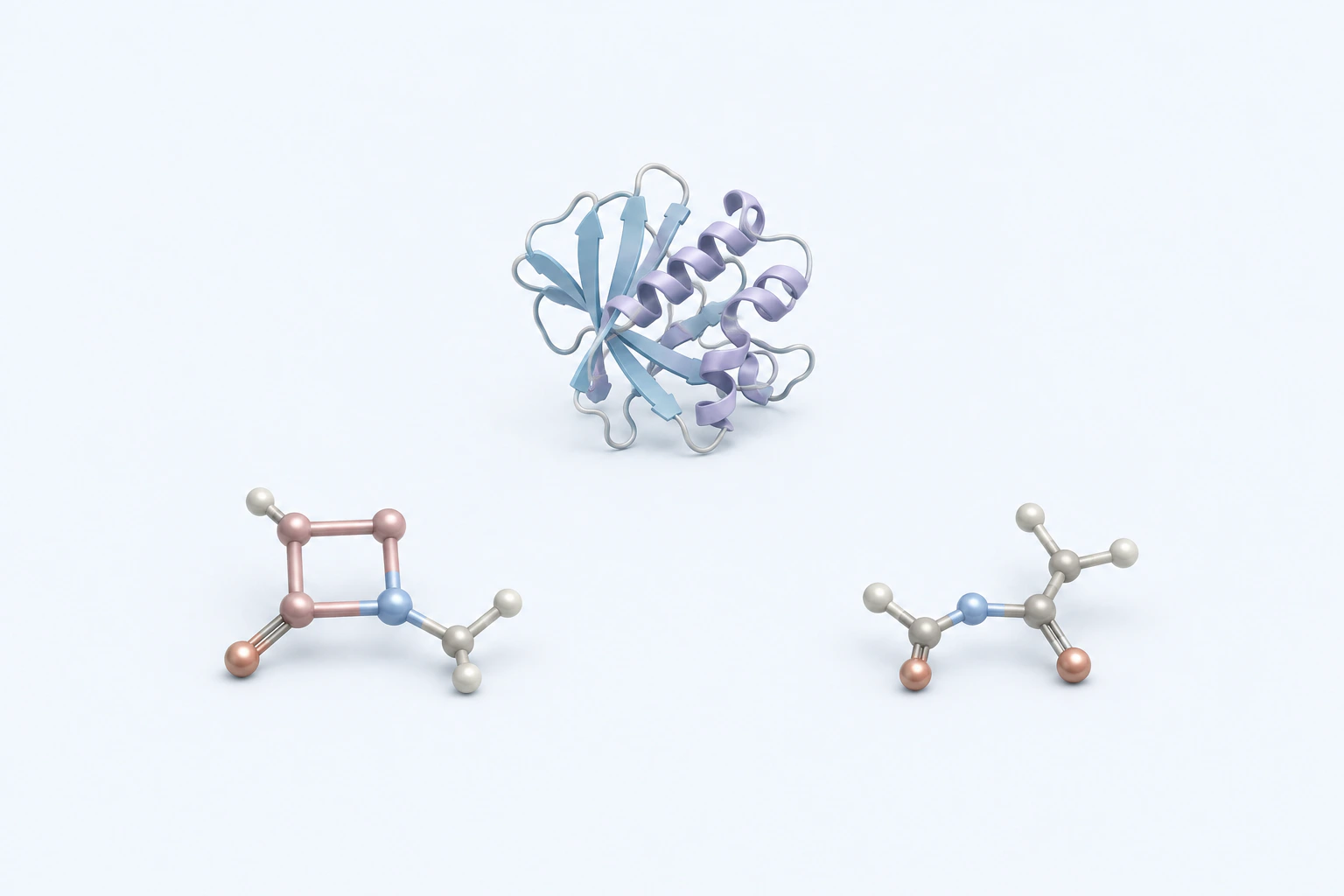
Generic enzyme-class and ring-context orientation for beta-lactamase. This reconstruction does not identify an enzyme subclass, antibiotic, resistance gene, bacterial species, susceptibility result, or treatment outcome.
Scientific media record2 verified identifiers
- Subject
- Beta-lactamasebiological-process
- Identifiers
- WikiBiome:beta-lactamaseEC:3.5.2.6
- Review
- Editorial review completeIdentifiers authority-verified · Accessibility validated · · beta-lactamase|beta-lactamase-mechanism-v2.webp
- Digital source
- Trained-algorithmic mediaCreated with a trained generative algorithm and reviewed by WikiBiome for subject identity, scientific framing, identifiers, provenance, and accessibility.
- Scientific basis
- Beta-lactamase — EC 3.5.2.6EC 3.5.2.6 reactionsBeta-Lactamase
- License
- CC BY-SA 4.0Created
Beta-lactamases are bacterial enzymes that hydrolyze the beta-lactam ring of penicillins, cephalosporins, and carbapenems, rendering them inactive. They are the most common mechanism of antibiotic resistance and a central concern in the Antimicrobial Resistance crisis. Extended-spectrum beta-lactamases (ESBLs) and carbapenemases (KPC, NDM, OXA-48) confer resistance to last-resort antibiotics.
Evidence map1 cited passagesInspect provenance +
Beta-lactamase genes frequently co-locate with metal resistance genes on the same plasmids and mobile genetic elements—meaning environmental metal exposure selects for beta-lactamase-producing bacteria without antibiotic exposure. This is documented in CKD gut microbiome.
Co-Selection with Metal Resistance#
Beta-lactamase genes frequently co-locate with metal resistance genes on the same plasmids and mobile genetic elements—meaning environmental metal exposure selects for beta-lactamase-producing bacteria without antibiotic exposure.[1]Baker-Austin 2006 — Co-selection of Antibiotic and Metal ResistanceBaker-Austin C, Wright MS, Stepanauskas R et al. · 2006Open reference 1 ↓[2]Understanding the Development of Environmental Resistance Among Microbes: A ReviewSrivastava J, Chandra H, Singh N et al. · 2016Open reference 2 ↓
This is documented in CKD Gut Microbiome.[3]Miranda 2022 — Characterization of Metal(loid)s and Antibiotic Resistance in Bacteria of Human Gut Microbiota from CKD SubjectsMaría V. Miranda, Fernanda C. González, Osvaldo S. Paredes-Godoy et al. · 2022Open reference 3 ↓
WikiBiome Relevance#
The beta-lactamase → Co-Selection → metal resistance connection is a core WikiBiome insight: heavy metal pollution in agriculture, water, and food is an unrecognized driver of antibiotic resistance in the human gut microbiome.
Cross-References#
- Antimicrobial Resistance—AMR context
- Co-Selection—metal-antibiotic co-resistance on shared plasmids
- Cephalosporins—beta-lactam antibiotic class
- Vancomycin—alternative when beta-lactams fail
- Klebsiella—major carbapenemase-producing genus
References 3
Numbered by first appearance in the article, then reconciled with its declared source list.
- 1
Baker-Austin C, Wright MS, Stepanauskas R et al. (2006). Baker-Austin 2006 — Co-selection of Antibiotic and Metal Resistance. Trends in Microbiology.
- 2
Srivastava J, Chandra H, Singh N et al. (2016). Understanding the Development of Environmental Resistance Among Microbes: A Review. Clean - Soil, Air, Water.
- 3
María V. Miranda, Fernanda C. González, Osvaldo S. Paredes-Godoy et al. (2022). Miranda 2022 — Characterization of Metal(loid)s and Antibiotic Resistance in Bacteria of Human Gut Microbiota from CKD Subjects. Biological Research.
Article network
Mentioned here 6
Pages linking here 1
Connect the evidence
Publicly readable discussion by ORCID-authenticated researchers. Questions, interpretation, methods, corrections, and new evidence stay attached to this record.
No discussion yet. Start with a precise question or a source-backed observation.
Published page changes
This record shows only material changes published on this page, including changes to its content, evidence, conclusions, or author context. Internal processes and discussion activity are excluded. Pending, declined, and withdrawn proposals remain private.
- published revision
Created “Beta-Lactamase”: Beta-lactamases are bacterial enzymes that hydrolyze the beta-lactam ring of penicillins, cephalosporins, and carbapenems, rendering them inactive. They are the most common mechanism of antibiotic…
Created “Beta-Lactamase”: Beta-lactamases are bacterial enzymes that hydrolyze the beta-lactam ring of penicillins, cephalosporins, and carbapenems, rendering them inactive. They are the most common mechanism of antibiotic… Published sections: Beta-Lactamase; Co-Selection with Metal Resistance; WikiBiome Relevance; Cross-References. · WikiBiome Deploy Bot · +36 −0
Inspect exact Git diff ↗