

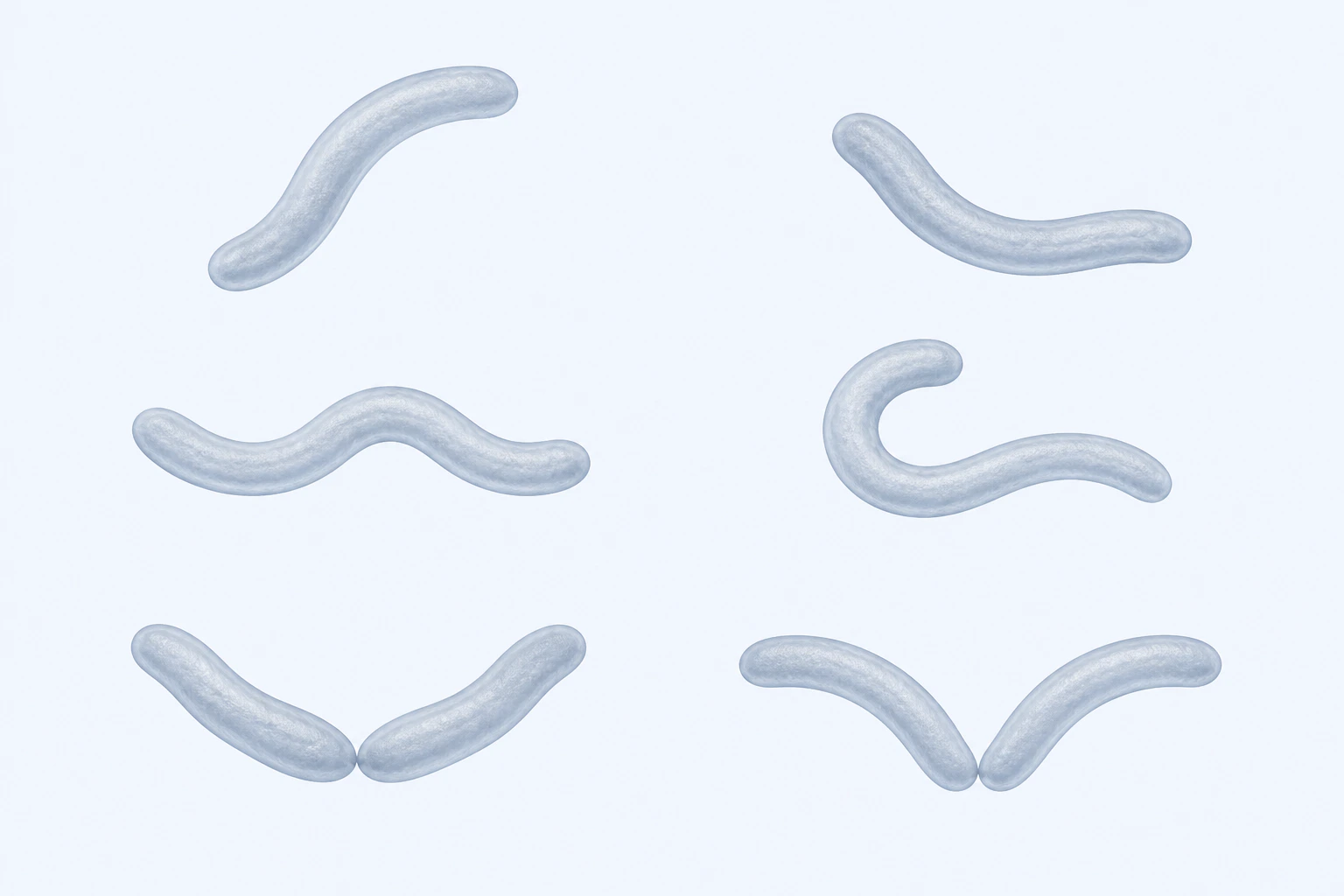
Selected curved-form breadth within Campylobacter, shown as eight bodies in six single or gull-wing groupings. This genus-level reconstruction is non-exhaustive, non-diagnostic, and not a micrograph.
Scientific media record1 verified identifier
- Subject
- Campylobactertaxon · genus
- Identifiers
- NCBITaxon:194
- Review
- Editorial review completeIdentifiers authority-verified · Accessibility validated · · campylobacter|campylobacter-morphology-v1.webp
- Digital source
- Trained-algorithmic mediaCreated with a trained generative algorithm and reviewed by WikiBiome for subject identity, scientific framing, identifiers, provenance, and accessibility.
- Scientific basis
- Campylobacter — NCBI TaxonomyEmended descriptions of Campylobacter speciesMorphology of Campylobacter jejuni
- License
- CC BY-SA 4.0Created
Campylobacter is a genus of Gram-negative, microaerophilic, spiral-shaped bacteria. C. jejuni is the most common bacterial cause of foodborne gastroenteritis worldwide and a trigger for post-infectious Guillain-Barré syndrome (molecular mimicry between Campylobacter LOS and gangliosides).
In the WikiBiome framework, Campylobacter is notable for its iron and nickel dependencies and its role in metal-antibiotic co-selection.
Evidence map6 cited passagesInspect provenance +
Iron: Campylobacter possesses multiple iron uptake systems including siderophore receptors and heme/hemoglobin acquisition proteins. Iron restriction impairs colonization.
Nickel: NiFe hydrogenase is essential for C. jejuni colonization of the chicken cecum and human gut—hydrogen oxidation provides a colonization advantage in the microaerobic niche.
Co-selection: The AcrAB-TolC efflux pump confers resistance to both fluoroquinolones AND metals, making environmental metal exposure a driver of antibiotic-resistant Campylobacter.
Heart failure: Part of gut dysbiosis in heart failure via Mendelian randomization.
IBD: Campylobacter concisus enriched in IBD; may act as pathobiont in inflamed mucosa.
Prostatitis: Detected in chronic prostatitis microbiome.
Metal Dependencies#
Iron: Campylobacter possesses multiple iron uptake systems including siderophore receptors and heme/hemoglobin acquisition proteins. Iron restriction impairs colonization.[1]Role of Nickel in Microbial PathogenesisRobert J. Maier, Stéphane L. Benoit · 2019Open reference 1 ↓
Nickel: NiFe Hydrogenase is essential for C. jejuni colonization of the chicken cecum and human gut—hydrogen oxidation provides a colonization advantage in the microaerobic niche.[1]Role of Nickel in Microbial PathogenesisRobert J. Maier, Stéphane L. Benoit · 2019Open reference 1 ↓
cobalt (Co)-selection: The AcrAB-TolC efflux pump confers resistance to both fluoroquinolones AND metals, making environmental metal exposure a driver of antibiotic-resistant Campylobacter.[2]Understanding the Development of Environmental Resistance Among Microbes: A ReviewSrivastava J, Chandra H, Singh N et al. · 2016Open reference 2 ↓[3]Baker-Austin 2006 — Co-selection of Antibiotic and Metal ResistanceBaker-Austin C, Wright MS, Stepanauskas R et al. · 2006Open reference 3 ↓
Disease Associations#
Heart failure: Part of gut Dysbiosis in heart failure via Mendelian randomization.[4]Effects of Gut Microbiota and Metabolites on Heart Failure and Its Risk Factors: A Two-Sample Mendelian Randomization StudyQiang Luo, Yilan Hu, Xin Chen et al. · 2022Open reference 4 ↓ IBD: Campylobacter concisus enriched in IBD; may act as pathobiont in inflamed mucosa.[5]Wang 2024 — Integrated 16S rRNA sequencing and metagenomics insights into microbial dysbiosis and distinct virulence factors in inflammatory bowel diseaseHaijing Wang, Yuanjun Wang, Libin Yang et al. · 2024Open reference 5 ↓
Prostatitis: Detected in chronic prostatitis microbiome.[6]Vocca 2025 — Probiotics in the Management of Chronic Bacterial Prostatitis: A Randomized, Double-Blind Trial to Evaluate a Possible Link Between Gut Microbiota Restoring and Symptom ReliefCristina Vocca, Diana Marisol Abrego-Guandique, Erika Cione et al. · 2025Open reference 6 ↓
Cross-References#
- Nickel—NiFe-hydrogenase dependency for gut colonization
- Iron—iron acquisition for virulence
- Co-Selection—AcrAB-TolC efflux conferring metal + antibiotic resistance
- Molecular Mimicry—Guillain-Barré syndrome trigger
References 6
Numbered by first appearance in the article, then reconciled with its declared source list.
- 1
★Robert J. Maier, Stéphane L. Benoit (2019). Role of Nickel in Microbial Pathogenesis. Inorganics.
- 2
Srivastava J, Chandra H, Singh N et al. (2016). Understanding the Development of Environmental Resistance Among Microbes: A Review. Clean - Soil, Air, Water.
- 3
Baker-Austin C, Wright MS, Stepanauskas R et al. (2006). Baker-Austin 2006 — Co-selection of Antibiotic and Metal Resistance. Trends in Microbiology.
- 4
Qiang Luo, Yilan Hu, Xin Chen et al. (2022). Effects of Gut Microbiota and Metabolites on Heart Failure and Its Risk Factors: A Two-Sample Mendelian Randomization Study. Frontiers in Nutrition.
- 5
Haijing Wang, Yuanjun Wang, Libin Yang et al. (2024). Wang 2024 — Integrated 16S rRNA sequencing and metagenomics insights into microbial dysbiosis and distinct virulence factors in inflammatory bowel disease. Frontiers in Microbiology.
- 6
Cristina Vocca, Diana Marisol Abrego-Guandique, Erika Cione et al. (2025). Vocca 2025 — Probiotics in the Management of Chronic Bacterial Prostatitis: A Randomized, Double-Blind Trial to Evaluate a Possible Link Between Gut Microbiota Restoring and Symptom Relief. Microorganisms.
Article network
Mentioned here 6
Pages linking here 2
Connect the evidence
Publicly readable discussion by ORCID-authenticated researchers. Questions, interpretation, methods, corrections, and new evidence stay attached to this record.
No discussion yet. Start with a precise question or a source-backed observation.
Activity and accepted changes
Accepted researcher context, editorial status, public discussion, and upstream Git revisions are shown together. Pending, declined, and withdrawn proposals remain private.
- published revision
Complete corpus-wide Dysbiosis linking
Karen Pendergrass · +1 −1
Inspect exact Git diff ↗ - published revision
Complete Hydrogenase contextual coverage
Karen Pendergrass · +1 −1
Inspect exact Git diff ↗ - published revision
massive wiki expansion: 149 stubs fixed, 100+ new pages, Rule 15 scan, keystone papers
WikiBiome Deploy Bot · +50 −0
Inspect exact Git diff ↗