
 metals · microbes · host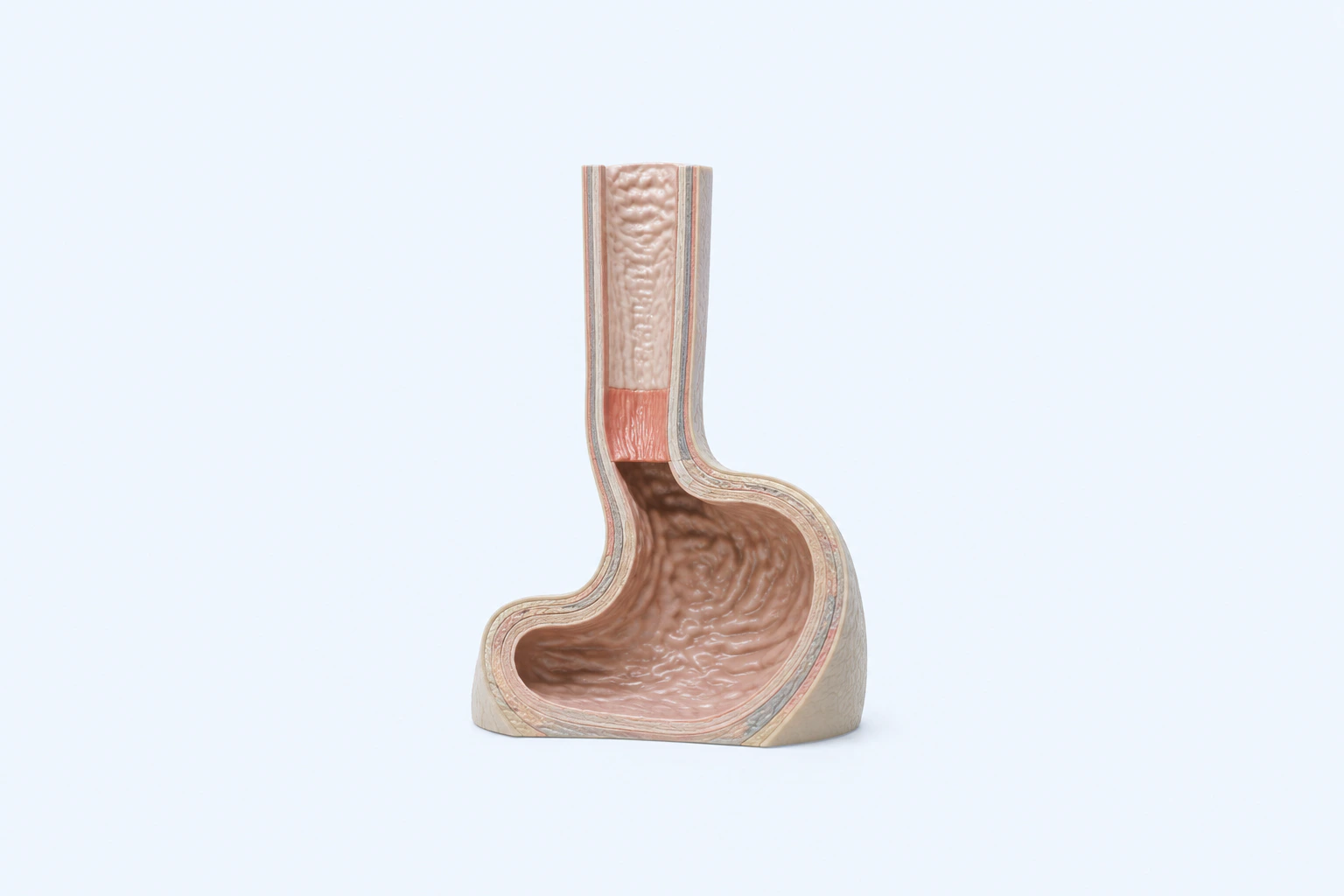
Representative distal-esophageal mucosal orientation for Barrett esophagus. The salmon-toned segment is an educational reconstruction, not an endoscopic view, histology slide, dysplasia grade, or diagnosis.
Scientific media record1 verified identifier
- Subject
- Barrett Esophaguscondition
- Identifiers
- MeSH:D001471
- Review
- Editorial review completeIdentifiers authority-verified · Accessibility validated · · barretts-esophagus|barretts-esophagus-pathology-v2.webp
- Digital source
- Trained-algorithmic mediaCreated with a trained generative algorithm and reviewed by WikiBiome for subject identity, scientific framing, identifiers, provenance, and accessibility.
- License
- CC BY-SA 4.0Created
Barrett's esophagus (BE) is a premalignant condition in which the normal squamous epithelium of the distal esophagus is replaced by intestinal-type columnar epithelium (intestinal metaplasia). It is the primary risk factor for esophageal adenocarcinoma (EAC), a cancer with a 5-year survival of ~20%.
Barrett's develops in 6-12% of patients with chronic Gastroesophageal Reflux Disease (GERD), and its progression through dysplasia to EAC follows a well-defined metaplasia → low-grade dysplasia → high-grade dysplasia → carcinoma sequence.
The esophageal microbiome undergoes a parallel transformation that may drive or accelerate this progression—shifting from a Streptococcus-dominated healthy community to one enriched in Gram-negative anaerobes that produce LPS, activate TLR4, and sustain chronic Metal-Driven Inflammation.
Evidence map22 cited passagesInspect provenance +
Prevotella melaninogenica prevalence rises progressively through disease stages: 22% (normal) → 50% (esophagitis) → 58% (Barrett's) → 83% (metaplasia). This gradient suggests Prevotella is not merely a bystander but may contribute to the inflammatory environment driving metaplasia.
Host genetics shape esophageal microbiome structure, defining three community types:
Leptotrichia has been identified as a key biomarker for the Barrett's-to-EAC transition, emerging in the later stages of the progression sequence.
| Taxa | Direction | Effect | Source | |------|-----------|--------|--------| | enterobacteriaceae / Escherichia-Shigella | Risk | OR=1.10 for Barrett's | | | akkermansia muciniphila | Protective | OR=0.76—strongest protective signal | | | faecalibacterium prausnitzii | Risk (paradoxical) | Increases both GERD and Barrett's risk | |
H. pylori-positive individuals had 22% lower aneuploidy incidence in Barrett's tissue. This aligns with the broader epidemiological observation that H. pylori eradication (which reduces gastric cancer risk) paradoxically increases GERD and Barrett's risk—likely by removing the acid-suppressive effect of H. pylori-associated gastritis.
Iron (Fe)—Metaplasia-associated P. melaninogenica strains carry TonBC iron transport domains, suggesting iron acquisition is a key virulence adaptation in the Barrett's esophageal environment. Host STEAP2 metalloreductase (iron/copper reduction) SNPs are associated with esophageal microbiome composition, indicating that iron availability shapes which organ
PPI therapy—While PPIs control acid, they raise intragastric pH, facilitating gram-negative bacterial colonization and Candida expansion; increase oral bacterial contribution to gastric fluid from 26.7% to 49.2%.
Oral microbial burden—Periodontal pathogens detected in Barrett's tissue suggest chronic oral-esophageal microbial seeding as an environmental exposure source.
IL-6, NF-kB—TLR2 expression elevated 2.1-fold in GERD/Barrett's with gram-negative dysbiosis; IL-6 production drives inflammatory signaling.
Claudin-1—Tight junction protein decreased 47% in GERD/Barrett's with gram-negative dysbiosis; provides the molecular mechanism for barrier failure and persistent mucosal injury.
Sources:,,
P. melaninogenica prevalence rises progressively: 22% (normal) → 50% (esophagitis) → 58% (Barrett's) → 83% (metaplasia). Metaplasia-associated strains carry distinct genomic features:
| Taxon | Role | Evidence | |-------|------|----------| | prevotella | Progressive enrichment (22%→83%); TonBC iron transport; defines Type B esotype |, | | veillonella | 19% of BE community; ↑52% in BE-to-EAC progression |, | | leptotrichia | Key EAC biomarker; ↑48% in late-stage progression | | | fusobacterium nucleatum | Gram-negative oral anaerobe; LPS p
| Taxon | Role | Evidence | |-------|------|----------| | streptococcus | Healthy esophageal dominant (39%); ↓45% from BE to EAC; defines Type A esotype |, | | akkermansia muciniphila | Strongest protective signal (MR OR=0.76); mucin-reinforcing | | | bifidobacterium | Generally protective; depleted by PPI therapy | |
H. pylori-positive individuals had 22% lower aneuploidy incidence in Barrett's tissue (n=433). This aligns with epidemiological data showing that H. pylori eradication paradoxically increases GERD and Barrett's risk—likely by removing acid suppression from H. pylori-associated gastritis. The clinical dilemma: H. pylori is a clear risk factor for gastric ca
F. prausnitzii—widely considered anti-inflammatory and gut-protective—paradoxically increases both GERD and Barrett's risk in MR analysis. This may reflect site-specific effects where organisms beneficial in the colon are harmful in the esophageal context, challenging oversimplified "good bacteria" narratives and warranting investigation on the faecaliba
Host genetics define three esophageal community types:
TonB-dependent iron transport—Metaplasia-associated P. melaninogenica strains carry TonBC domains; iron acquisition as a specific virulence adaptation and potential intervention target.
MlaD (membrane lipid asymmetry)—Genomic feature of metaplasia-associated Prevotella; membrane-targeting interventions could selectively disadvantage these strains.
LPS biosynthesis—Enriched gram-negative community produces LPS that activates TLR2/TLR4 signaling, elevating TLR2 2.1-fold and degrading claudin-1 by 47%.
Aneuploidy—Genomic instability in Barrett's tissue is associated with microbiome composition; H. pylori-positive individuals show 22% lower aneuploidy incidence.
MR evidence identifies causal metabolite associations:
One disease. Five evidence layers.
A generated systems view of the metals, organisms, host sequestration signals, ecological conditions, and microbial functions indexed for Barrett's Esophagus.
Evidence layer
Taxonomic signature
Organisms reported as enriched or depleted, with their indexed functional context kept beside the name.P. melaninogenica prevalence rises 22%→50%→58%→83% from normal to metaplasia; metaplasia strains carry TonB_C iron transport and MlaD membrane domains; defines Type B esotype
Gram-negative anaerobe enriched in Barrett's (19% of BE community); ↑52% in BE-to-EAC progression
Key biomarker for Barrett's-to-EAC transition; ↑48% in progression; emergence in late-stage disease may reflect increasingly anaerobic ecology
Gram-negative oral anaerobe enriched in Barrett's; LPS producer driving TLR4 activation
Causally increase Barrett's risk (MR OR=1.10); Escherichia-Shigella specifically implicated
Paradoxically increases both GERD and Barrett's risk by MR — gut-protective organism may be esophagus-harmful
Enriched in reflux esophagitis (9% of community); gram-negative LPS producer
Dominant in healthy esophagus (39%); ↓45% from BE to EAC; loss marks the fundamental ecological shift; defines Type A esotype
Causally protective against Barrett's (MR OR=0.76) — strongest protective signal; mucin-reinforcing
Generally protective; protective trend in MR analysis
Acid-tolerant commensal depleted by PPI therapy; loss removes competitive exclusion of gram-negatives and Candida
Evidence layer
Nutritional immunity
Host metal-withholding, inflammatory, antioxidant, and microbial-metabolite signals indexed in the signature.Elevated host signals
4Depleted protective signals
1Evidence layer
Ecological state
The environmental conditions that connect the organism-level observations into a system.Evidence layer
Virulence functions
Microbial structures, enzymes, and acquisition systems implicated by the linked evidence.The disease record, in full.
The original WikiBiome disease narrative remains intact beneath the generated signature atlas.
Microbiome Associations#
The Microbiome Shift#
| Stage | Dominant Microbiome | Key Changes |
|---|---|---|
| Healthy esophagus | Streptococcus-dominated (Type I) | Aerobic, low diversity |
| Reflux esophagitis | Proteobacteria (Pseudomonadota) emergence | Increased Gram-negatives |
| Barrett's esophagus | Firmicutes (Bacillota) most prevalent (55%); Gram-negative anaerobes enriched | Prevotella, Veillonella, Fusobacterium nucleatum |
| EAC | Leptotrichia emergence; further Streptococcus loss | Streptococcus -45%, Prevotella +60%, Leptotrichia +48% |
Progressive Prevotella Enrichment#
Prevotella melaninogenica prevalence rises progressively through disease stages: 22% (normal) → 50% (esophagitis) → 58% (Barrett's) → 83% (metaplasia).[1]Luu 2022 — Upper GI Microbiota in Children from Reflux to MetaplasiaLuu · 2022Open reference 1 ↓ This gradient suggests Prevotella is not merely a bystander but may contribute to the inflammatory environment driving metaplasia.
Three Esotypes#
Host genetics shape esophageal microbiome structure, defining three community types.[2]Deshpande 2018 — Esophageal Microbiome Signatures and Host GeneticsDeshpande NP, Riordan SM, Castano-Rodriguez N et al. · 2018Open reference 2 ↓ Type A: Streptococcus-dominated (healthy pattern). Type B: Prevotella-dominated (Barrett's-associated).
Type C: Haemophilus-intermediate.
Leptotrichia as EAC Biomarker#
Leptotrichia has been identified as a key biomarker for the Barrett's-to-EAC transition, emerging in the later stages of the progression sequence.[3]Alageel 2025 — Examining the Microbiome Composition in Patients with Gastroesophageal Reflux Disease: A Systematic ReviewAlageel AA, Alomran DA, Alharbi HB et al. · 2025Open reference 3 ↓
Causal Evidence (Mendelian Randomization)#
| Taxa | Direction | Effect | Source |
|---|---|---|---|
| Enterobacteriaceae / Escherichia-Shigella | Risk | OR=1.10 for Barrett's | [4]Liu Y 2024 — Bidirectional MR of Gut Microbiota with GERD and Barrett's EsophagusLiu Y · 2024Open reference 4 ↓ |
| Akkermansia muciniphila | Protective | OR=0.76—strongest protective signal | [4]Liu Y 2024 — Bidirectional MR of Gut Microbiota with GERD and Barrett's EsophagusLiu Y · 2024Open reference 4 ↓ |
| Faecalibacterium prausnitzii | Risk (paradoxical) | Increases both GERD and Barrett's risk | [4]Liu Y 2024 — Bidirectional MR of Gut Microbiota with GERD and Barrett's EsophagusLiu Y · 2024Open reference 4 ↓ |
The paradoxical F. prausnitzii finding (risk rather than protective) warrants investigation—it may reflect site-specific effects where gut-beneficial organisms are harmful in the esophageal context.
H. pylori Paradox#
H. pylori-positive individuals had 22% lower aneuploidy incidence in Barrett's tissue.[5]Bacterial Composition of the Human Upper Gastrointestinal Tract Microbiome Is Dynamic and Associated with Genomic Instability in a Barrett's Esophagus CohortGail A, Fero J, McCoy C et al. · 2015Open reference 5 ↓
This aligns with the broader epidemiological observation that H. pylori eradication (which reduces gastric cancer risk) paradoxically increases GERD and Barrett's risk—likely by removing the acid-suppressive effect of H. pylori-associated gastritis.
Open Questions#
Unresolved questions identified by the current evidence record.
01Does the Prevotella enrichment gradient causally drive Barrett's progression, or is it a consequence of the pH/inflammatory environment?+
The current WikiBiome record identifies this as an unresolved evidence gap.
02Can microbiome-based screening (Leptotrichia detection) improve EAC surveillance beyond current endoscopic protocols?+
The current WikiBiome record identifies this as an unresolved evidence gap.
03Does the F. prausnitzii paradox (gut-protective, esophagus-harmful) reflect site-specific microbe-host interactions?+
The current WikiBiome record identifies this as an unresolved evidence gap.
04What role do metal exposures play in esophageal microbiome shifts?+
The current WikiBiome record identifies this as an unresolved evidence gap.
Cross-References#
- Gastroesophageal Reflux Disease (GERD)—Primary risk factor for Barrett's development
- Proteobacteria (Pseudomonadota)—Expanding during esophagitis phase
- Prevotella—Progressive enrichment across Barrett's stages
- Fusobacterium nucleatum—Enriched in Barrett's; oral origin
- Akkermansia muciniphila—Causally protective (MR)
- Helicobacter pylori—Paradoxical protective effect
- Mendelian Randomization—Causal evidence for taxa-Barrett's relationships
- Oral Microbiome—Source of esophageal colonizers
- TLR4—LPS-TLR4 inflammation in Barrett's tissue
References 7
Numbered by first appearance in the article, then reconciled with its declared source list.
- 1
Luu (2022). Luu 2022 — Upper GI Microbiota in Children from Reflux to Metaplasia. Microbial Genomics.
- 2
Deshpande NP, Riordan SM, Castano-Rodriguez N et al. (2018). Deshpande 2018 — Esophageal Microbiome Signatures and Host Genetics. Microbiome.
- 3
Alageel AA, Alomran DA, Alharbi HB et al. (2025). Alageel 2025 — Examining the Microbiome Composition in Patients with Gastroesophageal Reflux Disease: A Systematic Review. TPM (The Primary Care Companion for CNS Disorders).
- 4
Liu Y (2024). Liu Y 2024 — Bidirectional MR of Gut Microbiota with GERD and Barrett's Esophagus. BMC Genomics.
- 5
Gail A, Fero J, McCoy C et al. (2015). Bacterial Composition of the Human Upper Gastrointestinal Tract Microbiome Is Dynamic and Associated with Genomic Instability in a Barrett's Esophagus Cohort. PLoS ONE.
- 6
Liu N, Ando T, Ishiguro K et al. (2013). Characterization of bacterial biota in the distal esophagus of Japanese patients with reflux esophagitis and Barrett's esophagus. BMC Infectious Diseases.
- 7
Yang H, Wang Y, Zhao Y et al. (2024). Causal effects of genetically determined metabolites and metabolite ratios on esophageal diseases: a two-sample Mendelian randomization study. BMC Gastroenterology.
Article network
Mentioned here 14
Pages linking here 3
Connect the evidence
Publicly readable discussion by ORCID-authenticated researchers. Questions, interpretation, methods, corrections, and new evidence stay attached to this record.
No discussion yet. Start with a precise question or a source-backed observation.
Published page changes
This record shows only material changes published on this page, including changes to its content, evidence, conclusions, or author context. Internal processes and discussion activity are excluded. Pending, declined, and withdrawn proposals remain private.
- published revision
Created “Barrett's Esophagus”: Barrett's esophagus (BE) is a premalignant condition in which the normal squamous epithelium of the distal esophagus is replaced by intestinal-type columnar epithelium (intestinal metaplasia). It is…
Created “Barrett's Esophagus”: Barrett's esophagus (BE) is a premalignant condition in which the normal squamous epithelium of the distal esophagus is replaced by intestinal-type columnar epithelium (intestinal metaplasia). It is… Published sections: Overview; The Microbiome Shift; Progressive Prevotella Enrichment; Three Esotypes; Leptotrichia as EAC Biomarker; Causal Evidence (Mendelian Randomization); H. pylori Paradox; Open Questions; Cross-References. · WikiBiome Deploy Bot · +82 −0
Inspect exact Git diff ↗