

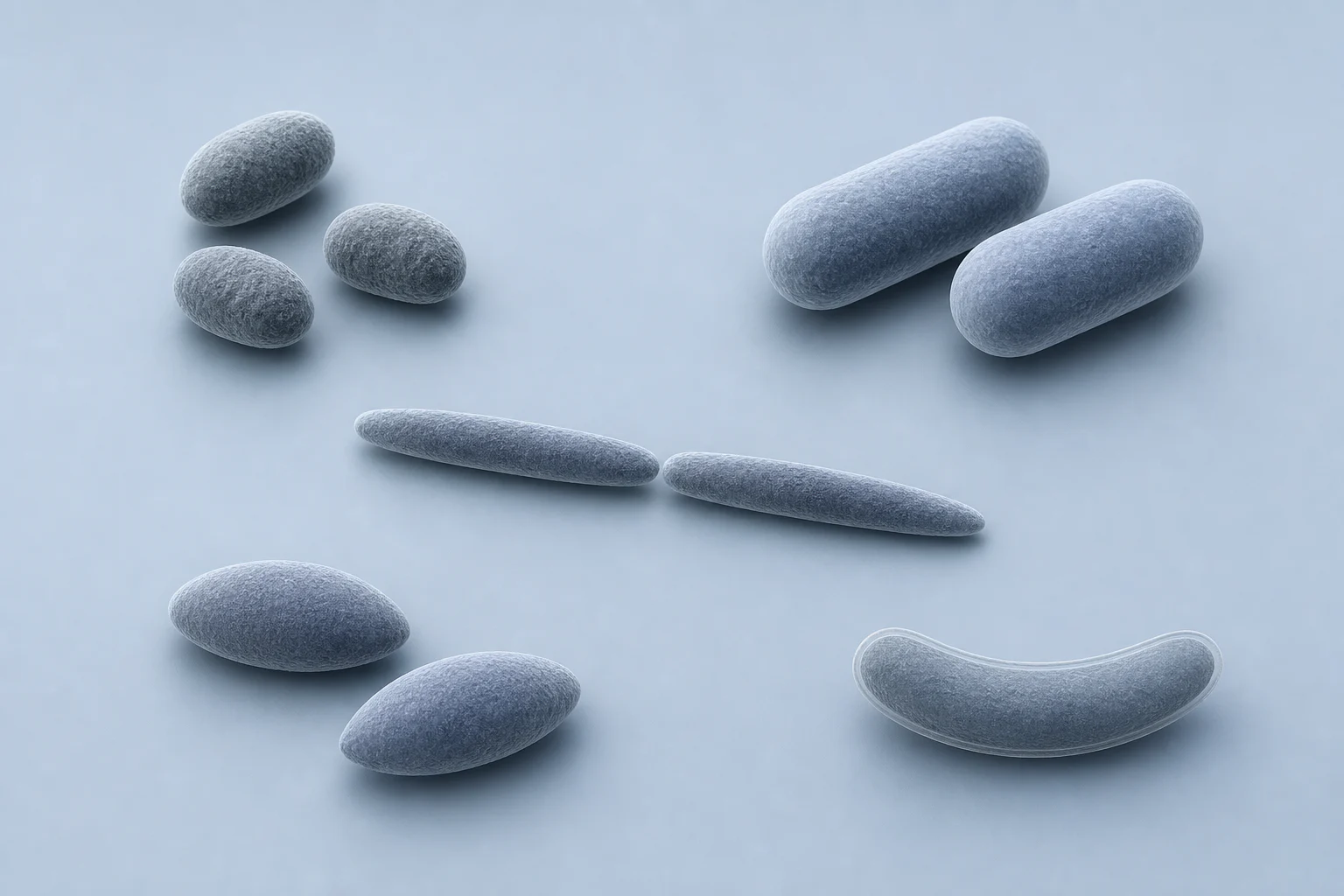
Selected cellular-form breadth within Bacteroidales, shown as ten cells in five groupings. The reconstruction is order-level, not exhaustive or diagnostic, and is not a micrograph.
Scientific media record1 verified identifier
- Subject
- Bacteroidalestaxon · order
- Identifiers
- NCBITaxon:171549
- Review
- Editorial review completeIdentifiers authority-verified · Accessibility validated · · bacteroidales|bacteroidales-microbial-community-v1.webp
- Digital source
- Trained-algorithmic mediaCreated with a trained generative algorithm and reviewed by WikiBiome for subject identity, scientific framing, identifiers, provenance, and accessibility.
- Scientific basis
- Bacteroidales — NCBI TaxonomyBacteroidaceae — NCBI TaxonomyBacteroides cell structure and surface diversity
- License
- CC BY-SA 4.0Created
Bacteroidales is an order of obligate anaerobic, Gram-negative bacteria within the phylum Bacteroidetes. It includes the families Bacteroidaceae (Bacteroides), Prevotellaceae (Prevotella), Rikenellaceae, and Porphyromonadaceae (Porphyromonas). Bacteroidales are among the most abundant gut commensals, specializing in complex polysaccharide degradation via their signature polysaccharide utilization loci (PULs).
Evidence map4 cited passagesInspect provenance +
Diet-responsive: Mediterranean and fiber-rich diets increase Bacteroidales abundance.
T1D: Altered Bacteroidales in autoimmune beta-cell destruction.
CRC: Immunotherapy response (PD-1 blockade) associated with Bacteroidales abundance.
CKD: Dietary fiber modulates Bacteroidales and downstream metabolome.
Ecological Role#
Fiber fermentation: Bacteroidales encode extensive PUL systems for degrading dietary fiber, resistant starch, and host-derived glycans (mucin)—making them the primary fiber-fermenting order in the gut.
SCFA production: Major producers of propionate and acetate (less Butyrate than Firmicutes). Bile acid metabolism: Bacteroidales possess bile salt hydrolases that deconjugate primary bile acids.
Diet-responsive: Mediterranean and fiber-rich diets increase Bacteroidales abundance.[1]Latorre-Pérez 2021 — The Spanish Gut Microbiome Reveals Links Between Microorganisms and Mediterranean DietAdriel Latorre-Pérez, Marta Hernández, Jose Ramón Iglesias et al. · 2021Open reference 1 ↓[2]The interplay between diet and the gut microbiome: implications for health and diseaseFiona C. Ross, Dhrati Patangia, Ghjuvan Grimaud et al. · 2024Open reference 2 ↓
Disease Associations#
T1D: Altered Bacteroidales in autoimmune beta-cell destruction.[3]Honkanen 2020 — Fungal Dysbiosis and Intestinal Inflammation in Children with Beta-Cell AutoimmunityJarno Honkanen, Arja Vuorela, Daniel Muthas et al. · 2020Open reference 3 ↓ CRC: Immunotherapy response (PD-1 blockade) associated with Bacteroidales abundance.[4]Gut Microbiome Influences the Efficacy of PD-1 Antibody Immunotherapy on MSS-Type Colorectal Cancer via Metabolic PathwayXinjian Xu, Ji Lv, Fang Guo et al. · 2020Open reference 4 ↓ CKD: Dietary fiber modulates Bacteroidales and downstream metabolome.[5]Hall et al. 2020 — CKD in Cats Alters Response of the Plasma Metabolome and Fecal Microbiome to Dietary FiberJean A. Hall, Matthew I. Jackson, Dennis E. Jewell et al. · 2020Open reference 5 ↓
Cross-References#
- Bacteroides—dominant genus
- Prevotella—fiber-associated genus
- Bacteroidetes (Bacteroidota)—phylum context
- Dietary Fiber (Cross-Condition)—substrate for Bacteroidales PUL systems
- Short-Chain Fatty Acids (SCFAs)—metabolic output
References 5
Numbered by first appearance in the article, then reconciled with its declared source list.
- 1
Adriel Latorre-Pérez, Marta Hernández, Jose Ramón Iglesias et al. (2021). Latorre-Pérez 2021 — The Spanish Gut Microbiome Reveals Links Between Microorganisms and Mediterranean Diet. Scientific Reports.
- 2
Fiona C. Ross, Dhrati Patangia, Ghjuvan Grimaud et al. (2024). The interplay between diet and the gut microbiome: implications for health and disease. Nature Reviews Microbiology.
- 3
Jarno Honkanen, Arja Vuorela, Daniel Muthas et al. (2020). Honkanen 2020 — Fungal Dysbiosis and Intestinal Inflammation in Children with Beta-Cell Autoimmunity. Frontiers in Immunology.
- 4
Xinjian Xu, Ji Lv, Fang Guo et al. (2020). Gut Microbiome Influences the Efficacy of PD-1 Antibody Immunotherapy on MSS-Type Colorectal Cancer via Metabolic Pathway. Frontiers in Microbiology.
- 5
Jean A. Hall, Matthew I. Jackson, Dennis E. Jewell et al. (2020). Hall et al. 2020 — CKD in Cats Alters Response of the Plasma Metabolome and Fecal Microbiome to Dietary Fiber. PLOS ONE.
Article network
Connect the evidence
Publicly readable discussion by ORCID-authenticated researchers. Questions, interpretation, methods, corrections, and new evidence stay attached to this record.
No discussion yet. Start with a precise question or a source-backed observation.
Activity and accepted changes
Accepted researcher context, editorial status, public discussion, and upstream Git revisions are shown together. Pending, declined, and withdrawn proposals remain private.
- published revision
massive wiki expansion: 149 stubs fixed, 100+ new pages, Rule 15 scan, keystone papers
WikiBiome Deploy Bot · +51 −0
Inspect exact Git diff ↗