
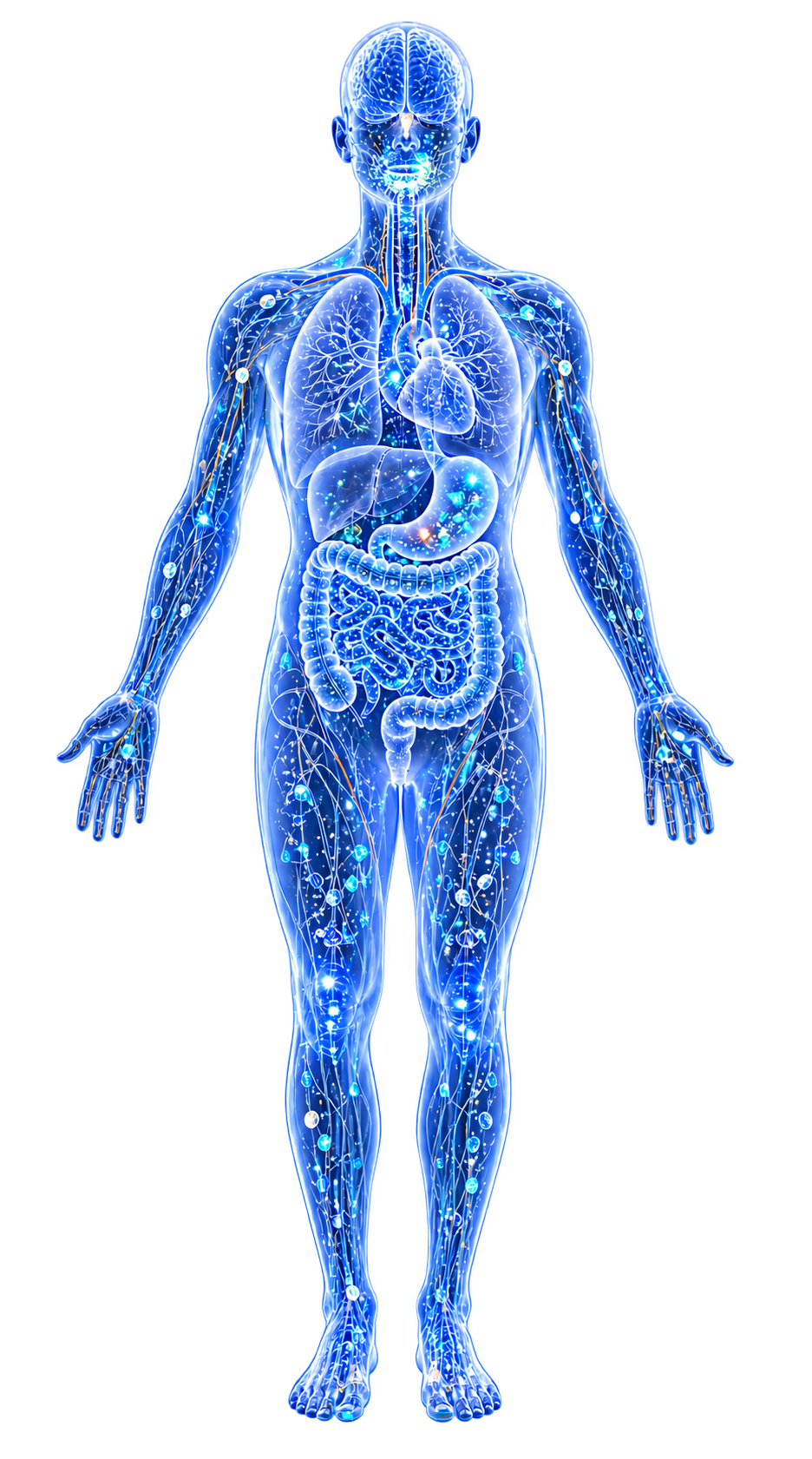
Vitamin B12 (cobalamin) is an essential cobalt-containing cofactor required for homocysteine metabolism, methylation reactions, and neurological function. Its core corrin ring chelates a cobalt ion, placing B12 at the intersection of metallomics and microbial ecology.
Certain gut bacteria synthesize cobalamin de novo, making the microbiome a secondary source of B12 beyond dietary intake. Disrupted microbial communities can impair this endogenous production, contributing to functional deficiency even when dietary intake appears adequate.
In Hashimoto's thyroiditis, altered metabolic profiles include perturbations in B12-dependent methylation pathways ([1]Identifying the metabolic profile of Hashimoto's thyroiditis from the METHAP clinical studySarandi E, Tsoukalas D, Rudofsky G et al. · 2025Open reference 1 ↓), and B12 status has been linked to testosterone metabolism and type 2 diabetes outcomes ([2]Griffith 2026 — Lifestyle Changes and Probiotic Supplementation for Improving Longstanding Type 2 Diabetes in a Male Undergoing Testosterone Replacement TherapyAnna Griffith, Adam Perlman, Tara Karr et al. · 2026Open reference 2 ↓).
The cobalt center of cobalamin connects B12 to broader metallomics. Nickel and cobalt share chemical properties and biological transport pathways, and nickel exposure can interfere with cobalt-dependent enzymatic processes ([3]Genchi 2020 — Nickel: Human Health and Environmental ToxicologyGenchi G, Carocci A, Lauria G et al. · 2020Open reference 3 ↓). This mis-metallation potential positions B12 metabolism as a target of heavy metal disruption.
Evidence map2 cited passagesInspect provenance +
Certain gut bacteria synthesize cobalamin de novo, making the microbiome a secondary source of B12 beyond dietary intake. Disrupted microbial communities can impair this endogenous production, contributing to functional deficiency even when dietary intake appears adequate. In Hashimoto's thyroiditis, altered metabolic profiles include perturbations in B12-de
The cobalt center of cobalamin connects B12 to broader metallomics. Nickel and cobalt share chemical properties and biological transport pathways, and nickel exposure can interfere with cobalt-dependent enzymatic processes (). This mis-metallation potential positions B12 metabolism as a target of heavy metal disruption.
Contents
1. Cross-ReferencesCross-References#
- Nickel—cobalt/nickel chemical similarity and mis-metallation
- Cobalt—the metal cofactor at the heart of cobalamin
- Hashimoto's Thyroiditis—B12-dependent methylation disruption
- Homocysteine—metabolic pathway dependent on B12
References 3
Numbered by first appearance in the article, then reconciled with its declared source list.
- 1
Sarandi E, Tsoukalas D, Rudofsky G et al. (2025). Identifying the metabolic profile of Hashimoto's thyroiditis from the METHAP clinical study. Scientific Reports.
- 2
Anna Griffith, Adam Perlman, Tara Karr et al. (2026). Griffith 2026 — Lifestyle Changes and Probiotic Supplementation for Improving Longstanding Type 2 Diabetes in a Male Undergoing Testosterone Replacement Therapy. Frontiers in Endocrinology.
- 3
Genchi G, Carocci A, Lauria G et al. (2020). Genchi 2020 — Nickel: Human Health and Environmental Toxicology. International Journal of Environmental Research and Public Health.
Article network
Mentioned here 4
Pages linking here 3
Connect the evidence
Publicly readable discussion by ORCID-authenticated researchers. Questions, interpretation, methods, corrections, and new evidence stay attached to this record.
No discussion yet. Start with a precise question or a source-backed observation.
Activity and accepted changes
Accepted researcher context, editorial status, public discussion, and upstream Git revisions are shown together. Pending, declined, and withdrawn proposals remain private.
- published revision
massive wiki expansion: 149 stubs fixed, 100+ new pages, Rule 15 scan, keystone papers
WikiBiome Deploy Bot · +31 −0
Inspect exact Git diff ↗