
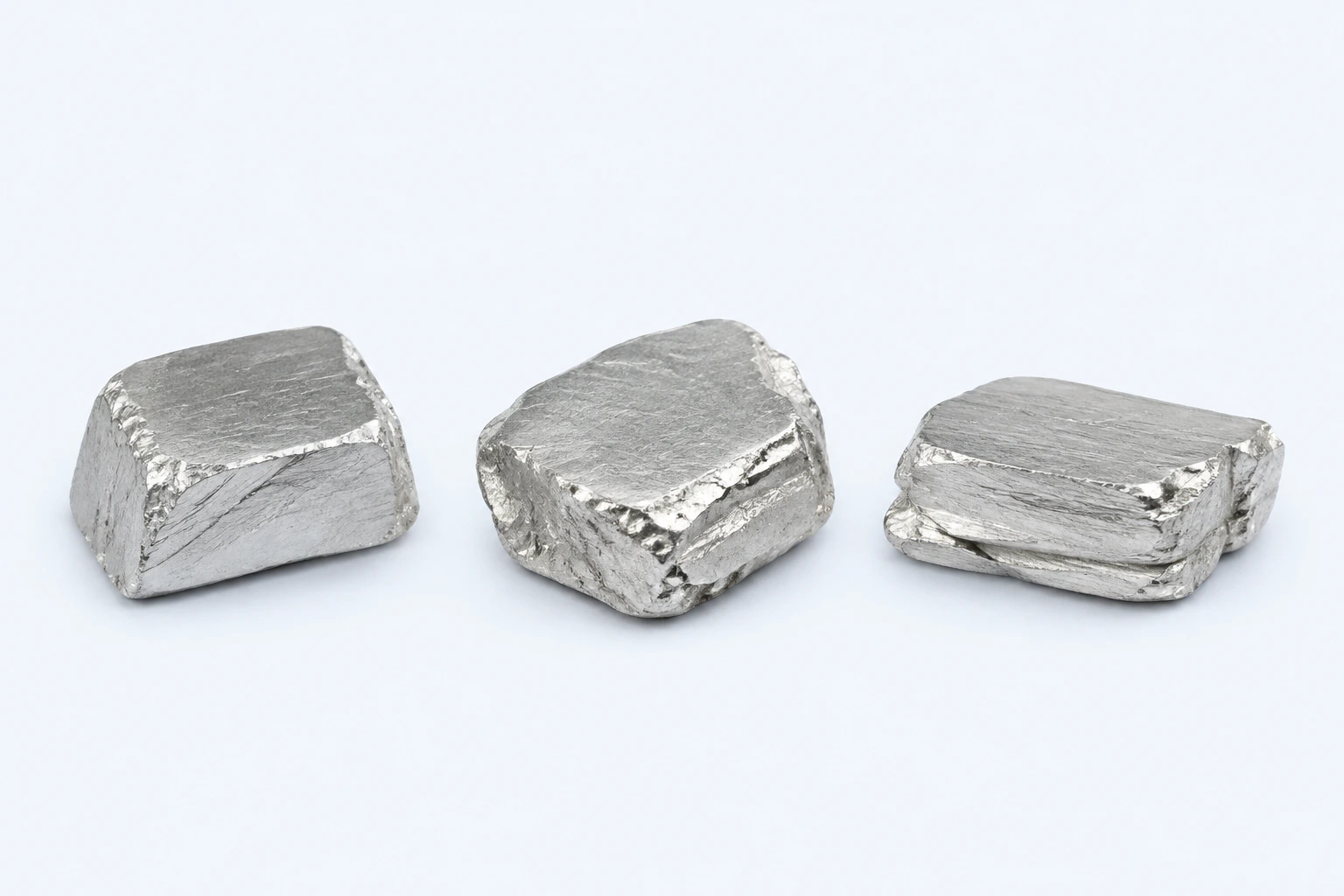
Elemental platinum (Pt), shown as three representative dense silvery-white solid specimens. Form and surface vary with purity and processing; this is not jewelry, ore, analytical reference material, or a photograph.
Scientific media record2 verified identifiers
- Subject
- Platinumelement
- Identifiers
- Atomic number 78PubChem CID:23939
- Review
- Editorial review completeIdentifiers authority-verified · Accessibility validated · · platinum|platinum-technical-specimen-v1.webp
- Digital source
- Trained-algorithmic mediaCreated with a trained generative algorithm and reviewed by WikiBiome for subject identity, scientific framing, identifiers, provenance, and accessibility.
- Scientific basis
- Platinum — PubChem ElementPlatinum, PubChem CID 23939
- License
- CC BY-SA 4.0Created
A dense, chemically inert noble metal with no known biological function—yet platinum compounds are the backbone of chemotherapy for ovarian, testicular, lung, and bladder cancers. The discovery that cisplatin inhibits bacterial cell division (Rosenberg, 1965) led to one of oncology's most important drug classes.
What is only now emerging is that the Gut Microbiome profoundly influences whether platinum chemotherapy works or fails.
Contents
1. Cisplatin Mechanism2. Microbiome-Dependent Efficacy3. Ferroptosis Resistance4. Glutathione Connection5. Clinical Significance6. Cross-ReferencesCisplatin Mechanism#
Cisplatin (cis-diamminedichloroplatinum(II)) forms intrastrand DNA crosslinks, primarily at GG and AG sequences, blocking replication and triggering apoptosis. Second-generation carboplatin has reduced nephrotoxicity; third-generation oxaliplatin has a distinct spectrum of activity against colorectal cancer. All platinum compounds ultimately kill cells by inducing DNA damage beyond the cell's repair capacity.
Microbiome-Dependent Efficacy#
The gut microbiome is not a bystander during chemotherapy—it is a determinant of response. Antibiotic-induced Dysbiosis increases tumor growth AND platinum resistance—germ-free and antibiotic-treated mice show reduced cisplatin efficacy, demonstrating that intact gut microbiota are required for full chemotherapeutic effect.
Immune surveillance dependency—The microbiome primes tumor-infiltrating immune cells (particularly CD8+ T cells) that are required for cisplatin to eliminate cancer stem cells. Without this immune component, platinum kills bulk tumor cells but spares resistant clones.
Microbial metabolite modulation—Short-chain fatty acids (especially Butyrate) from commensal bacteria enhance cisplatin-induced apoptosis in tumor cells through HDAC inhibition.
Ferroptosis Resistance#
The primary mechanism of platinum resistance converges on ferroptosis evasion. Keap1-Nrf2-GPX4 axis—Platinum-resistant cells upregulate Nrf2, which activates GPX4 (glutathione peroxidase 4), the master suppressor of ferroptosis. This simultaneously blocks both cisplatin-induced apoptosis and ferroptosis.
Glutathione (GSH) is the most altered pathway in platinum-resistant cells. Elevated GSH directly inactivates cisplatin (Pt-GSH conjugation) and fuels GPX4 to prevent lipid peroxidation.
Iron homeostasis disruption—Resistant cells alter Iron handling to minimize Fenton chemistry, reducing the Oxidative Stress that platinum compounds rely on for cytotoxicity.
Glutathione Connection#
Cisplatin resistance and Glutathione (GSH) metabolism are inseparable: GSH conjugation is the primary detoxification route, and gamma-glutamylcysteine synthetase upregulation is a hallmark of resistant clones.
This creates a therapeutic paradox: interventions that deplete glutathione may resensitize tumors to platinum but also compromise host antioxidant defense. The microbiome influences systemic glutathione through cysteine and glycine metabolism, providing another mechanism for microbiome-dependent platinum sensitivity.
Clinical Significance#
Ovarian cancer: Platinum-based chemotherapy achieves ~80% initial response rate, but ~70% of patients develop resistance. The Keap1-Nrf2 pathway is now a major therapeutic target for resensitization.
Colorectal cancer: Oxaliplatin efficacy correlates with pre-treatment microbiome composition, with higher Fusobacterium nucleatum abundance predicting poorer response. Nephrotoxicity: Cisplatin-induced kidney injury involves ferroptotic cell death in proximal tubule cells, linking platinum toxicity to the same Ferroptosis pathway that governs resistance.
Cross-References#
- Iron—Ferroptosis substrate and resistance determinant
- Glutathione (GSH)—Primary detoxification pathway for cisplatin
- Ferroptosis—The cell death pathway platinum compounds exploit
- Breast Cancer, Ovarian Cancer—Primary clinical applications
References 8
Numbered by first appearance in the article, then reconciled with its declared source list.
- 1
Loganathan T, Doss CGP (2025). Gut microbiota and its influence on the Gut-Brain axis in comparison with chemotherapy patients and cancer-free control data in Breast cancer. PLoS One.
- 2
Otto LD (2024). Cancer and cancer treatments induce immune dysfunction, gut microbiome disruption, and physiological and behavioral symptoms. The Ohio State University PhD Dissertation.
- 3
Tian M, Zeng X, Zhong Y et al. (2026). Tian et al. 2026 — Tripterygium Glycosides and Lactobacillus paracasei Sensitize EOC to Cisplatin via Keap1-Nrf2-GPX4 Pathway. Cellular and Molecular Biology Letters.
- 4
Englert-Golon M, Sajdak S, Plagens-Rotman KM et al. (2025). Englert-Golon 2025 — Potential Role of Microbiota in Ovarian Cancer Treatment. Archives of Medical Science.
- 5
Zhou C, Kang J, Wang X et al. (2015). Phage display screening identifies a novel peptide to suppress ovarian cancer cells in vitro and in vivo in mouse models. BMC Cancer.
- 6
Loman BR, Jordan KR, Haynes B et al. (2019). Chemotherapy-induced neuroinflammation is associated with disrupted colonic and bacterial homeostasis in female mice. Scientific Reports.
- 7
Dash R, Hosen SMZ, Karim MR et al. (2015). In silico analysis of indole-3-carbinol and its metabolite DIM as EGFR tyrosine kinase inhibitors in platinum resistant ovarian cancer. Journal of Applied Pharmaceutical Science.
- 8
Lori M. Poisson, Adnan Munkarah, Hala Madi et al. (2015). Poisson 2015 — A Metabolomic Approach to Identifying Platinum Resistance in Ovarian Cancer. Journal of Ovarian Research.
Article network
Connect the evidence
Publicly readable discussion by ORCID-authenticated researchers. Questions, interpretation, methods, corrections, and new evidence stay attached to this record.
No discussion yet. Start with a precise question or a source-backed observation.
Activity and accepted changes
Accepted researcher context, editorial status, public discussion, and upstream Git revisions are shown together. Pending, declined, and withdrawn proposals remain private.
- published revision
Backfill oxidative stress concept links
Karen Pendergrass · +1 −1
Inspect exact Git diff ↗ - published revision
Backfill gut microbiome concept links
Karen Pendergrass · +1 −1
Inspect exact Git diff ↗ - published revision
Complete corpus-wide Dysbiosis linking
Karen Pendergrass · +1 −1
Inspect exact Git diff ↗ - published revision
massive wiki expansion: 149 stubs fixed, 100+ new pages, Rule 15 scan, keystone papers
WikiBiome Deploy Bot · +23 −17
Inspect exact Git diff ↗ - published revision
nightly maintenance: 94 stub demotions, 181 source_count fixes, 22 auto-discovered stubs, 5 adversarial audits, 3 boundary fixes, 3 evidence-level corrections
WikiBiome Deploy Bot · +2 −0
Inspect exact Git diff ↗ - published revision
Health check gap fill: 15 missing pages identified and created
WikiBiome Deploy Bot · +60 −0
Inspect exact Git diff ↗