
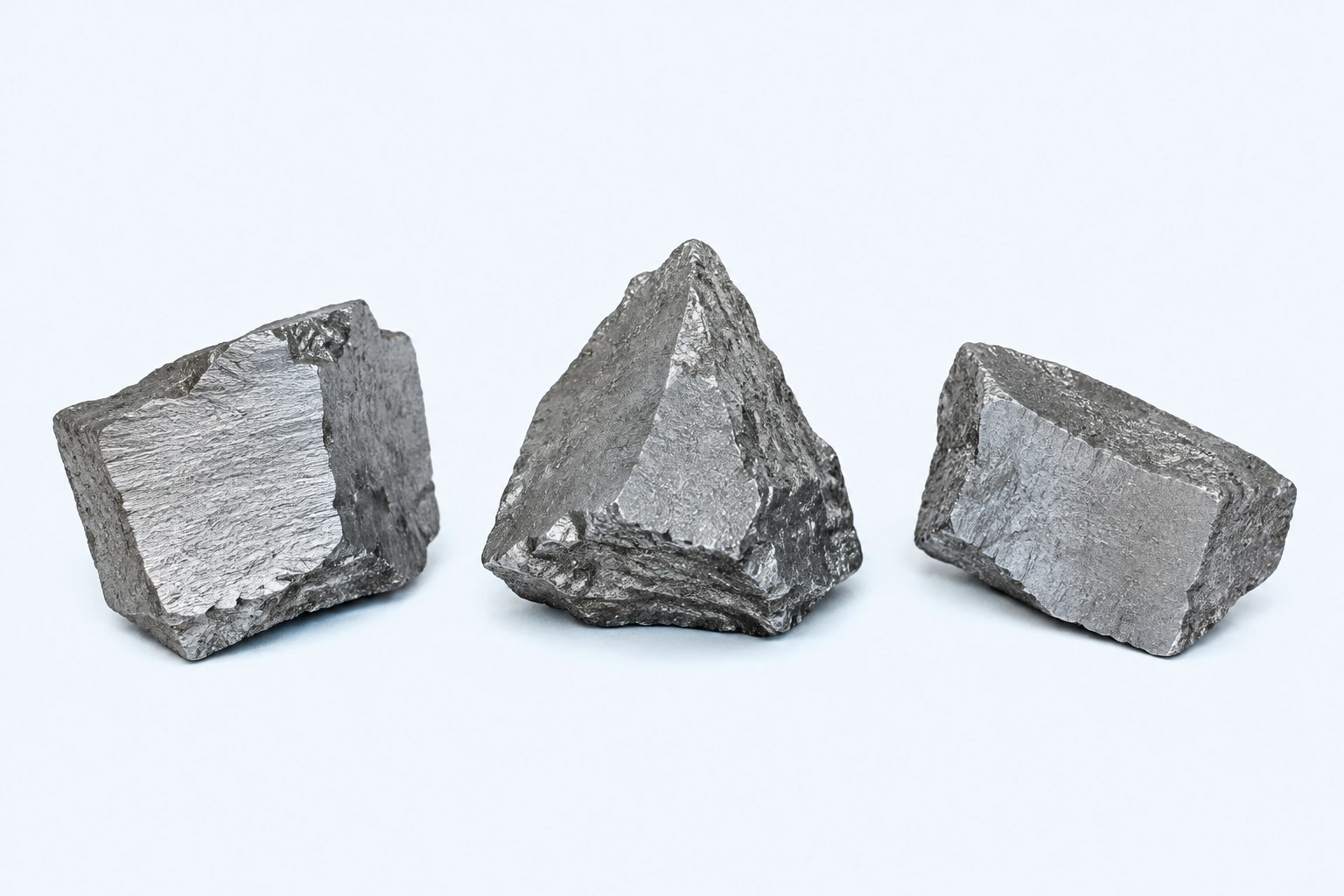
Elemental molybdenum (Mo), shown as three representative hard silvery-gray solid specimens. Form and surface vary with purity, processing, and oxidation; this is not molybdenite, analytical reference material, or a photograph.
Scientific media record2 verified identifiers
- Subject
- Molybdenumelement
- Identifiers
- Atomic number 42PubChem CID:23932
- Review
- Editorial review completeIdentifiers authority-verified · Accessibility validated · · molybdenum|molybdenum-technical-specimen-v1.webp
- Digital source
- Trained-algorithmic mediaCreated with a trained generative algorithm and reviewed by WikiBiome for subject identity, scientific framing, identifiers, provenance, and accessibility.
- Scientific basis
- Molybdenum — PubChem ElementMolybdenum, PubChem CID 23932
- License
- CC BY-SA 4.0Created
An essential trace element that serves as a cofactor for a small but critical family of enzymes—the molybdoenzymes—involved in purine catabolism, sulfite detoxification, and aldehyde metabolism.[1]Association of Trace Elements with Polycystic Ovary Syndrome in Women -- A Case-Control StudySmovrsnik T, Pinter B, Horvat M et al. · 2025Open reference 1 ↓
Molybdenum appears in this wiki primarily through two findings: an inverse association with breast cancer risk in the largest prospective study of metals and breast cancer,[2]Metals and Breast Cancer Risk: A Prospective Study Using Toenail BiomarkersNiehoff NM, O'Brien KM, Keil AP et al. · 2021Open reference 2 ↓ and lower levels in PCOS patients in the first study to examine molybdenum (Mo) in that condition.[1]Association of Trace Elements with Polycystic Ovary Syndrome in Women -- A Case-Control StudySmovrsnik T, Pinter B, Horvat M et al. · 2025Open reference 1 ↓
Preterm mothers show reduced molybdenum status alongside other trace-element deficiencies, suggesting molybdenum adequacy may play a role in pregnancy outcomes (aluminum (Al)-Saleh et al. 2004; Hansen et al. 2017).
Evidence map14 cited passagesInspect provenance +
An essential trace element that serves as a cofactor for a small but critical family of enzymes—the molybdoenzymes—involved in purine catabolism, sulfite detoxification, and aldehyde metabolism. Molybdenum appears in this wiki primarily through two findings: an inverse association with breast cancer risk in the largest prospective study of metals and b
Baby food jars from Spain contained Mo at 4 times higher than maximum recommended values, alongside elevated manganese.
| Enzyme | Function | Clinical Relevance | |---|---|---| | Xanthine oxidase (XO) | Catalyzes hypoxanthine—xanthine—uric acid; generates superoxide and H2O2 as byproducts | Gout (uric acid accumulation); oxidative stress source; target of allopurinol | | Sulfite oxidase | Oxidizes sulfite (SO3 2-) to sulfate (SO4 2-); detoxifies dietary and endogenous s
Xanthine oxidase is particularly relevant to this wiki because it is both a Mo-dependent enzyme and a significant endogenous source of ROS (superoxide and H2O2), connecting molybdenum status to oxidative stress.
The Sister Study, the largest prospective study of metals and breast cancer (1,495 cases, 1,605 subcohort), found that Mo was the only metal with a significant inverse association with breast cancer risk:
Mechanism: potentially related to Mo's role as cofactor for enzymes that break down toxic sulfites and other xenobiotics.
The first study to examine Mo in PCOS found significantly lower levels in affected women:
Dietary predictors: cereals and boiled vegetables were important predictors of Mo levels; Cu-Mo antagonism (excess Cu decreases Mo absorption by forming non-absorbable Cu-Mo complexes in the GI tract) may be relevant given elevated copper in PCOS.
Mo positively correlated with AST, ALT, and urinary urobilinogen in PCOS, suggesting associations with liver function.
Included in multi-element urinary panels assessing associations between trace elements and kidney function.
Included in machine learning analyses of heavy metal associations with arthritis.
Baby food jars showed Mo at 4x recommended values, raising concern about infant exposure.
Copper-molybdenum antagonism: Excess Cu decreases Mo absorption by forming insoluble Cu-Mo-S complexes (thiomolybdates) in the GI tract. This is well established in ruminant nutrition ("swayback" in sheep from Cu deficiency induced by high-Mo pastures) and may be relevant in human PCOS where Cu is elevated and Mo is low.
Mo is classified as a toxic element in some food safety contexts (baby food studies) despite being essential.
Contents
1. Chemical Properties2. Sources of Exposure3. Key Molybdoenzymes4. Health Effects5. Interactions with Other Metals6. ConnectionsChemical Properties#
Transition metal (Group 6); biologically active as molybdenum (Mo)(IV), molybdenum(vanadium (V)), and molybdenum(VI).
Functions exclusively as part of the molybdenum cofactor (Moco), a pterin-based organic molecule that coordinates molybdenum and inserts it into the active sites of molybdoenzymes.
Moco deficiency is a rare but lethal inborn error of metabolism causing seizures, neurodegeneration, and early death. Dietary requirement is low: RDA of 45 ug/day for adults; UL of 2 mg/day.
Sources of Exposure#
Dietary#
Legumes, grains, nuts, and leafy vegetables are the primary dietary sources. Soil molybdenum content varies geographically, affecting plant molybdenum (Mo) concentrations.
Baby food jars from Spain contained molybdenum at 4 times higher than maximum recommended values, alongside elevated manganese.[3]Baby Food Jars as a Dietary Source of Essential (K, Na, Ca, Mg, Fe, Zn, Cu, Co, Mo, Mn) and Toxic Elements (Al, Cd, Pb, B, Ba, V, Sr, Li, Ni)Gonzalez-Suarez S, Paz-Montelongo S, Niebla-Canelo D et al. · 2022Open reference 3 ↓
Key Molybdoenzymes#
| Enzyme | Function | Clinical Relevance |
|---|---|---|
| Xanthine oxidase (XO) | Catalyzes hypoxanthine --> xanthine --> uric acid; generates superoxide and H2O2 as byproducts | Gout (uric acid accumulation); Oxidative Stress source; target of allopurinol |
| Sulfite oxidase | Oxidizes sulfite (SO3 2-) to sulfate (SO4 2-); detoxifies dietary and endogenous sulfite[1]Association of Trace Elements with Polycystic Ovary Syndrome in Women -- A Case-Control StudySmovrsnik T, Pinter B, Horvat M et al. · 2025Open reference 1 ↓ | Sulfite sensitivity; isolated sulfite oxidase deficiency and Moco deficiency cause toxic sulfite accumulation, neurological damage, and early death (Schwarz et al. 2009) |
| Aldehyde oxidase | Oxidizes aromatic and aliphatic aldehydes; metabolizes drugs and xenobiotics | Drug metabolism (affects bioavailability of some pharmaceuticals) |
Xanthine oxidase is particularly relevant to this wiki because it is both a molybdenum (Mo)-dependent enzyme and a significant endogenous source of ROS (superoxide and H2O2), connecting molybdenum status to oxidative stress.[1]Association of Trace Elements with Polycystic Ovary Syndrome in Women -- A Case-Control StudySmovrsnik T, Pinter B, Horvat M et al. · 2025Open reference 1 ↓
Bacterial nitrate reductase and related molybdenum-dependent enzymes (formate dehydrogenase, DMSO reductase) enable anaerobic respiration in enteric pathogens such as E. coli and Salmonella.
In the inflamed gut, host-derived nitrate from nitric oxide oxidation is exploited by Enterobacteriaceae via these molybdenum-dependent enzymes to outcompete obligate anaerobe commensals—a key mechanism of dysbiotic bloom (Winter et al. 2013; Lopez et al. 2015).
Health Effects#
Breast Cancer—Inverse Association#
The Sister Study, the largest prospective study of metals and breast cancer (1,495 cases, 1,605 subcohort), found that molybdenum (Mo) was the only metal with a significant inverse association with breast cancer risk.[2]Metals and Breast Cancer Risk: A Prospective Study Using Toenail BiomarkersNiehoff NM, O'Brien KM, Keil AP et al. · 2021Open reference 2 ↓
Third tertile vs. first: HR = 0.82 (95% CI: 0.67, 1.00) for overall breast cancer. Stronger inverse association for ER-negative breast cancer (HR = 0.57, 95% CI: 0.38, 0.88). Toenail molybdenum reflects 6-12 months of exposure, providing longer-term assessment than blood/urine.
Mechanism: potentially related to molybdenum's role as cofactor for enzymes that break down toxic sulfites and other xenobiotics.[2]Metals and Breast Cancer Risk: A Prospective Study Using Toenail BiomarkersNiehoff NM, O'Brien KM, Keil AP et al. · 2021Open reference 2 ↓
PCOS—Lower Levels#
The first study to examine molybdenum (Mo) in PCOS found significantly lower levels in affected women.[1]Association of Trace Elements with Polycystic Ovary Syndrome in Women -- A Case-Control StudySmovrsnik T, Pinter B, Horvat M et al. · 2025Open reference 1 ↓
molybdenum whole blood: PCOS 0.60 vs control 0.71 ug/L (p = 0.024). molybdenum serum: PCOS 0.85 vs control 1.00 ug/L (p = 0.011). Negative correlation between molybdenum and LH levels in PCOS women, suggesting a potential protective role of molybdenum in reducing androgen levels.
Differences were no longer statistically significant after adjusting for age, BMI, and hematocrit, indicating possible confounding.
Dietary predictors: cereals and boiled vegetables were important predictors of molybdenum levels; copper (Cu)-molybdenum antagonism (excess copper decreases molybdenum absorption by forming non-absorbable copper-molybdenum complexes in the GI tract) may be relevant given elevated Copper in PCOS.[1]Association of Trace Elements with Polycystic Ovary Syndrome in Women -- A Case-Control StudySmovrsnik T, Pinter B, Horvat M et al. · 2025Open reference 1 ↓
molybdenum positively correlated with AST, ALT, and urinary urobilinogen in PCOS, suggesting associations with liver function.[1]Association of Trace Elements with Polycystic Ovary Syndrome in Women -- A Case-Control StudySmovrsnik T, Pinter B, Horvat M et al. · 2025Open reference 1 ↓
Kidney Function#
- Included in multi-element urinary panels assessing associations between trace elements and kidney function.[4]Association between urinary heavy metal/trace element concentrations and kidney function: a prospective studyXie S, Perrais M, Golshayan D et al. · 2025Open reference 4 ↓
Arthritis#
- Included in machine learning analyses of heavy metal associations with arthritis.[5]Analyzing the impact of heavy metal exposure on osteoarthritis and rheumatoid arthritis: an approach based on interpretable machine learningFan W, Pi Z, Kong K et al. · 2024Open reference 5 ↓
Infant Overexposure#
- Baby food jars showed molybdenum (Mo) at 4x recommended values, raising concern about infant exposure.[3]Baby Food Jars as a Dietary Source of Essential (K, Na, Ca, Mg, Fe, Zn, Cu, Co, Mo, Mn) and Toxic Elements (Al, Cd, Pb, B, Ba, V, Sr, Li, Ni)Gonzalez-Suarez S, Paz-Montelongo S, Niebla-Canelo D et al. · 2022Open reference 3 ↓
Interactions with Other Metals#
Copper-molybdenum antagonism: Excess copper (Cu) decreases molybdenum (Mo) absorption by forming insoluble copper-molybdenum-S complexes (thiomolybdates) in the GI tract.
This is well established in ruminant nutrition ("swayback" in sheep from copper deficiency induced by high-molybdenum pastures) and may be relevant in human PCOS where copper is elevated and molybdenum is low.[1]Association of Trace Elements with Polycystic Ovary Syndrome in Women -- A Case-Control StudySmovrsnik T, Pinter B, Horvat M et al. · 2025Open reference 1 ↓
Iron: molybdenum and iron (Fe) share some transport pathways; Moco synthesis requires iron-sulfur cluster biogenesis.
molybdenum is classified as a toxic element in some food safety contexts (baby food studies) despite being essential.[3]Baby Food Jars as a Dietary Source of Essential (K, Na, Ca, Mg, Fe, Zn, Cu, Co, Mo, Mn) and Toxic Elements (Al, Cd, Pb, B, Ba, V, Sr, Li, Ni)Gonzalez-Suarez S, Paz-Montelongo S, Niebla-Canelo D et al. · 2022Open reference 3 ↓
Connections#
- Breast Cancer—only metal inversely associated with risk in the Sister Study; stronger for ER-negative
- Polycystic Ovary Syndrome—lower molybdenum (Mo) in PCOS patients; copper (Cu)-molybdenum antagonism potentially relevant
- Copper—antagonistic relationship; elevated copper may drive low molybdenum in PCOS
- oxidative stress—xanthine oxidase (molybdenum-dependent) is a significant endogenous ROS source
- molybdenum-dependent enzyme; target of gout therapy (allopurinol)
- molybdenum overexposure in baby food jars
- Iron—shared biosynthetic pathways for cofactor assembly
References 6
Numbered by first appearance in the article, then reconciled with its declared source list.
- 1
Smovrsnik T, Pinter B, Horvat M et al. (2025). Association of Trace Elements with Polycystic Ovary Syndrome in Women -- A Case-Control Study. Metabolites.
- 2
Niehoff NM, O'Brien KM, Keil AP et al. (2021). Metals and Breast Cancer Risk: A Prospective Study Using Toenail Biomarkers. American Journal of Epidemiology.
- 3
Gonzalez-Suarez S, Paz-Montelongo S, Niebla-Canelo D et al. (2022). Baby Food Jars as a Dietary Source of Essential (K, Na, Ca, Mg, Fe, Zn, Cu, Co, Mo, Mn) and Toxic Elements (Al, Cd, Pb, B, Ba, V, Sr, Li, Ni). Applied Sciences.
- 4
Xie S, Perrais M, Golshayan D et al. (2025). Association between urinary heavy metal/trace element concentrations and kidney function: a prospective study. Clinical Kidney Journal.
- 5
Fan W, Pi Z, Kong K et al. (2024). Analyzing the impact of heavy metal exposure on osteoarthritis and rheumatoid arthritis: an approach based on interpretable machine learning. Frontiers in Nutrition.
- 6
Jessica Briffa, Emmanuel Sinagra, Renald Blundell (2020). Heavy Metal Pollution in the Environment and Their Toxicological Effects on Humans. Heliyon.
Article network
Connect the evidence
Publicly readable discussion by ORCID-authenticated researchers. Questions, interpretation, methods, corrections, and new evidence stay attached to this record.
No discussion yet. Start with a precise question or a source-backed observation.
Activity and accepted changes
Accepted researcher context, editorial status, public discussion, and upstream Git revisions are shown together. Pending, declined, and withdrawn proposals remain private.
- published revision
Backfill oxidative stress concept links
Karen Pendergrass · +2 −2
Inspect exact Git diff ↗ - published revision
massive wiki expansion: 149 stubs fixed, 100+ new pages, Rule 15 scan, keystone papers
WikiBiome Deploy Bot · +12 −12
Inspect exact Git diff ↗ - published revision
Deepen metal/concept entities + 8 new sources for T1D/schizophrenia
WikiBiome Deploy Bot · +4 −2
Inspect exact Git diff ↗ - published revision
WikiBiome update — 2026-04-15 17:23
WikiBiome Deploy Bot · +2 −2
Inspect exact Git diff ↗ - published revision
wiki: bulk entity upgrades, new article pages, and site regeneration
WikiBiome Deploy Bot · +6 −0
Inspect exact Git diff ↗ - published revision
WikiBiome update — integrity fixes, metallomic diet pages, cross-condition analyses
WikiBiome Deploy Bot · +15 −13
Inspect exact Git diff ↗ - published revision
WikiBiome v7 — interactive microbiome metallomics encyclopedia
Karen Pendergrass · +85 −0
Inspect exact Git diff ↗