

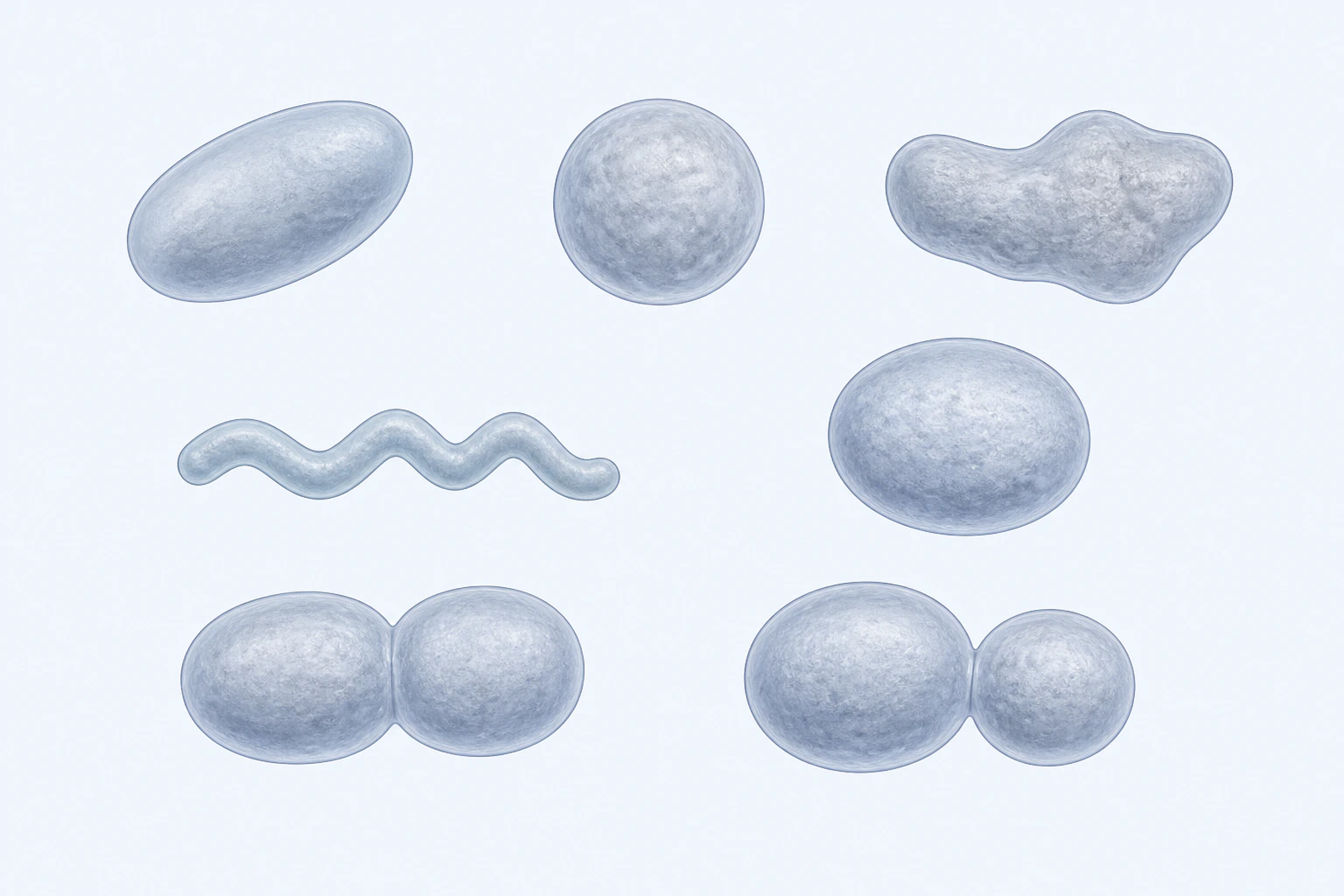
Selected wall-less descendant forms within Mollicutes, shown as nine bodies in five single and two paired groupings. This class-level diversity reconstruction is representative, non-exhaustive, non-universal, non-diagnostic, and not a micrograph.
Scientific media record1 verified identifier
- Subject
- Mollicutestaxon · class
- Identifiers
- NCBITaxon:31969
- Review
- Editorial review completeIdentifiers authority-verified · Accessibility validated · · mollicutes|mollicutes-microbial-community-v1.webp
- Digital source
- Trained-algorithmic mediaCreated with a trained generative algorithm and reviewed by WikiBiome for subject identity, scientific framing, identifiers, provenance, and accessibility.
- Scientific basis
- Mollicutes — NCBI TaxonomyMollicutes — LPSNMinimal standards for Mollicutes descriptionsMycoplasma and spiroplasma cell architectureSpiroplasma helical morphology
- License
- CC BY-SA 4.0Created
A class of bacteria within the phylum Tenericutes defined by the complete absence of a cell wall—the smallest self-replicating organisms known, with minimal genomes (580 kb-1.4 Mb).
While Mollicutes are best known through their pathogenic members (Mycoplasma pneumoniae, Ureaplasma urealyticum), gut-resident Mollicutes have gained attention through Mendelian randomization studies linking the class to GERD risk and through antidepressant research showing that ketamine selectively restores Mollicutes abundance in depression-susceptible mice.
Evidence map4 cited passagesInspect provenance +
Class Mollicutes causally increases GERD risk (OR = 1.09, 95% CI 1.01-1.19, p = 0.037). The phylum Tenericutes (which contains only Mollicutes) showed a similar signal (OR = 1.11, p = 0.024). The mechanism is unclear but may involve Mollicutes-derived metabolites affecting esophageal motility or lower esophageal sphincter tone via the gut-esophageal axis.
Mollicutes are significantly decreased in chronic social defeat stress (CSDS)-susceptible mice. Notably, (R)-ketamine but not (S)-ketamine significantly restored Mollicutes levels, providing one of the earliest demonstrations that antidepressant efficacy may partly operate through microbiome modulation. The stereoselective difference (R vs. S enantiomer) sug
(Mendelian randomization)—Established Mollicutes as a causal GERD risk factor (OR 1.09).
(animal model)—Demonstrated stereoselective ketamine restoration of Mollicutes in depression-susceptible mice.
Contents
1. Taxonomy2. Metal Dependencies3. Ecological Role4. Conditions Associated5. Key Studies6. Open Questions7. Cross-ReferencesTaxonomy#
Class Mollicutes, phylum Tenericutes (sometimes placed within Firmicutes based on phylogenomics). Key orders: Mycoplasmatales (includes Mycoplasma, Ureaplasma), Entomoplasmatales, Acholeplasmatales, Anaeroplasmatales. Gut-relevant members: Anaeroplasma (strict anaerobe, found in ruminant and human gut), Erysipelothrix-related lineages (some classifications overlap with Erysipelotrichia).
Defining characteristic: cell wall deficiency renders Mollicutes inherently resistant to beta-lactam antibiotics (penicillins, cephalosporins) which target cell wall synthesis.
Metal Dependencies#
Mollicutes have dramatically reduced metal requirements compared to other bacteria, consistent with their minimal genomes. Most Mollicutes lack siderophore systems and complex iron acquisition machinery. Reduced respiratory chain components minimize iron-sulfur cluster requirements.
Some species are entirely fermentative, further reducing metal cofactor needs.
This metabolic minimalism may explain their survival strategy: parasitism and cross-feeding rather than independent metabolic capability.
Ecological Role#
In the Healthy Gut#
Gut-resident Mollicutes (primarily Anaeroplasma and related genera) are low-abundance members of the colonic microbiota. Their cell wall deficiency makes them osmotically fragile and dependent on the relatively stable osmotic environment of the colon.
In Disease States#
The absence of a cell wall gives Mollicutes unusual properties in the gut.
Antibiotic resistance: Inherent resistance to beta-lactams means Mollicutes can expand during antibiotic therapy that depletes cell-wall-bearing competitors. Immune evasion: Without peptidoglycan (the primary PAMP detected by NOD receptors), Mollicutes may evade innate immune detection pathways. Biofilm participation: Some Mollicutes integrate into polymicrobial biofilms despite lacking a cell wall.
Conditions Associated#
GERD (Causal Risk Factor)#
Class Mollicutes causally increases GERD risk (OR = 1.09, 95% CI 1.01-1.19, p = 0.037).[1]Wang K 2024 — Causal Gut Microbiota-GERD Associations via Bidirectional Mendelian RandomizationKui Wang, Suijian Wang, Yuhua Chen et al. · 2024Open reference 1 ↓ The phylum Tenericutes (which contains only Mollicutes) showed a similar signal (OR = 1.11, p = 0.024).
The mechanism is unclear but may involve Mollicutes-derived metabolites affecting esophageal motility or lower esophageal sphincter tone via the gut-esophageal axis.
Depression (Depleted; Ketamine-Responsive)#
Mollicutes are significantly decreased in chronic social defeat stress (CSDS)-susceptible mice. Notably, (R)-ketamine but not (S)-ketamine significantly restored Mollicutes levels,[2]Possible Role of the Gut Microbiota-Brain Axis in the Antidepressant Effects of (R)-Ketamine in a Social Defeat Stress ModelYang C, Qu Y, Fujita Y et al. · 2017Open reference 2 ↓ providing one of the earliest demonstrations that antidepressant efficacy may partly operate through microbiome modulation. The stereoselective difference (R vs.
S enantiomer) suggests a specific receptor-mediated or metabolic pathway rather than a nonspecific drug effect.
Pancreatitis (Depleted)#
Acute pancreatitis decreases Mollicutes alongside other Firmicutes classes, consistent with broad inflammatory disruption of gut ecology.
Guillain-Barre Syndrome (Risk Factor)#
Mollicutes and Tenericutes are risk factors for GBS (OR = 3.016) via MR, suggesting involvement in autoimmune neuropathy.
Key Studies#
[1]Wang K 2024 — Causal Gut Microbiota-GERD Associations via Bidirectional Mendelian RandomizationKui Wang, Suijian Wang, Yuhua Chen et al. · 2024Open reference 1 ↓ (Mendelian randomization)—Established Mollicutes as a causal GERD risk factor (OR 1.09).[2]Possible Role of the Gut Microbiota-Brain Axis in the Antidepressant Effects of (R)-Ketamine in a Social Defeat Stress ModelYang C, Qu Y, Fujita Y et al. · 2017Open reference 2 ↓ (animal model)—Demonstrated stereoselective ketamine restoration of Mollicutes in depression-susceptible mice.
Open Questions#
Unresolved questions identified by the current evidence record.
01Which gut-resident Mollicutes species mediate the GERD and depression signals?+
Class-level MR and 16S data lack species resolution; metagenomic studies are needed.
02Does Mollicutes' inherent beta-lactam resistance contribute to post-antibiotic Dysbiosis?+
Antibiotic-driven expansion of Mollicutes at the expense of cell-wall-bearing commensals could exacerbate GERD or other conditions.
03What metabolites do gut Mollicutes produce that could affect esophageal or neural function?+
The minimal genomes of Mollicutes limit their metabolic repertoire, but the specific products remain uncharacterized.
Cross-References#
- Gastroesophageal Reflux Disease (GERD)—Mollicutes causally increase GERD risk
- Depression—depleted in susceptible mice; restored by (R)-ketamine
- Anaerostipes—co-identified as GERD risk taxon in the same MR study
- Methanobrevibacter—causally protective against GERD in the same study
- Lachnospiraceae—co-depleted in multiple conditions where Mollicutes are affected
References 8
Numbered by first appearance in the article, then reconciled with its declared source list.
- 1
Kui Wang, Suijian Wang, Yuhua Chen et al. (2024). Wang K 2024 — Causal Gut Microbiota-GERD Associations via Bidirectional Mendelian Randomization. Frontiers in Immunology.
- 2
Yang C, Qu Y, Fujita Y et al. (2017). Possible Role of the Gut Microbiota-Brain Axis in the Antidepressant Effects of (R)-Ketamine in a Social Defeat Stress Model. Translational Psychiatry.
- 3
Kui Wang, Xianzheng Qin, Taojing Ran et al. (2023). Causal link between gut microbiota and four types of pancreatitis: a genetic association and bidirectional Mendelian randomization study. Frontiers in Microbiology.
- 4
Fang L, Ning J (2024). Fang & Ning 2024 — Recent Advances in Gut Microbiota and Thyroid Disease: Pathogenesis and Therapeutics. Frontiers in Cellular and Infection Microbiology.
- 5
Liu Y, Yu J, Yang Y et al. (2024). Investigating the causal relationship of gut microbiota with GERD and BE: a bidirectional mendelian randomization. BMC Genomics.
- 6
Shaun Trecarten, Michael A. Liss, Jill Hamilton-Reeves et al. (2025). Trecarten 2025 — Obesity, Dietary Interventions and Microbiome Alterations in Prostate Cancer. Frontiers in Immunology.
- 7
Zhang M, Fang J, Zheng C et al. (2024). Gut Microbiota and Autoimmune Neurologic Disorders: A Two-Sample Bidirectional Mendelian Randomization Study. Frontiers in Microbiology.
- 8
Wang K, Wang S, Chen Y et al. (2024). Causal relationship between gut microbiota and risk of gastroesophageal reflux disease: a genetic correlation and bidirectional Mendelian randomization study. Frontiers in Immunology.
Article network
Connect the evidence
Publicly readable discussion by ORCID-authenticated researchers. Questions, interpretation, methods, corrections, and new evidence stay attached to this record.
No discussion yet. Start with a precise question or a source-backed observation.
Published page changes
This record shows only material changes published on this page, including changes to its content, evidence, conclusions, or author context. Internal processes and discussion activity are excluded. Pending, declined, and withdrawn proposals remain private.
- published revision
Added references: wang-2023-mendelian-randomization-gut-microbiota-pancreatitis; fang-2024-gut-microbiota-thyroid-disease-advances; liu-2024-causal-gut-microbiota-gerd-be-bidirectional-mr; trecarten-2025-obesity-diet-microbiome-prostate-cancer;…
Added references: wang-2023-mendelian-randomization-gut-microbiota-pancreatitis; fang-2024-gut-microbiota-thyroid-disease-advances; liu-2024-causal-gut-microbiota-gerd-be-bidirectional-mr; trecarten-2025-obesity-diet-microbiome-prostate-cancer; zhang-2024-gut-microbiota-autoimmune-neurologic-mr; wang-2024-causal-gut-microbiota-gerd-mendelian-bidirectional. · WikiBiome Deploy Bot · +21 −15
Inspect exact Git diff ↗ - published revision
Created “Mollicutes”: A class of bacteria within the phylum Tenericutes defined by the complete absence of a cell wall -- the smallest self-replicating organisms known, with minimal genomes (580 kb-1.4 Mb). While…
Created “Mollicutes”: A class of bacteria within the phylum Tenericutes defined by the complete absence of a cell wall -- the smallest self-replicating organisms known, with minimal genomes (580 kb-1.4 Mb). While… Published sections: Mollicutes; Taxonomy; Metal Dependencies; In the Healthy Gut; In Disease States; GERD (Causal Risk Factor); Depression (Depleted; Ketamine-Responsive); Pancreatitis (Depleted); Guillain-Barre Syndrome (Risk Factor); Key Studies; Open Questions; Cross-References. · WikiBiome Deploy Bot · +86 −0
Inspect exact Git diff ↗