
 metals · microbes · host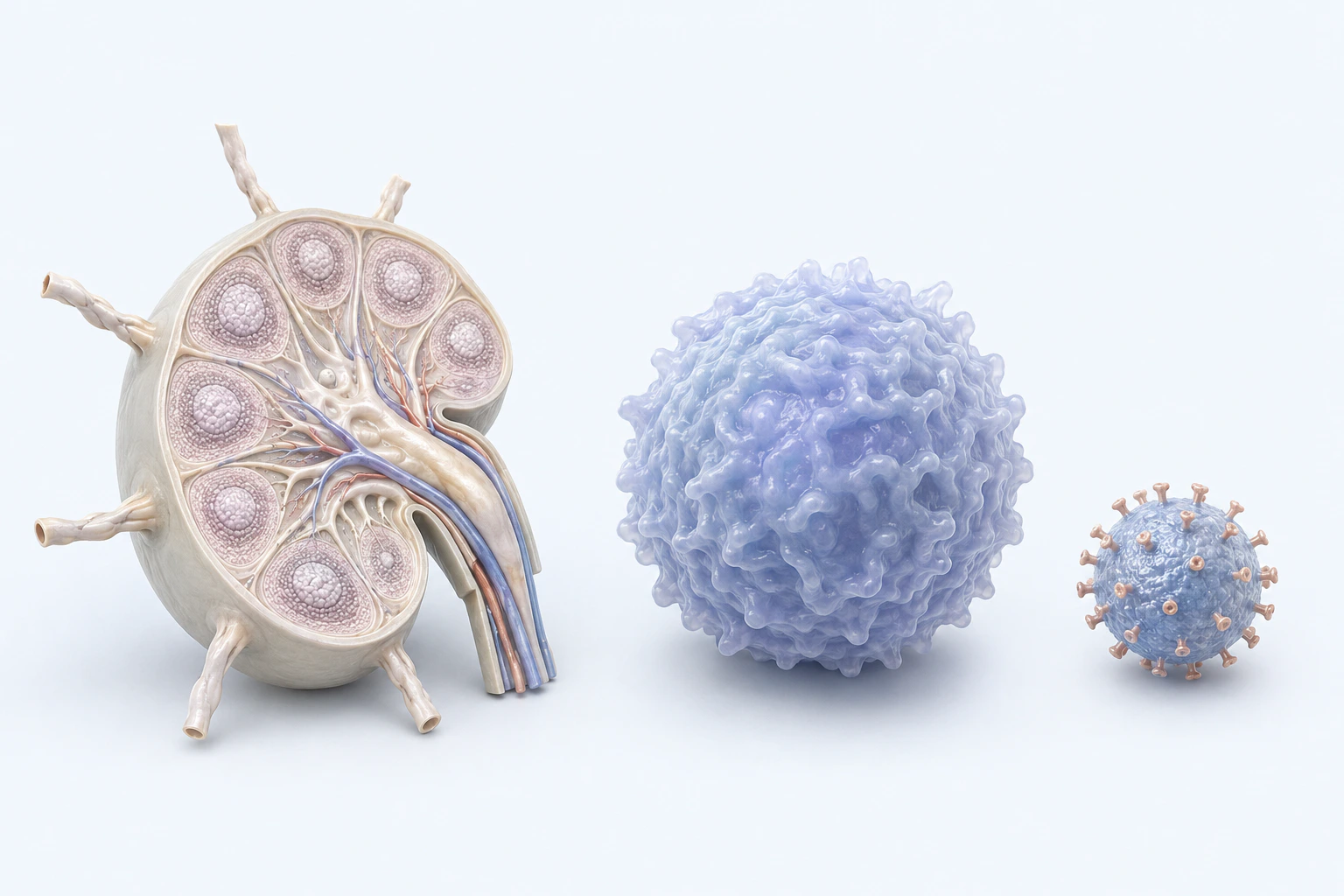
Non-stigmatizing immune-system orientation for HIV. Appearance does not establish exact virion ultrastructure, immune-cell type, lymph-node pathology, HIV type, viral load, stage, AIDS, prognosis, or diagnosis.
Scientific media record1 verified identifier
- Subject
- HIV Infectionscondition
- Identifiers
- MeSH:D015658
- Review
- Editorial review completeIdentifiers authority-verified · Accessibility validated · · hiv|hiv-pathology-v1.webp
- Digital source
- Trained-algorithmic mediaCreated with a trained generative algorithm and reviewed by WikiBiome for subject identity, scientific framing, identifiers, provenance, and accessibility.
- Scientific basis
- HIV Infections — MeSHWhat Are HIV and AIDS?Immune System
- License
- CC BY-SA 4.0Created
HIV (Human Immunodeficiency Virus) causes progressive CD4+ T cell depletion leading to AIDS.
In the WikiBiome framework, HIV is notable for the gut-centric model of disease progression: HIV preferentially destroys gut-associated lymphoid tissue (GALT) early in infection, causing massive CD4+ depletion in the gut → barrier failure → microbial translocation → chronic immune activation—a cycle that drives disease progression and cardiometabolic comorbidities even when viral load is suppressed by ART.
Evidence map4 cited passagesInspect provenance +
dysbiosis: Depletion of Bacteroides, Lactobacillus, and SCFA producers; enrichment of Proteobacteria, Prevotella (in MSM), and pathobionts.
Microbial translocation: LPS and bacterial DNA in plasma even during successful ART—driving chronic inflammation, endotoxemia, and cardiovascular risk.
Gut-brain axis: Cannabinoid-microbiota interactions in HIV/SIV models.
Heavy metal exposure promotes candida albicans virulence in immunocompromised HIV patients.
One disease. Five evidence layers.
A generated systems view of the metals, organisms, host sequestration signals, ecological conditions, and microbial functions indexed for HIV/AIDS.
Evidence layer
Taxonomic signature
Organisms reported as enriched or depleted, with their indexed functional context kept beside the name.No structured taxa indexed yet.
No structured taxa indexed yet.
Evidence layer
Nutritional immunity
Host metal-withholding, inflammatory, antioxidant, and microbial-metabolite signals indexed in the signature.Elevated host signals
0No structured signals indexed yet.
Depleted protective signals
0No structured signals indexed yet.
Evidence layer
Ecological state
The environmental conditions that connect the organism-level observations into a system.No structured ecological features indexed yet.
Evidence layer
Virulence functions
Microbial structures, enzymes, and acquisition systems implicated by the linked evidence.No structured virulence functions indexed yet.
The disease record, in full.
The original WikiBiome disease narrative remains intact beneath the generated signature atlas.
Gut Microbiome in HIV#
Dysbiosis: Depletion of Bacteroides, Lactobacillus, and SCFA producers; enrichment of Proteobacteria, Prevotella (in MSM), and pathobionts.[1]Troseid 2024 — Gut Microbiome and Cardiometabolic Comorbidities in People Living with HIVMarius Trøseid, Susanne Dam Nielsen, Ivan Vujkovic-Cvijin · 2024Open reference 1 ↓
Microbial translocation: LPS and bacterial DNA in plasma even during successful ART—driving chronic Metal-Driven Inflammation, Endotoxemia, and cardiovascular risk.[1]Troseid 2024 — Gut Microbiome and Cardiometabolic Comorbidities in People Living with HIVMarius Trøseid, Susanne Dam Nielsen, Ivan Vujkovic-Cvijin · 2024Open reference 1 ↓
Cardiometabolic: HIV-associated gut dysbiosis and microbial translocation drive atherosclerosis, metabolic syndrome, and CVD—the leading cause of death in ART-treated HIV. Gut-brain axis: Cannabinoid-microbiota interactions in HIV/SIV models.[2]Cannabinoids modulate the microbiota-gut-brain axis in HIV/SIV infection by reducing neuroinflammation and dysbiosis while concurrently elevating endocannabinoid and indole-3-propionate levelsMarina McDew-White, Eunhee Lee, Lakmini S. Premadasa et al. · 2023Open reference 2 ↓
Metal Connection#
Heavy metal exposure promotes Candida albicans virulence in immunocompromised HIV patients.[3]Effect of Heavy Metal Ions on Candida Isolated from HIV Positive PatientsMonal M. Kukde, Silpi Basak, Deepak P. Selkar · 2019Open reference 3 ↓ HIV-associated immune depletion impairs Nutritional Immunity (Metal Sequestration), reducing the host's ability to restrict metals from pathogens.
Cross-References#
- Endotoxemia—microbial translocation driving chronic activation
- Candida albicans—opportunistic infection in immunocompromised
- Cardiovascular Disease—leading cause of death in ART-treated HIV
- Tuberculosis—major HIV co-infection
- Gut-Brain Axis—HIV-associated neurocognitive disorders
References 5
Numbered by first appearance in the article, then reconciled with its declared source list.
- 1
Marius Trøseid, Susanne Dam Nielsen, Ivan Vujkovic-Cvijin (2024). Troseid 2024 — Gut Microbiome and Cardiometabolic Comorbidities in People Living with HIV. Microbiome.
- 2
Marina McDew-White, Eunhee Lee, Lakmini S. Premadasa et al. (2023). Cannabinoids modulate the microbiota-gut-brain axis in HIV/SIV infection by reducing neuroinflammation and dysbiosis while concurrently elevating endocannabinoid and indole-3-propionate levels. Journal of Neuroinflammation.
- 3
Monal M. Kukde, Silpi Basak, Deepak P. Selkar (2019). Effect of Heavy Metal Ions on Candida Isolated from HIV Positive Patients. Journal of Clinical and Diagnostic Research.
- 4
Yan Guo, Yunhua Dong, Runzi Zheng et al. (2024). Guo 2024 — Correlation Between Viral Infections in Male Semen and Infertility: A Literature Review. Virology Journal.
- 5
Chrobak AA, Nowakowski J, Dudek D (2016). Interactions between the Gut Microbiome and the Central Nervous System and Their Role in Schizophrenia, Bipolar Disorder and Depression. Archives of Psychiatry and Psychotherapy.
Article network
Connect the evidence
Publicly readable discussion by ORCID-authenticated researchers. Questions, interpretation, methods, corrections, and new evidence stay attached to this record.
No discussion yet. Start with a precise question or a source-backed observation.
Published page changes
This record shows only material changes published on this page, including changes to its content, evidence, conclusions, or author context. Internal processes and discussion activity are excluded. Pending, declined, and withdrawn proposals remain private.
- published revision
Revised “Gut Microbiome in HIV”: now reads “- dysbiosis: Depletion of Bacteroides, Lactobacillus, and SCFA”.
Revised “Gut Microbiome in HIV”: changed “- Dysbiosis: Depletion of Bacteroides, Lactobacillus, and SCFA” to “- dysbiosis: Depletion of Bacteroides, Lactobacillus, and SCFA”. · Karen Pendergrass · +1 −1
Inspect exact Git diff ↗ - published revision
Created “HIV/AIDS”: HIV (Human Immunodeficiency Virus) causes progressive CD4+ T cell depletion leading to AIDS. In the WikiBiome framework, HIV is notable for the gut-centric model of disease progression: HIV…
Created “HIV/AIDS”: HIV (Human Immunodeficiency Virus) causes progressive CD4+ T cell depletion leading to AIDS. In the WikiBiome framework, HIV is notable for the gut-centric model of disease progression: HIV… Published sections: HIV/AIDS; Gut Microbiome in HIV; Metal Connection; Cross-References. · WikiBiome Deploy Bot · +46 −0
Inspect exact Git diff ↗