
 metals · microbes · host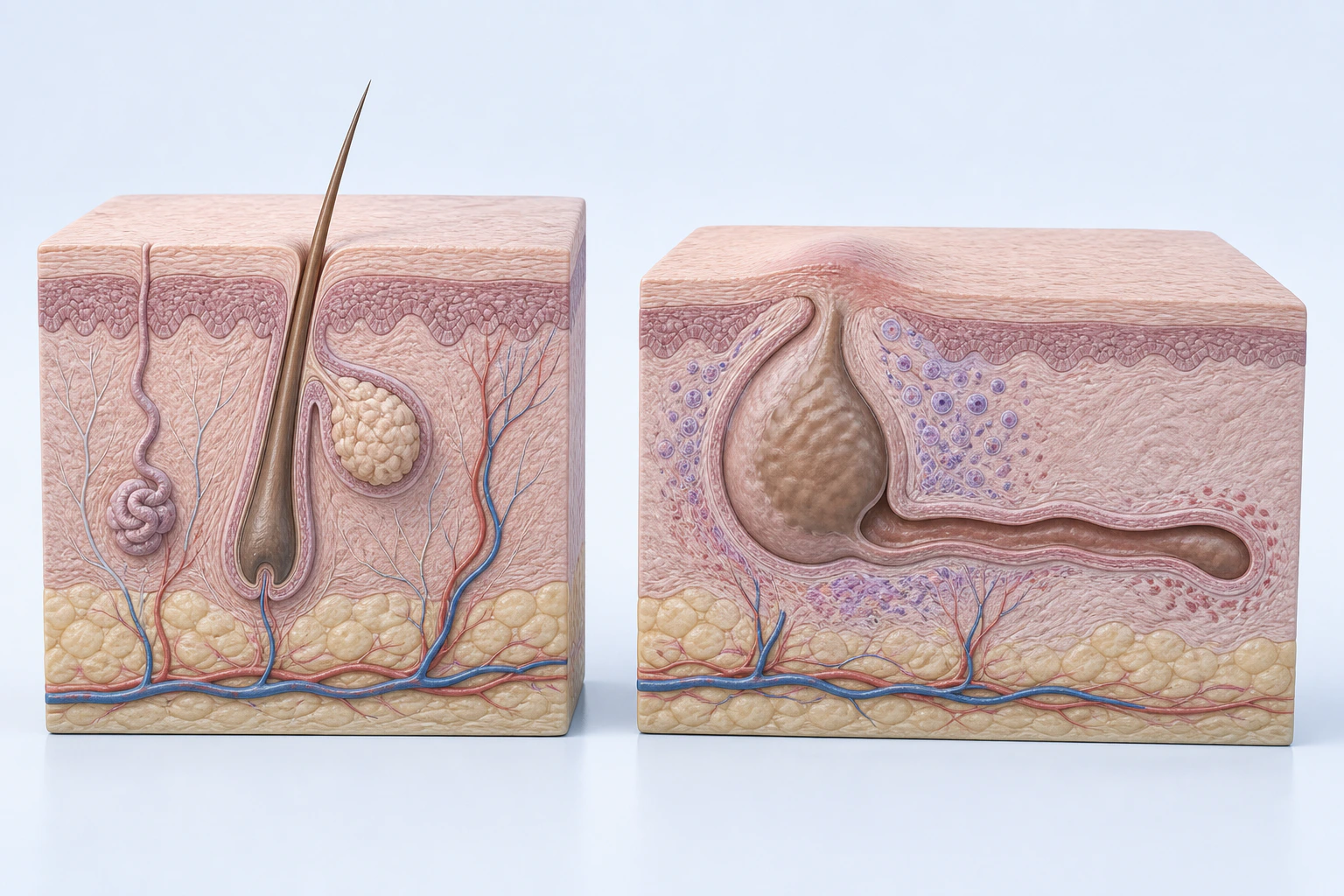
Representative follicular and tunnel architecture for hidradenitis suppurativa. The schematic does not show literal abscess contents and does not establish stage, severity, activity, treatment response, or diagnosis.
Scientific media record1 verified identifier
- Subject
- Hidradenitis Suppurativacondition
- Identifiers
- MeSH:D017497
- Review
- Editorial review completeIdentifiers authority-verified · Accessibility validated · · hidradenitis-suppurativa|hidradenitis-suppurativa-pathology-v1.webp
- Digital source
- Trained-algorithmic mediaCreated with a trained generative algorithm and reviewed by WikiBiome for subject identity, scientific framing, identifiers, provenance, and accessibility.
- Scientific basis
- Hidradenitis Suppurativa — MeSHHidradenitis Suppurativa (HS)
- License
- CC BY-SA 4.0Created
Hidradenitis suppurativa (HS) is a chronic, relapsing inflammatory skin disease characterized by painful nodules, abscesses, and sinus tracts in apocrine gland-bearing skin (axillae, groin, inframammary folds).
Long classified as a purely dermatological condition, emerging evidence reveals HS as a systemic inflammatory disorder with a significant gut microbiome component—connecting it to the broader gut-skin axis framework.
Evidence map5 cited passagesInspect provenance +
Clostridium innocuum group—OR 2.17 (P = 0.00038); the strongest causal signal
lachnospira—OR 2.45 (P = 0.017); a paradoxical risk association for an SCFA-producing genus, suggesting that the mechanism may involve SCFA-mediated alteration of cutaneous immune responses rather than simple inflammation
Remarkably, 40% of HS patients harbor a gut microbiota configuration similar to Crohn's disease, characterized by enrichment of pathogenic genera and depletion of beneficial genera including faecalibacterium prausnitzii. This overlap is consistent with clinical observations that HS and CD frequently co-occur and share TNF-alpha-driven pathology.
—Two-sample MR identifying causal gut taxa (cross-sectional/MR design)
—40% HS-CD gut microbiome overlap
One disease. Five evidence layers.
A generated systems view of the metals, organisms, host sequestration signals, ecological conditions, and microbial functions indexed for Hidradenitis Suppurativa.
Evidence layer
Taxonomic signature
Organisms reported as enriched or depleted, with their indexed functional context kept beside the name.No structured taxa indexed yet.
No structured taxa indexed yet.
Evidence layer
Nutritional immunity
Host metal-withholding, inflammatory, antioxidant, and microbial-metabolite signals indexed in the signature.Elevated host signals
0No structured signals indexed yet.
Depleted protective signals
0No structured signals indexed yet.
Evidence layer
Ecological state
The environmental conditions that connect the organism-level observations into a system.No structured ecological features indexed yet.
Evidence layer
Virulence functions
Microbial structures, enzymes, and acquisition systems implicated by the linked evidence.No structured virulence functions indexed yet.
The disease record, in full.
The original WikiBiome disease narrative remains intact beneath the generated signature atlas.
Microbiome Associations#
Gut Microbiome#
Mendelian randomization analysis has identified two gut taxa with causal risk effects on HS. Clostridium innocuum group—OR 2.17 (P = 0.00038); the strongest causal signal.[1]Causal Relationship Between Gut Microbiota and Hidradenitis Suppurativa: A Two-Sample Mendelian Randomization StudyLiu C, Liu X, Li X · 2024Open reference 1 ↓
Lachnospira—OR 2.45 (P = 0.017); a paradoxical risk association for an SCFA-producing genus, suggesting that the mechanism may involve SCFA-mediated alteration of cutaneous immune responses rather than simple inflammation.[1]Causal Relationship Between Gut Microbiota and Hidradenitis Suppurativa: A Two-Sample Mendelian Randomization StudyLiu C, Liu X, Li X · 2024Open reference 1 ↓
Remarkably, 40% of HS patients harbor a gut microbiota configuration similar to Crohn's disease, characterized by enrichment of pathogenic genera and depletion of beneficial genera including Faecalibacterium prausnitzii.[2]Comparative Diet-Gut Microbiome Analysis in Crohn's Disease and Hidradenitis SuppurativaCronin P, McCarthy S, Hurley C et al. · 2023Open reference 2 ↓
This overlap is consistent with clinical observations that HS and CD frequently co-occur and share TNF-alpha-driven pathology.
Skin Microbiome#
The HS lesional skin microbiome shows enrichment of anaerobic and biofilm-forming organisms in sinus tracts, including Prevotella, Porphyromonas, and coagulase-negative staphylococci. The tunneling nature of HS sinus tracts creates anaerobic microenvironments that may select for specific pathobiont communities—paralleling the oxygen-dependent ecological dynamics seen in gut dysbiosis.
Metal Associations#
Direct metal studies in HS are limited. However, the strong overlap with Crohn's disease microbiome patterns and shared TNF-alpha-driven inflammation suggest that metal-microbiome dynamics relevant to CD—including iron-siderophore competition and zinc-dependent metalloprotease activity—may operate in HS as well.
Nickel allergy, which is highly prevalent in inflammatory skin conditions, has not been systematically studied in HS but represents a plausible connection given nickel's role in immune sensitization.
Associated Conditions#
- Crohn's Disease—40% gut microbiota overlap; shared TNF-alpha pathology; clinical co-occurrence well-documented. Both conditions respond to anti-TNF therapy (adalimumab is approved for both).
Environmental Factors#
Diet—Western diet patterns (high-fat, low-fiber) are associated with HS severity, consistent with the gut-microbiome-mediated mechanism. Smoking—Strong independent risk factor; may influence both skin and gut microbiome composition. Obesity—Mechanical and inflammatory contributor; shared metabolic endotoxemia pathway.
Key Studies#
- [1]Causal Relationship Between Gut Microbiota and Hidradenitis Suppurativa: A Two-Sample Mendelian Randomization StudyLiu C, Liu X, Li X · 2024Open reference 1 ↓—Two-sample MR identifying causal gut taxa (cross-sectional/MR design)
- [2]Comparative Diet-Gut Microbiome Analysis in Crohn's Disease and Hidradenitis SuppurativaCronin P, McCarthy S, Hurley C et al. · 2023Open reference 2 ↓—40% HS-CD gut microbiome overlap
Open Questions#
Unresolved questions identified by the current evidence record.
01Does the Lachnospira risk association operate through SCFA-mediated cutaneous immune modulation, or through a different mechanism?+
The current WikiBiome record identifies this as an unresolved evidence gap.
02Would dietary interventions targeting the gut microbiome (fiber supplementation, Mediterranean diet) improve HS outcomes?+
The current WikiBiome record identifies this as an unresolved evidence gap.
03Are the shared CD-HS microbiome features a cause or consequence of shared genetic susceptibility at TNF pathway loci?+
The current WikiBiome record identifies this as an unresolved evidence gap.
Cross-References#
- Crohn's Disease—shared gut microbiome configuration and TNF-alpha pathology
- Lachnospira—causal risk factor via MR analysis
- Faecalibacterium prausnitzii—depleted in HS gut microbiome (CD-like pattern)
- barrier-dysfunction—gut permeability as route for systemic inflammation affecting skin
References 2
Numbered by first appearance in the article, then reconciled with its declared source list.
- 1
Liu C, Liu X, Li X (2024). Causal Relationship Between Gut Microbiota and Hidradenitis Suppurativa: A Two-Sample Mendelian Randomization Study. Frontiers in Microbiology.
- 2
Cronin P, McCarthy S, Hurley C et al. (2023). Comparative Diet-Gut Microbiome Analysis in Crohn's Disease and Hidradenitis Suppurativa. Frontiers in Microbiology.
Article network
Mentioned here 4
Pages linking here 1
Connect the evidence
Publicly readable discussion by ORCID-authenticated researchers. Questions, interpretation, methods, corrections, and new evidence stay attached to this record.
No discussion yet. Start with a precise question or a source-backed observation.
Published page changes
This record shows only material changes published on this page, including changes to its content, evidence, conclusions, or author context. Internal processes and discussion activity are excluded. Pending, declined, and withdrawn proposals remain private.
- published revision
Created “Hidradenitis Suppurativa”: Hidradenitis suppurativa (HS) is a chronic, relapsing inflammatory skin disease characterized by painful nodules, abscesses, and sinus tracts in apocrine gland-bearing skin (axillae, groin,…
Created “Hidradenitis Suppurativa”: Hidradenitis suppurativa (HS) is a chronic, relapsing inflammatory skin disease characterized by painful nodules, abscesses, and sinus tracts in apocrine gland-bearing skin (axillae, groin,… Published sections: Overview; Gut Microbiome; Skin Microbiome; Metal Associations; Associated Conditions; Environmental Factors; Key Studies; Open Questions; Cross-References. · WikiBiome Deploy Bot · +90 −0
Inspect exact Git diff ↗