

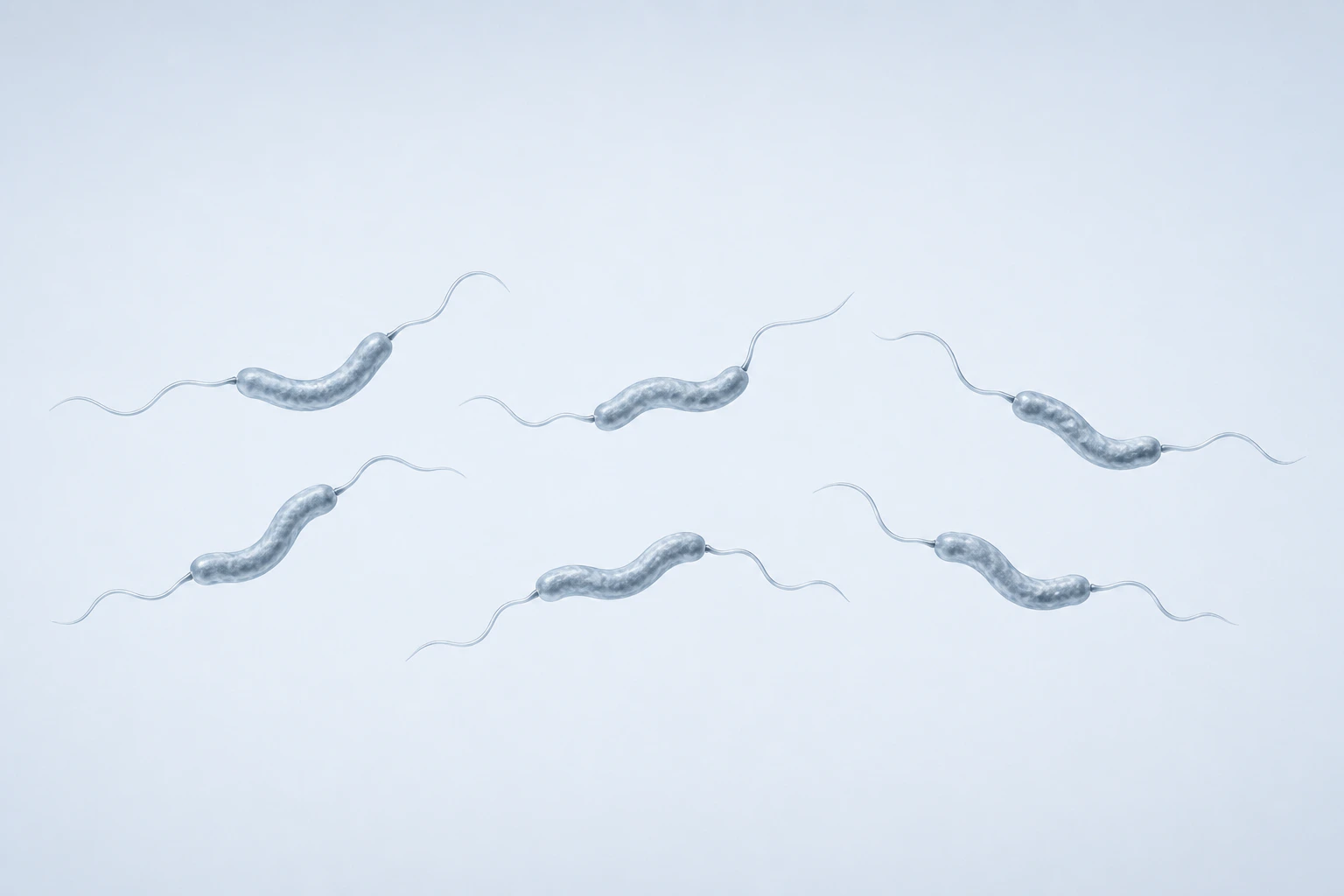
Representative curved-to-slightly-spiral Helicobacter hepaticus bodies with source-supported single sheathed flagella at both poles. This static scientific reconstruction is non-diagnostic, is explicitly not a generic H. pylori portrait, and is not a micrograph.
Scientific media record1 verified identifier
- Subject
- Helicobacter hepaticustaxon · species
- Identifiers
- NCBITaxon:32025
- Review
- Editorial review completeIdentifiers authority-verified · Accessibility validated · · helicobacter-hepaticus|helicobacter-hepaticus-morphology-v1.webp
- Digital source
- Trained-algorithmic mediaCreated with a trained generative algorithm and reviewed by WikiBiome for subject identity, scientific framing, identifiers, provenance, and accessibility.
- Scientific basis
- Helicobacter hepaticus — NCBI TaxonomyHelicobacter hepaticus — LPSNHelicobacter hepaticus sp. nov.Helicobacter hepaticus genome and morphologyHelicobacter hepaticus
- License
- CC BY-SA 4.0Created
A Gram-negative, microaerophilic bacterium within the Epsilonproteobacteria (family Helicobacteraceae) that is the primary murine model of hepatobiliary and intestinal disease.
Unlike its more famous relative Helicobacter pylori, which colonizes the stomach, H. hepaticus targets the liver and lower intestinal tract, causing chronic hepatitis, hepatocellular carcinoma, and colitis in susceptible mouse strains.
Its relevance to WikiBiome lies in its nickel-dependent Hydrogenase—a metalloenzyme that powers amino acid uptake and cell growth in the hepatobiliary niche.
Evidence map5 cited passagesInspect provenance +
H. hepaticus possesses a functional [NiFe] hydrogenase that oxidizes molecular H2 to generate energy. Unlike H. pylori, which uses hydrogenase primarily for colonization density in the stomach, H. hepaticus hydrogenase supports amino acid uptake and cell growth in the hepatobiliary environment.
[NiFe] Hydrogenase: The central metabolic engine. Provides energy from molecular H2 to support amino acid uptake, enabling colonization of the nutrient-limited hepatobiliary niche.
Dietary zinc imbalance affects H. hepaticus abundance in the gut. In a murine model, H. hepaticus was enriched in the low-zinc diet group, suggesting that zinc deficiency creates conditions favorable to this pathogen. This aligns with the broader principle that metal imbalance selects for metal-tolerant or metal-dependent pathobionts.
(review)—Established the nickel-hydrogenase-virulence link across Helicobacter species, including H. hepaticus's dependence on hydrogenase for amino acid uptake and cell growth.
(animal model)—Showed zinc-diet-dependent enrichment of H. hepaticus in the murine gut.
Contents
1. Taxonomy2. Metal Dependencies3. Key Enzymes and Virulence Factors4. Ecological Role5. Conditions Associated6. Interkingdom Relationships7. Key Studies8. Cross-ReferencesTaxonomy#
Helicobacter hepaticus—type strain ATCC 51449; first isolated from livers of mice with chronic hepatitis (Fox et al. , 1994). Family Helicobacteraceae, order Campylobacterales, class Epsilonproteobacteria.
Closely related to Helicobacter pylori, but lacks Urease—a striking divergence given urease's central role in H. pylori gastric colonization.
Metal Dependencies#
Nickel. H. hepaticus possesses a functional [NiFe] hydrogenase that oxidizes molecular H2 to generate energy.[1]Role of Nickel in Microbial PathogenesisRobert J. Maier, Stéphane L. Benoit · 2019Open reference 1 ↓ Unlike H. pylori, which uses hydrogenase primarily for colonization density in the stomach, H. hepaticus hydrogenase supports amino acid uptake and cell growth in the hepatobiliary environment.
Hydrogenase activity is critical for full virulence: mutants lacking hydrogenase show reduced colonization and attenuated liver lesions in mice. The nickel requirement creates a potential Achilles' heel—restricting nickel availability could limit hydrogenase activity and reduce pathogenic capacity.
Iron. Like other Helicobacter species, H. hepaticus requires iron for electron transport chain components and Oxidative Stress defense.
The hepatobiliary niche is relatively iron-rich compared to the gastric environment, which may partly explain why H. hepaticus does not require urease (no need to buffer acid for survival) but does rely heavily on iron-dependent metabolism.
Key Enzymes and Virulence Factors#
[NiFe] Hydrogenase: The central metabolic engine. Provides energy from molecular H2 to support amino acid uptake, enabling colonization of the nutrient-limited hepatobiliary niche.[1]Role of Nickel in Microbial PathogenesisRobert J. Maier, Stéphane L. Benoit · 2019Open reference 1 ↓
Cytolethal distending toxin (CDT): A genotoxin that induces DNA double-strand breaks in host cells. CDT is the primary virulence factor driving hepatocellular carcinoma in chronically infected mice.
Absence of urease: A key distinction from H. pylori. H. hepaticus does not colonize the acidic stomach and does not require urease-mediated acid neutralization.
Ecological Role#
In the Healthy Gut#
H. hepaticus is not part of the normal human microbiota. It is a natural colonizer of the murine intestine and liver, where it exists as a commensal in immunocompetent wild-type mice of certain strains.
In Disease Models#
In immunocompromised or genetically susceptible mice (IL-10 knockout, Rag2 knockout), H. hepaticus triggers. Chronic active hepatitis progressing to hepatocellular carcinoma. Typhlocolitis resembling human inflammatory bowel disease.
Colorectal cancer in AOM/DSS models where H. hepaticus accelerates tumorigenesis.
Zinc-Diet Connection#
Dietary zinc imbalance affects H. hepaticus abundance in the gut. In a murine model, H. hepaticus was enriched in the low-zinc diet group, suggesting that zinc deficiency creates conditions favorable to this pathogen.[2]Chen 2021 — Effect of Long-Term and Short-Term Imbalanced Zn Manipulation on Gut Microbiota and Screening for Microbial Markers Sensitive to Zinc StatusLingjun Chen, Zhonghang Wang, Peng Wang et al. · 2021Open reference 2 ↓
This aligns with the broader principle that metal imbalance selects for metal-tolerant or metal-dependent pathobionts.
Conditions Associated#
Hepatitis and hepatocellular carcinoma (murine)—the defining disease association; chronic infection drives the Metal-Driven Inflammation-cancer cascade via CDT-mediated genotoxicity.
Inflammatory bowel disease (murine model)—H. hepaticus-induced colitis in IL-10 knockout mice is one of the most widely used IBD models in research.
Colorectal cancer (murine model)—accelerates tumorigenesis in chemically initiated models.
Interkingdom Relationships#
H. hepaticus relies on H2 produced by fermentative bacteria in the gut—a form of syntrophic cross-feeding where the metabolic waste of anaerobic fermenters becomes the energy source for hydrogenase-equipped pathogens.
This positions H. hepaticus within the same ecological framework as Helicobacter pylori: both exploit the H2 economy of the Gut Microbiome, but in different anatomical niches.
Key Studies#
[1]Role of Nickel in Microbial PathogenesisRobert J. Maier, Stéphane L. Benoit · 2019Open reference 1 ↓ (review)—Established the nickel-hydrogenase-virulence link across Helicobacter species, including H. hepaticus's dependence on hydrogenase for amino acid uptake and cell growth.
[2]Chen 2021 — Effect of Long-Term and Short-Term Imbalanced Zn Manipulation on Gut Microbiota and Screening for Microbial Markers Sensitive to Zinc StatusLingjun Chen, Zhonghang Wang, Peng Wang et al. · 2021Open reference 2 ↓ (animal model)—Showed zinc-diet-dependent enrichment of H. hepaticus in the murine gut.
Cross-References#
- Helicobacter pylori—closest relative; contrasting metalloenzyme strategy (urease + hydrogenase vs. hydrogenase alone)
- Nickel—essential cofactor for the hydrogenase powering H. hepaticus virulence
- Hydrogenase—the NiFe metalloenzyme enabling H2-dependent energy generation
- Metal-Dependent Virulence—H. hepaticus as a case study in nickel-powered pathogenesis
- Zinc—dietary zinc imbalance affects H. hepaticus abundance
- Colorectal Cancer—H. hepaticus accelerates tumorigenesis in murine models
References 9
Numbered by first appearance in the article, then reconciled with its declared source list.
- 1
★Robert J. Maier, Stéphane L. Benoit (2019). Role of Nickel in Microbial Pathogenesis. Inorganics.
- 2
Lingjun Chen, Zhonghang Wang, Peng Wang et al. (2021). Chen 2021 — Effect of Long-Term and Short-Term Imbalanced Zn Manipulation on Gut Microbiota and Screening for Microbial Markers Sensitive to Zinc Status. Microbiology Spectrum.
- 3
Benoit, S.L., Bhatt et al. (2021). Benoit & Maier 2021 — Nickel Chelator Inhibits Amyloid-Beta Aggregation. Scientific Reports.
- 4
Zirun Jin, Yuzhuo Yang, Yalei Cao et al. (2023). Jin 2023 — Gut Metabolite 3-HPAA Rejuvenates Spermatogenic Dysfunction in Aged Mice through GPX4-Mediated Ferroptosis. Microbiome.
- 5
Riley A McFarlane, Jana N Radin, Rafat Mazgaj et al. (2025). McFarlane 2025 — A Manganese-Sparing Response Balances Competing Cellular Demands to Enable Staphylococcus aureus Infection. mBio.
- 6
Docimo G, Cangiano A, Romano RM et al. (2020). Docimo et al. 2020 — The Human Microbiota in Endocrinology: Implications for Pathophysiology, Treatment, and Prognosis in Thyroid Diseases. Frontiers in Endocrinology.
- 7
Benoit SL, Bhatt RJ, Maier RJ (2021). The nickel-chelator dimethylglyoxime inhibits human amyloid beta peptide in vitro aggregation. Scientific Reports.
- 8
Antonelli A, Ferrari SM, Ragusa F et al. (2023). Graves' disease: Epidemiology, genetic and environmental risk factors and viruses. Best Practice & Research Clinical Endocrinology & Metabolism.
- 9
Swierc J, Drzymala S, Wozniak D et al. (2022). The influence of nickel on intestinal microbiota disturbances. Pomeranian Journal of Life Sciences.
Article network
Connect the evidence
Publicly readable discussion by ORCID-authenticated researchers. Questions, interpretation, methods, corrections, and new evidence stay attached to this record.
No discussion yet. Start with a precise question or a source-backed observation.
Activity and accepted changes
Accepted researcher context, editorial status, public discussion, and upstream Git revisions are shown together. Pending, declined, and withdrawn proposals remain private.
- published revision
Backfill oxidative stress concept links
Karen Pendergrass · +1 −1
Inspect exact Git diff ↗ - published revision
Backfill gut microbiome concept links
Karen Pendergrass · +1 −1
Inspect exact Git diff ↗ - published revision
Backfill inflammation concept links
Karen Pendergrass · +1 −1
Inspect exact Git diff ↗ - published revision
Complete Hydrogenase contextual coverage
Karen Pendergrass · +2 −2
Inspect exact Git diff ↗ - published revision
Complete reviewed Urease contextual coverage
Karen Pendergrass · +1 −1
Inspect exact Git diff ↗ - published revision
massive wiki expansion: 149 stubs fixed, 100+ new pages, Rule 15 scan, keystone papers
WikiBiome Deploy Bot · +27 −21
Inspect exact Git diff ↗ - published revision
nightly maintenance: 94 stub demotions, 181 source_count fixes, 22 auto-discovered stubs, 5 adversarial audits, 3 boundary fixes, 3 evidence-level corrections
WikiBiome Deploy Bot · +2 −0
Inspect exact Git diff ↗ - published revision
pre-overnight checkpoint 2026-04-18
WikiBiome Deploy Bot · +89 −0
Inspect exact Git diff ↗