
 metals · microbes · host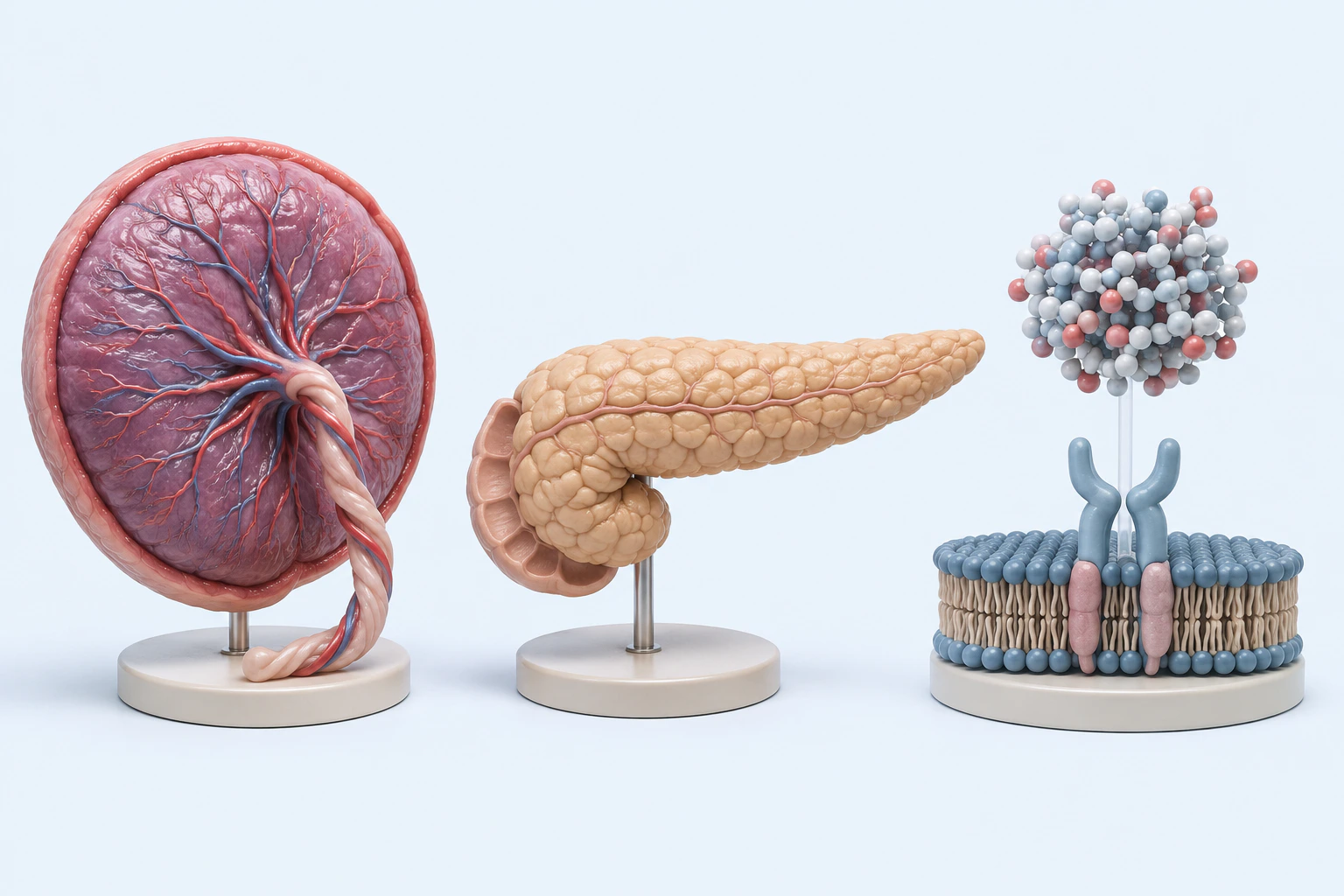
Representative anatomic and molecular orientation for gestational diabetes. The unlabeled abstraction does not identify a molecule, receptor, biomarker, single mechanism, severity, outcome, or diagnosis.
Scientific media record1 verified identifier
- Subject
- Diabetes, Gestationalcondition
- Identifiers
- MeSH:D016640
- Review
- Editorial review completeIdentifiers authority-verified · Accessibility validated · · gestational-diabetes|gestational-diabetes-pathology-v1.webp
- Digital source
- Trained-algorithmic mediaCreated with a trained generative algorithm and reviewed by WikiBiome for subject identity, scientific framing, identifiers, provenance, and accessibility.
- License
- CC BY-SA 4.0Created
Gestational diabetes mellitus (GDM) is a condition of glucose intolerance first recognized during pregnancy, affecting approximately 14% of pregnancies worldwide. It carries risks for both mother and offspring, including increased likelihood of developing type 2 diabetes postpartum.
Evidence map5 cited passagesInspect provenance +
Emerging research indicates significant gut microbiome alterations in GDM, including both bacterial and fungal dysbiosis (, ). Microbiome-derived metabolites may contribute to insulin resistance mechanisms ().
—Fungal dysbiosis in pregnancy
—Bacterial and fungal microbiota in GDM
—16S rRNA gut microbiota analysis
Enrichment of bacteroides and depletion of faecalibacterium prausnitzii observed across multiple studies (, ). Fungal dysbiosis—particularly shifts in Candida and Saccharomyces—is a distinctive feature ().
One disease. Five evidence layers.
A generated systems view of the metals, organisms, host sequestration signals, ecological conditions, and microbial functions indexed for Gestational Diabetes Mellitus.
Evidence layer
Taxonomic signature
Organisms reported as enriched or depleted, with their indexed functional context kept beside the name.Altered carbohydrate metabolism, bile acid modulation
Lost SCFA production, reduced anti-inflammatory capacity
Evidence layer
Nutritional immunity
Host metal-withholding, inflammatory, antioxidant, and microbial-metabolite signals indexed in the signature.Elevated host signals
2Depleted protective signals
1Evidence layer
Ecological state
The environmental conditions that connect the organism-level observations into a system.Evidence layer
Virulence functions
Microbial structures, enzymes, and acquisition systems implicated by the linked evidence.The disease record, in full.
The original WikiBiome disease narrative remains intact beneath the generated signature atlas.
Microbiome Associations#
Emerging research indicates significant Gut Microbiome alterations in GDM, including both bacterial and fungal Dysbiosis ([1]Fungal Dysbiosis 2023 — Gut Fungal Communities in Gestational DiabetesVarious · 2023Open reference 1 ↓[2]Wang 2026 — Intestinal Fungal Dysbiosis in Gestational Diabetes Mellitus Associated with Adverse Pregnancy OutcomesWenxin Wang, Sha Lu, Yuanqing Fu et al. · 2026Open reference 2 ↓). Microbiome-derived metabolites may contribute to insulin resistance mechanisms ([3]Susarla 2024 — Microbiome-Derived Metabolites in Early to Mid-Pregnancy and Risk of Gestational DiabetesSita Manasa Susarla, Oliver Fiehn, Ines Thiele et al. · 2024Open reference 3 ↓).
Associated Conditions#
GDM shares microbial and metabolic patterns with Type 2 Diabetes, Polycystic Ovary Syndrome, and Obesity. Women with GDM have significantly elevated risk of developing type 2 diabetes later in life.
Key Studies#
- [1]Fungal Dysbiosis 2023 — Gut Fungal Communities in Gestational DiabetesVarious · 2023Open reference 1 ↓—Fungal dysbiosis in pregnancy
- [4]Vavreckova 2022 — Specific Gut Bacterial and Fungal Microbiota Pattern in the First Half of Pregnancy Is Linked to GDM DevelopmentMarketa Vavreckova, Natalie Galanova, Martin Kostovick et al. · 2022Open reference 4 ↓—Bacterial and fungal microbiota in GDM
- [5]Wei 2022 — 16S rRNA Gene Amplicon Sequencing of Gut Microbiota in Gestational Diabetes MellitusJ. Wei, Y. Qing, H. Zhou et al. · 2022Open reference 5 ↓—16S rRNA gut microbiota analysis
Open Questions#
Unresolved questions identified by the current evidence record.
01What specific metal dysregulation patterns characterize GDM distinct from T2D?+
The current WikiBiome record identifies this as an unresolved evidence gap.
02Does gestational fungal dysbiosis persist postpartum and influence T2D conversion?+
The current WikiBiome record identifies this as an unresolved evidence gap.
03Can microbiome-targeted interventions during pregnancy prevent GDM onset?+
The current WikiBiome record identifies this as an unresolved evidence gap.
Cross-References#
References 11
Numbered by first appearance in the article, then reconciled with its declared source list.
- 1
Various (2023). Fungal Dysbiosis 2023 — Gut Fungal Communities in Gestational Diabetes. Scientific Reports.
- 2
Wenxin Wang, Sha Lu, Yuanqing Fu et al. (2026). Wang 2026 — Intestinal Fungal Dysbiosis in Gestational Diabetes Mellitus Associated with Adverse Pregnancy Outcomes. BMC Pregnancy and Childbirth.
- 3
Sita Manasa Susarla, Oliver Fiehn, Ines Thiele et al. (2024). Susarla 2024 — Microbiome-Derived Metabolites in Early to Mid-Pregnancy and Risk of Gestational Diabetes. BMC Medicine.
- 4
Marketa Vavreckova, Natalie Galanova, Martin Kostovick et al. (2022). Vavreckova 2022 — Specific Gut Bacterial and Fungal Microbiota Pattern in the First Half of Pregnancy Is Linked to GDM Development. Frontiers in Endocrinology.
- 5
J. Wei, Y. Qing, H. Zhou et al. (2022). Wei 2022 — 16S rRNA Gene Amplicon Sequencing of Gut Microbiota in Gestational Diabetes Mellitus. Journal of Endocrinological Investigation.
- 6
Marie-Louise H. Rasmussen, Gry J. Poulsen, Poul Videbech et al. (2023). Rasmussen 2023 — Endocrine Disease History and the Risk of Postpartum Depression. The British Journal of Psychiatry.
- 7
Ding R, Ruan Y, He X et al. (2021). Pregnancy complications effect on the nickel content in maternal blood, placenta blood and umbilical cord blood during pregnancy. World J Clin Cases.
- 8
Various (2026). Fungal Dysbiosis 2026 — Pregnancy and Gestational Diabetes Reference. BMC Pregnancy and Childbirth.
- 9
Chloe Love, Luba Sominsky, Martin O'Hely et al. (2024). Love 2024 -- Prenatal Environmental Risk Factors for Autism Spectrum Disorder and Their Potential Mechanisms. BMC Medicine.
- 10
Guifeng Xu, Jin Jing, Katherine Bowers et al. (2014). Xu 2014 — Maternal Diabetes and the Risk of Autism Spectrum Disorders in the Offspring: A Systematic Review and Meta-Analysis. Journal of Autism and Developmental Disorders.
- 11
Queenie Li Ling Jun (2025). Li 2025 — Gestational Diabetes Linked to Elevated Risk of Cognitive Decline in Mothers, ADHD and Autism in Children. NUS Medicine Press Release / European Association for the Study of Diabetes (EASD).
Article network
Connect the evidence
Publicly readable discussion by ORCID-authenticated researchers. Questions, interpretation, methods, corrections, and new evidence stay attached to this record.
No discussion yet. Start with a precise question or a source-backed observation.
Activity and accepted changes
Accepted researcher context, editorial status, public discussion, and upstream Git revisions are shown together. Pending, declined, and withdrawn proposals remain private.
- published revision
Backfill gut microbiome concept links
Karen Pendergrass · +1 −1
Inspect exact Git diff ↗ - published revision
Complete corpus-wide Dysbiosis linking
Karen Pendergrass · +1 −1
Inspect exact Git diff ↗ - published revision
massive wiki expansion: 149 stubs fixed, 100+ new pages, Rule 15 scan, keystone papers
WikiBiome Deploy Bot · +9 −8
Inspect exact Git diff ↗ - published revision
cycle 1: health check + lint fixes + 8 ingests + 2 stubs + gestational-diabetes signature
WikiBiome Deploy Bot · +65 −0
Inspect exact Git diff ↗