

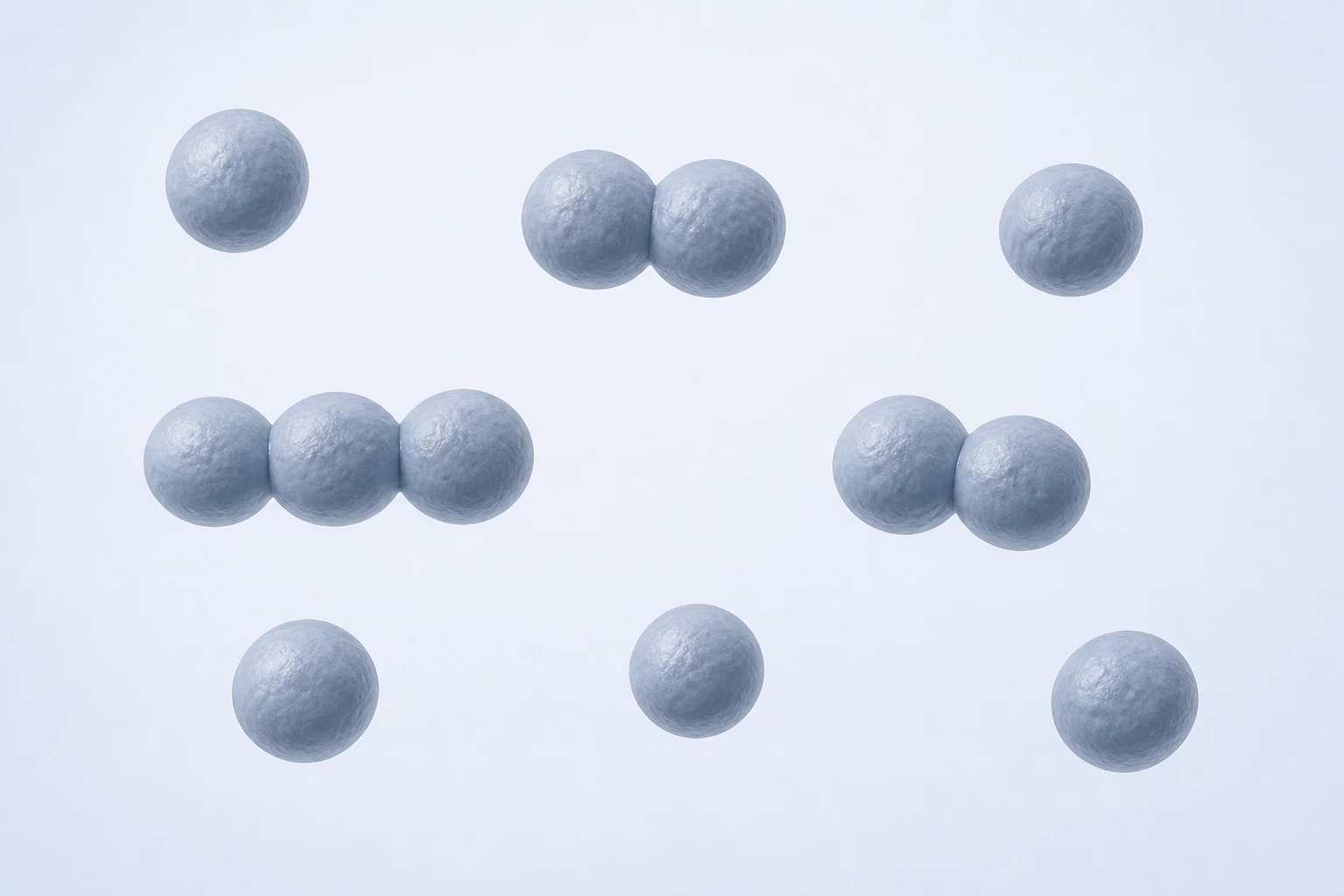
Selected type-species-anchored Finegoldia coccoid forms, shown as twelve bodies in five single, two paired, and one short-chain grouping. This genus-level scientific reconstruction is representative, non-diagnostic, and not a micrograph.
Scientific media record1 verified identifier
- Subject
- Finegoldiataxon · genus
- Identifiers
- NCBITaxon:150022
- Review
- Editorial review completeIdentifiers authority-verified · Accessibility validated · · finegoldia|finegoldia-morphology-v1.webp
- Digital source
- Trained-algorithmic mediaCreated with a trained generative algorithm and reviewed by WikiBiome for subject identity, scientific framing, identifiers, provenance, and accessibility.
- Scientific basis
- Finegoldia — NCBI TaxonomyFinegoldia — LPSNReclassification of Peptostreptococcus magnus as Finegoldia magnaFinegoldia magna type strain — BacDiveFinegoldia magna review
- License
- CC BY-SA 4.0Created
Finegoldia is a genus of Gram-positive, strictly anaerobic cocci, with Finegoldia magna as the primary species of clinical relevance. Formerly classified within Peptostreptococcus, this organism inhabits mucosal surfaces including the vaginal, skin, and gastrointestinal microbiomes.
Evidence map2 cited passagesInspect provenance +
Finegoldia is a recognized component of both the vaginal and seminal microbiomes. In endometriosis, it appears as part of the altered vaginal microbial community, potentially contributing to local inflammatory cascades (). It has also been identified in male reproductive tract microbiome profiling, where its presence correlates with compositional shifts asso
Maternal gut Finegoldia abundance has been associated with postpartum depression (PPD) and infant neurodevelopmental outcomes, positioning this genus within the gut-brain axis during the perinatal period ().
Reproductive Tract Associations#
Finegoldia is a recognized component of both the vaginal and seminal microbiomes. In endometriosis, it appears as part of the altered vaginal microbial community, potentially contributing to local inflammatory cascades ([1]Ser 2023 — Current Updates on the Role of Microbiome in Endometriosis: A Narrative ReviewHooi-Leng Ser, Siu-Jung Au Yong, Mohamad Nasir Shafiee et al. · 2023Open reference 1 ↓).
It has also been identified in male reproductive tract microbiome profiling, where its presence correlates with compositional shifts associated with subfertility ([2]Molina Morales 2023 — The Microbiome of the Male Reproductive Tract: Uncovering Its Composition and OriginsNerea Molina Morales · 2023Open reference 2 ↓).
Gut-Brain Axis Associations#
Maternal gut Finegoldia abundance has been associated with postpartum depression (PPD) and infant neurodevelopmental outcomes, positioning this genus within the gut-brain axis during the perinatal period ([3]Zhou 2024 — Association of Maternal Postpartum Depression Symptoms with Infant Neurodevelopment and Gut MicrobiotaLepeng Zhou, Linghong Tang, Chuhui Zhou et al. · 2024Open reference 3 ↓).
Cross-References#
- Endometriosis—vaginal microbiome associations
- Postpartum Depression—maternal Gut Microbiome and PPD
- Semen Microbiome—male reproductive tract presence
- Peptostreptococcus—former taxonomic classification
References 3
Numbered by first appearance in the article, then reconciled with its declared source list.
- 1
Hooi-Leng Ser, Siu-Jung Au Yong, Mohamad Nasir Shafiee et al. (2023). Ser 2023 — Current Updates on the Role of Microbiome in Endometriosis: A Narrative Review. Microorganisms.
- 2
Nerea Molina Morales (2023). Molina Morales 2023 — The Microbiome of the Male Reproductive Tract: Uncovering Its Composition and Origins. Doctoral Thesis, Universidad de Granada.
- 3
Lepeng Zhou, Linghong Tang, Chuhui Zhou et al. (2024). Zhou 2024 — Association of Maternal Postpartum Depression Symptoms with Infant Neurodevelopment and Gut Microbiota. Frontiers in Psychiatry.
Article network
Connect the evidence
Publicly readable discussion by ORCID-authenticated researchers. Questions, interpretation, methods, corrections, and new evidence stay attached to this record.
No discussion yet. Start with a precise question or a source-backed observation.
Activity and accepted changes
Accepted researcher context, editorial status, public discussion, and upstream Git revisions are shown together. Pending, declined, and withdrawn proposals remain private.
- published revision
Backfill gut microbiome concept links
Karen Pendergrass · +1 −1
Inspect exact Git diff ↗ - published revision
massive wiki expansion: 149 stubs fixed, 100+ new pages, Rule 15 scan, keystone papers
WikiBiome Deploy Bot · +43 −0
Inspect exact Git diff ↗