

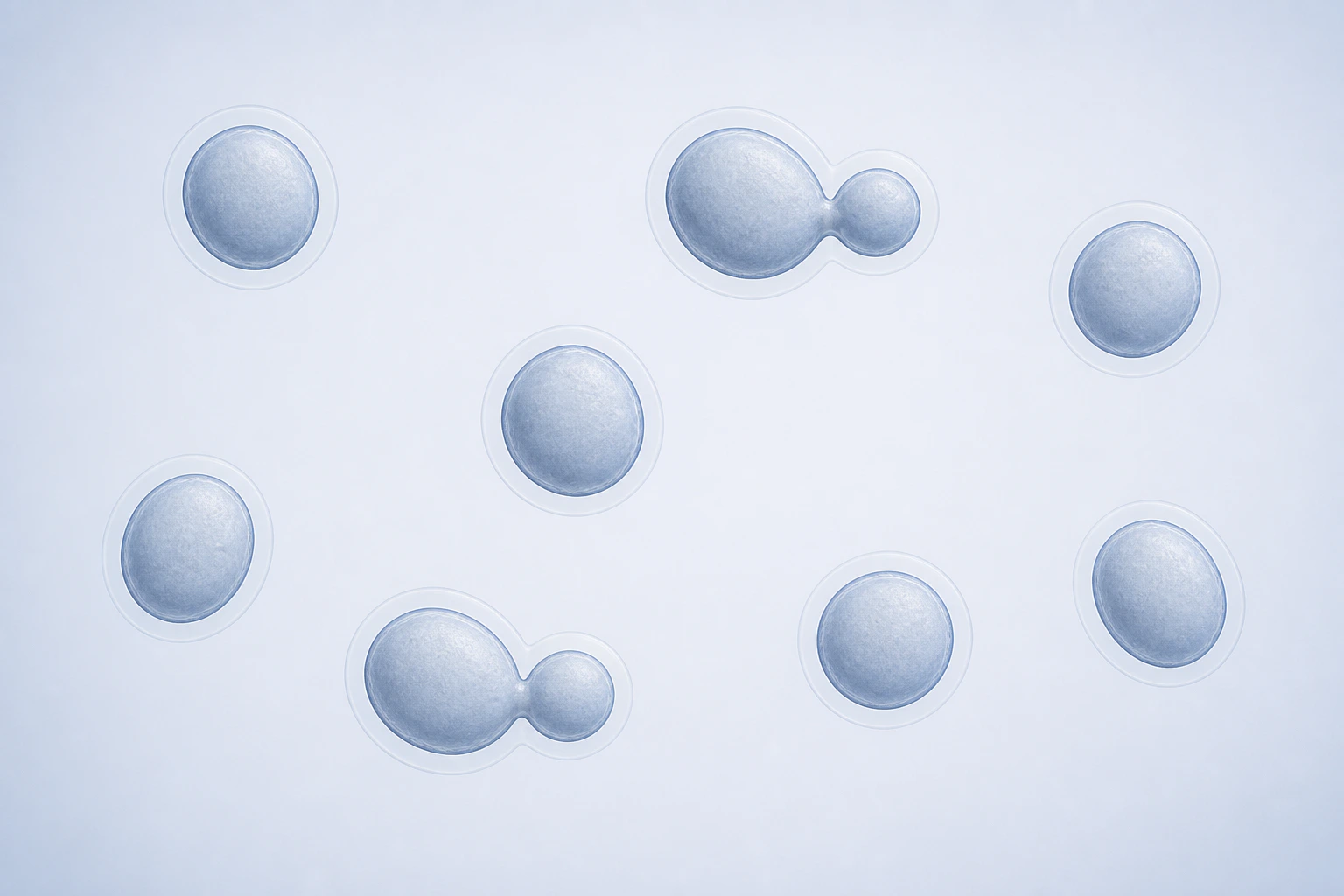
Representative Cryptococcus neoformans encapsulated round-to-ovoid yeast with two narrow-based budding pairs; the transparent halo forms a continuous lobed contour around each attached mother-bud pair. This is a non-diagnostic scientific reconstruction, not a micrograph.
Scientific media record2 verified identifiers
- Subject
- Cryptococcus neoformanstaxon · species
- Identifiers
- NCBITaxon:5207Index Fungorum:119294
- Review
- Editorial review completeIdentifiers authority-verified · Accessibility validated · · cryptococcus-neoformans|cryptococcus-neoformans-morphology-v1.webp
- Digital source
- Trained-algorithmic mediaCreated with a trained generative algorithm and reviewed by WikiBiome for subject identity, scientific framing, identifiers, provenance, and accessibility.
- Scientific basis
- Cryptococcus neoformans — NCBI TaxonomyCryptococcus neoformans — Index FungorumCryptococcus neoformans cellular morphologyCryptococcus neoformans capsule microscopyCryptococcus capsule structural review
- License
- CC BY-SA 4.0Created
An encapsulated basidiomycete yeast that causes cryptococcal meningitis—the leading cause of meningitis in HIV/AIDS patients and responsible for an estimated 180,000 deaths annually. Its Nickel-dependent Urease has been called the organism's "Achilles' heel" because it is essential for the critical step of brain invasion.
Evidence map2 cited passagesInspect provenance +
C. neoformans Ni-urease is essential for crossing the blood-brain barrier (BBB) and establishing CNS infection.
Urease may also contribute to the "Trojan horse" mechanism, where C. neoformans within macrophages crosses the BBB via transcytosis.
Contents
1. Nickel-Dependent Virulence2. Other Metal Dependencies3. Clinical Significance4. The Urease-as-Achilles'-Heel Concept5. ConnectionsNickel-Dependent Virulence#
Ni-Urease—The Brain Invasion Enzyme#
C. neoformans nickel (Ni)-urease is essential for crossing the blood-brain barrier (BBB) and establishing CNS infection.[1]Role of Nickel in Microbial PathogenesisRobert J. Maier, Stéphane L. Benoit · 2019Open reference 1 ↓
Urease-negative mutants show dramatically reduced brain colonization in animal models while retaining virulence in the lungs—demonstrating that urease is specifically required for neurotropism, not general virulence.
Three proposed mechanisms for urease-mediated brain invasion. Microvascular sequestration: urease activity promotes trapping of yeast cells in brain capillary microvasculature, creating a staging area for BBB penetration. Phagolysosomal pH modulation: Ammonia generated by urease alkalinizes the phagosome, promoting intracellular survival in brain-resident macrophages and microglia.
Endothelial tight junction disruption: ammonia damages BBB endothelial tight junctions, paralleling Helicobacter pylori urease disruption of gastric epithelial tight junctions.
Urease may also contribute to the "Trojan horse" mechanism, where C. neoformans within macrophages crosses the BBB via transcytosis.[2]Infection metallomics for critical care in the post-COVID eraPatil RH, Luptakova D, Havlicek V · 2021Open reference 2 ↓
Environmental Nickel and the Saprophytic Reservoir#
C. neoformans natural habitat is soil and pigeon droppings—environments where urea is abundant (from avian uric acid metabolism) and nickel is environmentally available.
In this saprophytic niche, urease provides a nitrogen source and competitive advantage. Environmental nickel supports urease metalation in the reservoir, pre-arming the organism with active urease before human infection occurs.
Other Metal Dependencies#
Iron#
Iron acquisition is essential for C. neoformans growth in the iron-poor host environment. Uses reductive iron uptake (Cft1/Cfo1) and siderophore piracy (does not synthesize its own siderophores). Iron availability in the CNS is tightly restricted; the pathogen's ability to scavenge iron within the brain determines disease progression.
Copper#
Laccase is a copper-dependent phenol oxidase that produces melanin, a major virulence factor. Melanin protects against oxidative killing in macrophage phagosomes and reduces antifungal drug efficacy. Copper acquisition via the Ctr1/Ctr4 system is essential for laccase activity and virulence.
Clinical Significance#
Cryptococcal meningitis: subacute onset with headache, fever, altered mental status. Without treatment, uniformly fatal. Even with amphotericin B + flucytosine, mortality is 10-30% in well-resourced settings, exceeding 70% in sub-Saharan Africa.
HIV/AIDS: the primary risk factor. Usually occurs at CD4 counts <100 cells/uL. Accounts for 15% of all AIDS-related deaths globally.
Other immunocompromised hosts: transplant recipients, chronic corticosteroid users, patients with hepatic cirrhosis. Pulmonary cryptococcosis: initial infection site; may remain asymptomatic or cause pneumonia.
C. gattii: a related species that can infect immunocompetent individuals and also depends on nickel (Ni)-urease.
The Urease-as-Achilles'-Heel Concept#
C. neoformans illustrates why nickel (Ni)-urease is a particularly attractive therapeutic target. Urease is dispensable for lung infection but essential for brain invasion—meaning anti-urease therapy could prevent the lethal meningitic form of disease.
Nickel restriction (dietary or pharmacological chelation) could theoretically disarm the brain invasion machinery without affecting the host, since mammals do not use nickel-dependent enzymes.
The environmental reservoir (pigeon droppings) provides a clear ecological context for why this organism evolved nickel dependency.
Connections#
- Urease—nickel (Ni)-urease essential for BBB crossing and brain colonization
- Nickel—cofactor for urease; environmentally available in the saprophytic reservoir
- Copper—cofactor for laccase/melanin; virulence factor for oxidative defense
- Iron—essential for CNS growth; acquired via reductive uptake
- Metal-Dependent Virulence—urease as the key nickel-virulence factor for neurotropism
- Nutritional Immunity (Metal Sequestration)—host iron and nickel restriction in the CNS
- Helicobacter pylori—parallel urease-mediated tight junction disruption
- Candida albicans—fellow fungal pathogen with distinct metal biology
- Inter-Kingdom Metal Shielding—environmental pigeon dropping niche as metal source
References 3
Numbered by first appearance in the article, then reconciled with its declared source list.
- 1
★Robert J. Maier, Stéphane L. Benoit (2019). Role of Nickel in Microbial Pathogenesis. Inorganics.
- 2
★Patil RH, Luptakova D, Havlicek V (2021). Infection metallomics for critical care in the post-COVID era. Mass Spectrometry Reviews.
- 3
Agnieszka Krawczyk, Tomasz Kasperski, Tomasz Gosiewski et al. (2025). Krawczyk 2025 — Effects of Fecal Microbiota Transplantation on the Abundance and Diversity of Selected Fungal and Archaeal Species in the Gut Microbiota in the Rat Model of Schizophrenia. Pharmacological Reports.
Article network
Connect the evidence
Publicly readable discussion by ORCID-authenticated researchers. Questions, interpretation, methods, corrections, and new evidence stay attached to this record.
No discussion yet. Start with a precise question or a source-backed observation.
Activity and accepted changes
Accepted researcher context, editorial status, public discussion, and upstream Git revisions are shown together. Pending, declined, and withdrawn proposals remain private.
- published revision
Complete Ammonia contextual coverage
Karen Pendergrass · +1 −1
Inspect exact Git diff ↗ - published revision
Complete Tight junctions contextual coverage
Karen Pendergrass · +1 −1
Inspect exact Git diff ↗ - published revision
massive wiki expansion: 149 stubs fixed, 100+ new pages, Rule 15 scan, keystone papers
WikiBiome Deploy Bot · +20 −19
Inspect exact Git diff ↗ - published revision
nightly maintenance: 94 stub demotions, 181 source_count fixes, 22 auto-discovered stubs, 5 adversarial audits, 3 boundary fixes, 3 evidence-level corrections
WikiBiome Deploy Bot · +3 −0
Inspect exact Git diff ↗ - published revision
WikiBiome update — 2026-04-15 17:23
WikiBiome Deploy Bot · +3 −3
Inspect exact Git diff ↗ - published revision
wiki: bulk entity upgrades, new article pages, and site regeneration
WikiBiome Deploy Bot · +6 −0
Inspect exact Git diff ↗ - published revision
WikiBiome update — integrity fixes, metallomic diet pages, cross-condition analyses
WikiBiome Deploy Bot · +4 −2
Inspect exact Git diff ↗ - published revision
WikiBiome v7 — interactive microbiome metallomics encyclopedia
Karen Pendergrass · +74 −0
Inspect exact Git diff ↗