

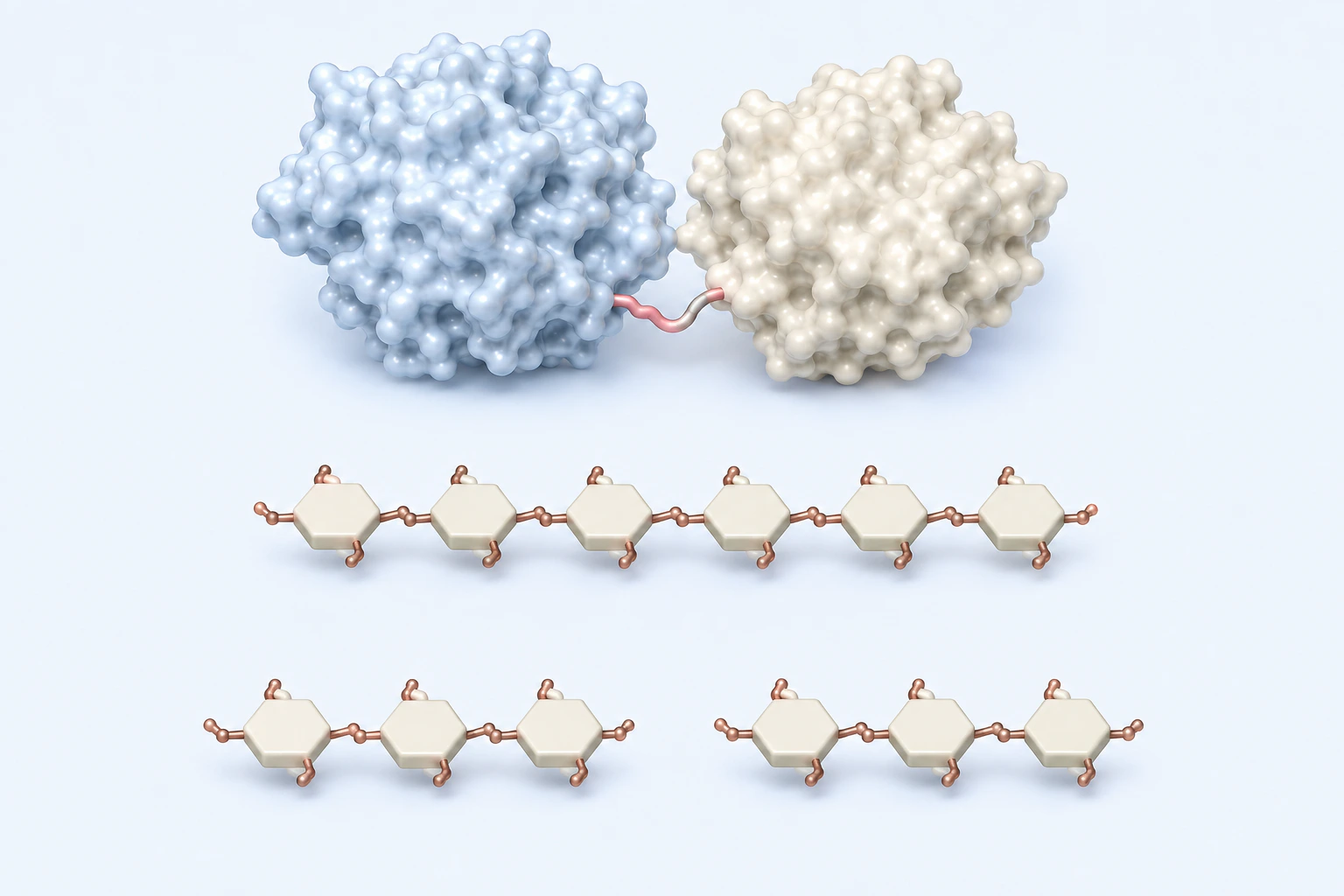
Human chitotriosidase identity and substrate context. The generic models do not establish literal structure, binding, a catalytic sequence, direct metal catalysis, an enzyme level, biomarker performance, disease status, prognosis, or treatment response.
Scientific media record3 verified identifiers
- Subject
- Chitotriosidasebiological-process
- Review
- Editorial review completeIdentifiers authority-verified · Accessibility validated · · chitotriosidase|chitotriosidase-mechanism-v1.webp
- Digital source
- Trained-algorithmic mediaCreated with a trained generative algorithm and reviewed by WikiBiome for subject identity, scientific framing, identifiers, provenance, and accessibility.
- Scientific basis
- Chitotriosidase-1 — UniProt Q13231Chitotriosidase
- License
- CC BY-SA 4.0Created
Chitotriosidase (CHIT1) is a human chitinase that degrades chitin—the structural polysaccharide of fungal cell walls, insect exoskeletons, and parasitic helminths. It is the most abundant chitinase in human serum and represents a direct arm of innate Nutritional Immunity (Metal Sequestration) against fungal pathogens.
Biological Role#
Chitotriosidase is produced primarily by activated macrophages and neutrophils. Its function is analogous to metal sequestration (Calprotectin (S100A8/A9), Lactoferrin) but targets structural polysaccharides rather than metal ions.
Fungal cell wall degradation—Hydrolyzes chitin polymers in the cell walls of Candida albicans, Aspergillus, and other fungal pathogens, compromising structural integrity and exposing intracellular targets to other immune effectors.
Macrophage activation marker—Serum chitotriosidase rises dramatically in conditions involving chronic macrophage activation: Gaucher disease (100-1,000x elevation), Atherosclerosis, and chronic inflammatory states.
Mycobiome surveillance—Acts as an innate immune checkpoint on gut Mycobiome composition. Elevated chitotriosidase reflects active anti-fungal responses that shape which fungi persist in the gut.
Metallomics Connection#
Chitotriosidase connects to the metallomics framework through several pathways. Zinc-dependent regulation—Chitinase activity is modulated by zinc availability; the enzyme's catalytic mechanism involves substrate distortion rather than direct metal catalysis, but zinc-dependent transcription factors regulate CHIT1 expression in macrophages.
Complement to calprotectin—While Calprotectin (S100A8/A9) starves pathogens of zinc and manganese, chitotriosidase physically degrades fungal architecture. Together they represent the two arms of anti-fungal nutritional immunity: metal restriction + structural attack.
Biofilm disruption—Chitin-like polymers in Biofilm matrices make chitotriosidase relevant to biofilm clearance, connecting to Primitive 6 (interkingdom relationships).
Clinical Relevance#
Gaucher disease—CHIT1 is the primary clinical biomarker; 100-1,000x serum elevation reflects glucocerebroside-laden macrophage activation.
CHIT1 null allele—A 24-bp duplication (dup24) in exon 10 causes complete enzyme deficiency in ~6% of the population and partial deficiency in ~35%. Null carriers may have altered susceptibility to fungal colonization—a potential modifier of Mycobiome composition.
CKD and dialysis—Elevated in chronic kidney disease, correlating with Metal-Driven Inflammation burden. May serve as a mycobiome-driven inflammation biomarker alongside FLC kappa. IBD—Elevated in Crohn's Disease and Ulcerative Colitis, reflecting interkingdom immune activation.
Cross-References#
- Mycobiome—Fungal community shaped by chitotriosidase activity
- Calprotectin (S100A8/A9)—Complementary innate immune effector (metal sequestration vs. structural attack)
- Nutritional Immunity (Metal Sequestration)—Broader host defense framework
- Biofilm—Chitin-like polymers in biofilm matrices
- Candida albicans—Primary target organism
References 4
Numbered by first appearance in the article, then reconciled with its declared source list.
- 1
Ane Otaegui-Chivite, Miriam Gorostidi-Aicua, Laura Martins-Almeida et al. (2025). Exploring the Mycobiota in Multiple Sclerosis: Its Influence on Disease Development and Progression. Frontiers in Immunology.
- 2
Valentina Ignatova (2023). Biomarkers in Multiple Sclerosis: Analysis of the Present Advantages and Look to the Future. Journal of Psychology and Neuroscience.
- 3
Ting Ding, Chang Liu, Zhengyu Li (2025). The mycobiome in human cancer: analytical challenges, molecular mechanisms, and therapeutic implications. Molecular Cancer.
- 4
Park CH, Seo SI, Kim JS et al. (2020). Treatment of non-erosive reflux disease and dynamics of the esophageal microbiome: a prospective multicenter study. Scientific Reports.
Article network
Connect the evidence
Publicly readable discussion by ORCID-authenticated researchers. Questions, interpretation, methods, corrections, and new evidence stay attached to this record.
No discussion yet. Start with a precise question or a source-backed observation.
Activity and accepted changes
Accepted researcher context, editorial status, public discussion, and upstream Git revisions are shown together. Pending, declined, and withdrawn proposals remain private.
- published revision
Backfill inflammation concept links
Karen Pendergrass · +1 −1
Inspect exact Git diff ↗ - published revision
massive wiki expansion: 149 stubs fixed, 100+ new pages, Rule 15 scan, keystone papers
WikiBiome Deploy Bot · +18 −16
Inspect exact Git diff ↗ - published revision
maintenance: 409 source fixes, 34 entity updates, 17 concept updates, 30 analysis outputs
WikiBiome Deploy Bot · +50 −0
Inspect exact Git diff ↗