

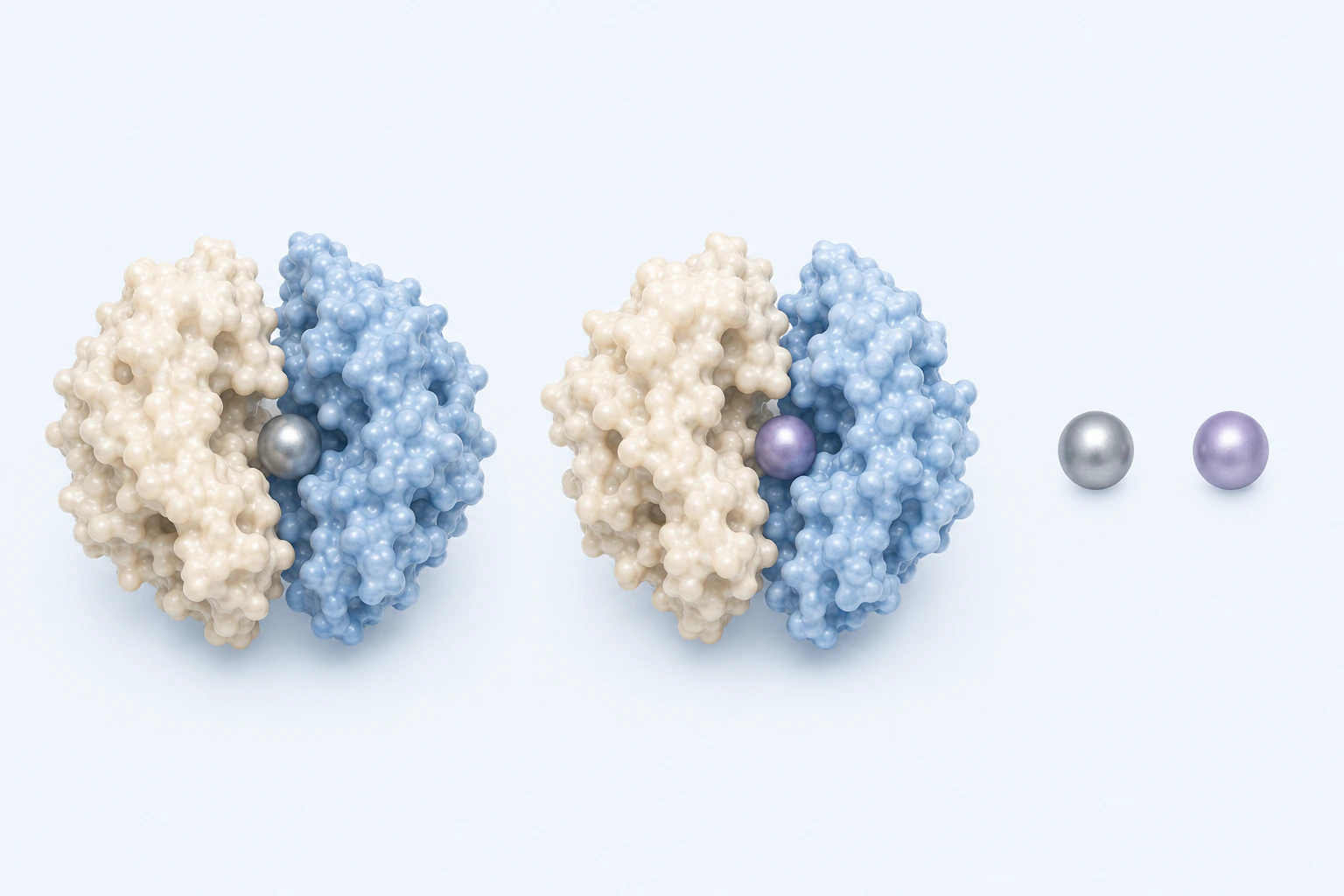
Cambialistic metalloenzyme context anchored to Fe/Mn superoxide-dismutase evidence. The generic models do not establish molecular structure, metal identity by color, exchange, preference, activity, species, mechanism, or treatment relevance.
Scientific media record3 verified identifiers
- Subject
- Cambialistic Enzymesbiological-process
- Review
- Editorial review completeIdentifiers authority-verified · Accessibility validated · · cambialistic-enzymes|cambialistic-enzymes-mechanism-v1.webp
- Digital source
- Trained-algorithmic mediaCreated with a trained generative algorithm and reviewed by WikiBiome for subject identity, scientific framing, identifiers, provenance, and accessibility.
- Scientific basis
- Characterization of ancestral Fe/Mn superoxide dismutases indicates their cambialistic originA Streptococcus mutans superoxide dismutase active with manganese or iron
- License
- CC BY-SA 4.0Created
Cambialistic enzymes are enzymes that can function with more than one metal cofactor, switching between metals depending on environmental availability.
The term derives from the Latin cambium ("exchange") and describes a remarkable adaptation: rather than being locked into a single metal dependency, these enzymes maintain catalytic activity across different metal environments.
Contents
1. The Paradigm: Superoxide Dismutase2. Ecological Advantage3. Relevance to Gut Metal Ecology4. Cross-ReferencesThe Paradigm: Superoxide Dismutase#
The best-characterized cambialistic enzymes are superoxide dismutases (SODs) found in certain bacteria. While most organisms produce either iron (Fe)-SOD or manganese (Mn)-SOD exclusively, cambialistic SODs—first described in Propionibacterium shermanii and later in Streptococcus mutans—function with either iron or manganese.
This flexibility allows the organism to maintain Oxidative Stress defense regardless of which metal the host makes available, effectively sidestepping Nutritional Immunity (Metal Sequestration).
Ecological Advantage#
Cambialistic enzymes represent a survival strategy for organisms facing fluctuating metal environments. In the gut, where Nutritional Immunity (Metal Sequestration) dynamically restricts iron, zinc, and manganese, bacteria with cambialistic enzymes can maintain virulence functions that metal-specific competitors cannot.
This connects directly to the principle that metal-dependencies are Achilles' heels—cambialistic enzymes are the evolutionary counter-move.
Relevance to Gut Metal Ecology#
Understanding cambialism has practical implications. If a pathogen's key virulence enzyme is cambialistic, restricting a single metal may not disable it—the enzyme simply switches cofactors.
Effective ecological interventions must account for this flexibility, potentially requiring simultaneous restriction of multiple metals or targeting the enzyme itself rather than its cofactor supply.
Cross-References#
- Mis-Metallation—involuntary metal substitution (contrasts with cambialistic flexibility)
- Nutritional Immunity (Metal Sequestration)—the host pressure cambialistic enzymes evade
- Manganese—alternative cofactor in manganese (Mn)/iron (Fe) switching
- Deinococcus—manganese-based antioxidant strategy
References 4
Numbered by first appearance in the article, then reconciled with its declared source list.
- 1
Riley A McFarlane, Jana N Radin, Rafat Mazgaj et al. (2025). McFarlane 2025 — A Manganese-Sparing Response Balances Competing Cellular Demands to Enable Staphylococcus aureus Infection. mBio.
- 2
★James E. Cassat, Eric P. Skaar (2012). Metal Ion Acquisition in Staphylococcus aureus: Overcoming Nutritional Immunity. Seminars in Immunopathology.
- 3
Alastair G. McEwan (2024). McEwan 2024 — Metalloproteome Plasticity: A Factor in Bacterial Pathogen Adaptive Responses?. Emerging Topics in Life Sciences.
- 4
Sanjay Kumar Rohaun, Ramakrishnan Sethu, James A Imlay (2024). Rohaun 2024 — Microbes Vary Strategically in Their Metalation of Mononuclear Enzymes. Proceedings of the National Academy of Sciences.
Article network
Mentioned here 6
Pages linking here 1
Connect the evidence
Publicly readable discussion by ORCID-authenticated researchers. Questions, interpretation, methods, corrections, and new evidence stay attached to this record.
No discussion yet. Start with a precise question or a source-backed observation.
Published page changes
This record shows only material changes published on this page, including changes to its content, evidence, conclusions, or author context. Internal processes and discussion activity are excluded. Pending, declined, and withdrawn proposals remain private.
- published revision
Added references: mcfarlane-2025-manganese-sparing-response-rsac-saureus-infection; cassat-2012-metal-acquisition-staphylococcus-aureus; mcewan-2024-metalloproteome-plasticity-pathogen-adaptation; rohaun-2024-microbes-strategic-metalation-mononuclear-enzymes.
WikiBiome Deploy Bot · +9 −7
Inspect exact Git diff ↗ - published revision
Created “Cambialistic Enzymes”: Cambialistic enzymes are enzymes that can function with more than one metal cofactor, switching between metals depending on environmental availability. The term derives from the Latin cambium…
Created “Cambialistic Enzymes”: Cambialistic enzymes are enzymes that can function with more than one metal cofactor, switching between metals depending on environmental availability. The term derives from the Latin cambium… Published sections: Overview; The Paradigm: Superoxide Dismutase; Ecological Advantage; Relevance to Gut Metal Ecology; Cross-References. · WikiBiome Deploy Bot · +44 −0
Inspect exact Git diff ↗