

Butyrivibrio is a genus of Gram-positive, obligate anaerobic bacteria within the family Lachnospiraceae (phylum Firmicutes). Originally characterized as a dominant fiber-fermenting genus in the rumen, Butyrivibrio species are also found in the human colon where they contribute to Butyrate production through fermentation of complex plant polysaccharides including xylan and cellulose.
As a butyrate producer, Butyrivibrio supports colonic epithelial integrity and anti-inflammatory signaling. Its depletion has been documented across several disease states. In endometriosis, stool microbial profiling identified reduced Butyrivibrio abundance as part of a broader loss of short-chain fatty acid producers (,[1]Hicks et al. 2025 — Oral, Vaginal, and Stool Microbial Signatures in Patients With Endometriosis as Potential Diagnostic Non-Invasive BiomarkersChloe Hicks, Mathew Leonardi, Xin-Yi Chua et al. · 2025Open reference 1 ↓ cross-sectional).
Mendelian randomization analyses have linked genetically predicted Butyrivibrio abundance to reduced autoimmune thyroid disease risk (,[2]Fang et al. 2024 — Gut Microbiota and Autoimmune Thyroid Disease: A Bidirectional Mendelian Randomization Study and Mediation AnalysisFang Y, Zhang X, Huang R et al. · 2024Open reference 2 ↓ Mendelian randomization).
The genus is also depleted in perimenopausal panic disorder, consistent with the pattern of butyrate-producing taxa loss in conditions involving gut-brain axis disruption (,[3]Lin 2023 — Gut Microbiota in Perimenopausal Panic DisorderShen Lin, Hongjin Wang, Jingjing Qiu et al. · 2023Open reference 3 ↓ cross-sectional).
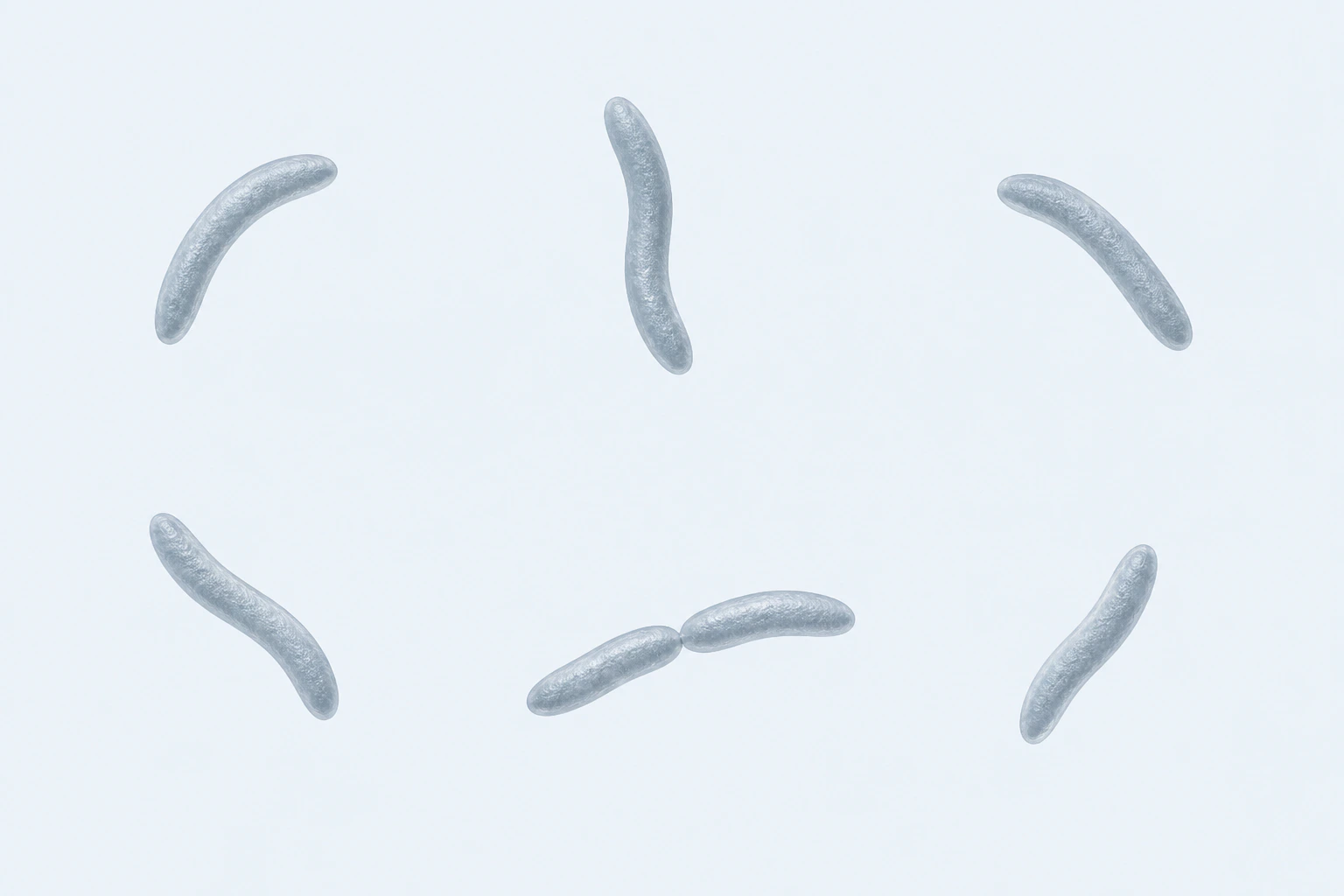
Representative Butyrivibrio curved-rod morphology, shown as seven bodies in six groupings. This reconstruction is non-diagnostic, shows no external flagella, and is not a micrograph.
Scientific media record1 verified identifier
- Subject
- Butyrivibriotaxon · genus
- Identifiers
- NCBITaxon:830
- Review
- Editorial review completeIdentifiers authority-verified · Accessibility validated · · butyrivibrio|butyrivibrio-morphology-v1.webp
- Digital source
- Trained-algorithmic mediaCreated with a trained generative algorithm and reviewed by WikiBiome for subject identity, scientific framing, identifiers, provenance, and accessibility.
- Scientific basis
- Butyrivibrio — NCBI TaxonomyButyrivibrio — LPSNButyrivibrio fibrisolvens gen. nov., sp. nov.Morphological variation in Butyrivibrio strains
- License
- CC BY-SA 4.0Created
Evidence map1 cited passagesInspect provenance +
As a butyrate producer, Butyrivibrio supports colonic epithelial integrity and anti-inflammatory signaling. Its depletion has been documented across several disease states. In endometriosis, stool microbial profiling identified reduced Butyrivibrio abundance as part of a broader loss of short-chain fatty acid producers (, cross-sectional). Mendelian randomiz
Contents
1. Cross-ReferencesCross-References#
- Lachnospiraceae—parent family
- Short-Chain Fatty Acids (SCFAs)—primary metabolic output
- Anaerostipes—co-depleted butyrate producer in multiple conditions
- Endometriosis—condition of depletion
References 3
Numbered by first appearance in the article, then reconciled with its declared source list.
- 1
Chloe Hicks, Mathew Leonardi, Xin-Yi Chua et al. (2025). Hicks et al. 2025 — Oral, Vaginal, and Stool Microbial Signatures in Patients With Endometriosis as Potential Diagnostic Non-Invasive Biomarkers. BJOG: An International Journal of Obstetrics and Gynaecology.
- 2
Fang Y, Zhang X, Huang R et al. (2024). Fang et al. 2024 — Gut Microbiota and Autoimmune Thyroid Disease: A Bidirectional Mendelian Randomization Study and Mediation Analysis. Frontiers in Microbiology.
- 3
Shen Lin, Hongjin Wang, Jingjing Qiu et al. (2023). Lin 2023 — Gut Microbiota in Perimenopausal Panic Disorder. Frontiers in Psychiatry.
Article network
Mentioned here 5
Pages linking here 1
Connect the evidence
Publicly readable discussion by ORCID-authenticated researchers. Questions, interpretation, methods, corrections, and new evidence stay attached to this record.
No discussion yet. Start with a precise question or a source-backed observation.
Activity and accepted changes
Accepted researcher context, editorial status, public discussion, and upstream Git revisions are shown together. Pending, declined, and withdrawn proposals remain private.
- published revision
massive wiki expansion: 149 stubs fixed, 100+ new pages, Rule 15 scan, keystone papers
WikiBiome Deploy Bot · +37 −0
Inspect exact Git diff ↗