

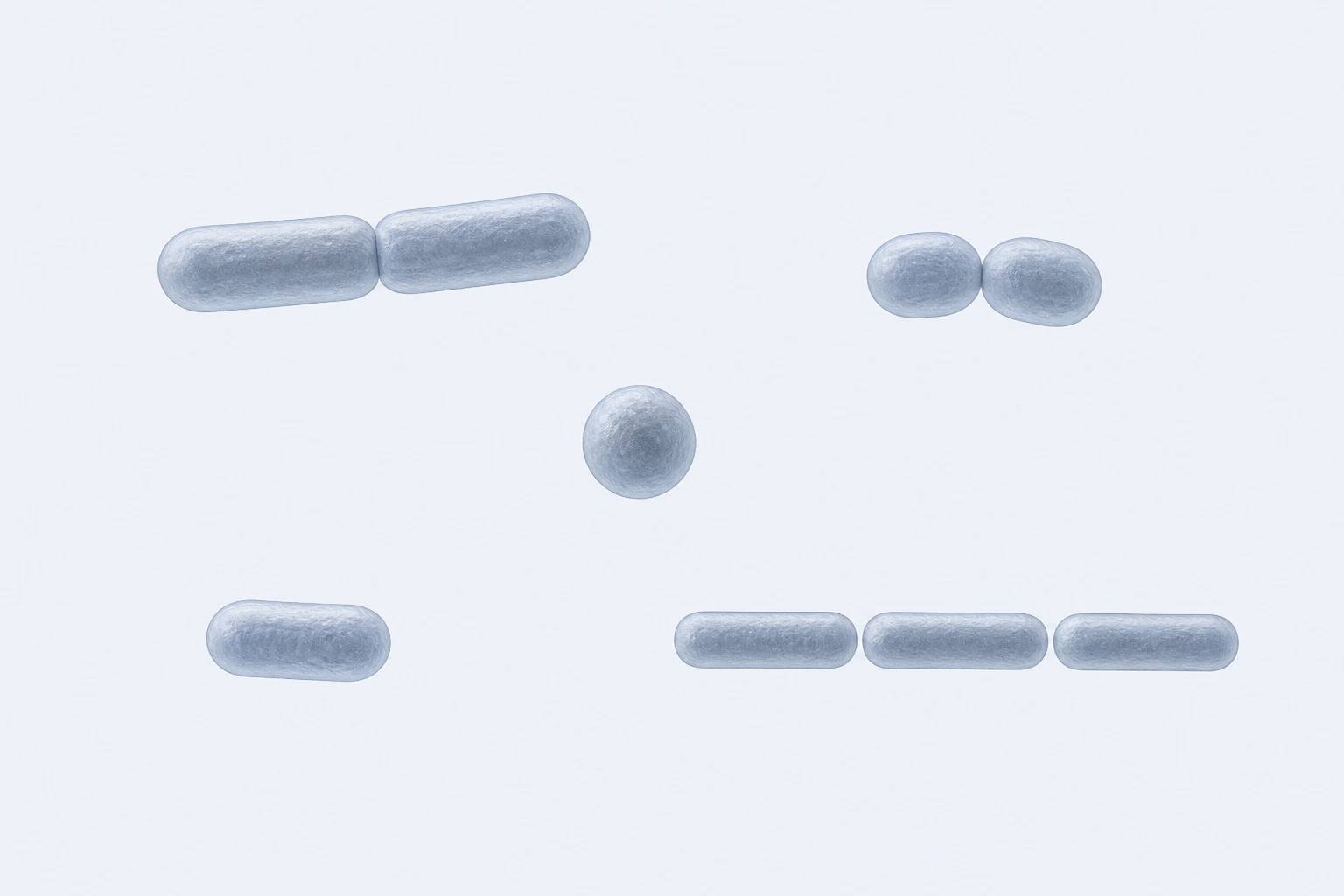
Selected cellular-form breadth within Burkholderiales, shown as nine bodies in five groupings. This order-level reconstruction is non-exhaustive, non-diagnostic, uses illustrative relative scale, and is not a micrograph.
Scientific media record1 verified identifier
- Subject
- Burkholderialestaxon · order
- Identifiers
- NCBITaxon:80840
- Review
- Editorial review completeIdentifiers authority-verified · Accessibility validated · · burkholderiales|burkholderiales-microbial-community-v1.webp
- Digital source
- Trained-algorithmic mediaCreated with a trained generative algorithm and reviewed by WikiBiome for subject identity, scientific framing, identifiers, provenance, and accessibility.
- Scientific basis
- Burkholderiales — NCBI TaxonomyBurkholderiales — LPSNBurkholderia cepacia type strain — BacDiveBordetella pertussis type strain — BacDiveLautropia mirabilis type strain — BacDiveSutterella wadsworthensis type strain — BacDive
- License
- CC BY-SA 4.0Created
Burkholderiales is an order of Gram-negative Betaproteobacteria that includes environmentally versatile genera such as Ralstonia, Burkholderia, and Sutterella. Many members are notable for their metal resistance mechanisms, which enable survival in heavy metal-contaminated environments—a property that translates to competitive advantage in metal-burdened gut ecosystems.
In murine models of endometriosis, Burkholderiales abundance shifts as part of the broader gut microbiota alterations induced by the disease ([1]Yuan 2018 — Endometriosis Induces Gut Microbiota Alterations in MiceMing Yuan, Dong Li, Zhe Zhang et al. · 2018Open reference 1 ↓).
Members of this order have also been identified in Gut Microbiome profiling of autism spectrum disorder cohorts, though their contribution to GI symptoms remains unclear ([2]Deng 2022 — Gastrointestinal Symptoms Have a Minor Impact on Autism Spectrum Disorder and Associations with Gut Microbiota and Short-Chain Fatty AcidsWenlin Deng, Siqi Wang, Fang Li et al. · 2022Open reference 2 ↓).
Evidence map1 cited passagesInspect provenance +
In murine models of endometriosis, Burkholderiales abundance shifts as part of the broader gut microbiota alterations induced by the disease (). Members of this order have also been identified in gut microbiome profiling of autism spectrum disorder cohorts, though their contribution to GI symptoms remains unclear ().
Contents
1. Cross-ReferencesCross-References#
- Ralstonia—metal-resistant genus within Burkholderiales
- Endometriosis—gut microbiota alterations
- Autism Spectrum Disorder—ASD microbiome associations
- Antimicrobial Metals—metal resistance as ecological strategy
References 4
Numbered by first appearance in the article, then reconciled with its declared source list.
- 1
Ming Yuan, Dong Li, Zhe Zhang et al. (2018). Yuan 2018 — Endometriosis Induces Gut Microbiota Alterations in Mice. Human Reproduction.
- 2
Wenlin Deng, Siqi Wang, Fang Li et al. (2022). Deng 2022 — Gastrointestinal Symptoms Have a Minor Impact on Autism Spectrum Disorder and Associations with Gut Microbiota and Short-Chain Fatty Acids. Frontiers in Microbiology.
- 3
Zhang M, Fang J, Zheng C et al. (2024). Gut Microbiota and Autoimmune Neurologic Disorders: A Two-Sample Bidirectional Mendelian Randomization Study. Frontiers in Microbiology.
- 4
Youjie Zeng, Si Cao, Heng Yang (2023). Roles of gut microbiome in epilepsy risk: a Mendelian randomization study. Frontiers in Microbiology.
Article network
Connect the evidence
Publicly readable discussion by ORCID-authenticated researchers. Questions, interpretation, methods, corrections, and new evidence stay attached to this record.
No discussion yet. Start with a precise question or a source-backed observation.
Activity and accepted changes
Accepted researcher context, editorial status, public discussion, and upstream Git revisions are shown together. Pending, declined, and withdrawn proposals remain private.
- published revision
Backfill gut microbiome concept links
Karen Pendergrass · +1 −1
Inspect exact Git diff ↗ - published revision
massive wiki expansion: 149 stubs fixed, 100+ new pages, Rule 15 scan, keystone papers
WikiBiome Deploy Bot · +38 −0
Inspect exact Git diff ↗