

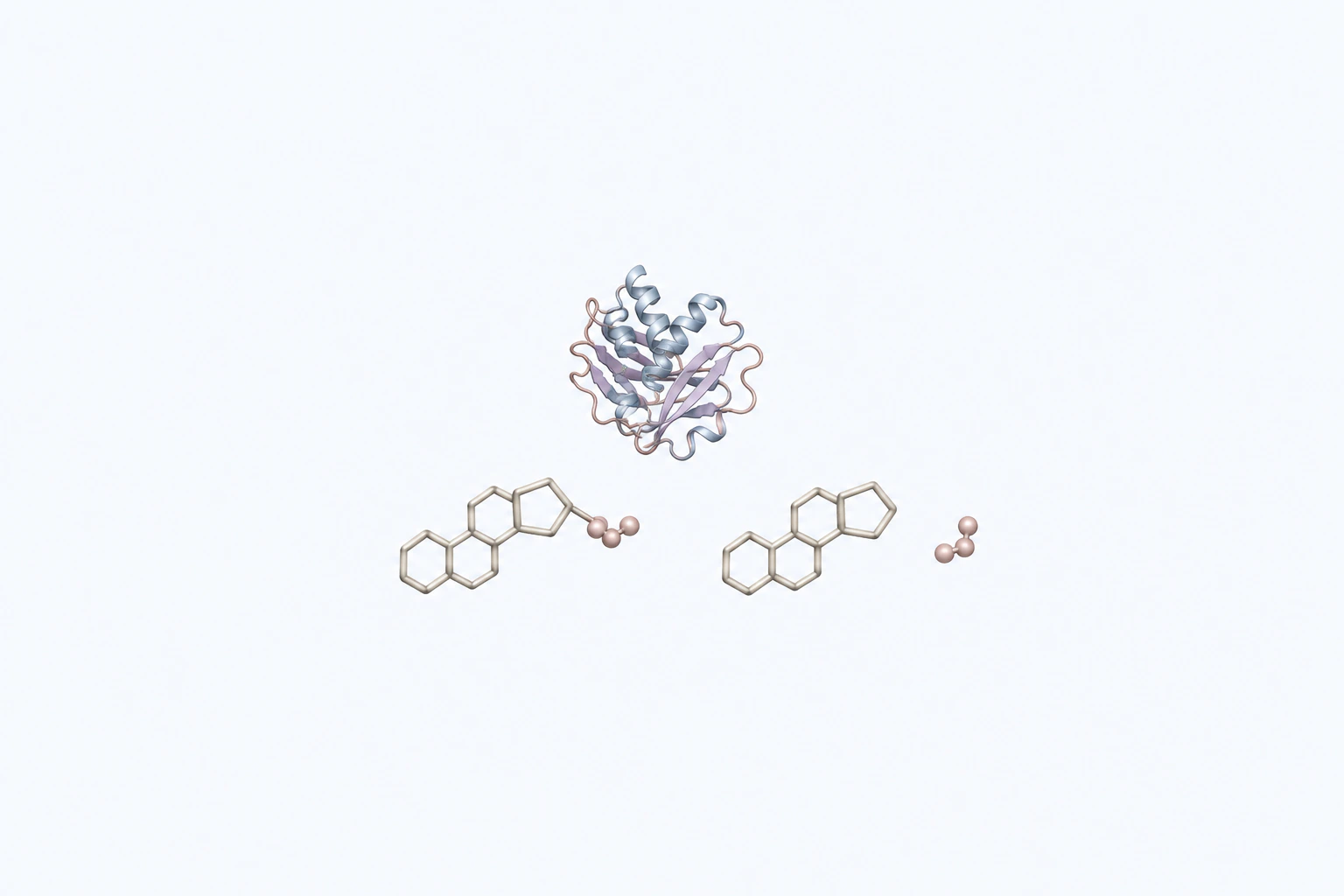
Generic enzyme-class and conjugated/product-context orientation for bile salt hydrolase. The reconstruction does not assign glycine versus taurine, organism, literal molecule, measured reaction, pathway flux, disease, diagnosis, prognosis, or treatment.
Scientific media record2 verified identifiers
- Subject
- Bile salt hydrolasebiological-process
- Identifiers
- WikiBiome:bile-salt-hydrolaseEC:3.5.1.24
- Review
- Editorial review completeIdentifiers authority-verified · Accessibility validated · · bile-salt-hydrolase|bile-salt-hydrolase-mechanism-v3.webp
- Digital source
- Trained-algorithmic mediaCreated with a trained generative algorithm and reviewed by WikiBiome for subject identity, scientific framing, identifiers, provenance, and accessibility.
- License
- CC BY-SA 4.0Created
Bile salt hydrolase (BSH) is the microbial enzyme that deconjugates primary bile acids (taurocholate, glycocholate) by cleaving the amino acid (taurine or glycine) from the steroid core.
This is the first and rate-limiting step in microbial bile acid transformation—without BSH, the entire secondary bile acid pool and its signaling functions would not exist.
BSH is found in Lactobacillus, Bifidobacterium, Bacteroides, Clostridium, and Enterococcus—among the most widely distributed microbial enzyme activities in the human gut.
Evidence map1 cited passagesInspect provenance +
At high concentrations, are pro-carcinogenic—DCA promotes CRC by generating ROS and activating Wnt/β-catenin.
Downstream Consequences#
Deconjugated bile acids undergo further microbial transformation (7α-dehydroxylation) to produce secondary bile acids (deoxycholic acid, lithocholic acid), which.
Activate FXR and TGR5 nuclear receptors → regulate cholesterol metabolism, gluconeogenesis, and energy expenditure. Are directly antimicrobial—secondary bile acids inhibit C. difficile germination (basis of Colonization Resistance). At high concentrations, are pro-carcinogenic—DCA promotes CRC by generating ROS and activating Wnt/β-catenin.[1]Rezen et al. 2022 — The Role of Bile Acids in CarcinogenesisRezen T, Rozman D, Kovacs T et al. · 2022Open reference 1 ↓
WikiBiome Relevance#
BSH activity determines the balance between primary and secondary bile acids—a balance disrupted by Dysbiosis.
Antibiotic-induced loss of BSH-producing bacteria → primary bile acid accumulation → C. difficile spore germination (primary bile acids promote it; secondary bile acids inhibit it).
BSH is a target for probiotic engineering—enhancing BSH activity could improve cholesterol metabolism.
Cross-References#
- Bile Acid Metabolism—broader bile acid context
- Colonization Resistance—secondary bile acids inhibit C. difficile
- Clostridioides difficile—BSH loss enables C. difficile
- Lipid Metabolism—FXR-mediated cholesterol regulation
- Taurine—released by BSH deconjugation
References 4
Numbered by first appearance in the article, then reconciled with its declared source list.
- 1
Rezen T, Rozman D, Kovacs T et al. (2022). Rezen et al. 2022 — The Role of Bile Acids in Carcinogenesis. Cellular and Molecular Life Sciences.
- 2
Fiona C. Ross, Dhrati Patangia, Ghjuvan Grimaud et al. (2024). The interplay between diet and the gut microbiome: implications for health and disease. Nature Reviews Microbiology.
- 3
Junwen Zhu, Jin Lyu, Ruochi Zhao et al. (2023). Gut macrobiotic and its metabolic pathways modulate cardiovascular disease. Frontiers in Microbiology.
- 4
Arpana Gupta, Vadim Osadchiy, Emeran A. Mayer (2020). Gupta, Osadchiy & Mayer 2020 — Brain-Gut-Microbiome Interactions in Obesity and Food Addiction. Nature Reviews Gastroenterology & Hepatology.
Article network
Mentioned here 6
Pages linking here 2
Connect the evidence
Publicly readable discussion by ORCID-authenticated researchers. Questions, interpretation, methods, corrections, and new evidence stay attached to this record.
No discussion yet. Start with a precise question or a source-backed observation.
Published page changes
This record shows only material changes published on this page, including changes to its content, evidence, conclusions, or author context. Internal processes and discussion activity are excluded. Pending, declined, and withdrawn proposals remain private.
- published revision
Created “Bile Salt Hydrolase (BSH)”: Bile salt hydrolase (BSH) is the microbial enzyme that deconjugates primary bile acids (taurocholate, glycocholate) by cleaving the amino acid (taurine or glycine) from the steroid core. This is the…
Created “Bile Salt Hydrolase (BSH)”: Bile salt hydrolase (BSH) is the microbial enzyme that deconjugates primary bile acids (taurocholate, glycocholate) by cleaving the amino acid (taurine or glycine) from the steroid core. This is the… Published sections: Overview; Downstream Consequences; WikiBiome Relevance; Cross-References. · WikiBiome Deploy Bot · +46 −0
Inspect exact Git diff ↗