

Bifidobacterium adolescentis is a Gram-positive, obligate anaerobic species within the phylum Actinobacteria and the dominant Bifidobacterium species in the adult human gut. It is a specialist degrader of resistant starch and dietary fiber, producing acetate and lactate that are cross-fed to Butyrate-producing bacteria in the colon.
This species is consistently depleted in multiple disease states.
In type 2 diabetes, metformin treatment has been shown to partially restore B. adolescentis abundance, suggesting the species is sensitive to the metabolic environment and may mediate some of metformin's gut-level therapeutic effects (,[1]Metformin alters the gut microbiome of individuals with treatment-naive type 2 diabetes, contributing to the therapeutic effects of the drugHao Wu, Eduardo Esteve, Valentina Tremaroli et al. · 2017Open reference 1 ↓ randomized controlled trial).
Mendelian randomization studies have identified genetically predicted B. adolescentis abundance as inversely associated with autoimmune disease risk (,[2]Xu 2022 — Causal relationship between gut microbiota and autoimmune diseases (SLE, RA, IBD, MS, T1D, CeD): two-sample Mendelian randomizationQian Xu, Jing-Jing Ni, Bai-Xue Han et al. · 2022Open reference 2 ↓ Mendelian randomization).
The species is also depleted in multiple sclerosis, where its loss contributes to reduced short-chain fatty acid production and impaired immune regulation (,[3]Multiple Sclerosis: A Story of the Interaction Between Gut Microbiome and Components of the Immune SystemEsraa Mohsen, Hesham Haffez, Sandra Ahmed et al. · 2025Open reference 3 ↓ review).
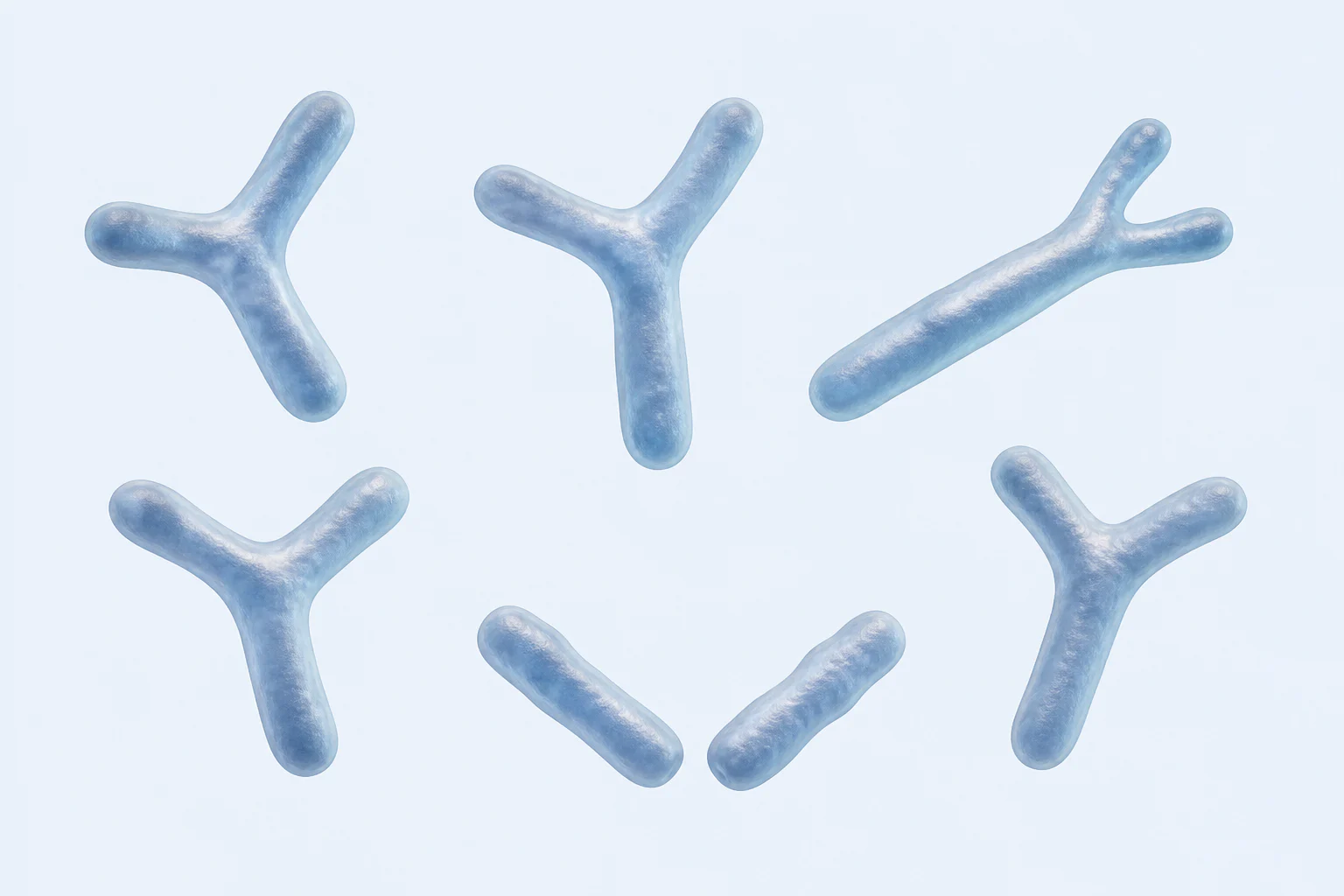
Representative Bifidobacterium adolescentis bifid and rod forms, shown as seven cellular bodies in six groupings. This reconstruction is not diagnostic and is not a micrograph.
Scientific media record1 verified identifier
- Subject
- Bifidobacterium adolescentistaxon · species
- Identifiers
- NCBITaxon:1680
- Review
- Editorial review completeIdentifiers authority-verified · Accessibility validated · · bifidobacterium-adolescentis|bifidobacterium-adolescentis-morphology-v1.webp
- Digital source
- Trained-algorithmic mediaCreated with a trained generative algorithm and reviewed by WikiBiome for subject identity, scientific framing, identifiers, provenance, and accessibility.
- Scientific basis
- Bifidobacterium adolescentis — NCBI TaxonomyBifidobacterium adolescentis type strainBifid Shape Is Intrinsic to Bifidobacterium adolescentis
- License
- CC BY-SA 4.0Created
Evidence map1 cited passagesInspect provenance +
This species is consistently depleted in multiple disease states. In type 2 diabetes, metformin treatment has been shown to partially restore B. adolescentis abundance, suggesting the species is sensitive to the metabolic environment and may mediate some of metformin's gut-level therapeutic effects (, randomized controlled trial). Mendelian randomization stu
Contents
1. Cross-ReferencesCross-References#
- Actinobacteria (Actinomycetota)—parent phylum
- Akkermansia muciniphila—co-depleted commensal in multiple conditions
- Type 2 Diabetes—primary condition of depletion
- Short-Chain Fatty Acids (SCFAs)—metabolic output
References 3
Numbered by first appearance in the article, then reconciled with its declared source list.
- 1
Hao Wu, Eduardo Esteve, Valentina Tremaroli et al. (2017). Metformin alters the gut microbiome of individuals with treatment-naive type 2 diabetes, contributing to the therapeutic effects of the drug. Nature Medicine.
- 2
Qian Xu, Jing-Jing Ni, Bai-Xue Han et al. (2022). Xu 2022 — Causal relationship between gut microbiota and autoimmune diseases (SLE, RA, IBD, MS, T1D, CeD): two-sample Mendelian randomization. Frontiers in Immunology.
- 3
Esraa Mohsen, Hesham Haffez, Sandra Ahmed et al. (2025). Multiple Sclerosis: A Story of the Interaction Between Gut Microbiome and Components of the Immune System. Molecular Neurobiology.
Article network
Connect the evidence
Publicly readable discussion by ORCID-authenticated researchers. Questions, interpretation, methods, corrections, and new evidence stay attached to this record.
No discussion yet. Start with a precise question or a source-backed observation.
Activity and accepted changes
Accepted researcher context, editorial status, public discussion, and upstream Git revisions are shown together. Pending, declined, and withdrawn proposals remain private.
- published revision
massive wiki expansion: 149 stubs fixed, 100+ new pages, Rule 15 scan, keystone papers
WikiBiome Deploy Bot · +37 −0
Inspect exact Git diff ↗