

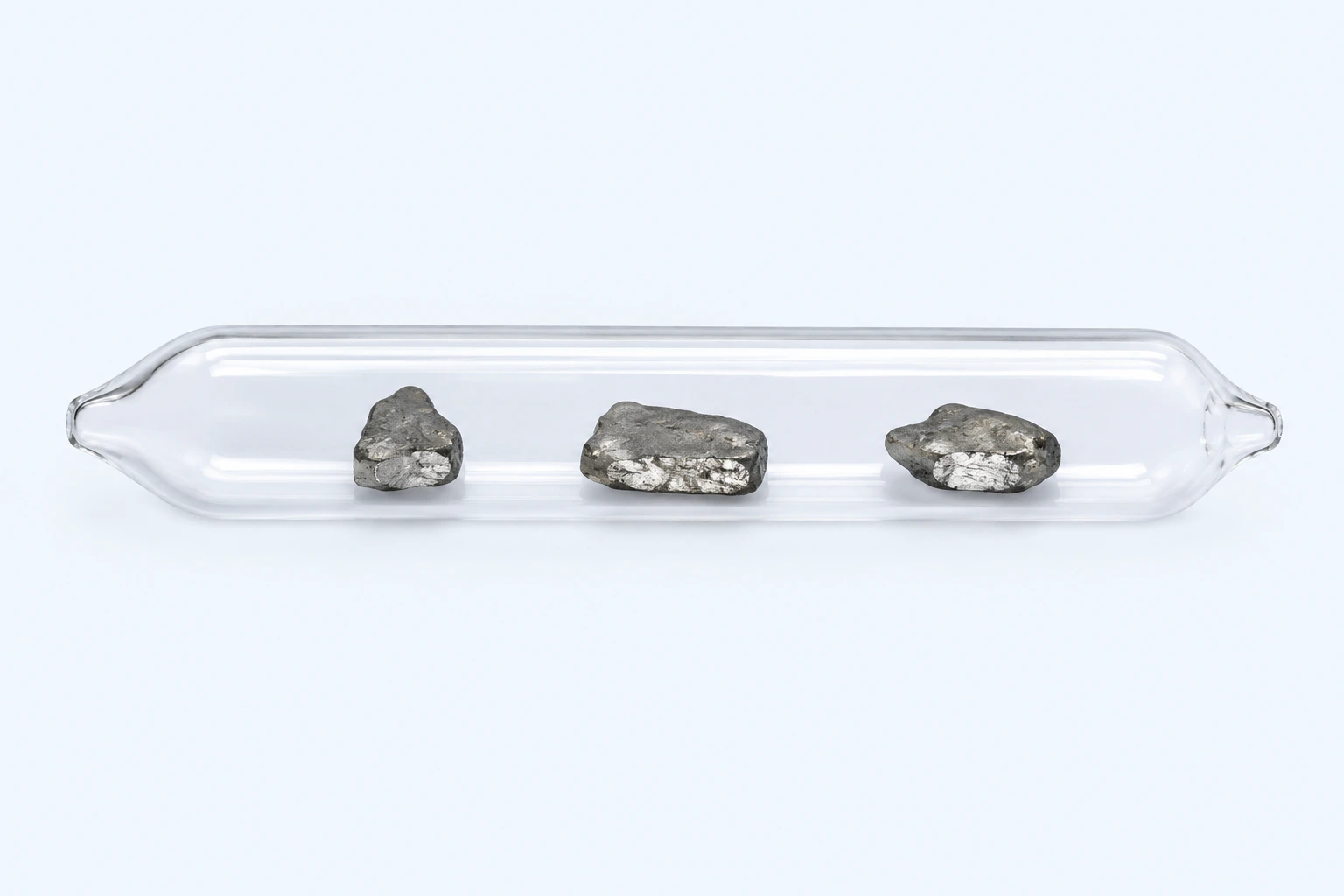
Elemental thallium (Tl), represented by three gray solid specimens with brighter cut faces in a sealed ampoule. Containment avoids implying direct handling and does not certify purity; this is not an exposure scene, analytical reference material, or a photograph.
Scientific media record2 verified identifiers
- Subject
- Thalliumelement
- Identifiers
- Atomic number 81PubChem CID:5359464
- Review
- Editorial review completeIdentifiers authority-verified · Accessibility validated · · thallium|thallium-technical-specimen-v1.webp
- Digital source
- Trained-algorithmic mediaCreated with a trained generative algorithm and reviewed by WikiBiome for subject identity, scientific framing, identifiers, provenance, and accessibility.
- Scientific basis
- Thallium — PubChem ElementThallium, PubChem CID 5359464
- License
- CC BY-SA 4.0Created
One of the most toxic metals known to biology, thallium earns its reputation through a deceptively simple trick: it masquerades as potassium.
With an ionic radius (1.50 A) nearly identical to K+ (1.38 A) and a +1 charge, thallium enters cells through potassium channels and Na+/K+-ATPase pumps, distributing itself wherever potassium is needed—which is everywhere.
This potassium mimicry makes thallium uniquely dangerous at low concentrations, and recent evidence positions it as a significant player in Chronic Kidney Disease pathogenesis through the Alpha-Klotho axis.
Evidence map2 cited passagesInspect provenance +
The most striking finding for thallium in this wiki comes from a machine learning-guided analysis of 51 pollutants and CKD risk:
The gut microbiome dimensions of thallium toxicity are virtually unstudied. Thallium was measured in infant serum alongside gut microbiota composition, but direct microbiome effects have not been characterized.
Contents
1. Chemical Properties2. Sources of Exposure3. The CKD Connection4. Mechanism of Toxicity5. Microbiome Interactions6. Open Questions7. Cross-ReferencesChemical Properties#
- Atomic number: 81; Group 13 (post-transition metal)
- Exists as thallium+ (thallous, predominant in biology) and thallium(III) (Tl3+) (thallic, more toxic but less stable)
- thallium+ has the same charge and similar radius as K+, enabling entry through potassium transport systems
- Strong affinity for sulfhydryl groups, disrupting mitochondrial sulfhydryl-containing enzymes
- Does not bind Metallothionein efficiently, limiting cellular detoxification capacity
Sources of Exposure#
Industrial: Coal combustion, cement production, smelting of zinc and lead ores (thallium is a byproduct). Agricultural: Some rodenticides (now largely banned due to extreme toxicity). Environmental: Naturally present in some soils and groundwater; mobilized by acidic conditions.
Dietary: Low-level exposure through vegetables grown in contaminated soils and seafood.
The CKD Connection#
The most striking finding for thallium in this wiki comes from a machine learning-guided analysis of 51 pollutants and CKD risk.[1]The association between low-concentration heavy metal exposure and chronic kidney disease risk through alpha-klothoLiu S, Wang H, Cao Y et al. · 2025Open reference 1 ↓
Highest posterior inclusion probability (PIP = 1.0) in the Bayesian Kernel Machine Regression (BKMR) model among all metals tested (cadmium, mercury, lead, thallium).
Thallium and lead concentrations were significantly negatively correlated with CKD risk after full adjustment—a counterintuitive finding likely reflecting reverse causality from impaired renal excretion.
The relationship is mediated through Alpha-Klotho, an anti-aging protein with renal protective functions. Alpha-klotho mediates the mercury-CKD association (34.55% mediation proportion), and Mendelian randomization confirmed that higher alpha-klotho levels causally reduce CKD risk (OR 0.9842).
The negative association between thallium concentration and CKD risk underscores a critical interpretive challenge: in kidney disease, low serum metal levels may reflect impaired filtration and altered metal handling rather than protective effects. This aligns with the Nutritional Immunity (Metal Sequestration) framework's emphasis on interpreting metal levels within physiological context.
Mechanism of Toxicity#
Potassium Channel Mimicry#
thallium (Tl)+ enters cells through.
Na+/K+-ATPase: thallium+ is transported in place of K+, disrupting the electrochemical gradient essential for all cellular function. Potassium channels: thallium+ passes through K+ channels, which cannot discriminate between the two ions. Widespread distribution: Because potassium is ubiquitous, thallium distributes to every tissue—nervous system, kidneys, GI tract, skin, hair.
Mitochondrial Disruption#
- Binds sulfhydryl groups on mitochondrial enzymes, inhibiting oxidative phosphorylation
- Disrupts the mitochondrial membrane potential
- Interferes with riboflavin (vitamin B2) metabolism, compounding energy production failure
Neurological Effects#
Peripheral neuropathy (often the presenting symptom of thallium poisoning). Alopecia (hair loss)—a classic sign of chronic thallium exposure. CNS effects including confusion, ataxia, and in severe cases, coma.
Microbiome Interactions#
The Gut Microbiome dimensions of thallium toxicity are virtually unstudied. Thallium was measured in infant serum alongside gut microbiota composition,[2]Yan 2025 — Association Between Infants' Serum Levels of 26 Metals and Gut Microbiota: A Hospital-Based Cross-Sectional Study in ChinaXing Yan, Jun Qiu, Ruiwen Huang et al. · 2025Open reference 2 ↓ but direct microbiome effects have not been characterized.
Theoretical considerations. Bacterial potassium transport systems (Trk, Kdp, Kup) may also transport thallium (Tl)+, potentially concentrating it in bacterial cells. Disruption of bacterial K+ homeostasis could selectively affect species dependent on potassium-driven transport or pH regulation.
Thallium's sulfhydryl binding would target bacterial iron (Fe)-S cluster enzymes and thiol-dependent antioxidant systems.
Open Questions#
Unresolved questions identified by the current evidence record.
01Why does thallium have the highest posterior inclusion probability for CKD risk among all metals?+
Is this a direct nephrotoxic effect or a reflection of renal handling?
02Does thallium's potassium mimicry affect gut microbial potassium homeostasis?+
The current WikiBiome record identifies this as an unresolved evidence gap.
03Can gut bacteria biotransform or sequester thallium, altering host exposure?+
The current WikiBiome record identifies this as an unresolved evidence gap.
Cross-References#
- Chronic Kidney Disease—thallium as top-ranked metal in CKD risk models
- Alpha-Klotho—mediator of metal-CKD associations
- Lead—co-occurs with thallium in mining-related exposures
- Cadmium—co-measured in CKD metallomic panels
- Mercury—alpha-klotho mediates mercury (Hg)-CKD pathway
References 8
Numbered by first appearance in the article, then reconciled with its declared source list.
- 1
Liu S, Wang H, Cao Y et al. (2025). The association between low-concentration heavy metal exposure and chronic kidney disease risk through alpha-klotho. Scientific Reports.
- 2
Xing Yan, Jun Qiu, Ruiwen Huang et al. (2025). Yan 2025 — Association Between Infants' Serum Levels of 26 Metals and Gut Microbiota: A Hospital-Based Cross-Sectional Study in China. Frontiers in Microbiology.
- 3
Maria Assunta Meli, Donatella Desideri, Davide Sisti et al. (2024). Meli 2024 — Chemical characterization of baby food consumed in Italy. PLOS ONE.
- 4
Smovrsnik T, Virant-Klun I, Pinter B (2023). Heavy Metals and Essential Elements in Association with Oxidative Stress in Women with Polycystic Ovary Syndrome -- A Systematic Review. Antioxidants.
- 5
Amerikanou C, Karavoltsos S, Gioxari A et al. (2022). Clinical and inflammatory biomarkers of inflammatory bowel diseases are linked to plasma trace elements and toxic metals; new insights into an old concept. Frontiers in Nutrition.
- 6
Fan W, Pi Z, Kong K et al. (2024). Analyzing the impact of heavy metal exposure on osteoarthritis and rheumatoid arthritis: an approach based on interpretable machine learning. Frontiers in Nutrition.
- 7
Arias-Borrego A, Soto Cruz FJ, Selma-Royo M et al. (2022). Metallomic and Untargeted Metabolomic Signatures of Human Milk from SARS-CoV-2 Positive Mothers. Molecular Nutrition and Food Research.
- 8
John F. Dou, Rebecca J. Schmidt, Heather E. Volk et al. (2024). Dou 2024 — Exposure to Heavy Metals in Utero and Autism Spectrum Disorder at Age 3: A Meta-Analysis of Two Longitudinal Cohorts. Environmental Health.
Article network
Mentioned here 8
Pages linking here 1
Connect the evidence
Publicly readable discussion by ORCID-authenticated researchers. Questions, interpretation, methods, corrections, and new evidence stay attached to this record.
No discussion yet. Start with a precise question or a source-backed observation.
Published page changes
This record shows only material changes published on this page, including changes to its content, evidence, conclusions, or author context. Internal processes and discussion activity are excluded. Pending, declined, and withdrawn proposals remain private.
- published revision
Added references: meli-2024-baby-food-chemical-characterization-italy; smovrsnik-2023-heavy-metals-oxidative-stress-pcos; amerikanou-2022-ibd-biomarkers-trace-metals; fan-2024-heavy-metal-arthritis-machine-learning; arias-borrego-2022-metallomic-metabolomic-covid-mothers;…
Added references: meli-2024-baby-food-chemical-characterization-italy; smovrsnik-2023-heavy-metals-oxidative-stress-pcos; amerikanou-2022-ibd-biomarkers-trace-metals; fan-2024-heavy-metal-arthritis-machine-learning; arias-borrego-2022-metallomic-metabolomic-covid-mothers; dou-2024-heavy-metals-utero-asd-age3-meta-analysis. · WikiBiome Deploy Bot · +23 −17
Inspect exact Git diff ↗ - published revision
Created “Thallium”: One of the most toxic metals known to biology, thallium earns its reputation through a deceptively simple trick: it masquerades as potassium. With an ionic radius (1.50 A) nearly identical to K+ (1.38…
Created “Thallium”: One of the most toxic metals known to biology, thallium earns its reputation through a deceptively simple trick: it masquerades as potassium. With an ionic radius (1.50 A) nearly identical to K+ (1.38… Published sections: Thallium (Tl); Chemical Properties; Sources of Exposure; The CKD Connection; Potassium Channel Mimicry; Mitochondrial Disruption; Neurological Effects; Microbiome Interactions; Open Questions; Cross-References. · WikiBiome Deploy Bot · +90 −0
Inspect exact Git diff ↗